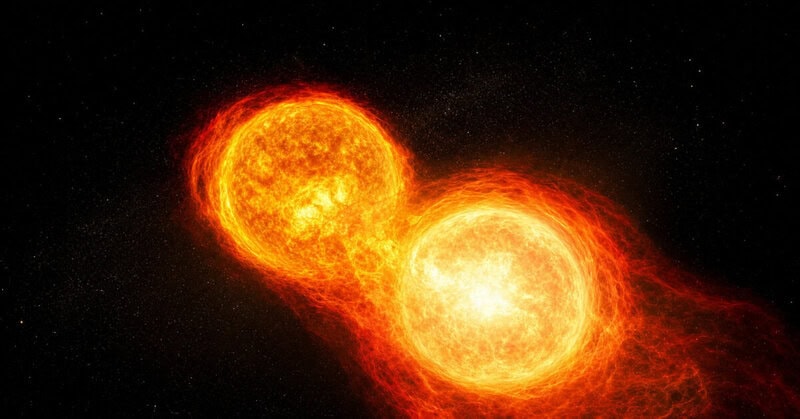
A companion star roughly 70% the mass of our sun spiraled into the core of an aging giant star and triggered a brilliant explosion — and for the first time in the history of astronomy, scientists watched the entire sequence unfold in near real time. NASA’s James Webb Space Telescope trained its infrared eye on the blast site just 47 days after the eruption, catching what researchers describe as the first directly observed act of stellar cannibalism from start to aftermath.
A Cosmic Crime Scene, Caught While the Evidence Was Still Fresh
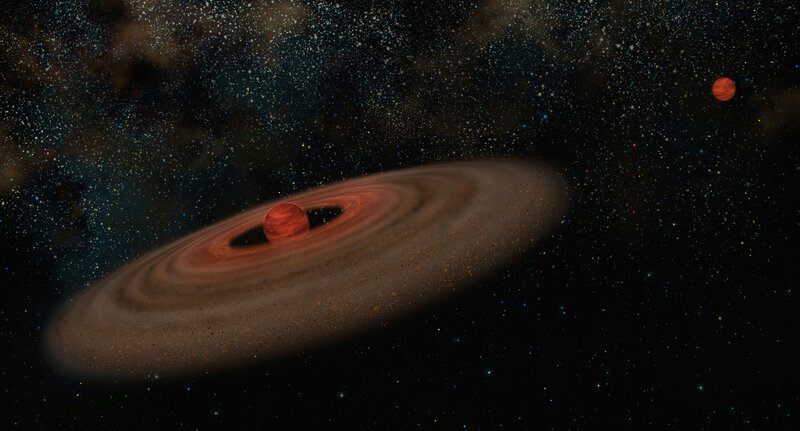
Astronomers have long theorized that stars in binary systems — pairs of stars gravitationally bound and orbiting a shared center — can merge violently when one of them swells into a giant late in its life. The theory was well-developed, suggestive remnants had been catalogued, but a live event had never been confirmed. That changed with a study published in the journal Nature, which documented the first observational confirmation of an aging star swallowing a stellar companion, elevating what was once purely theoretical into peer-reviewed, empirical science.
The stakes extend well beyond a single dramatic event. This landmark observation offers answers to longstanding puzzles: unexplained infrared outbursts catalogued over decades, a class of mysterious stellar explosions whose origins were debated, and the ultimate fate of roughly half the stars in the Milky Way that spend their lives in binary or multiple-star systems.
What Actually Happened: The Mechanics of a Stellar Merger
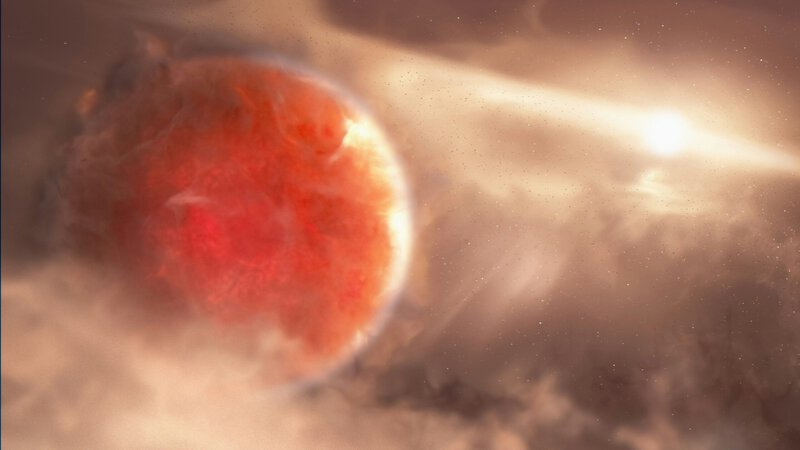
To understand the event, it helps to picture the setup. A binary star system is simply two stars orbiting their shared center of gravity — a gravitational partnership that can persist for billions of years without incident. The trouble begins when one star exhausts the hydrogen fuel in its core and swells into a red giant, dramatically expanding its outer layers. As that giant grew, its gravitational reach extended toward its smaller companion, and the giant began stripping material from the companion’s surface.
Over time, that mass transfer destabilized the companion’s orbit. Unable to maintain its distance, the companion began spiraling inward — entering what astrophysicists call a common envelope event, in which both stars become wrapped inside a single, shared shell of gas. This is not a gradual, gentle process. The companion, carrying approximately 70% of the sun’s mass, did not graze the giant’s outer layers and retreat. It drove directly into the giant star’s dense core.
The energy released by that fatal plunge was immense. The companion’s orbital kinetic energy was deposited deep inside the giant, inflating and ultimately blasting the giant’s outer envelope into surrounding space. The result was a luminous transient: a brief but brilliant flare of light that survey instruments detected and catalogued. In physical terms, the giant star was consumed from the inside out — the companion’s energy input inflated it until the outer layers could no longer be held and were violently ejected.
Why JWST Was the Right Instrument at the Right Moment
Identifying this event required more than luck — it required the right telescope. Stellar mergers had been predicted to produce a specific observational signature: not the blinding optical flash of a supernova, but a cooler, dust-shrouded infrared glow. That distinction matters enormously, because infrared light — longer in wavelength than visible light and largely blocked by Earth’s atmosphere — is precisely the band in which the James Webb Space Telescope was designed to excel.
Observing just 47 days after the eruption, JWST detected a characteristic warm dust cocoon surrounding the merged system, along with chemical fingerprints consistent with the ejection of a common envelope. That combination matched merger models rather than the signatures of a standard nova (a surface explosion on a white dwarf) or a core-collapse supernova. The 47-day timeline was critical: the dust shell had not yet cooled and dispersed, leaving the evidence of the merger mechanism still legible in the infrared spectrum.
Ground-based and archival survey data filled in the backstory. Researchers reconstructed the system’s pre-explosion behavior and found that the giant star had been brightening and shedding mass in the years before the final plunge — a warning pattern that merger models had long predicted but that had never before been confirmed in an event subsequently verified as a true merger. That pre-eruption brightening now becomes a prospective alert signal for future surveys.
Why No One Had Seen This Before
The historical gap in confirmed stellar merger observations is not surprising once the timescales are considered. Common envelope events are thought to progress over timescales ranging from decades to a few hundred years at most — an eyeblink on cosmic scales, but still long enough that catching one mid-process requires both a targeted survey strategy and an instrument sensitive enough to recognize what it is seeing. Prior infrared space telescopes lacked the sensitivity and angular resolution to distinguish a dust-shrouded merger remnant from other red transients at comparable distances. JWST’s vastly larger light-collecting mirror fundamentally changed that equation.
Astronomers had previously identified objects called luminous red novae — a category of transient explosion that is redder, cooler, and less energetic than a supernova — and suspected they might be stellar mergers. But suspicion is not confirmation. Without a case where pre-explosion data, a live eruption, and post-explosion infrared spectroscopy all pointed coherently to a common envelope merger, the luminous red nova category remained interpretively contested. The Nature study closes that gap for at least one confirmed event.
It is worth acknowledging what remains an open question. While the assembled evidence makes a strong case, the broader scientific community will continue testing the interpretation against alternative scenarios — including the possibility that the infalling object was a giant planet or brown dwarf rather than a stellar-mass companion. Follow-up observations will be essential to rule out those alternatives and cement consensus.
What the Explosion Left Behind

The observable aftermath is itself scientifically valuable. JWST’s data revealed that the ejected envelope had formed a warm, dusty, expanding shell around the merged object — a structure likely to remain detectable for decades, providing a physical template that astronomers can use to identify older merger remnants elsewhere in the galaxy. The event appeared not as a supernova but as exactly the luminous red nova signature that theorists had associated with mergers, now confirmed in a case with a known physical mechanism.
As for what survived the merger: the two stellar cores are expected to have coalesced into a single, more massive and rapidly rotating star. The combined mass is not sufficient to produce a black hole or neutron star; instead the result is a rejuvenated stellar object whose future evolution is now a subject of active theoretical modeling. That outcome connects the new observation to objects already catalogued in the Milky Way. Several anomalously massive or unusually fast-spinning stars are believed to be products of past mergers identical in mechanism to this one, suggesting the event is not exotic but is instead a standard — if rarely witnessed — chapter in stellar life.
Broader Implications: Recalibrating Stellar Evolution
Because an estimated 50% or more of sun-like stars exist in binary or multiple systems, the confirmed common envelope merger pathway carries significant implications for how astronomers model stellar populations. Mass once locked in a binary companion is recycled into a merged remnant and partially ejected into the interstellar medium — a contribution to galactic chemistry and stellar mass budgets that was previously unquantified by direct observation.
The connection to gravitational-wave astronomy is also direct. Stellar mergers involving sufficiently massive remnants are considered precursor steps in the formation of double compact-object binaries — pairs of neutron stars or black holes — whose eventual collisions generate the gravitational waves detected by facilities such as LIGO. The common envelope phase is widely understood to be a critical bottleneck in producing those tight compact pairs. Having a confirmed observational case now allows computational astrophysicists to benchmark their simulation codes against real data for the first time, rather than relying entirely on theoretical estimates. The rate at which LIGO detects merger signals depends partly on how efficiently common envelopes are ejected, so this single observation has practical consequences for gravitational-wave astronomy.
The specific fingerprint documented in the Nature study — pre-eruption brightening, a luminous red nova flash, and a warm dust cocoon detectable by JWST within 47 days — now constitutes a confirmed observational template. Survey teams can apply it to archival data to identify candidate past mergers and use it prospectively to flag systems approaching a common envelope event before an explosion occurs.
What Comes Next: Hunting for More Stellar Cannibals
Researchers plan to use JWST alongside ground-based infrared surveys to monitor known luminous red nova candidates and binary systems showing anomalous pre-merger brightening, with the goal of catching a second event — ideally before, rather than 47 days after, the explosion. NASA observations of stars consuming nearby objects have established that such real-time detections are achievable with the right instrument pointed at the right target.
The Vera C. Rubin Observatory’s Legacy Survey of Space and Time, expected to reach full operations in the mid-2020s, will scan the entire southern sky every few nights and is projected to discover luminous red novae at detection rates far exceeding current levels. A larger sample is essential: one confirmed observation, however landmark, cannot fully constrain the range of outcomes possible in common envelope events. The mass ratio between the two stars, their orbital separation, and the evolutionary state of the giant at the moment of engulfment all affect whether the companion merges into the core, is ejected along with the envelope, or is destroyed entirely. Statistical conclusions require statistical samples.
There is also a quietly personal dimension to this research. The sun will swell into a giant star billions of years from now, and while it has no stellar companion to consume, understanding how giants interact with nearby objects — stars and planets alike — is directly relevant to modeling the fate of planetary systems at the end of their host star’s life. The event witnessed here, a companion star roughly 70% the mass of our sun spiraling to its end inside a swelling giant, is a preview of dynamics that will one day reshape this solar system. Catching it live, for the first time, was not just a milestone in astronomy. It was a glimpse of a future written in stellar physics, finally made legible.