In a patch of sky that looks completely blank to the naked eye, NASA’s Hubble Space Telescope once revealed thousands of galaxies — and now the agency’s newest observatory is poised to do something even more striking: capture roughly 1,000 galaxies in a region of sky that Hubble itself would have rendered as nearly featureless. On December 7, the public will be able to watch that moment unfold in real time.
What NASA Is Releasing and How to Watch
NASA has confirmed that the first images from the Nancy Grace Roman Space Telescope will premiere live at the 2026 American Geophysical Union (AGU) Annual Meeting in San Francisco on December 7, with the live stream beginning at 3:30 p.m. The agency has invited both media and the general public to watch, making this one of the rare occasions in modern astronomy when cutting-edge observational data reaches a global audience at essentially the same moment it reaches the scientific community.
NASA has described the forthcoming images as “deep, panoramic, never-before-seen views of the universe” — language the agency has used consistently to signal that Roman’s debut data products are designed as demonstration showcases, not simply decorative astronomy photographs. Each image is expected to illustrate a distinct scientific capability of the observatory, from its extraordinary field of view to its sensitivity to faint, distant light. The AGU setting is deliberate, placing the reveal in front of an audience of Earth and space scientists who can immediately connect Roman’s data to ongoing research programs in cosmology, large-scale structure, and gravitational physics.
As of publication, NASA has not pre-released the specific sky targets chosen for the first images — standard protocol for major observatory releases, reflecting both scientific drama and the practical necessity of completing data quality review before public dissemination. Viewers can follow the live stream through NASA’s official channels, and NASA’s Roman social media accounts have been signaling the December 7 premiere as a landmark public event. NASA has also published a preview video on YouTube for those who want background before the live reveal.
Roman vs. Hubble: Why Field of View Changes Everything
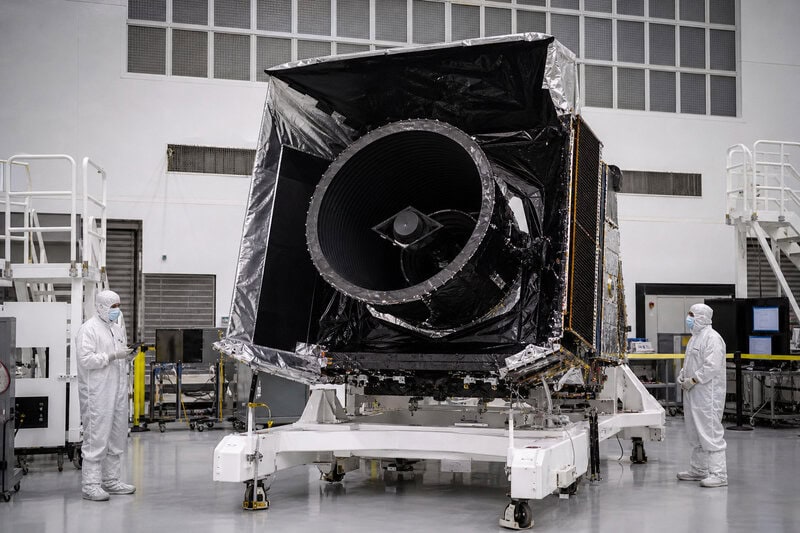
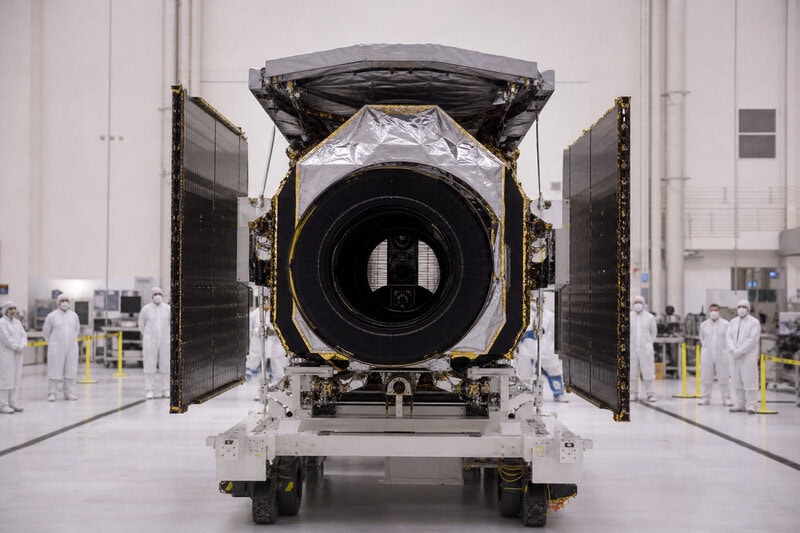
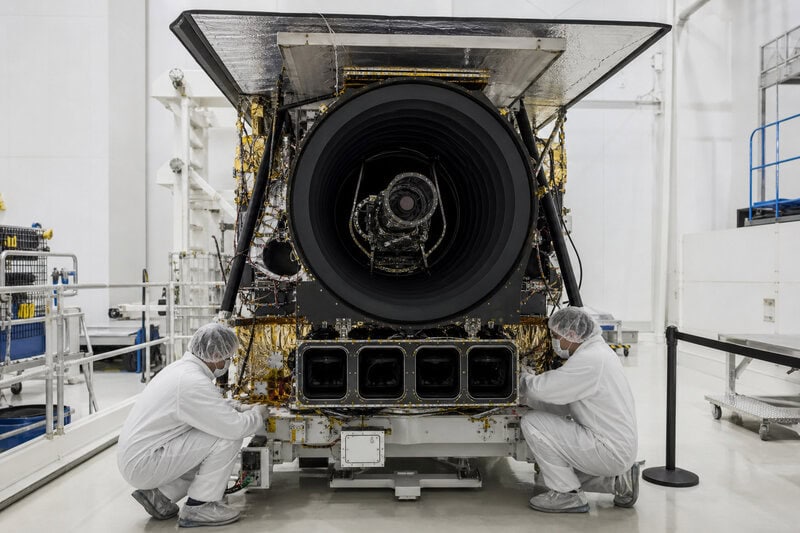
To understand why Roman’s first images are scientifically significant rather than merely visually impressive, it helps to understand the single most important difference between Roman and its famous predecessor. The Nancy Grace Roman Space Telescope carries a 2.4-meter primary mirror — the same diameter as Hubble’s — but its wide-field instrument captures approximately 0.28 square degrees of sky per exposure, compared to Hubble’s roughly 0.003 square degrees. That gives Roman about 100 times the field of view in a single shot, according to NASA’s official Roman mission documentation.
That factor of 100 is not an incremental improvement. It is a qualitative change in what a space telescope can accomplish. Many of the most important cosmological questions — mapping the cosmic web of dark matter, measuring how fast the universe is expanding, finding thousands of exoplanet candidates through gravitational microlensing — require statistical samples too large for a narrow-field telescope to assemble in any practical timeframe. Hubble, for all its extraordinary contributions to astronomy, was simply not designed for the kind of wide-area surveys those questions demand.
The “1,000 galaxies in a patch Hubble saw as nearly blank” framing reflects a real observational geometry: Roman’s panoramic detector array means that any given pointing sweeps up an enormous number of background galaxies that fall just outside Hubble’s narrow cone of vision. What looked like empty sky in a Hubble frame becomes a crowded cosmic landscape in a Roman exposure — not because Roman is peering deeper, but because it is looking wider.
A note on terminology worth clarifying before December 7: a deep field is a long-exposure image of a small, apparently empty region of sky, used to detect extremely faint and distant objects — Hubble’s Ultra Deep Field, first released in 2004, is the most famous example. Roman’s wide-field equivalent is sometimes described as a “wide-field deep survey,” combining the light-gathering depth of long exposures with the breadth of a panoramic camera. The two approaches answer different scientific questions and, crucially, complement each other rather than compete.
The Science Roman Is Built to Do
According to NASA’s Roman mission science documentation, the observatory’s primary science drivers include measuring the equation of state of dark energy — the mysterious force accelerating the universe’s expansion — through three independent methods: weak gravitational lensing surveys, baryon acoustic oscillations (subtle patterns in galaxy clustering that serve as a cosmological ruler), and counts of Type Ia supernovae across cosmic time. No previous space telescope has attempted these measurements at the scale Roman is designed to achieve.
Roman’s High Latitude Wide Area Survey is designed to image roughly 2,000 square degrees of sky over its nominal five-year mission. NASA scientists say that volume of data will yield shape measurements for hundreds of millions of galaxies — a statistical foundation robust enough to detect the subtle distortions in galaxy shapes caused by dark matter’s gravitational influence on light traveling across billions of light-years.
A second major program, the Galactic Bulge Time Domain Survey, will monitor the dense central region of the Milky Way repeatedly, watching for brief brightening events called gravitational microlensing — the temporary amplification of a background star’s light when a foreground object passes directly in front of it. NASA estimates that Roman could detect thousands of exoplanets through this method, including free-floating planets with no host star at all, a population that is poorly characterized by any existing survey.
It is important to draw a clear line between established science and open questions here. Dark energy’s existence is treated as scientific consensus, supported by multiple independent lines of evidence. Its precise nature — whether it behaves as a simple cosmological constant, as Einstein proposed, or as a dynamic field that changes over time — remains one of the deepest unresolved problems in physics. Roman’s measurements are expected to significantly constrain the possibilities, but NASA’s own mission science goals are careful not to promise a definitive answer. Roman will sharpen the question, not necessarily close it.
The Engineering Behind the Panorama
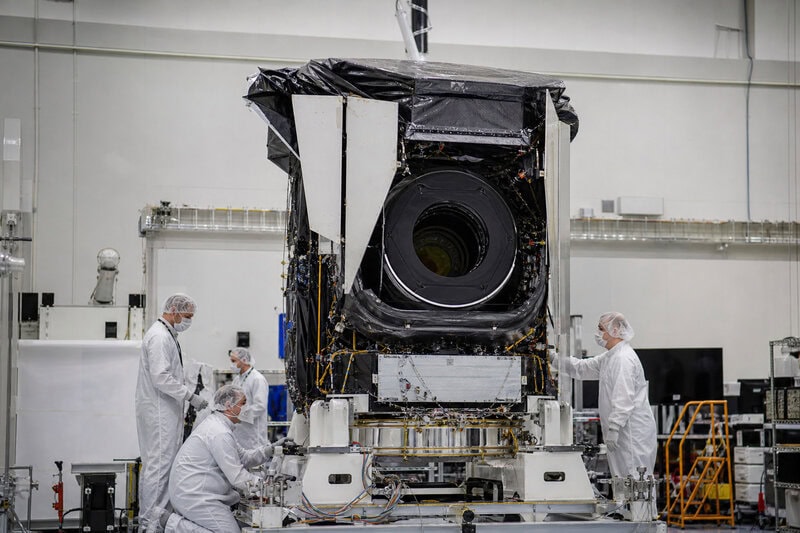
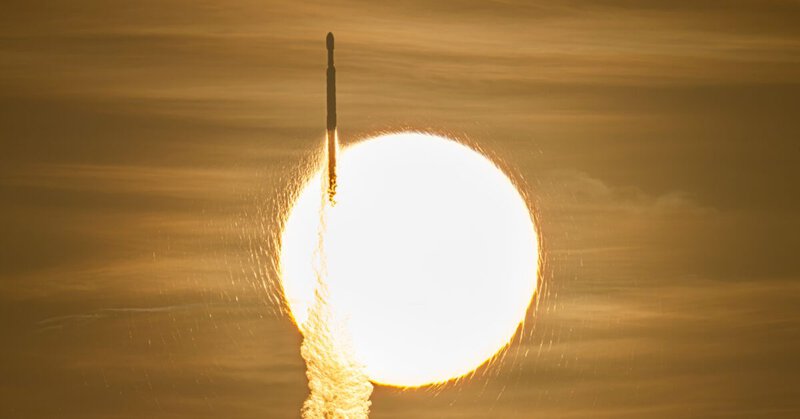
Roman was launched by SpaceX at a total mission cost of approximately $4.3 billion, according to NASA budget documents, placing it in the same investment tier as Hubble’s initial deployment and reflecting the agency’s confidence in its expected scientific return. The launch delivered the observatory to its operational orbit around the Sun-Earth L2 Lagrange point — the same gravitational parking spot used by the James Webb Space Telescope, approximately 1.5 million kilometers from Earth in the direction away from the Sun. That location provides the thermal stability and unobstructed deep-space sightlines that precision cosmological surveys require.
Roman’s focal plane consists of 18 near-infrared detector arrays, each containing 4 megapixels, for a combined 288-megapixel mosaic. The near-infrared sensitivity — spanning roughly 0.5 to 2.3 microns in wavelength — is essential for detecting light from the most distant galaxies, whose visible-light emissions have been redshifted into the infrared by the universe’s expansion over billions of years. Without that infrared coverage, the most cosmologically interesting objects would be invisible to the instrument.
The telescope also carries a Coronagraph Instrument, a technology demonstration designed to directly image planets around nearby stars by suppressing the overwhelming glare of their host stars. While the coronagraph is not the primary focus of the first-images release, it represents a pathfinder for future direct-imaging missions targeting Earth-like exoplanets — a capability NASA’s Jet Propulsion Laboratory, which leads the instrument, describes as a critical step in that longer-term scientific program.
Where Roman Fits in the Telescope Ecosystem
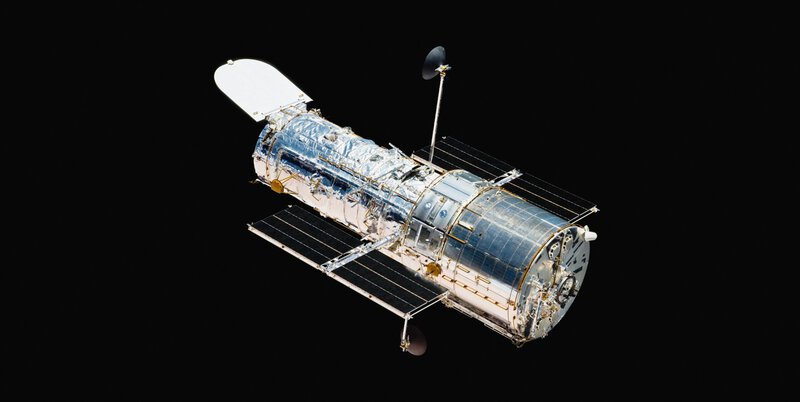
Roman does not replace Hubble or the James Webb Space Telescope; it occupies a distinct and complementary role. Webb delivers extraordinary sensitivity over a narrow field, revealing the chemistry and structure of individual distant objects with unmatched precision. Hubble provides decades of archival comparison data, an irreplaceable historical baseline for tracking how objects change over time. Roman’s value lies in breadth: it discovers rare objects at high statistical confidence across enormous volumes of sky and flags them for detailed follow-up with the narrower, more sensitive instruments that Webb and Hubble represent.
The choice of AGU — a broad Earth and space science meeting rather than a dedicated astrophysics conference — as the venue for Roman’s first-image premiere signals something meaningful about the observatory’s intended scientific community. Roman’s cosmological survey data will be used not only by traditional astrophysicists but also by researchers working on gravitational physics, large-scale cosmic structure, and planetary science, reflecting the genuinely cross-disciplinary reach of its survey programs.
Comparisons to Hubble’s legacy should be made with appropriate care. Hubble’s Deep Field images, first released in 1996, fundamentally changed both public and scientific understanding of how many galaxies populate the observable universe. Roman’s first images are widely expected to generate comparable scientific impact, but whether they produce an equivalent cultural moment depends substantially on public engagement with the December 7 live stream and the media coverage that follows.
One detail worth noting for researchers and science enthusiasts alike: Roman’s core survey data will be fully public with no proprietary period, meaning any scientist or citizen anywhere in the world will be able to access and analyze the same data simultaneously. NASA has described this as a deliberate choice to maximize scientific return on a $4.3 billion public investment, and it has significant implications for how quickly the broader research community will be able to build on whatever the first images reveal.
What to Watch For When the Images Drop
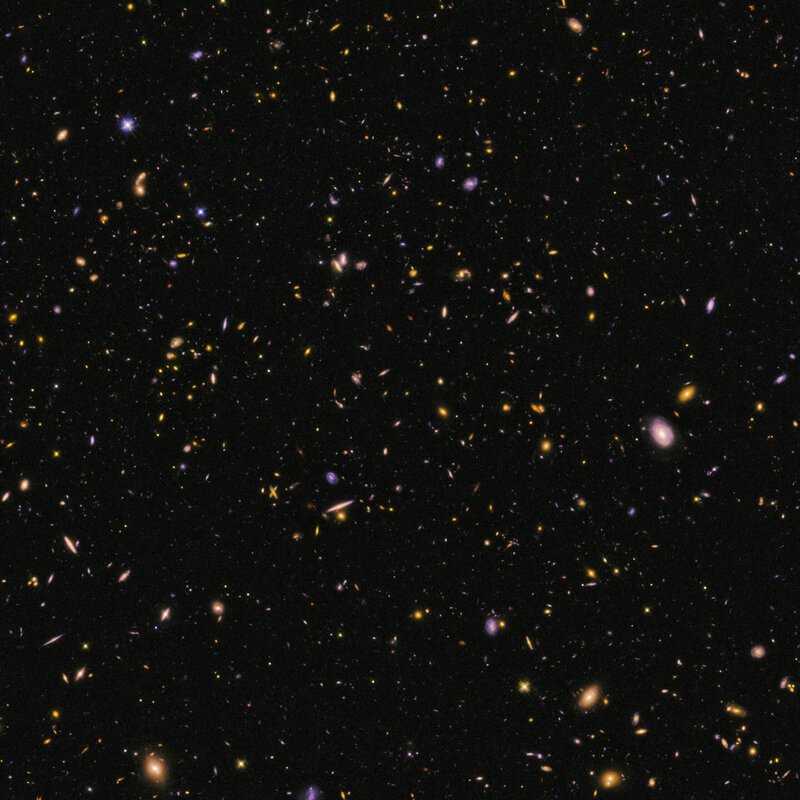
When the live stream begins at 3:30 p.m. on December 7, the most informative thing viewers can watch for is the stated field of view in each image. A Roman frame covering a half-degree patch of sky will contain structure that required dozens or hundreds of separate Hubble observations to assemble; NASA scientists are expected to annotate the images to make that scale difference clear rather than leaving audiences to intuit it from pixel counts alone.
It is equally important to understand what first-image releases are not. These carefully curated showcase products are optimized for visual communication while remaining scientifically genuine, but they are not raw science data. Any specific claims about object counts, distance records, or cosmological measurements made during the premiere should be treated as preliminary until peer-reviewed analysis follows — a distinction the Roman project scientists are likely to emphasize themselves during the live commentary.
For readers who want to go deeper after the reveal, NASA’s Roman mission website maintains updated repositories of technical documentation, survey design papers, and simulated data products that provide the peer-reviewed foundation for the claims that will accompany the December 7 premiere. The images will be the visible surface of a very deep body of preparatory science — and the documentation is there for anyone who wants to dive beneath it.