
Before Ivan Pavlov ever introduced a bell into his laboratory, his dogs were already salivating — not at food, but at the sight of the lab assistant who brought it. That unremarkable observation, made in the 1890s at the Imperial Military Medical Academy in St. Petersburg, accidentally redirected one of the most consequential research programs in the history of science.
The Accidental Discovery Inside a Digestion Study
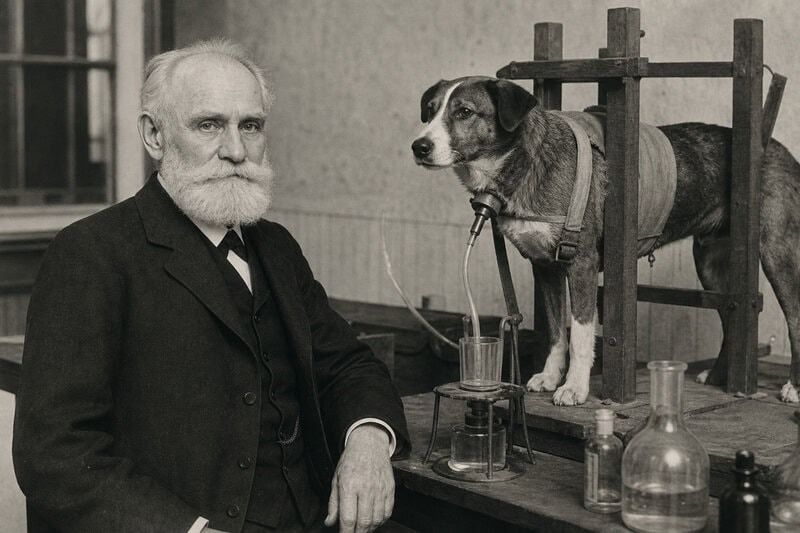
Pavlov was not, at first, studying learning or psychology. He was a physiologist investigating the mechanics of digestion, and the dogs in his laboratory had undergone fistula surgery — a procedure that created an external tube through which saliva could be collected and measured drop by drop. The experiment was about the gut, not the mind. When his animals began salivating before food arrived — triggered by footsteps, a white coat, or the rattle of a food bowl — Pavlov initially treated this as contamination of his data.
He called these early anticipatory responses psychic secretions, a phrase that reveals how unsettling the finding was for a committed physiologist. The animal’s nervous system was doing something his framework had not accounted for: it was anticipating. Rather than discard the contamination, Pavlov turned it into the experiment. That pivot gave the world classical conditioning.
The Nobel Prize he received in 1904 was awarded for his earlier work on digestive secretions — not for conditioning. The discovery that made him immortal in psychology was, technically, a digression from the work that made him a laureate. It is one of the more instructive accidents in the history of science.
The Bell Is Largely a Myth

The iconic bell is largely a pop-culture simplification. According to historian Daniel Todes’s 2014 biography Ivan Pavlov: A Russian Life in Science (Oxford University Press), no single bell was the defining instrument of Pavlov’s laboratory. His published protocols used metronomes, electric shocks, whistles, and tuning forks. The bell became the convenient stand-in — memorable, clean, and easy to illustrate in a textbook diagram. The real story, as is often the case in science, was messier and more interesting.
What Classical Conditioning Actually Involves
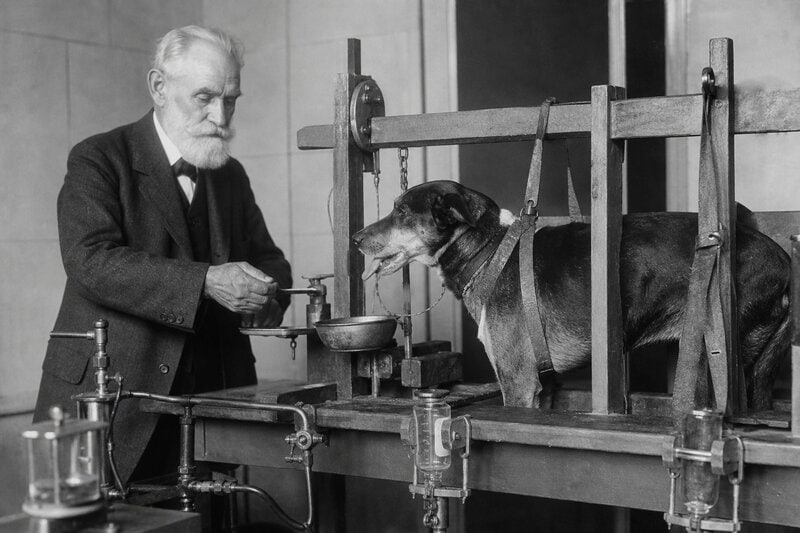
The core finding is accurate and remains one of the most replicated results in behavioral science. A neutral stimulus — one that initially produces no relevant response — paired repeatedly with food will eventually trigger salivation on its own. This is classical conditioning, also called Pavlovian conditioning. The neutral stimulus becomes a conditioned stimulus (CS); the food is the unconditioned stimulus (UCS); the salivation food reliably produces is the unconditioned response (UCR); and once the CS alone elicits salivation, that learned reaction is the conditioned response (CR). Simply Psychology’s overview of Pavlov’s experiment offers a clear breakdown of these terms for readers new to the framework.
The standard bell-food-drool diagram erases years of failed trials, significant individual variation between dogs, and the invasive surgical preparation that made measurement possible. Dogs underwent fistula procedures so that saliva could exit the body through an external tube and be counted. This was not a simple observation study. It was painstaking, surgical, and at times lethal — several animals died during or after the procedures, a fact acknowledged in institutional records but largely absent from the internationally circulated accounts of the research.
How the Conditioned Reflex Actually Works
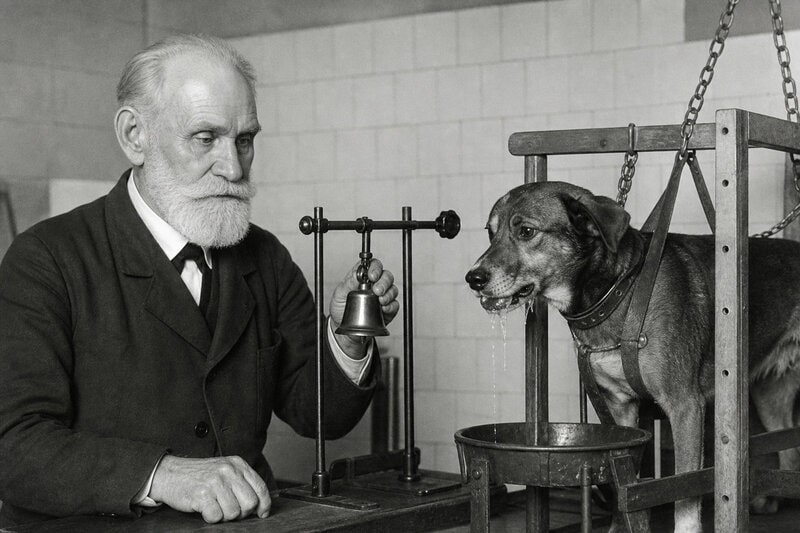
Classical conditioning operates on associative learning: the brain links a conditioned stimulus with an unconditioned stimulus until the CS alone produces a response that previously required the UCS. Neuroscientific research has identified the cerebellum and the amygdala as key structures where these associations are encoded — the cerebellum playing a prominent role in timing-dependent conditioning, the amygdala in emotionally significant associations.
Timing is critical. Conditioning is strongest when the CS precedes the UCS by approximately half a second — a window that appears to reflect how mammalian brains compute causal sequences. Extend the gap significantly and the association weakens, because the brain’s predictive machinery loses the temporal signal it needs to link the two events.
One of the most important — and frequently misunderstood — aspects of classical conditioning is what happens when the conditioned stimulus is repeatedly presented without the unconditioned stimulus. This process, called extinction, reduces the conditioned response, but it does not erase the underlying memory. The learned association is suppressed, not deleted. Evidence for this comes from spontaneous recovery: after a rest period, the conditioned response returns even without further training. The original memory trace persists beneath the suppression — a detail with significant implications for understanding relapse in clinical contexts.
A major theoretical refinement came in 1972 with the Rescorla-Wagner model, which remains one of the most cited computational frameworks in learning theory. Pavlov had assumed conditioning was a passive, mechanical recording of paired events. Rescorla and Wagner demonstrated that the brain actively predicts and updates — it tracks how surprising or expected a UCS is, and only revises associations when prediction errors occur. The brain, in other words, is not a tape recorder. It is a prediction engine. This insight presaged modern computational models of reinforcement learning by decades.
The Laboratory Conditions Pavlov Did Not Publicize
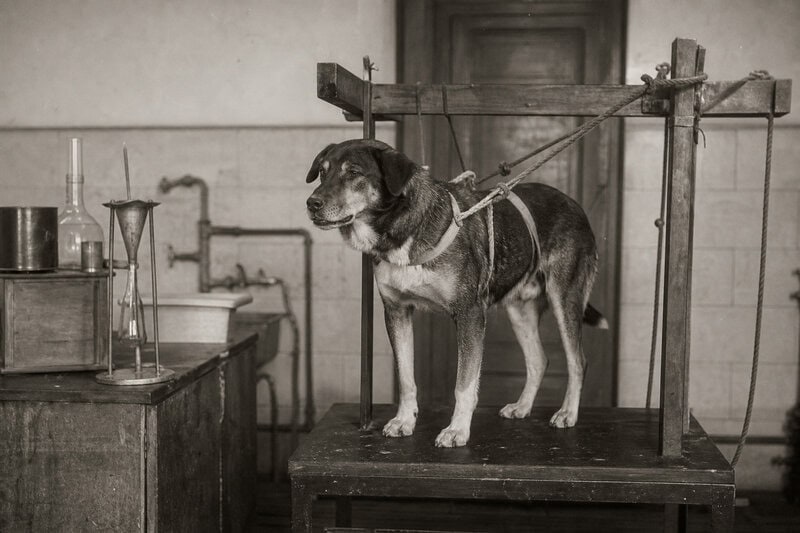
Photographs from Pavlov’s laboratory show dogs roped in place for the duration of experiments. These images complicate Pavlov’s public insistence — documented by Todes — that the animals were comfortable and well cared for. Pavlov lobbied vigorously against animal-rights critics in early 20th-century Russia and Europe, framing his laboratory as humane. The archival record, including those photographs, presents a more complicated picture.
This tension between Pavlov’s public narrative and the documented laboratory conditions is not merely a historical footnote. It is one reason why modern replication of core conditioning principles relies on non-invasive behavioral methods rather than surgical preparation. The science has been separated from the specific techniques that first produced it — a separation that reflects how scientific ethics evolve alongside scientific knowledge.
From Dogs to Humans: Why the Discovery Mattered

The conditioned reflex turned out to be foundational to understanding human behavior, not just canine digestion. Exposure therapy — a gold-standard psychological treatment for phobias and post-traumatic stress disorder — operates directly on Pavlovian principles. By repeatedly presenting a feared stimulus (the CS) without the aversive outcome (the UCS), therapists drive extinction of the conditioned fear response. Understanding that extinction suppresses rather than erases the original memory has directly shaped protocols designed to minimize relapse.
John B. Watson’s 1920 Little Albert experiment at Johns Hopkins University extended Pavlov’s animal model to a human infant, conditioning fear of a white rat by pairing its appearance with a loud, startling noise. The study is ethically indefensible by any modern standard and would not survive institutional review today, but it cemented classical conditioning in American psychology and demonstrated that the mechanism Pavlov identified in dogs operated in the human nervous system as well.
The reach extends beyond the clinic. Advertising, public health campaigns, and behavioral economics all exploit Pavlovian association. Pairing a brand logo with positive imagery is a direct application of CS-UCS linkage to consumer behavior — a fact the advertising industry understood intuitively long before neuroscience confirmed it. This broader contextual overview of Pavlov’s dogs traces some of those wider cultural applications.
What We Now Know That Pavlov Did Not
Pavlov assumed conditioning was a universal, mechanical process essentially identical across individuals. Modern research has substantially qualified that assumption. Genetics, stress history, early-life experience, and neurobiological differences significantly alter how quickly and robustly conditioned responses form. The conditioned reflex is real; the uniformity Pavlov attributed to it is not.
Latent inhibition — the phenomenon whereby a stimulus experienced without consequence becomes harder to condition later — was absent from Pavlov’s original framework but is now recognized as a robust effect with relevance to psychosis research, where reduced latent inhibition has been linked to certain psychotic symptoms.
Whether animals experience something subjectively during conditioning — whether there is something it is like to be Pavlov’s dog, anticipating food — is a question Pavlov deliberately set aside as outside the proper scope of physiology. It remains actively debated in comparative cognition, with no current scientific consensus. Public discussions of what Pavlov’s experiment actually demonstrated frequently surface this question, and researchers continue to disagree about what conditioning implies for animal inner experience.
A Legacy Built on an Accidental Observation
The American Psychological Association lists Pavlov’s conditioned reflex among the most influential discoveries in the history of psychological science. It appears in every introductory psychology curriculum worldwide — a presence that reflects not nostalgia but utility. Nearly every learning-based intervention in clinical, educational, and behavioral neuroscience traces its lineage to the associative principles Pavlov formalized, however accidentally.
The oversimplified bell-and-drool version, while misleading in its specifics, captured the public imagination in a way that fistula surgery and metronome calibration never could. That is worth reflecting on. Scientific communication always involves editorial choices, and those choices carry real consequences for what the public understands — and misunderstands — about how science actually works.
The full account — an accidental discovery born from contaminated digestion data, a Nobel Prize won for something else entirely, dogs restrained in place, a metaphor that outran its evidence, and a mechanistic insight that still shapes how anxiety is treated a century later — is considerably richer, and considerably more honest, than the version that made it into the textbooks. The drool came first. The bell came later. The story was never really about either one.