
In 1994, German archaeologist Klaus Schmidt crouched beside a limestone pillar jutting from a Turkish hillside and recognised, almost immediately, that it was at least 11,000 years old — carved by people who had never planted a field or herded a goat. That moment triggered one of the most consequential excavations in modern archaeology. Researchers now estimate they have uncovered only about 5 percent of what lies beneath the hill, meaning the discovery that already rewrote prehistory is nowhere near finished.
The Hill That Upended Everything We Thought We Knew
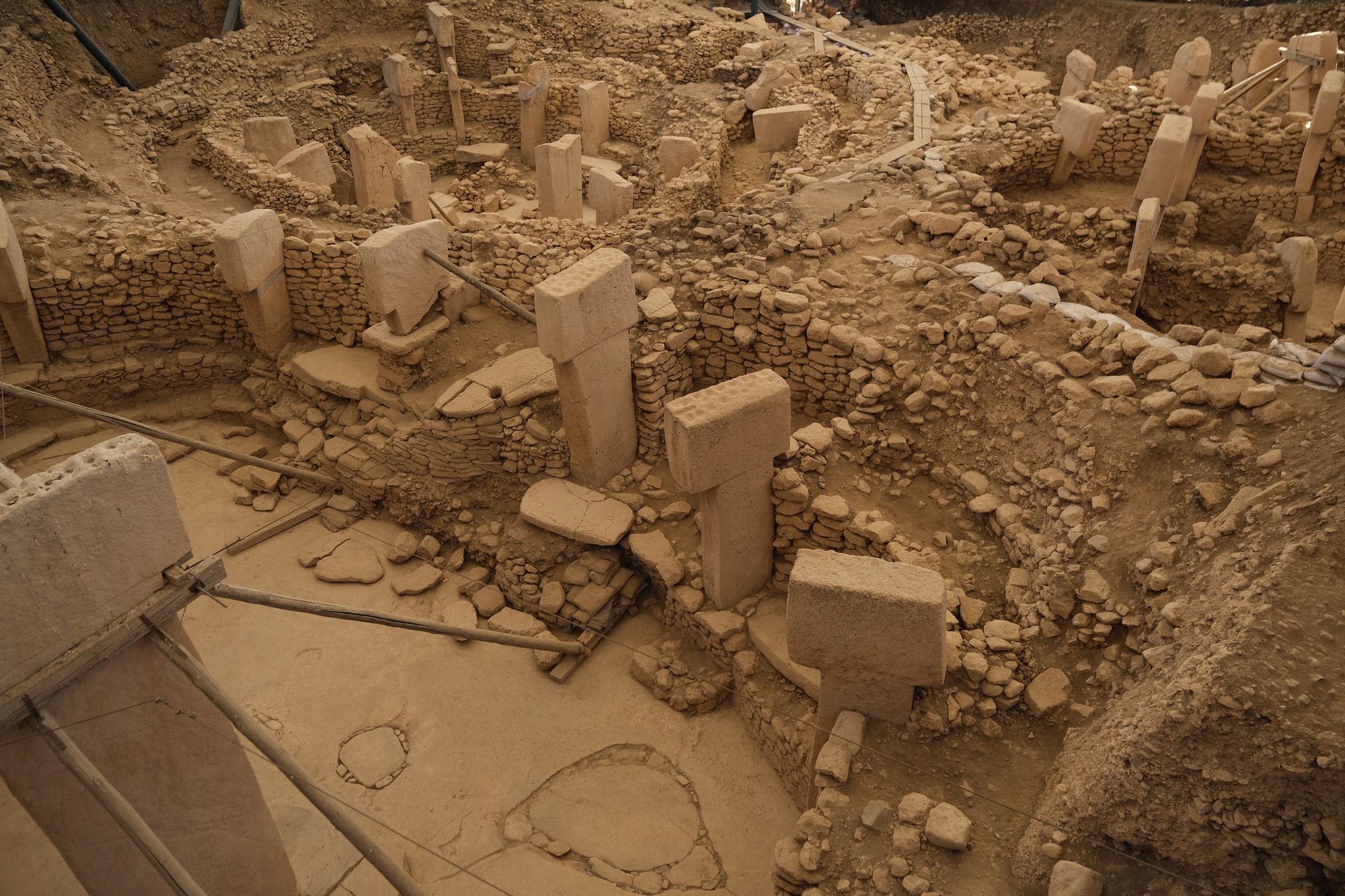
Göbekli Tepe — roughly translating to “Potbelly Hill” in Turkish — sits in the Southeastern Anatolia region of modern-day Turkey, on a limestone ridge overlooking the upper reaches of the Euphrates and Tigris watersheds. Its T-shaped megalithic pillars, some weighing up to 10 tonnes, predate Stonehenge by roughly 6,000 years and the Egyptian pyramids at Giza by approximately 7,000 years, making Göbekli Tepe the oldest known monumental architecture on Earth. Nothing in the established archaeological record had prepared researchers for its existence.
The site had, technically, been recorded before. A survey in 1963 documented the limestone slabs scattered across the hillside but catalogued them as probable medieval grave markers — a misidentification that shelved serious inquiry for more than three decades. Schmidt, working with the German Archaeological Institute (DAI), revisited those survey notes in 1994, recognised the morphology of the stones as Neolithic rather than medieval, and began excavations almost immediately. The project defined his career and ultimately redefined a field.
Work has continued under DAI stewardship following Schmidt’s death in 2014, with Turkish authorities managing site access under a UNESCO World Heritage designation granted in 2018. Ground-penetrating radar and geomagnetic surveys indicate that at least 16 additional enclosures remain unmapped beneath the hillside. The overwhelming majority of Göbekli Tepe’s physical evidence has never been touched by a trowel.
How Old Is Göbekli Tepe, and Why Does That Number Matter?
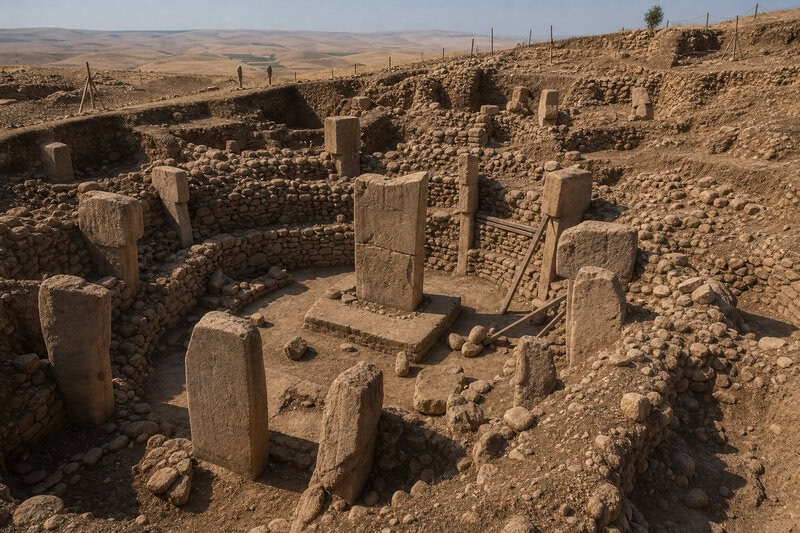
Radiocarbon dating places the site’s active construction between approximately 9500 BCE and 8000 BCE, a period archaeologists designate the Pre-Pottery Neolithic — the era before humans developed ceramic vessels or fully domesticated crops. That makes Göbekli Tepe roughly 11,000 to 12,000 years old, a figure representing broad scientific consensus. The Egyptian pyramids at Giza date to around 2500 BCE; Göbekli Tepe’s earliest layers predate them by approximately 7,000 years.
The site was not simply abandoned. Göbekli Tepe was deliberately buried — backfilled with flint, animal bone fragments, and construction debris — in a process that appears to have been intentional and organised, dated to roughly 11,500 years ago. Why a community would invest considerable effort in entombing a monumental structure it had apparently spent generations building remains one of archaeology’s most actively debated open questions. No consensus explanation has emerged.
As Smithsonian Magazine has noted, the sheer antiquity of Göbekli Tepe does not merely shift dates on a timeline — it forces a fundamental reconsideration of what hunter-gatherer communities were cognitively and socially capable of achieving before the so-called Neolithic Revolution took hold.
Göbekli Tepe Predates Farming — and That Reverses the Standard Story of Civilisation
For much of the twentieth century, the dominant academic model — associated most prominently with Australian archaeologist V. Gordon Childe’s concept of the “Neolithic Revolution” — sequenced the emergence of complex societies in a specific order: agriculture first, then food surplus, then specialised labour, then monumental construction. Göbekli Tepe inverts this sequence entirely. Its builders were hunter-gatherers, and the monument predates any confirmed evidence of domesticated crops or livestock in the region.
Schmidt and subsequent researchers proposed what has come to be called the “cathedral hypothesis”: that the social and logistical demands of communal ritual gathering may themselves have acted as a catalyst for early agriculture in the Fertile Crescent, rather than the other way around. The reasoning holds that large groups assembling repeatedly at a fixed location would have created pressure to ensure reliable food supplies, potentially nudging communities toward cultivation and herding. This hypothesis remains contested. Many archaeologists urge caution about drawing a direct causal line between monument-building and crop domestication; the evidentiary chain is circumstantial, not definitive.
What lends the idea circumstantial weight is genetic research into the origins of domesticated wheat. Studies published in peer-reviewed journals, including work appearing in Science, have identified a wheat domestication centre near the Karaçadağ mountains in southeastern Turkey — approximately 30 kilometres from Göbekli Tepe. That proximity is suggestive, but proximity alone does not establish cause. The relationship between the site and agricultural origins remains an emerging area of inquiry, not settled science.
What the Pillars Reveal: Art, Animals, and Organised Society
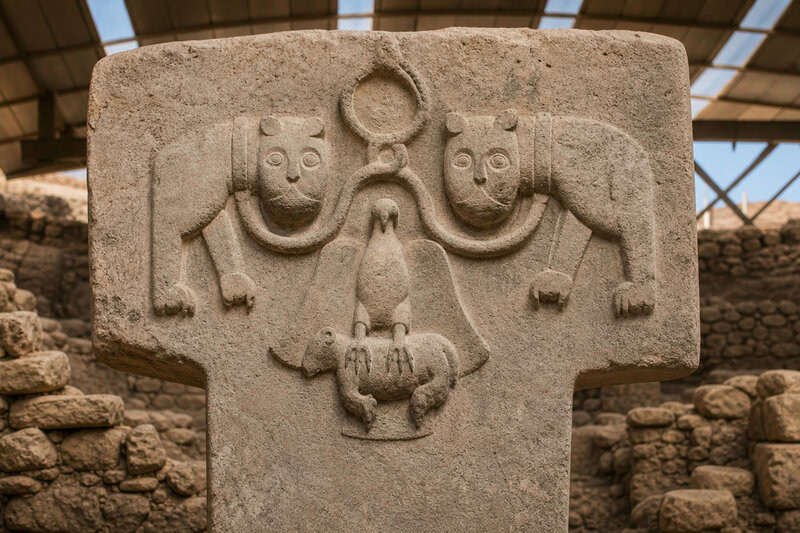
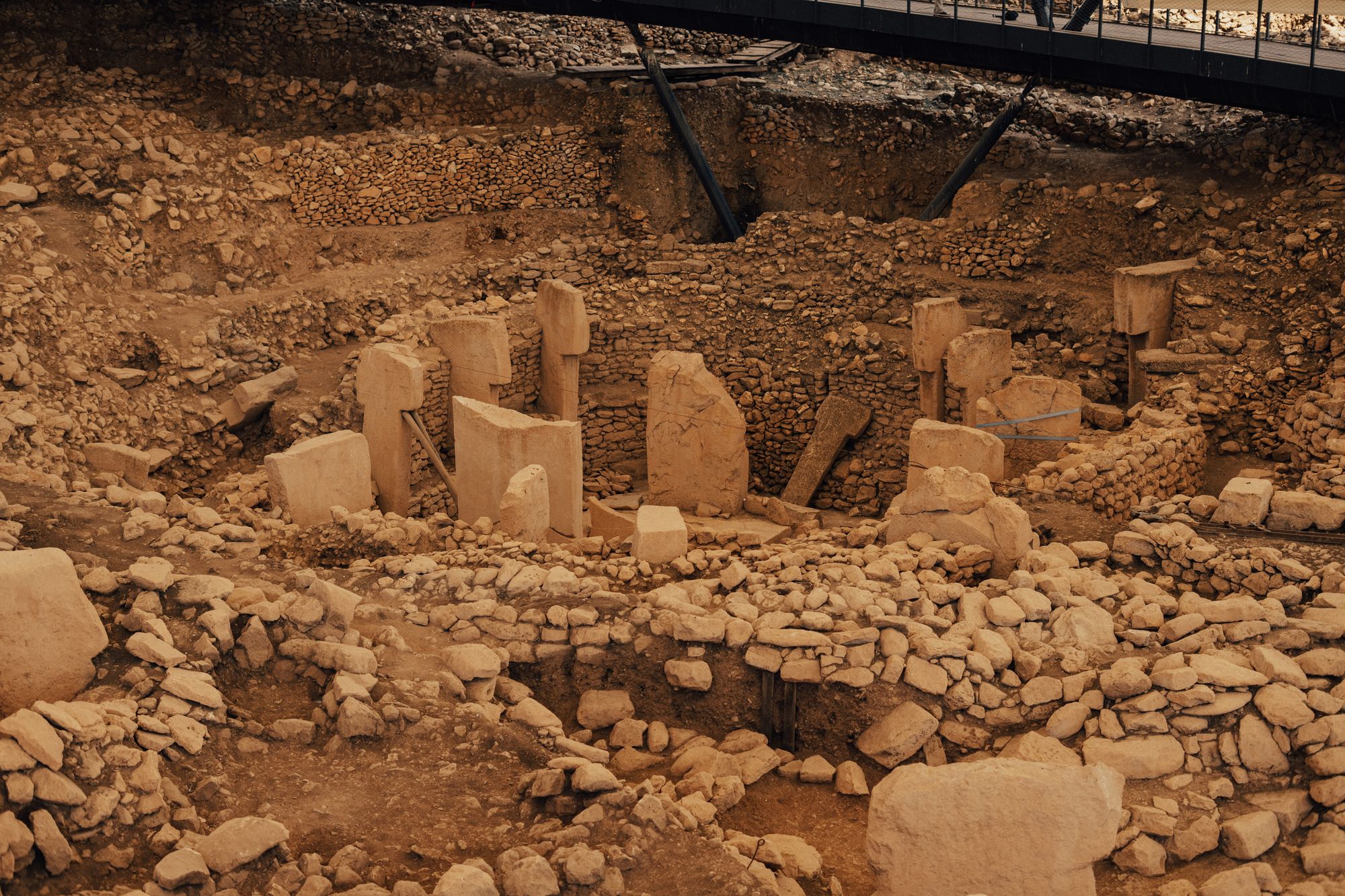
The site’s most immediately striking features are its large T-shaped limestone pillars, arranged in circular or oval enclosures. The pillars are carved with bas-reliefs depicting animals including foxes, vultures, scorpions, cranes, and wild boar. This symbolic vocabulary is sophisticated by any measure, indicating that the communities responsible for Göbekli Tepe possessed not only the physical capacity to quarry and erect massive stone structures but also a shared visual language for representing and interpreting their world.
Some pillars appear to represent stylised human figures, with arms and belt-like carvings rendered in low relief along their sides. Researchers have proposed that these anthropomorphic pillars may have functioned as ancestor shrines or representations of supernatural beings, but the exact interpretation remains debated. The iconographic programme at Göbekli Tepe is rich enough to support multiple readings, and without written records, certainty is elusive.
The logistics of construction alone carry important implications. Quarrying, transporting, and raising stones of up to 10 tonnes without metal tools or the wheel demands coordinated labour at a scale previously attributed only to settled agricultural societies. DAI excavations have also recovered large quantities of animal bones — gazelle, aurochs, and other wild species — consistent with large-scale feasting, supporting the interpretation that Göbekli Tepe functioned as a communal gathering site rather than a permanent settlement. Research covered by Popular Archaeology has explored how these faunal assemblages illuminate the social organisation required to sustain such gatherings over centuries.
The 1963 Misidentification and What It Cost Science
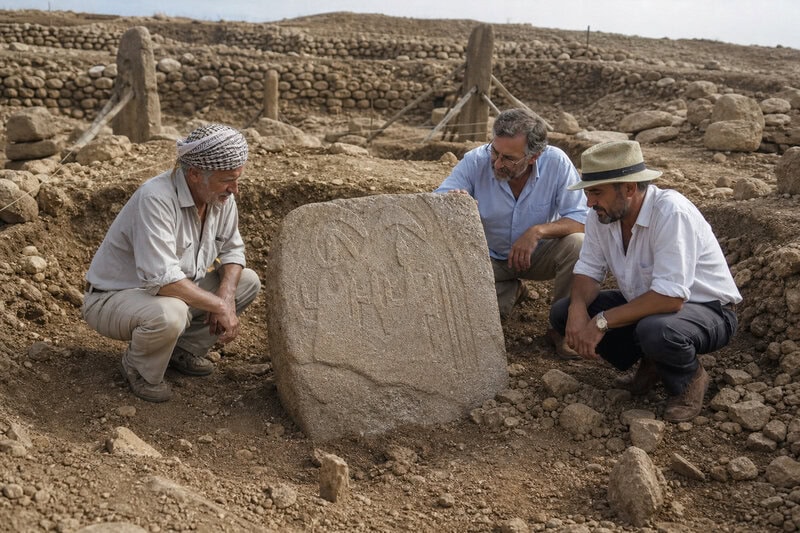
The three-decade gap between the 1963 survey and Schmidt’s 1994 re-examination is more than a footnote — it illustrates a recurring pattern in the discipline. The original survey team was not negligent; they were operating within the theoretical frameworks available to them, and medieval grave markers were a plausible interpretation for isolated limestone slabs on a rural Turkish hillside. What Schmidt brought in 1994 was a sharper eye for Neolithic stone morphology and a different set of expectations about where complex prehistoric behaviour might appear in the record.
The episode underscores the value of revisiting archival survey data with updated analytical frameworks. Dozens of mid-twentieth-century survey reports describe sites across the Near East that were recorded but never fully interpreted. Göbekli Tepe is a reminder that transformative discoveries sometimes wait not in uncharted wilderness but in filing cabinets. History.com’s overview of the site traces this archival dimension of the discovery in accessible detail.
What Remains Underground: The 95 Percent Problem
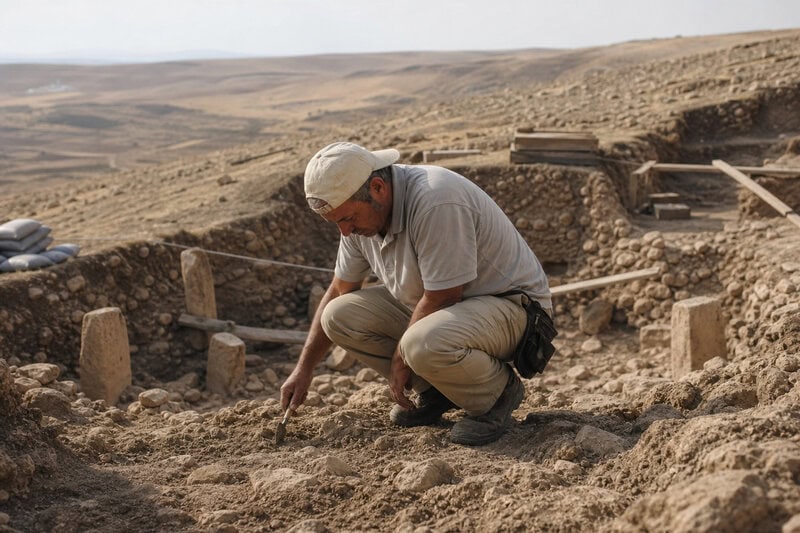
Geomagnetic survey data collected by the DAI indicates at least 16 additional stone enclosures beneath the hillside that have not yet been excavated. Researchers estimate the unexcavated areas could contain thousands more carved pillars, additional faunal assemblages, and potentially organic materials enabling a more precise radiocarbon chronology than currently exists. The 5 percent figure is humbling: Göbekli Tepe has already produced enough evidence to rewrite textbook accounts of early human society, and the vast majority of its physical record remains sealed underground.
Excavation pace is deliberately slow, and appropriately so. Modern archaeological best practice prioritises meticulous stratigraphic documentation — recording the precise position and context of every find within its soil layer — over speed. Rushing the process risks destroying the contextual information that gives artefacts their meaning. Turkish law additionally requires that finds remain in situ where possible or be housed in Turkish state museums, ensuring the material record stays within the country of discovery.
- At least 16 additional enclosures have been identified by geomagnetic survey but remain unexcavated.
- The site dates from approximately 9500 BCE to 8000 BCE, spanning the Pre-Pottery Neolithic period.
- Animal bone deposits indicate repeated large-scale feasting events rather than permanent habitation.
- The deliberate backfilling of the site, dated to roughly 11,500 years ago, remains one of archaeology’s most debated unsolved questions.
- Göbekli Tepe received UNESCO World Heritage status in 2018, formalising international recognition of its significance.
Why Göbekli Tepe Continues to Matter
The site has directly challenged the Neolithic Revolution model that structured archaeological thinking for much of the twentieth century, demonstrating that monumental construction, coordinated labour, and sophisticated symbolic culture can precede — and may in some meaningful sense have helped drive — the agricultural transition. It has reignited interdisciplinary research combining field archaeology, ancient genomics, and cognitive science, prompting new questions about the social and mental lives of late Palaeolithic and early Neolithic peoples that the discipline is only beginning to develop the tools to answer.
For the broader public, Göbekli Tepe offers something rarer than a dramatic discovery: a concrete, rigorously documented example of how a single site can invalidate a consensus that seemed secure. Archaeology is an active, evolving science, and its conclusions are only as robust as the evidence so far uncovered. With 95 percent of Göbekli Tepe still underground, the site is less a solved mystery than an open question written in limestone — the oldest known monumental structure on Earth is also, in a very real sense, one of the least understood places on it.