
A comet now racing out of our Solar System carries a chemical fingerprint that matches no object ever formed around our Sun — and according to a new study using the James Webb Space Telescope, that fingerprint may be nearly as old as the universe itself. The ratios of carbon and deuterium (heavy hydrogen) locked inside Comet 3I/ATLAS point to an origin roughly 10 to 12 billion years ago, placing its birth during one of the most turbulent and fertile eras in cosmic history.
Meet 3I/ATLAS: Only the Third Interstellar Comet Ever Found
3I/ATLAS is only the third confirmed interstellar object ever detected passing through our Solar System, following the cigar-shaped 1I/ʻOumuamua, discovered in 2017, and the icy 2I/Borisov, spotted in 2019. Each discovery is a rare scientific event by any measure. The designation “3I” simply means third interstellar object; “ATLAS” refers to the Asteroid Terrestrial-impact Last Alert System, the telescope network that first identified it.
What sets 3I/ATLAS apart from its predecessors is the richness of data it offered. Rocky ʻOumuamua showed almost no outgassing — the process by which sunlight vaporizes a comet’s ices and releases molecules into space — making detailed chemical analysis essentially impossible. Icy Borisov was more cooperative but still limited in what its outgassing revealed. 3I/ATLAS, by contrast, produced enough outgassing activity for Webb’s infrared instruments to perform a detailed spectroscopic survey of its chemical composition, according to NASA’s announcement of the findings.
Interstellar objects are thought to be ejected from their home planetary systems during gravitational upheavals early in a star’s life, then drift through interstellar space for billions of years before a chance encounter with another star system brings them briefly into view. That journey — measured in billions of years and light-years — is precisely what makes them so scientifically valuable: they arrive as frozen time capsules from environments astronomers would otherwise need to observe across cosmological distances.
A Chemical Fingerprint Unlike Anything in Our Solar System
Webb’s observations of 3I/ATLAS began in December 2025, as the comet was already moving away from the Sun. That timing mattered enormously. As 3I/ATLAS receded, its outgassing rate was declining, and researchers had a narrow window to capture its chemical signature before activity dropped below even Webb’s exceptional detection threshold. There will be no second pass — this object is not gravitationally bound to our Solar System and will never return.
Using Webb’s Near Infrared Spectrograph (NIRSpec) and Mid-Infrared Instrument (MIRI), scientists measured the spectral signatures of specific molecules released as sunlight heated the comet’s surface. Spectroscopy works by identifying chemical compounds through the precise wavelengths of light they absorb and emit — each molecule leaves a unique barcode in the light spectrum. The critical measurements were ratios, specifically the proportion of deuterium to carbon-bearing molecules. Deuterium is a heavier isotope of hydrogen that contains one neutron in addition to the single proton found in ordinary hydrogen; the ratio of deuterium to other elements in a comet’s ice is exquisitely sensitive to the temperature and chemistry of the environment where that ice originally condensed billions of years ago.
The result was unambiguous: the carbon and deuterium ratios found in 3I/ATLAS do not match those of any comet originating in our Solar System. Solar System comets formed roughly 4.5 billion years ago in the disk of gas and dust surrounding our young Sun, and their isotopic ratios reflect that specific local chemistry. 3I/ATLAS diverges sharply, signaling that it condensed in a fundamentally different environment. Those frozen ratios function, in effect, as a birth certificate: the proportions of isotopes locked inside cometary ice preserve the temperature, pressure, and elemental mix of the stellar nursery where the object formed, regardless of how far it has since traveled.
How Old? The Research Team Points to Cosmic Noon

The Webb study estimates that 3I/ATLAS may have formed between 10 and 12 billion years ago — potentially making it nearly as old as the universe itself, which cosmologists place at approximately 13.8 billion years. That formation window aligns with what researchers call “cosmic noon,” the era when star formation across the universe was at its absolute peak and the raw materials for planetary systems were most abundant.
Forming during cosmic noon would mean 3I/ATLAS was born in a galaxy-wide environment far richer in star-forming activity than the relatively quiet Milky Way of today. That distinction could explain its unusual chemistry: the interstellar medium — the diffuse gas and dust between stars — had a different elemental composition during cosmic noon than it does now, and a comet condensing from that earlier mixture would bear chemical signatures unlike anything assembled in our own planetary system’s more recent and locally specific conditions.
It is important to be precise about what “estimated” means here. According to the Space Telescope Science Institute’s release of the findings, the age estimate is inferred, not directly measured. Researchers derive it by matching the comet’s chemical ratios to models of interstellar medium composition at different epochs in cosmic history. Those models are well-grounded in observational cosmology, but they carry uncertainties, and the interpretation of what 3I/ATLAS’s specific ratios imply for its exact birthplace and age remains an emerging finding subject to further peer scrutiny — not yet an established scientific consensus.
Why Webb Was the Right Tool — and Why Timing Was Everything
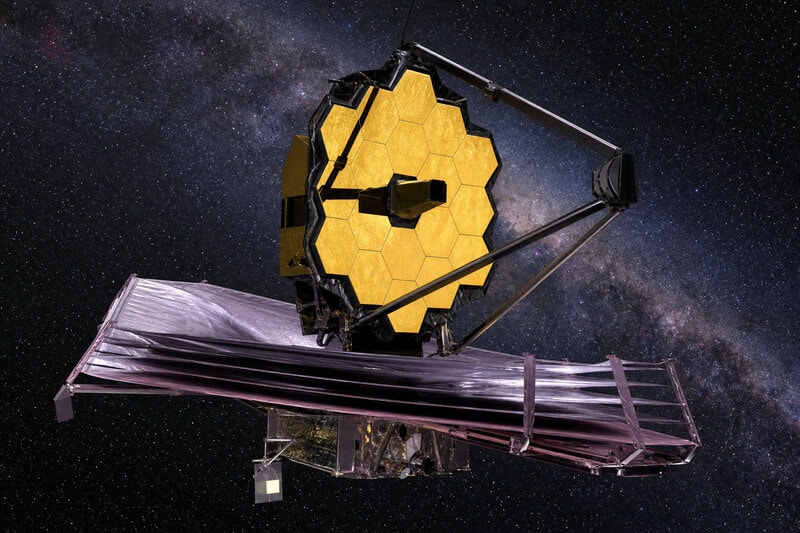
Webb operates primarily in infrared wavelengths, the portion of the electromagnetic spectrum associated with heat emission and the molecular absorption features of cold, icy bodies. Ground-based optical telescopes cannot match Webb’s sensitivity for this type of analysis, particularly for a fast-moving object already pulling away from the Sun. The telescope’s instruments are designed to detect faint spectral signals from objects that are inherently dim in visible light but chemically active in the infrared — a description that fits an outgassing interstellar comet almost perfectly.
The rapid coordination required to point Webb at 3I/ATLAS reflects a maturation in how the astronomical community responds to transient events. When ʻOumuamua passed through in 2017, the infrastructure for quickly mobilizing space-based assets on a newly discovered interstellar visitor was far less developed. By December 2025, the scientific community had protocols in place to act quickly — a capability that proved essential given the narrow observational window available before the comet’s activity faded beyond reach.
A Surprising Chemistry That Rewrites Expectations
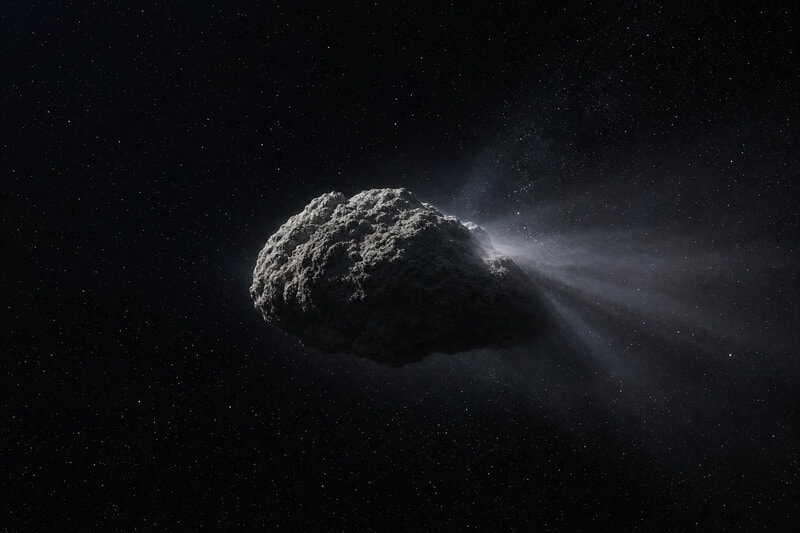
The research team describes 3I/ATLAS’s chemical makeup as “surprising,” and the word carries scientific weight. The surprise is not merely that the chemistry differs from Solar System comets — that was broadly expected for any interstellar object. The surprise lies in how different it is, and what that difference implies about the object’s age and origin environment. Those implications raise an immediate and profound question: is 3I/ATLAS a rare exotic outlier, or does it hint that interstellar space is populated with ancient comets carrying chemistry from the early universe that astronomers have never been able to sample before?
If objects like 3I/ATLAS are relatively common — ejected relics of cosmic noon star formation drifting through the galaxy in large numbers — then the chemistry of early-universe planetary formation may be far more physically accessible than previously assumed. Astronomers would not need to peer billions of light-years away to study that era; they would simply need to catch the next interstellar visitor and point Webb at it. Conversely, if 3I/ATLAS is genuinely unusual, it may represent a specific class of object from an unusually old or chemically distinct stellar system — a finding with significant implications for models of how diverse planetary systems can be across cosmic time.
Scientists caution, however, that with only three confirmed interstellar objects ever studied in any detail, drawing population-level conclusions is premature. 3I/ATLAS expands the sample by one. That is meaningful — and it is not nearly enough to settle fundamental questions about how common or exotic such objects are in the galaxy.
What Comes Next: Bigger Questions, Cautious Answers
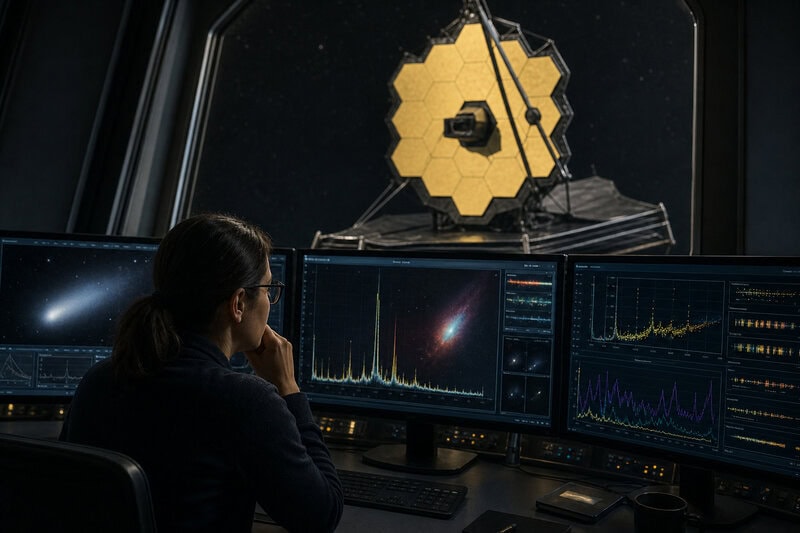
The Webb findings on 3I/ATLAS are best understood as a hypothesis-generating result. The anomalous chemical ratios are real, measured data. The interpretation — that the comet formed 10 to 12 billion years ago during cosmic noon — is a well-motivated scientific inference built on those measurements, but it rests on models that will require further refinement and independent verification before the community treats it as settled science.
Future detections of interstellar objects passing through our Solar System are expected to increase as next-generation survey telescopes come online. The Vera C. Rubin Observatory, currently beginning operations in Chile, is designed to survey the entire visible sky every few nights at unprecedented depth — exactly the kind of instrument that will catch interstellar visitors earlier and more frequently, providing the larger statistical sample needed to determine whether 3I/ATLAS’s chemistry represents a curiosity or a pattern.
If the age estimate ultimately holds up under peer review and further modeling, the implications are extraordinary in the most literal sense: 3I/ATLAS would represent direct physical material from the early universe, delivered to the doorstep of our Solar System without requiring a telescope pointed billions of light-years into the distant cosmos. Discussion in the scientific community reflects genuine excitement about exactly that prospect — ancient ice that traveled across the galaxy to be analyzed by a telescope that did not exist when most of its journey began.
For now, 3I/ATLAS has already achieved something concrete and lasting regardless of how the age debate resolves. It has demonstrated that Webb can extract meaningful, scientifically rich chemical information from interstellar visitors during the brief windows they are observable. That capability — the analytical playbook now established for studying the chemistry of objects from beyond our Solar System — will be ready and waiting when the next one arrives.