
A ribbon of cosmic debris so immense it could wrap around both Earth and the sun five hundred times over has been quietly drifting just 63 light-years from our planet — invisible until the Hubble Space Telescope finally turned its gaze in the right direction. When Hubble’s latest image revealed what astronomers are calling a “cat’s tail” nebula, it sparked immediate fascination: not just for its haunting, feline elegance, but for the violent collision story written inside every wisp of its structure.
A Cosmic Cat’s Tail Hidden in Plain Sight
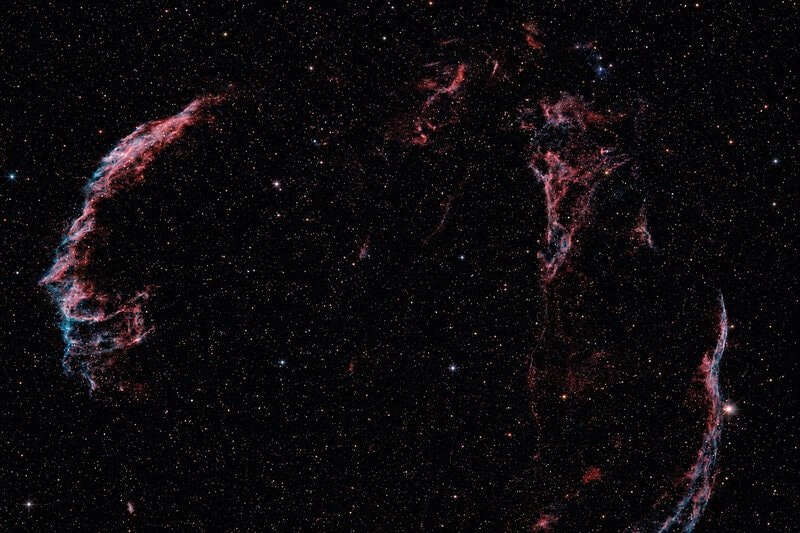
The nickname stuck immediately. In Hubble’s image, a long, gently curved filament of gas and dust sweeps away from a central stellar system in a shape unmistakably reminiscent of a cat’s tail mid-swish. It is graceful, delicate, and almost impossibly thin-looking against the black of space — which makes its true scale all the more staggering. At just 63 light-years from Earth, this structure qualifies as a relatively close cosmic neighbor by astronomical standards, yet it had escaped detection in visible light entirely until this observation.
What makes the discovery even more arresting is its origin story. Scientists believe this elegant ribbon almost certainly began with something catastrophic: a collision between two Pluto-sized icy bodies. Out of that ancient wreckage, stellar forces quietly sculpted one of the most visually striking structures Hubble has yet captured. The University of Arizona researchers behind the study have detailed how this enormous cat’s tail tells the story of a cosmic collision in ways no previous observation had managed, and Space.com has published full coverage of the discovery.
What Exactly Did Hubble See?
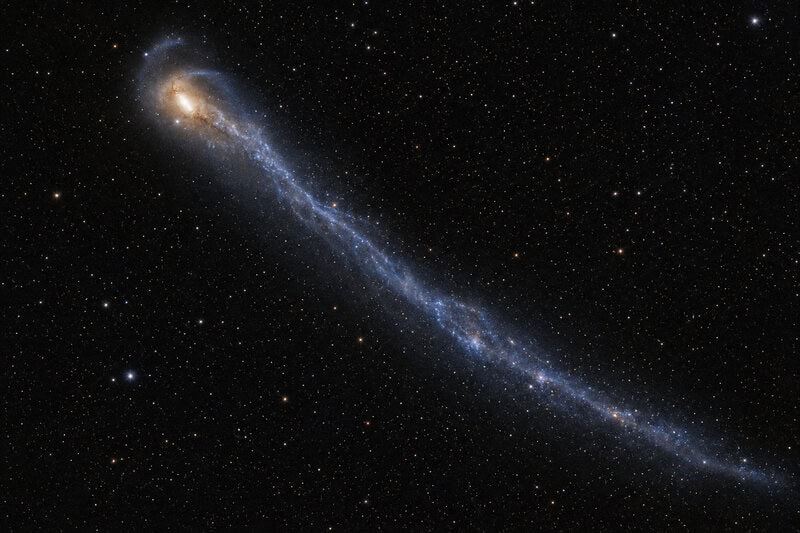
The cat’s tail is a long, curved filament — a flowing streamer of fine dust and gas extending outward from the vicinity of a stellar system. The critical distinction in this observation is wavelength: this is the first time the structure has ever been seen in visible light. Previous observations in other wavelengths had either missed the tail entirely or lacked the resolution needed to understand its true shape and extent. Hubble’s sensitivity across visible wavelengths made the difference, delivering a genuinely new view of a structure that had been hiding in our stellar backyard for an unknown length of time.
That this nebula went undetected despite lying only 63 light-years away underscores how much of the universe remains obscured from even our best instruments until the right telescope looks in the right way. Distance alone is no guarantee of detectability — orientation, wavelength, and instrument sensitivity all determine what gets seen and what stays hidden.
How Do You Build a Cat’s Tail in Space?
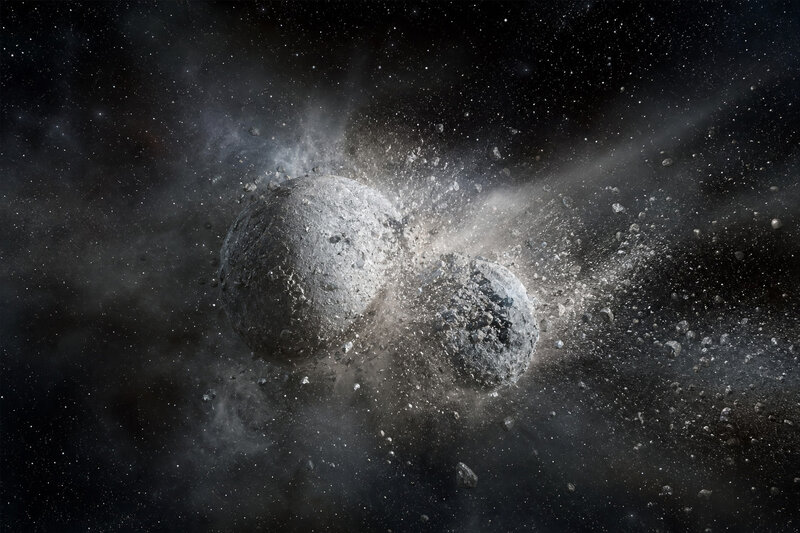
The leading explanation for the cat’s tail begins with a collision. Two Pluto-sized icy bodies — the kind of frozen worlds that populate the outer reaches of many solar systems — slammed into each other with enough force to shatter both objects and release an enormous cloud of pulverized dust and debris. That cloud did not disperse evenly in all directions. Something far more sculptural happened instead.
Stellar wind — the constant outward flow of energetic particles streaming from the host star — gradually caught the debris field and began pushing it. Over time, that sustained pressure stretched and shaped the cloud into the long, flowing tail visible in Hubble’s image. The process resembles the way a steady wind sculpts a flag into a rippling ribbon, or the way solar wind pushes a comet’s tail away from the sun regardless of the comet’s direction of travel. The force is consistent, directional, and over long timescales, capable of imposing elegant order on raw chaos.
Planetary-scale collisions, while violent in the extreme, are not regarded as rare aberrations. They are considered a normal and arguably necessary part of how solar systems grow and evolve — a point that ties this distant cat’s tail directly to the broader science of planet formation.
Putting the Scale in Perspective
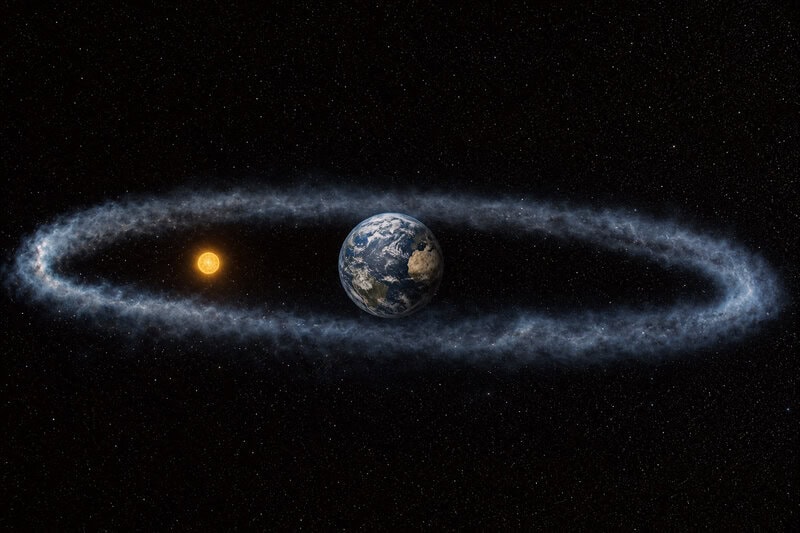
The claim that the cat’s tail could wrap around Earth and the sun 500 times is the kind of comparison that takes a moment to settle properly in the mind. The average Earth-sun distance — roughly 150 million kilometers — is already a number most people struggle to genuinely visualize. Multiply that by 500, and the resulting length dwarfs virtually every scale encountered in everyday life.
For further context: the distance from Earth to Pluto at its farthest stretches to around 7.5 billion kilometers. The cat’s tail is longer still. And yet in Hubble’s image it appears as a delicate, gossamer thread — a featherlight wisp against the dark. This is one of space’s quieter paradoxes: the most enormous structures can appear the most fragile, their vastness comprehensible only through mathematics rather than intuition. The astronomy community’s reaction on Reddit reflected that same mixture of awe and disbelief that tends to greet discoveries of this scale.
Why This Discovery Matters for Astronomy
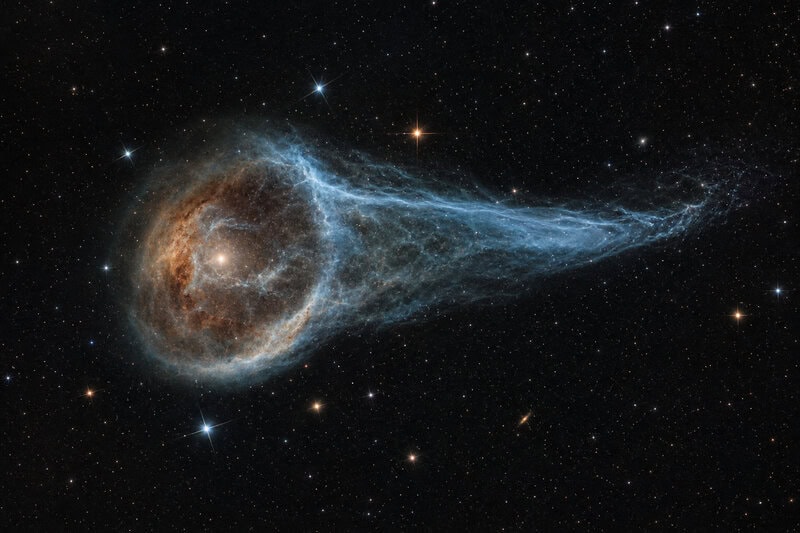
Stellar-wind-shaped filaments captured in visible light are rare observational prizes. The Hubble image gives scientists something they have seldom had before: a clear, optically resolved look at how debris from a planetary collision evolves under the persistent pressure of stellar wind. That alone places this among the more significant Hubble findings in recent years.
The tail’s composition and internal structure carry forensic value. By analyzing what the debris is made of — its density, particle size, and chemical fingerprint — scientists can work backward to reconstruct what the two colliding bodies were composed of before impact. It is, in a meaningful sense, reading a crime scene written across light-years of space.
There is also a directly personal dimension to the finding. Collisions between large icy bodies are thought to have occurred repeatedly during our own Solar System’s early history. The same kind of violent planetary demolition derby that helped shape Earth, produce the Moon, and sculpt the outer planets likely generated similar debris structures billions of years ago. Studying the cat’s tail 63 light-years away may offer a window into conditions that once existed right here — in our own cosmic neighborhood.
Hubble’s Continuing Relevance
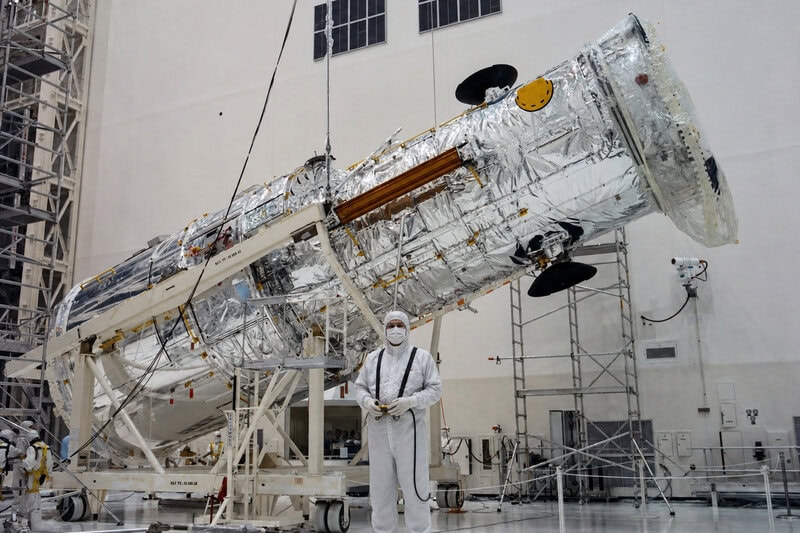
More than three decades after its launch, Hubble continues to produce images and data that surprise even veteran astronomers. The cat’s tail discovery is a compelling reminder that longevity and scientific relevance are not mutually exclusive — that a carefully maintained and thoughtfully pointed observatory can still deliver genuinely new science long after younger rivals have arrived.
Hubble and the James Webb Space Telescope are frequently framed as competitors, but the more accurate picture is one of complementarity. Webb excels at infrared observations, penetrating dust clouds and reaching back toward the earliest galaxies. Hubble’s strengths lie in visible light and ultraviolet wavelengths — precisely the regime that made the cat’s tail visible for the first time. The two instruments together offer a far more complete view of the universe than either could provide alone, and the cat’s tail is a concrete example of why both matter.
Discoveries like this also make a quiet but powerful argument for the sustained investment in space-based observatories. Every time an image of this quality emerges from an aging telescope, the case for keeping functional instruments operational essentially writes itself.
What Comes Next for the Cat’s Tail
Researchers now have a sharply defined set of questions to pursue. How long will the tail remain visible as stellar wind continues to disperse and dilute the debris? Is the structure still actively being shaped, or has the main phase of its evolution already passed? Do finer internal structures exist within the tail — clumps, density variations, or propagating waves — that could reveal more about the dynamics of the original collision?
Follow-up observations combining Hubble data with readings from other observatories could build a fuller, multi-wavelength portrait of the collision event and the debris field it produced. Each additional data layer adds forensic detail to what is already an unusually vivid record of planetary destruction and cosmic recycling.
The most resonant takeaway may be a simple one. If a structure this dramatic — this long, this sculptural, this scientifically rich — could remain hidden in visible light just 63 light-years away until now, the implied question is almost irresistible: what else is drifting quietly through our stellar neighborhood, waiting only for the right telescope to look?