
Off the Florida coast, a nurse shark produced a rapid series of low-frequency clicks that no researcher had formally catalogued as intentional communication — until recordings like it became the centerpiece of a landmark 2023 study from the University of Auckland. That finding is quietly rewriting one of marine biology’s most confident assumptions: that sharks, the ocean’s apex predators, have nothing to say.
Why Everyone Assumed Sharks Were Silent
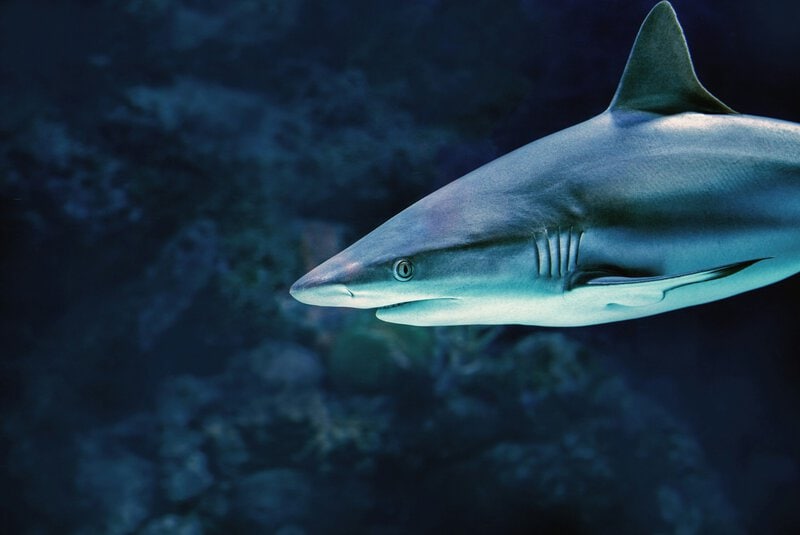
The case for shark silence seemed anatomically airtight. Sharks lack a larynx — the structure mammals use to push air across vocal cords — and they also lack a swim bladder, the gas-filled organ that many bony fish vibrate to produce sound. Early ichthyologists, the scientists who study fish, looked at that anatomical checklist and reached a logical conclusion: no hardware, no sound. The label “acoustically silent” was applied and largely left unchallenged for decades.
That conclusion was reinforced by a practical problem with the tools researchers were using. Standard underwater recording equipment was not sensitive enough to detect the low-amplitude, low-frequency signals sharks may produce, which meant the absence of evidence was mistaken for evidence of absence — a classic methodological blind spot. As recently as 2014, a review published in the journal Fish and Fisheries listed elasmobranchs — the group containing sharks, rays, and skates — as the vertebrate class with the least documented acoustic behavior of any on Earth.
It helps to understand what scientists mean when they distinguish between two related concepts. “Vocal” has a precise scientific meaning: producing sound through a dedicated throat structure. “Acoustic communication,” by contrast, simply means using sound to convey information, regardless of how that sound is generated. Sharks almost certainly cannot be vocal in the first sense. Whether they qualify under the second, broader definition is exactly what new research is now attempting to settle.
Sharks have existed for roughly 450 million years — longer than trees have grown on land — yet the question of whether they use sound to communicate is only now receiving rigorous, targeted scientific attention. That gap says more about the limits of human curiosity and instrumentation than it does about the animals themselves.
What the Clicking Sounds Study Actually Found
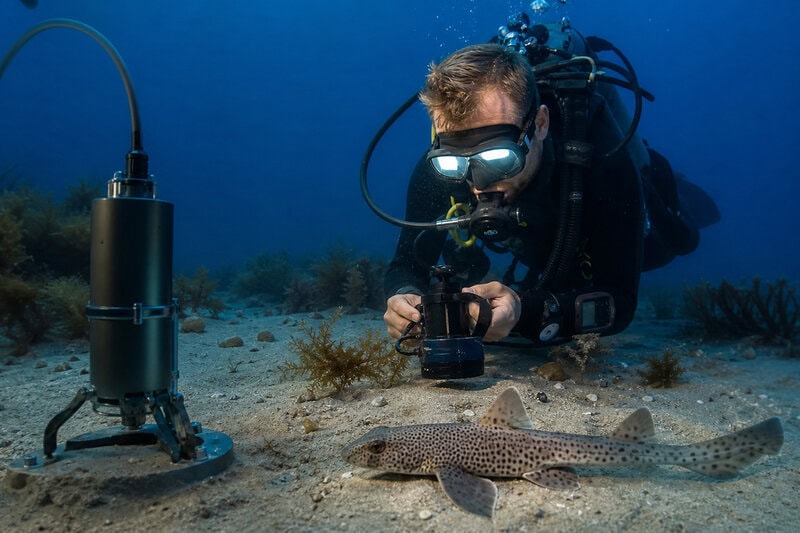
The University of Auckland research team designed their study to eliminate exactly the methodological weaknesses that had plagued earlier work. They deployed broadband hydrophones — underwater microphones capable of detecting frequencies ranging from 20 Hz up to 180 kHz — near small-spotted catsharks in both controlled tank environments and open-water conditions. The goal was to capture acoustic activity across the full range of frequencies a shark might plausibly use, not just the narrow band that older equipment could resolve.
What the hydrophones recorded were short-duration pulses: individual clicks lasting between one and five milliseconds, clustered in bursts of two to twenty clicks at a time. Critically, these bursts occurred predominantly during specific social moments — when one shark made close physical contact with another, or turned toward a neighboring animal. That behavioral correlation is what separates the finding from background noise. Random mechanical interference does not cluster around social encounters in a repeatable pattern.
The production of these clicks is documented and has passed peer review. Whether those clicks constitute “communication” in a cognitively meaningful sense — meaning the sender intends to convey information and the receiver demonstrably changes behavior in response — remains an active and genuinely contested area of research. The Auckland team has been careful not to overreach that distinction.
The study should also be read with appropriate caution about its scale. The sample involved fewer than 30 individual sharks, and as of mid-2025, independent replication by other institutions has not been published. In science, a single study, however well-designed, is a starting point rather than a verdict. You can read more about the foundational questions surrounding whether sharks are capable of producing communicative sounds and what the anatomical evidence suggests.
How Sharks Can Make Sound Without a Voice
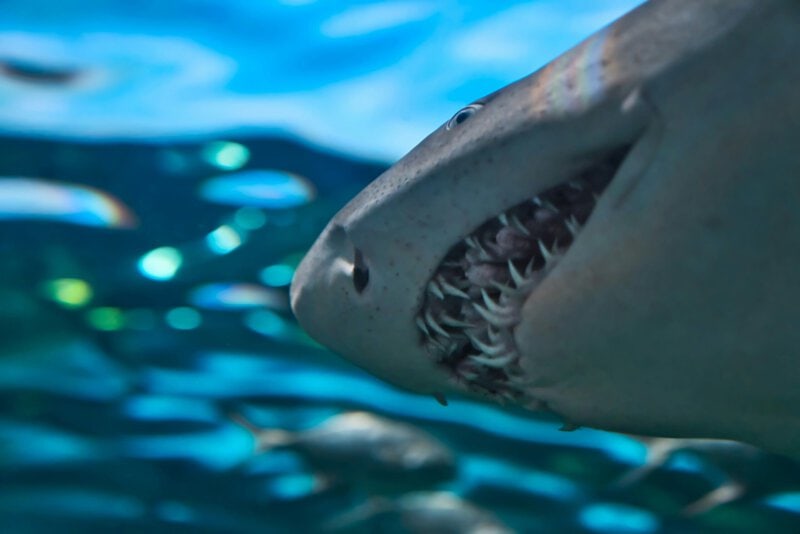
If sharks have no larynx and no swim bladder, the obvious question is: where are the clicks coming from? The Auckland team proposed a mechanism grounded in what sharks do have. Sharks possess highly mobile cartilaginous jaw structures, and their skin is covered in dermal denticles — tiny, tooth-like scales with a hard mineral surface. The hypothesis is that rapid jaw movements, and potentially the snapping or rubbing of denticles against each other or against a surface, release sudden bursts of mechanical energy that propagate through the water as pressure waves.
An accessible analogy: the mechanism is not entirely unlike the way a mantis shrimp snaps its appendage to generate a cavitation bubble, or the way a human cracks a knuckle. In each case, stored mechanical energy is released in a fraction of a second, creating a pressure event that the surrounding medium — water, in the shark’s case — transmits efficiently outward. Sound travels roughly four times faster in water than in air, which means even a brief, low-energy click can carry information across a meaningful distance.
What recorded acoustic evidence confirms is that sharks can produce sounds. What remains speculative — and the Auckland team has acknowledged this openly — is the precise anatomical pathway. The proposed jaw-and-denticle mechanism has not yet been confirmed through direct anatomical imaging or high-speed video capturing the production event in real time. That confirmation is one of the explicit next steps the researchers have outlined for future work.
The broader elasmobranch family provides suggestive context. Rays and skates, which share a common ancestor with sharks, have also been recorded producing low-frequency sounds in research conducted at the Woods Hole Oceanographic Institution. If acoustic capacity is documented across multiple branches of the elasmobranch family tree, that would suggest it is an ancient, conserved trait rather than an isolated quirk of one species — a finding with significant implications for understanding the evolution of animal communication.
A Richer Sensory World Than Most People Realize
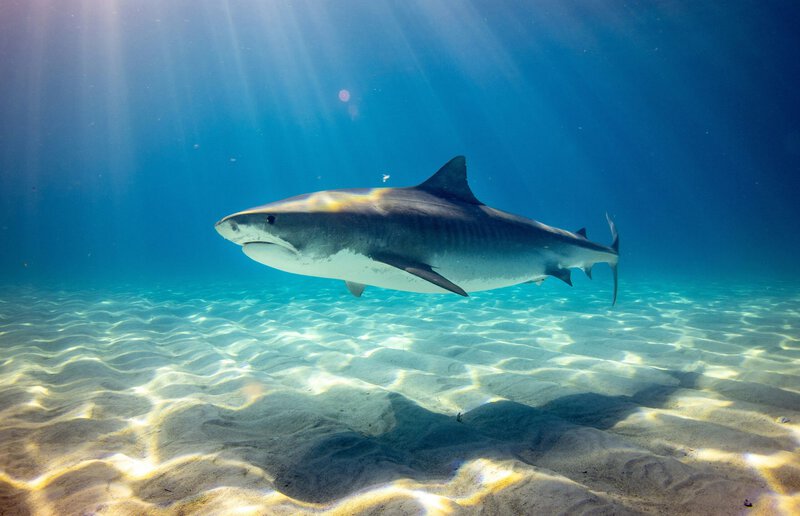
To appreciate why acoustic communication might make evolutionary sense for sharks, it is worth stepping back to consider the sensory environment these animals already inhabit. Sharks possess the ampullae of Lorenzini, a network of electroreceptors capable of detecting electric fields as weak as one-billionth of a volt — a sensitivity so fine that sharks can sense the bioelectric fields produced by a prey animal’s beating heart. They also have a lateral line system running along their bodies that detects subtle changes in water pressure and movement, and an olfactory system so acute it has become cultural shorthand for sensory precision.
Adding acoustic communication to that repertoire would be evolutionarily coherent. In deep or murky water, where visibility drops to near zero and chemical gradients disperse unpredictably, sound offers a reliable, fast-propagating channel for conveying information. Low-frequency sounds in particular can travel kilometers through the ocean with minimal degradation, making them well-suited for coordinating behavior across distances that vision and electroreception cannot bridge.
The receiver side of the equation is better established than the sender side. Shark inner ears are well-documented structures capable of detecting low-frequency sounds — roughly 10 Hz to 1,500 Hz according to studies reviewed by the American Elasmobranch Society. Sharks can hear. The unresolved question is whether they demonstrably change their behavior in direct response to clicks produced by other sharks, which is the behavioral experiment required to confirm that sound is functioning as a signal rather than simply as a detectable event.
Not all researchers are convinced the clicks rise to the level of signals at all. A 2024 commentary published in Marine Biology included dissenting voices who argue the clicks may be epiphenomenal — meaning incidental byproducts of feeding behavior or physical movement rather than purposeful transmissions. These scientists urge caution before the word “communication” is applied, and their skepticism represents a legitimate and important check on premature conclusions. This is not a debate between credulous enthusiasts and rigid skeptics; it is a normal, productive disagreement among researchers working at the frontier of an emerging field.
Why This Research Matters Beyond the Headline

The stakes of resolving this question extend well beyond satisfying scientific curiosity. If sharks do communicate acoustically, then the dramatic and ongoing increase in anthropogenic ocean noise — generated by commercial shipping, military sonar, seismic surveys, and offshore energy infrastructure — may be disrupting shark social behavior in ways that current environmental impact assessments simply do not account for. Those assessments were built on the assumption that sharks were acoustically silent, which is precisely the assumption now under review.
The conservation implications are concrete. The International Union for Conservation of Nature currently lists more than a third of all shark species as threatened with extinction, with overfishing and habitat degradation as the primary drivers. If acoustic disruption is an additional, unrecognized stressor affecting reproduction, social cohesion, or habitat selection, then conservation strategies built on incomplete information may be systematically underestimating what sharks need to survive. Noise pollution protocols, already standard in conservation planning for whales and dolphins, may eventually need to be extended to elasmobranchs.
The evolutionary implications reach even further back in time. Confirming acoustic communication in sharks would push the origin of sound-based signaling deeper into vertebrate history than current models assume. The split between cartilaginous fish — the lineage that includes sharks — and bony fish occurred approximately 420 million years ago. If both lineages use acoustic communication, and if that capacity was inherited rather than independently evolved, it suggests sound-based signaling is among the oldest communication strategies in the vertebrate world.
The methodological legacy of this research may prove as significant as the findings themselves. The ultra-sensitive broadband hydrophone protocols developed for the shark clicking study are already being adapted by researchers at the Scripps Institution of Oceanography to survey acoustic activity in other elasmobranch species previously assumed to be silent. A new subdiscipline of fish bioacoustics is taking shape, and the instruments scientists now carry into the water are capable of detecting things the ocean may have always been saying.
What We Know, What We Don’t, and What Comes Next
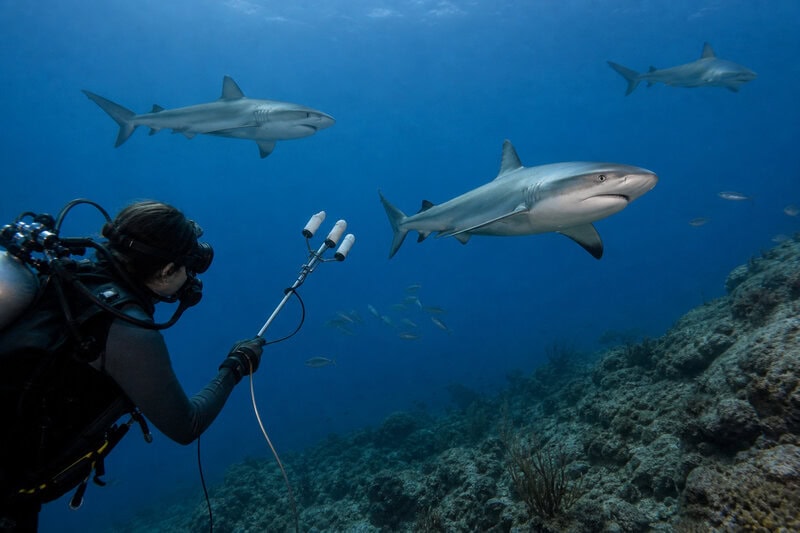
An honest summary of the science as it stands in 2025 looks like this: sharks can produce sounds — specifically, low-frequency click bursts under conditions that correlate with social interaction. That is the peer-reviewed, established finding. Everything beyond it is a research question, not a conclusion. Intentional communication, a confirmed anatomical production mechanism, and demonstrated behavioral response in receiving sharks are all open problems that future study must address before the field can claim a more complete understanding of shark communication.
No scientist involved in the Auckland research has claimed that sharks “talk” in any meaningful colloquial sense, and that distinction matters. Responsible science communication requires holding that line clearly, particularly for a finding this novel and this preliminary. The temptation to reach for dramatic language is understandable — the story is genuinely extraordinary — but overstating the evidence disserves both the science and the public trying to understand it.
The research team has publicly outlined the next phases of investigation: longer-duration field recordings across multiple shark species, playback experiments designed to test whether sharks alter behavior in response to recorded conspecific clicks, and collaboration with biomechanical engineers to image jaw and denticle movement during click events using high-speed underwater videography. Each step is designed to close one of the open questions methodically, building the kind of replicable, multi-institutional evidence base that a claim this significant requires.
The ocean’s most formidable predator may have been signaling all along — at a frequency too subtle for us to notice, through instruments too blunt for us to hear. The difference now is that we are finally listening with tools precise enough to find out.