
At 10:25 p.m. on June 28, a Falcon 9 rocket carrying SiriusXM’s SXM-11 satellite lifted off from Launch Complex 40 on Cape Canaveral Space Force Station. Within minutes, thousands of witnesses along the Florida coast were watching something unexpected bloom in the darkness above the Atlantic — a slow, luminous expanding cloud that social media users scrambled to describe and photograph before it faded.
The Mission: What SXM-11 Is and Why It Flew
SXM-11 is a high-power broadcast satellite built to refresh SiriusXM’s aging constellation, which provides satellite radio and data services across North America. The satellite weighs 7.5 tons — approximately 15,000 pounds — making it among the heaviest payloads the Falcon 9 regularly carries to geostationary transfer orbit, a high elliptical orbit from which the spacecraft will eventually circularize at roughly 22,236 miles above the equator. At that altitude, a satellite’s orbital period matches Earth’s rotation, allowing it to hover over a fixed point on the ground — the geometry that makes continuous broadcast coverage possible.
The mission profile matters for understanding the visual spectacle that followed. A heavy payload bound for geostationary transfer orbit requires the Falcon 9’s second stage to burn longer and at higher altitudes than missions targeting lower orbits, pushing its exhaust deep into the upper atmosphere where the physics of gas behavior changes entirely. TC Palm confirmed the rocket was visible across a wide geographic range that night, well beyond the immediate Space Coast.
Why Night Launches Produce Visible Atmospheric Phenomena
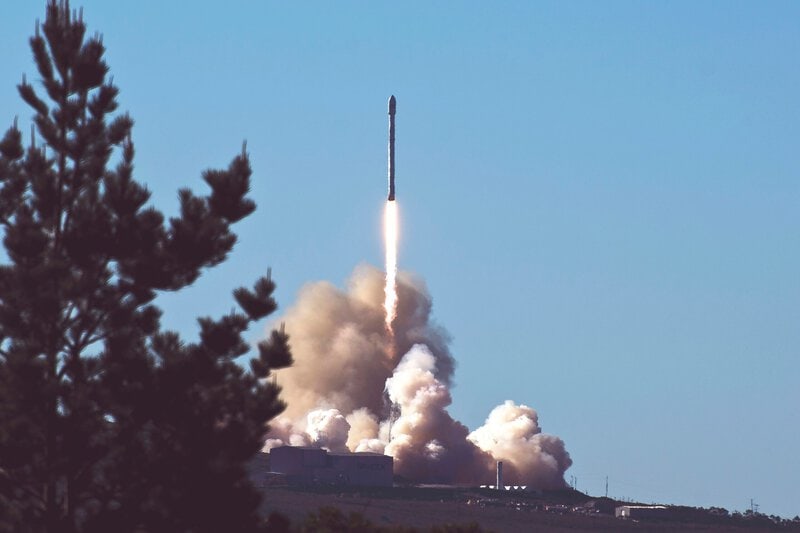
The Falcon 9 is a two-stage rocket. The first stage handles the initial two minutes of powered flight through the dense lower atmosphere, producing the roaring column of fire most people associate with launches. The second stage takes over at higher altitudes, burning liquid oxygen and RP-1 kerosene propellant above 50 miles — and it is there that the atmosphere behaves in ways that make rocket exhaust visible for hundreds of miles.
At sea level, atmospheric pressure is roughly 14.7 pounds per square inch. Above 80 kilometers — about 50 miles — pressure drops to less than one-thousandth of that value. In that near-vacuum, exhaust gases streaming from the second-stage engine have almost nothing pushing back against them. Rather than being confined to a narrow jet, they expand outward in every direction simultaneously, following the kinetic behavior of gases in low-pressure environments.
As those molecules expand and cool, ones energized by combustion release stored energy as light before recombining into stable compounds. This process is called chemiluminescence — light produced by a chemical reaction rather than by heat alone. The result is a slowly inflating luminous cloud that can grow to diameters exceeding 100 miles within minutes of engine cutoff, according to documentation from NASA’s Marshall Space Flight Center.
The color of that cloud is not arbitrary. Hydroxyl radicals — fragments of water molecules, written chemically as OH — emit in the blue-white range. Carbon-based molecular fragments produce warmer orange and red tones at the plume’s outer edges. The visible gradient maps directly to the chemical composition and temperature structure of the expanding gas cloud.
One critical geometric requirement links all of these phenomena: the rocket must be flying through sunlit upper atmosphere while observers on the ground remain in darkness. Above roughly 80 to 100 miles, the atmosphere is thin enough that sunlight passes through almost unimpeded, illuminating exhaust plumes from above even long after sunset at ground level — the same geometry that makes the International Space Station visible as a bright moving point during twilight passes.
The Jellyfish, the Spiral, and What They Actually Are
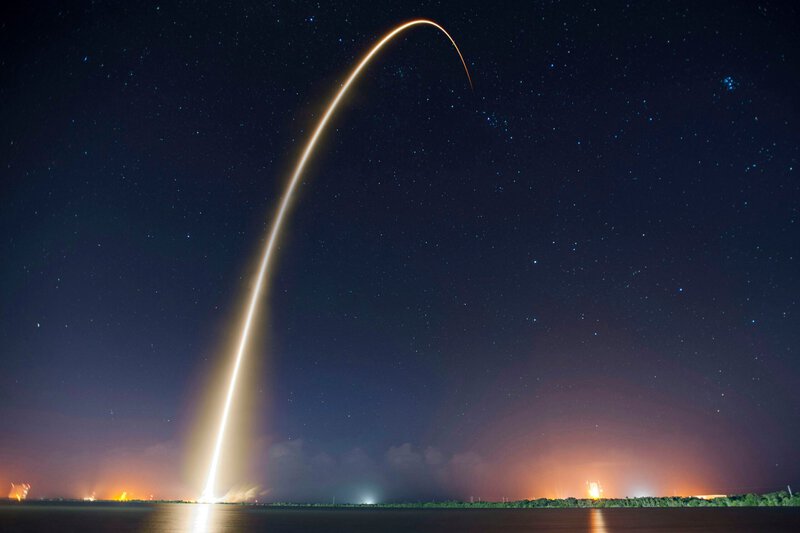
The expanding cloud shape observers most frequently describe — the so-called jellyfish plume — is a direct consequence of unconstrained gas expansion. In dense lower-atmosphere air, exhaust is compressed into a column. In near-vacuum, it balloons outward in a roughly spherical or oblate shape that, when viewed at an angle from the ground, resembles a jellyfish or a slow-motion aurora.
A related but distinct phenomenon — the rocket spiral — is less common and even more visually striking. It occurs when a slowly rotating upper stage vents residual propellant after engine cutoff. Because the stage is tumbling while the vented gas expands, the cloud traces a corkscrew pattern across the sky. The University of Alaska Fairbanks Geophysical Institute has documented multiple such events correlated with SpaceX second-stage deorbit burns over Alaska, and similar spirals have appeared over New Zealand and Europe following other rocket operations.
A clarification worth making: the word “plasma” appears frequently in social media descriptions of these glows, and while it sounds precise, it is technically inaccurate for most of what observers see. True plasma requires ionization — electrons stripped entirely from their parent atoms. The light from most upper-atmosphere exhaust plumes is more accurately described as chemiluminescent emission, arising from excited but not fully ionized molecules. Some ionization does occur very close to the nozzle exit, but the dramatic expanding cloud visible from the ground is predominantly chemiluminescent in character.
How Cape Canaveral’s Geography Shapes the Show
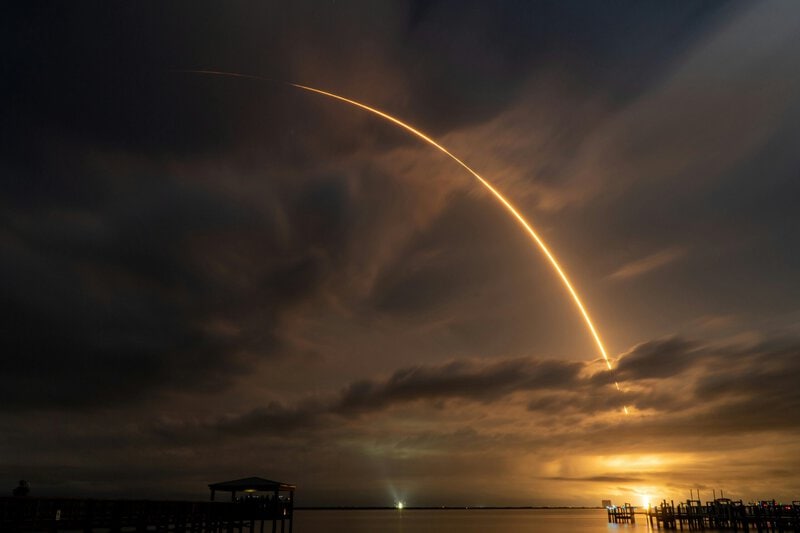
Cape Canaveral’s location shapes the optical display in specific ways. Rockets ascending from Launch Complex 40 pass through layers of marine humidity in the lower troposphere before entering the drier, thinner air of the stratosphere and mesosphere. That layering affects how quickly the exhaust plume becomes visible and how rapidly it disperses once it reaches the upper atmosphere.
The National Weather Service’s Melbourne, Florida office routinely provides SpaceX and other launch operators with upper-level wind data gathered from radiosonde balloon soundings, because high-altitude wind shear can tilt and stretch a plume in ways that substantially alter its shape on the ground. Calm upper-level air allows expansion in a near-perfect sphere; strong wind shear can elongate the cloud into a comet-like streak or twist it into unexpected forms.
Florida’s flat terrain and relatively sparse light pollution to the south and west of the Space Coast make Cape Canaveral launches among the most widely observable in the continental United States. Florida Today reported the SXM-11 launch as visible across a wide geographic range, consistent with the atmospheric conditions present that night.
What Scientists Are Still Working Out
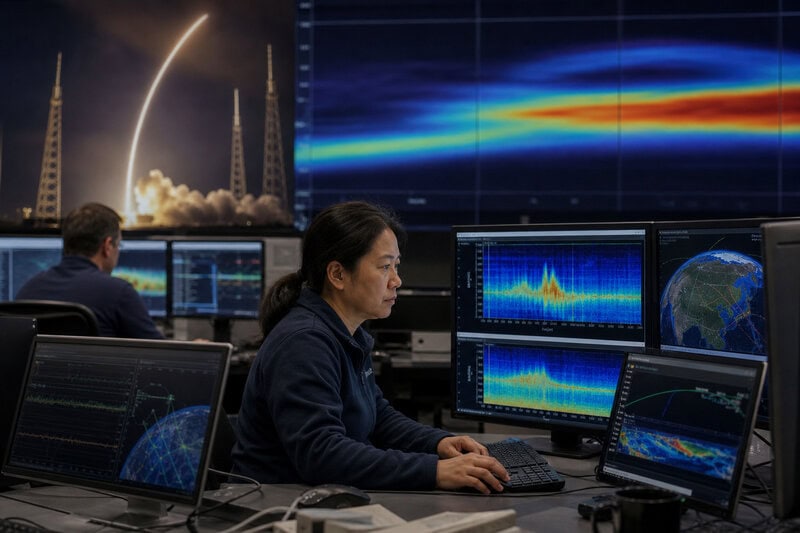
Not everything about rocket launch glows is settled. Researchers at the Naval Research Laboratory have published findings suggesting that heavy rocket launches can produce measurable disturbances in the ionosphere — the electrically charged atmospheric layer beginning around 60 miles altitude — but the scale and persistence of these effects from commercial launches remain an area of active study rather than established consensus.
A 2022 paper published in Geophysical Research Letters found that large hydrazine-fueled rockets produce more persistent chemiluminescent trails than kerosene-oxygen rockets like the Falcon 9, suggesting that propellant chemistry meaningfully shapes what observers see. The authors noted, however, that their dataset covered fewer than 30 launch events — a caution against broad generalizations.
A further unresolved question involves the relative contribution of soot versus reactive gas molecules to the orange color in kerosene-fueled plumes. The Falcon 9’s RP-1 combustion produces fine carbon particles, and some optical scientists argue that scattering of ambient sunlight by those soot particles accounts for a meaningful portion of the visible orange hue — more than molecular emission alone would produce. The precise apportionment remains unquantified in the published literature.
SpaceX does not publicly release telemetry data on second-stage exhaust composition or plume altitude at engine cutoff, which limits independent scientific characterization of Falcon 9-specific phenomena — a gap several atmospheric scientists have flagged. Much of what researchers currently know about Falcon 9 upper-atmosphere behavior is inferred from ground-based optical observations rather than direct measurement.
What to Watch for at the Next Night Launch
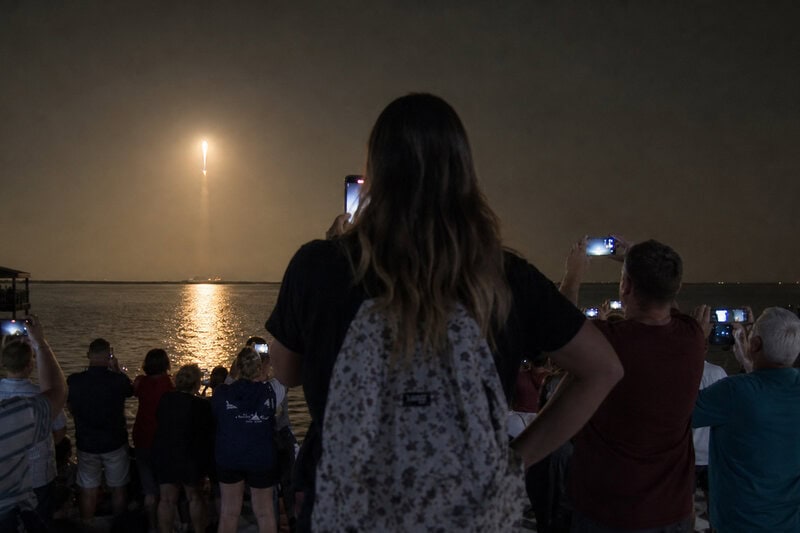
Spaceflight Now maintains a regularly updated launch schedule that includes upcoming missions from Cape Canaveral. For anyone positioned within viewing range of a future night launch, knowing when and where to look significantly improves the experience.
- T+4 to T+9 minutes: The most dramatic plume effects typically appear in this window, when the Falcon 9 second stage is burning at altitudes between 50 and 120 miles. Watch for the exhaust to shift from a tight bright streak to a diffuse, slowly expanding luminous cloud.
- A sudden brightening followed by a spreading circular glow usually marks second-stage main engine cutoff, when the abrupt halt of combustion allows pressurized exhaust to expand rapidly into the surrounding near-vacuum.
- Binoculars or a basic telephoto lens will resolve structural detail invisible to the naked eye — concentric rings of differing color correspond to temperature and chemical gradients within the expanding gas cloud.
- Face east and look high for launches from Cape Canaveral headed to geostationary transfer orbit. The second stage travels roughly northeast to east as it builds orbital velocity, and the plume will appear above and ahead of the rocket’s ground track.
SiriusXM’s constellation refresh program suggests additional launches are likely in coming years, each carrying a similar payload profile and each offering another opportunity to observe — and better understand — the chemistry and physics that briefly turn a rocket exhaust trail into something that looks, from the ground, like a temporary aurora painted across the edge of space.