
On the morning of August 11, 2026, a Falcon 9 rocket lifted off from Space Launch Complex 4E at Vandenberg Space Force Base, California, at 9:35 a.m. local time (12:35 p.m. EDT), carrying 24 Starlink satellites into low Earth orbit. The launch was operationally routine — booster ignition, stage separation, recovery, deployment — yet it arrives at a moment when the cumulative weight of these routine events is drawing sustained scrutiny from astronomers, regulators, and cultural communities worldwide. With the active Starlink constellation now exceeding 7,000 spacecraft, the scientific and policy questions surrounding large satellite constellations have moved well past theoretical concern.
The Mission and What Comes Next
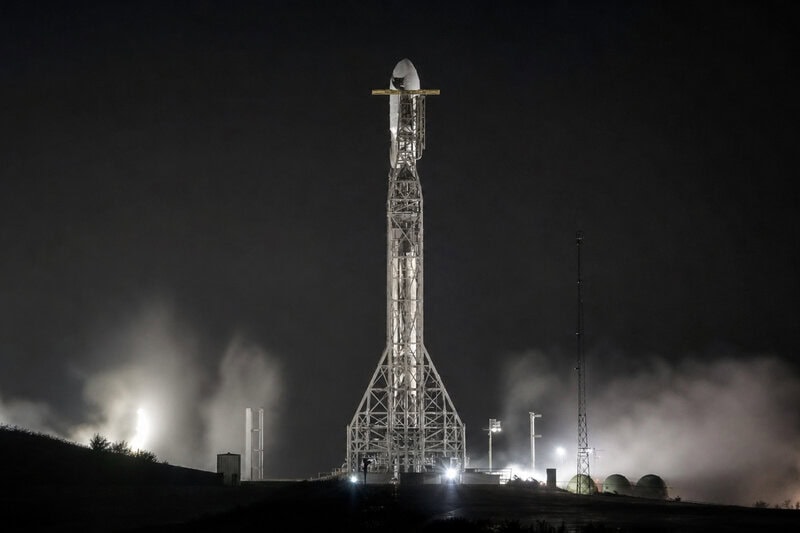
The mission, designated Starlink Group 17-38, was confirmed by Spaceflight Now’s live coverage and is listed on SpaceX’s launch manifest, which shows two additional Starlink missions scheduled within days: another Falcon 9 from SLC-4E on August 18, and a third from SLC-40 in Florida on August 20. That cadence — multiple constellation-expansion missions per month, sustained over years — is the defining feature of the Starlink program. Space.com’s mission coverage provides additional technical detail on the flight profile and booster recovery aboard the drone ship Of Course I Still Love You.
Each individual launch is an engineering achievement — a reusable first stage flying again, a payload of flat-panel internet-relay satellites deploying nominally. Collectively, they are reshaping one of humanity’s oldest shared resources: the night sky.
Why Low Earth Orbit Satellites Are Visible at Night
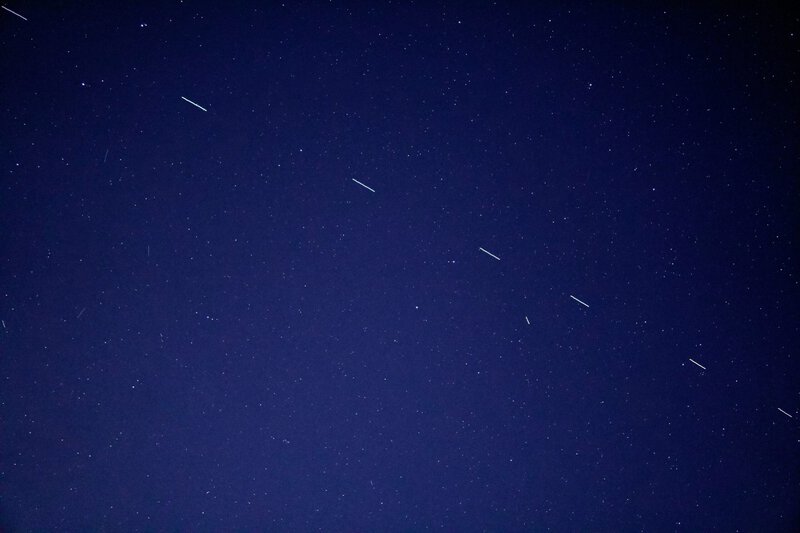
Starlink satellites operate at altitudes of roughly 340 to 570 kilometers — close enough that sunlight reflected off their flat-panel bodies and solar arrays reaches the ground well after local sunset, a phenomenon astronomers call a satellite glint. A glint occurs when a spacecraft briefly acts as a mirror, catching direct sunlight that has already passed below the horizon for ground-based observers. Geostationary communications satellites, parked at 35,786 kilometers, spend most of the night inside Earth’s shadow and are rarely visible. LEO satellites are sunlit for a far larger fraction of the night, particularly in summer at mid-latitudes when astronomical twilight is prolonged.
The practical effect is familiar to anyone who has watched a freshly launched Starlink train: a string of 20 to 30 bright points moving in close formation, each crossing the field of view of a wide-field telescope in seconds. SpaceX introduced VisorSat sunshades on earlier satellite batches and subsequently shifted to dark anodized coatings on newer hardware, both intended to reduce reflectivity. The American Astronomical Society’s Satellite Constellation Impact Mitigation Working Group acknowledged measurable brightness reductions from these changes but noted a fundamental arithmetic problem: sheer numbers offset per-unit improvements. Sky brightness from a satellite constellation is a function of both albedo and quantity. Dimming each satellite by a factor of five while multiplying the fleet tenfold produces a net increase in integrated light reaching the ground.
What Peer-Reviewed Science Has Established
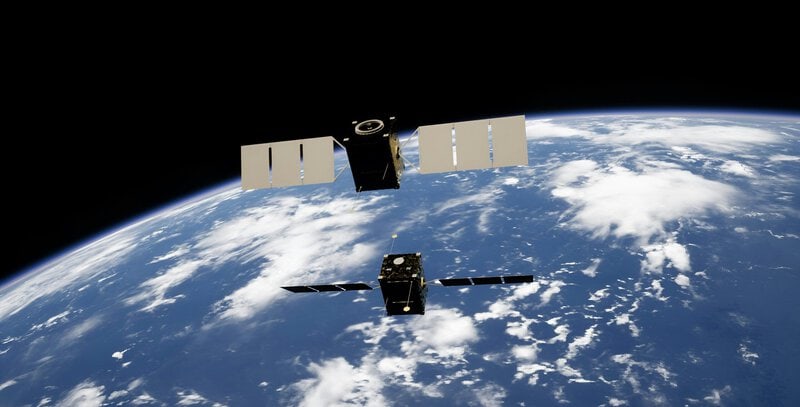
The evidence base on satellite constellation interference has expanded rapidly since 2020, and researchers are careful to distinguish between well-established findings and those requiring longer observational baselines.
On the optical side, a 2023 study published in Nature Astronomy by Fabio Falchi and colleagues at the Light Pollution Science and Technology Institute found that artificial luminance of the night sky has increased by roughly 10 percent per year globally since 2011, with satellite constellations identified as an emerging contributor alongside ground-based light sources. Separately, research led by Miroslav Kocifaj of the Slovak Academy of Sciences, published in Monthly Notices of the Royal Astronomical Society in 2021, modeled cumulative scatter from large satellite constellations and concluded that even satellites too faint to see individually contribute to a diffuse skyglow. The authors described this finding as preliminary, requiring longer observational records to confirm at scale — an honest acknowledgment of uncertainty characteristic of responsible work in this field.
The most comprehensive institutional assessment is the NOIRLab and SKAO joint report, Dark and Quiet Skies for Science and Society, published through the United Nations Office for Outer Space Affairs in 2021. It concluded that constellations of 400 or more satellites in LEO pose a significant risk to wide-field optical surveys and identified the Vera C. Rubin Observatory’s Legacy Survey of Space and Time as particularly vulnerable. The report’s consensus is not that professional astronomy is ruined, but that mitigation is urgently necessary and only partially achieved, and that some researchers argue adaptive software masking can recover most affected data frames.
The Rubin Observatory: A Concrete Case Study
The Vera C. Rubin Observatory in Chile — designed to image the entire southern sky every few nights with a 3.2-gigapixel camera — represents the most studied example of established satellite interference with next-generation science. A 2020 simulation by Hainaut and Williams of the European Southern Observatory, published in Astronomy & Astrophysics, estimated that with a 48,000-satellite Starlink constellation, up to 30 percent of Rubin’s twilight images could contain at least one satellite trail. That figure is not a catastrophe projection; it is a specific, peer-reviewed, modeled estimate for a defined scenario.
Rubin’s mitigation strategy relies heavily on software developed partly in collaboration with SpaceX — algorithms that identify and mask streaked pixels before science data is processed. However, astronomer Tony Tyson of the University of California, Davis, Rubin’s chief scientist, has publicly stated that software masking alone cannot fully recover lost photons in heavily affected exposures. Once a bright streak saturates pixels on a detector, the underlying astronomical signal in those pixels is unrecoverable. The Rubin case is valuable precisely because it moves the debate from hypothetical to measured and modeled.
Radio Astronomy: A Separate and Equally Real Problem
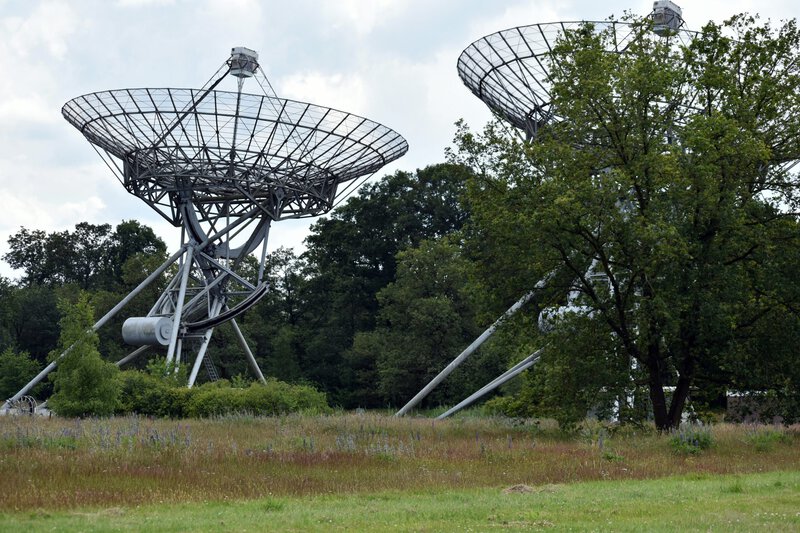
While satellite streaks in optical images attract the most public attention, radio astronomers have documented a distinct category of interference. A 2020 paper by Bassa and colleagues, published in Astronomy & Astrophysics, reported that the Low-Frequency Array (LOFAR) in the Netherlands detected unintended electromagnetic emissions from early Starlink satellites at frequencies used for radio astronomy, with signal strengths measured well above thresholds set by the International Telecommunication Union. SpaceX subsequently worked with the U.S. National Science Foundation to adjust satellite firmware. The National Radio Astronomy Observatory stated in 2023 that improvements had been made but that monitoring was ongoing — placing this issue in the category of active regulatory negotiation rather than resolved problem.
The Square Kilometre Array, under construction in South Africa and Australia and expected to become the world’s most sensitive radio telescope, has flagged Starlink and competing constellations as the primary anthropogenic radio-frequency interference risk in its planning documentation.
Amateur Observers, Indigenous Communities, and the Cultural Dimension

Professional observatories have institutional resources — engineering teams, software developers, and direct communication channels with satellite operators. Amateur astronomers and Indigenous communities have none of these, a disparity that the International Astronomical Union’s Centre for the Protection of the Dark and Quiet Sky from Satellite Constellation Interference, established in 2022, has highlighted as a significant gap in both research attention and policy response.
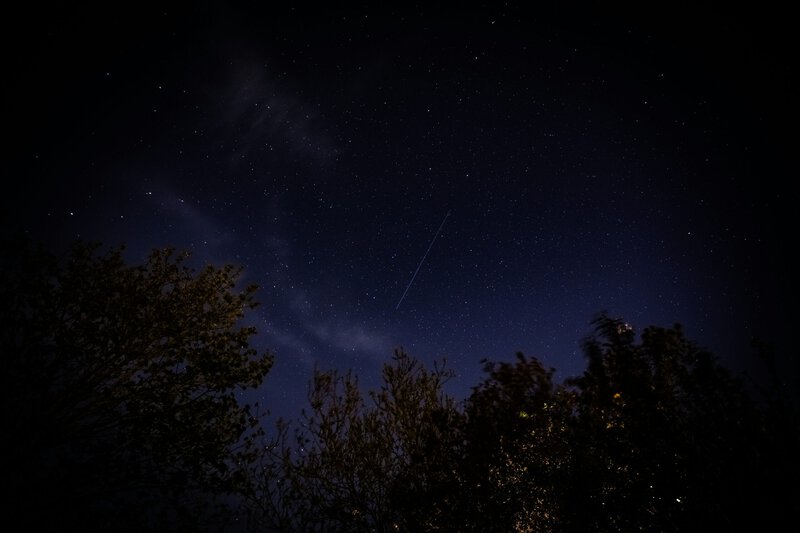
A 2023 IAU CPS survey found that satellite trails are now visible to naked-eye observers during twilight windows with increasing frequency, with mid-latitude observers during summer months facing the highest exposure. For many Indigenous traditions, the night sky carries navigational, ceremonial, and cosmological significance accumulated over millennia. Researchers including Duane Hamacher of the University of Melbourne have argued that satellite light pollution constitutes harm to living cultural practices, though this framing has not yet entered formal regulatory frameworks anywhere in the world.
Regulation, Voluntary Cooperation, and the Path Forward
No binding international regulation currently governs satellite brightness or orbital density in low Earth orbit. The ITU allocates radio spectrum and orbital slots but has no enforceable optical brightness standard. Mitigation depends entirely on voluntary agreements between individual operators and observatories — a structure that functions imperfectly when one operator cooperates and breaks down when the broader industry does not follow.
The FCC approved SpaceX’s license for up to 12,000 Starlink satellites in 2018 and subsequently considered a second-generation constellation of up to 30,000. Competing systems from Amazon’s Project Kuiper, OneWeb, and China’s Guowang constellation would add tens of thousands of additional spacecraft, meaning no single operator’s mitigation efforts can address the cumulative impact. Jonathan McDowell of the Harvard-Smithsonian Center for Astrophysics has proposed an international dark-sky treaty modeled on Antarctic environmental protections, though no formal diplomatic process toward such an agreement had been initiated as of mid-2026.
The Starlink Group 17-38 launch on August 11, and the two missions scheduled within the same month, are individually unremarkable in the rhythm of commercial spaceflight. Collectively, they represent incremental steps in a cumulative process that the available science describes clearly: the night sky is measurably changing, the tools to observe that change exist, and the regulatory architecture to manage it does not yet. The science does not say the outcome is fixed. It does say the window for deliberate decision-making is narrowing with each launch.