
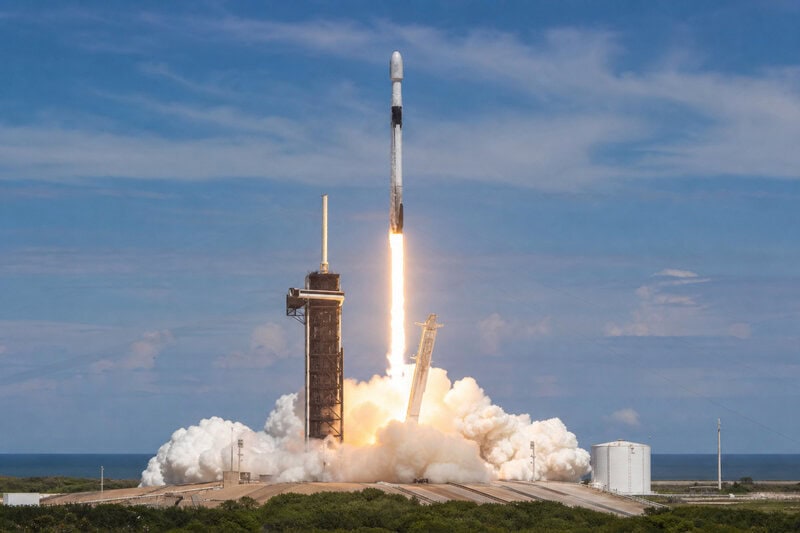
At 10:25 PM Eastern on June 28, a Falcon 9 rocket ignited on Florida’s Space Coast and within roughly 32 minutes had deposited SXM-11 — a SiriusXM satellite weighing approximately 15,000 pounds and roughly the size of a city bus — into space, beginning a days-long climb to an altitude where orbital mechanics, not rocket engines, would keep it aloft for the next decade and a half.
The Hardest Standard Destination in Commercial Spaceflight
Geostationary orbit, universally abbreviated as GEO, sits at precisely 22,236 miles above the equator. At that altitude, a satellite’s orbital period exactly matches Earth’s 24-hour rotation, making the spacecraft appear completely motionless from the ground. Reaching GEO requires more energy per pound than any other operational orbit in routine commercial use — more than low Earth orbit, more than medium Earth orbit, and more energy per mile than some trajectories to the Moon. That single fact explains nearly every engineering decision made on the night of June 28.
The Falcon 9 carrying SXM-11 to geosynchronous orbit from Florida’s Space Coast executed what engineers in the launch industry call one of the hardest standard mission profiles in the business. Understanding why requires following the satellite through three distinct phases: the violent eight-minute ascent through Earth’s atmosphere, the long elliptical climb through a transfer orbit, and the precise circularization burn that finally parks SXM-11 in its permanent slot.
Why SiriusXM Needs Geostationary Orbit and Nothing Else
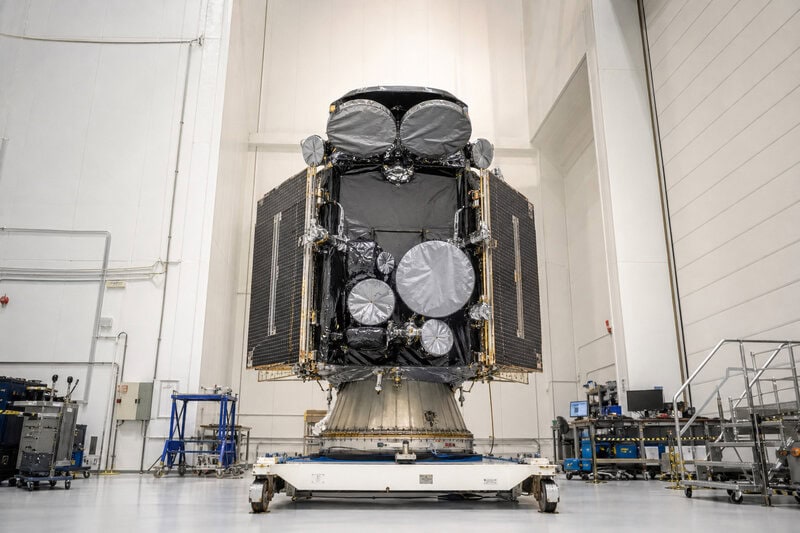
SXM-11 is the 12th high-powered digital audio radio satellite built by Lanteris Space for SiriusXM, designed to deliver continuous satellite radio service to tens of millions of subscribers across North America. The engineering requirement is absolute: the satellite’s signal must be receivable by a small, fixed antenna mounted in a car or on a house. That is only possible if the satellite never appears to drift across the sky. A satellite in low Earth orbit moves visibly across the sky in minutes; a satellite in GEO appears stationary by comparison.
Large geostationary satellites typically range from roughly 6,000 to 15,000 pounds at launch, and SXM-11, at approximately 15,000 pounds, sits at the heavy end of that range. A substantial fraction of that mass is propellant the satellite will burn over its own operational lifetime, not propellant the rocket carries. The satellite arrives at GEO already fueled for roughly 15 years of self-maintenance.
One distinction is worth establishing clearly: geosynchronous orbit and geostationary orbit are frequently used interchangeably but are technically different. Geosynchronous means any orbit with a 24-hour period, including inclined orbits that trace a figure-eight pattern over Earth’s surface. Geostationary specifically means a circular, equatorial, 24-hour orbit — the operationally useful subset. SXM-11 is headed for the latter.
Phase One — Eight Minutes to Space: The Physics of Ascent
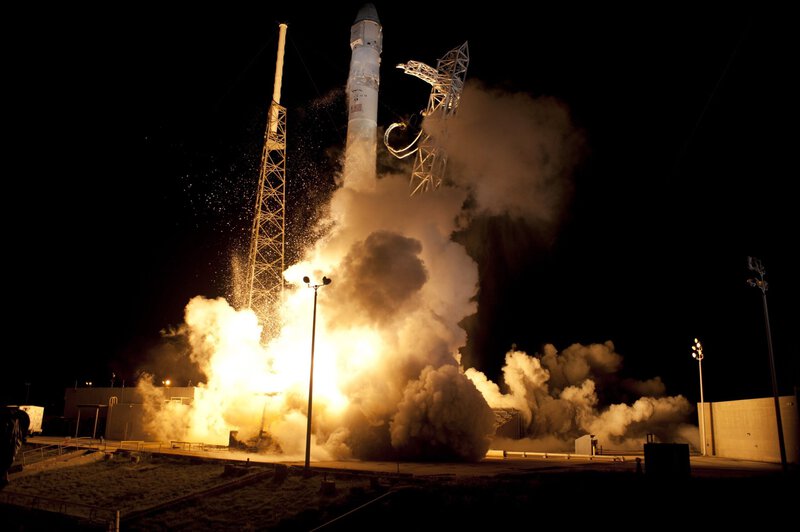
The Falcon 9’s nine Merlin engines produce approximately 1.7 million pounds of thrust at liftoff — more than eleven times SXM-11’s own weight. That ratio is not accidental. To escape Earth’s lower atmosphere efficiently, a rocket must accelerate quickly through the densest, most drag-laden portion of flight while simultaneously tipping toward the horizon rather than climbing straight up. This trajectory, called a gravity turn, is the most fuel-efficient ascent path available: the rocket uses gravity itself to arc downrange, minimizing energy wasted fighting drag at high angles of attack.
Approximately 80 seconds into flight, the vehicle passes through Max-Q — the moment of maximum aerodynamic pressure on the rocket’s structure. At this point, dynamic forces on Falcon 9’s airframe peak, and SpaceX’s standard procedure is to throttle the Merlin engines back slightly to reduce structural loads before throttling back up once the atmosphere thins. It is the most mechanically stressful instant of any launch, and it lasts only seconds.
Stage separation occurs roughly 2.5 minutes into flight. The nine first-stage engines shut down, the two stages physically separate, and the second stage’s single Merlin Vacuum engine — optimized for the near-vacuum of high altitude with a much larger nozzle — ignites to continue the climb. Meanwhile, the first stage begins its autonomous return sequence: a flip maneuver, a boostback burn to reverse course, a reentry burn to manage heating, and a final landing burn timed to milliseconds. SpaceX successfully deployed SXM-11 and confirmed a clean booster landing — the 17th flight for that particular first stage, a milestone that would have been considered implausible in commercial spaceflight a decade ago.
The second stage burns for approximately six minutes, first achieving a low preliminary parking orbit and then, after a coast phase, reigniting to inject SXM-11 into a geostationary transfer orbit, abbreviated GTO. Separation from the second stage is where the rocket’s job formally ends and the satellite’s begins.
The Transfer Orbit: Why You Cannot Simply Fly to 22,236 Miles
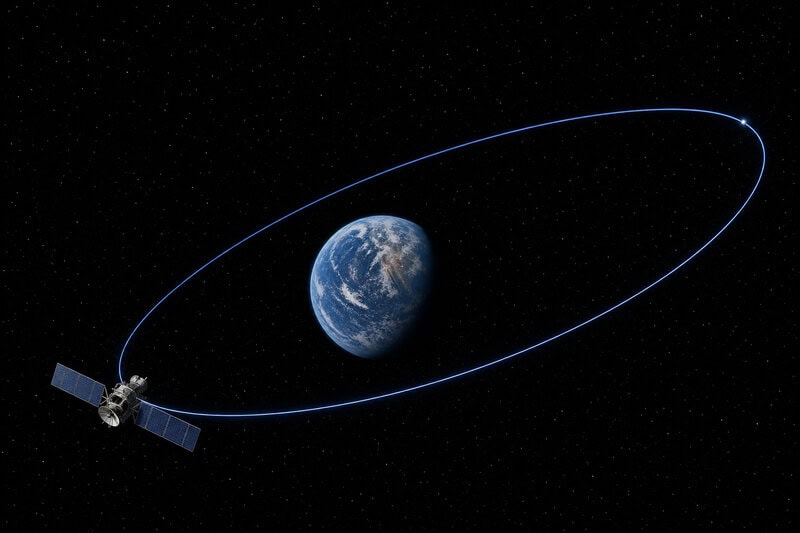
Geostationary transfer orbit is an elongated ellipse — technically a Hohmann transfer orbit — with its low point, called perigee, near Earth and its high point, called apogee, near the target GEO altitude. It remains the standard pathway to GEO for one reason: it is the most energy-efficient route from a low parking orbit to a high circular one.
The underlying physics come from Kepler’s laws of planetary motion. The counterintuitive reality is this: to move to a higher orbit, a spacecraft must accelerate — yet a satellite in GEO travels at only about 6,879 miles per hour, far slower than the roughly 17,500 mph of a satellite in low Earth orbit. The satellite is not moving faster; it is moving in a much larger circle, and the geometry of that larger circle happens to match Earth’s rotation rate exactly.
The total energy cost of reaching GEO from Earth’s surface, measured in delta-v — the change in velocity a spacecraft must accumulate — is approximately 8,900 meters per second. Reaching low Earth orbit requires roughly 7,800 meters per second. That means the additional 22,000 miles from low orbit to GEO costs nearly as much energy as getting off the ground in the first place, which is precisely why geostationary orbit is considered the most demanding routine destination in commercial spaceflight.
Once SXM-11 separates from Falcon 9, the satellite’s own onboard propulsion system must perform what engineers call the apogee kick burn — a thruster firing at the highest point of the transfer ellipse to circularize the orbit at GEO altitude. Depending on the propulsion architecture chosen, chemical thrusters deliver this burn in hours while electric ion thrusters take days to weeks but consume less propellant. The satellite essentially finishes its own journey to GEO under its own power, long after the rocket has returned to Earth.
What Keeps SXM-11 There: The Ongoing Physics of Station-Keeping
Arriving at GEO is not the end of the physics problem — it is the beginning of a 15-year negotiation with perturbations. Earth’s gravitational field is not perfectly uniform; uneven mass distribution in the planet’s interior causes satellites to drift slowly from their assigned orbital slots. Lunar and solar gravity add additional tugs. Radiation pressure from sunlight — which exerts a real, measurable force on large satellite surfaces — compounds the effect.
To counteract these forces, GEO satellites perform regular station-keeping maneuvers: small thruster firings several times per week. Collectively, these maneuvers consume the majority of the propellant a satellite carries at launch. The operational lifetime of a GEO satellite is therefore not limited by hardware wear in the traditional sense but by propellant supply — which is why the industry standard design life of roughly 15 years is a propellant budget, not an arbitrary deadline.
At end of life, guidelines established by the Inter-Agency Space Debris Coordination Committee require GEO operators to boost their satellites roughly 200 to 300 kilometers higher into what the industry calls a graveyard orbit — a disposal zone above the valuable GEO belt where defunct satellites can drift without threatening operational spacecraft. SXM-11’s 15,000-pound launch mass will shrink considerably over its lifetime as propellant is expended, illustrating how satellite economics and orbital physics are inseparable from propulsion choices made years before a rocket ever leaves the pad.
The Booster’s 17th Flight and What Reusability Actually Changes
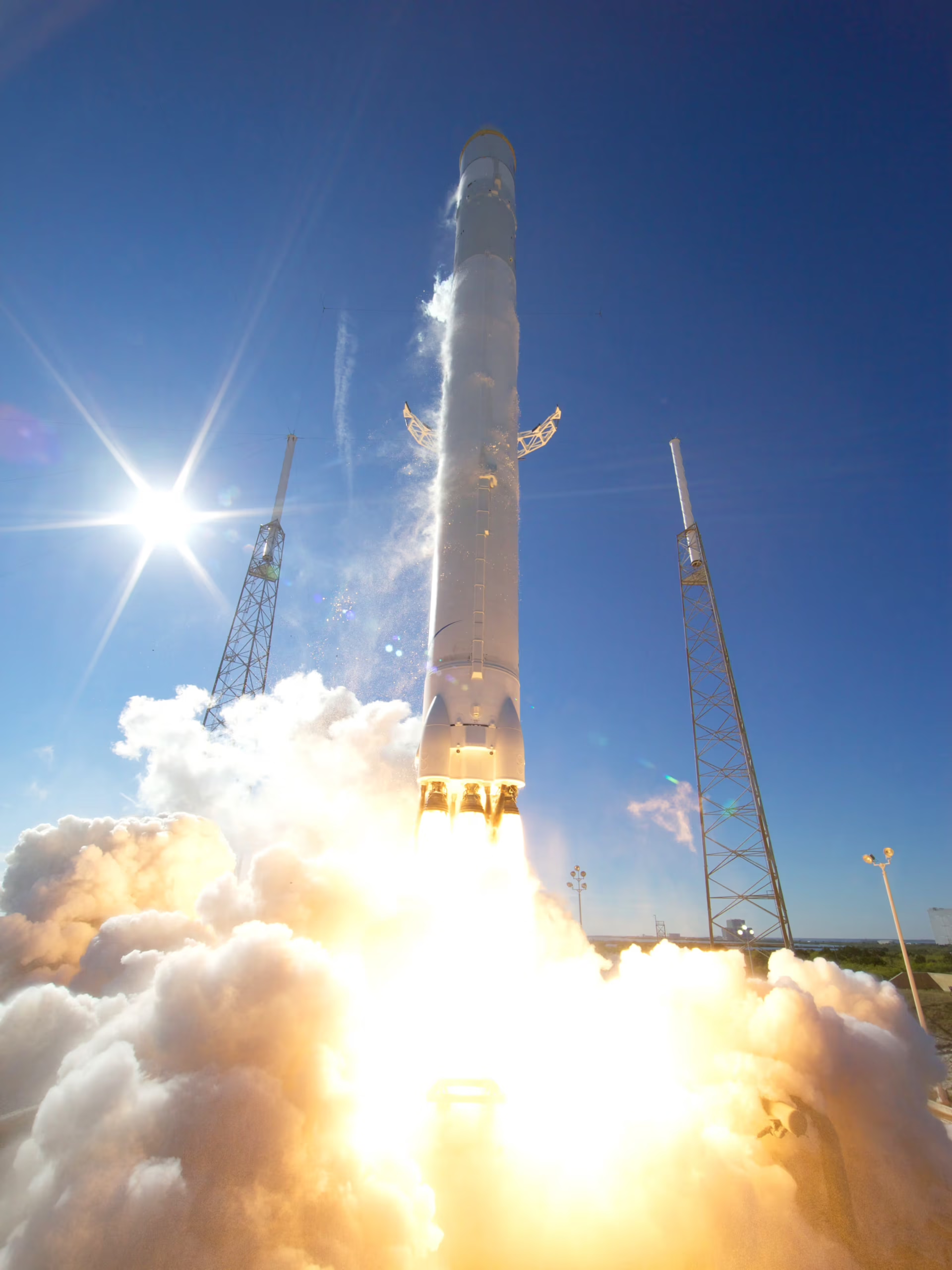
The physics of landing a rocket booster are entirely distinct from the physics of launch. The returning Falcon 9 first stage must decelerate from several times the speed of sound to near-zero velocity using only its engines — no parachutes on the main structure — guided by real-time algorithms solving a minimum-fuel powered descent problem, a variant of classical optimal control theory. The June 28 landing was confirmed successful, marking the 17th successful flight and recovery of that particular booster.
The economic consequence is direct. A new Falcon 9 first stage costs an estimated $30 to $35 million to manufacture. Flying a single booster 17 times amortizes that manufacturing cost across 17 missions, dramatically reducing the per-mission cost of reaching GEO. Independent analyses have estimated that SpaceX’s reusable architecture has reduced the cost of GEO launch by roughly 30 to 50 percent compared to the expendable rockets that dominated the market in the 2000s — a cost reduction that makes a satellite like SXM-11 commercially viable to build and launch on a regular replacement cycle.
What SXM-11 Reveals About Where Commercial Spaceflight Stands
The successful deployment of SXM-11 fits within a larger hardware refresh cycle in the GEO communications market. Operators are replacing aging satellites with higher-powered digital platforms capable of serving more users at better signal quality, and they are doing so with greater regularity and predictability than at any previous point in the industry’s history. Falcon 9 has become the dominant launch vehicle for commercial GEO payloads globally, a position reinforced by each successful mission.
It is worth being precise about what the SXM-11 launch represents and what it does not. This was a well-executed instance of mature, established technology — not an experimental mission or a technological breakthrough. The orbital mechanics involved have been understood since the mid-twentieth century. The genuine frontiers in GEO satellite technology lie elsewhere: in electric propulsion efficiency, on-orbit servicing and refueling, and software-defined radio payloads that can be reprogrammed from the ground after launch to serve different frequency bands and markets.
What SXM-11’s successful deployment demonstrates — clearly and without overstatement — is how reliable commercial spaceflight to the most demanding standard orbit has become. A 15,000-pound satellite is now orbiting 22,236 miles above Earth, held there by nothing more than the mathematics Kepler described four centuries ago and the propellant its engineers packed carefully into its tanks before it ever left the ground.