
Just 1.4 billion years after the Big Bang, a small, dense galaxy called MXDFz4.4 was already doing something extraordinary: blasting its surroundings with enough ultraviolet radiation to convert the opaque hydrogen fog of the early universe into the transparent cosmic medium that light — and eventually life — depends on. NASA’s Hubble Space Telescope has now captured the clearest visible-light images yet of the stellar machinery driving that transformation, giving astronomers their most direct look at what cosmic dawn actually looked like from the inside.
What Hubble Actually Saw Inside MXDFz4.4
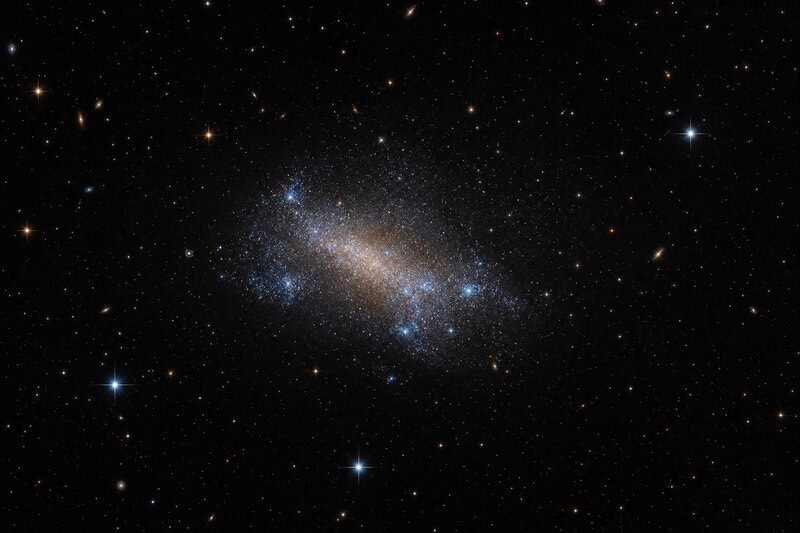
The new findings, published by the Space Telescope Science Institute as STScI news release 2026-014, center on something deceptively simple: a series of pictures. But the detail encoded in those visible-light images is anything but simple. Hubble resolved multiple distinct episodes of star formation within MXDFz4.4, revealing that the galaxy did not ignite in a single, uniform burst. Instead, it underwent several successive starbursts — successive waves of new stars, each amplifying the ionizing power of the last.
The tightly packed stellar clusters within MXDFz4.4 are central to what makes this galaxy so effective as a cosmic engine. High stellar density means that the ultraviolet photons produced by hot young stars have a shorter average path to travel before escaping the galaxy’s own gas clouds and reaching the surrounding intergalactic medium — the vast, diffuse material that fills the space between galaxies. According to the STScI research team, this compactness is not incidental; it is part of why MXDFz4.4 punched so far above its weight.
Astronomers were also able to map where gas had already been cleared inside and around the galaxy. These structurally open regions in the images correspond directly to the locations of the youngest, hottest stellar populations — a spatial match that links specific star-formation episodes to specific acts of gas clearance. That level of detail, attributing ionization to identifiable stellar events in a galaxy observed at such an early cosmic epoch, is what distinguishes these Hubble findings on early galaxy reionization from lower-resolution predecessors.
The Science Behind the Spectacle: Understanding Cosmic Reionization
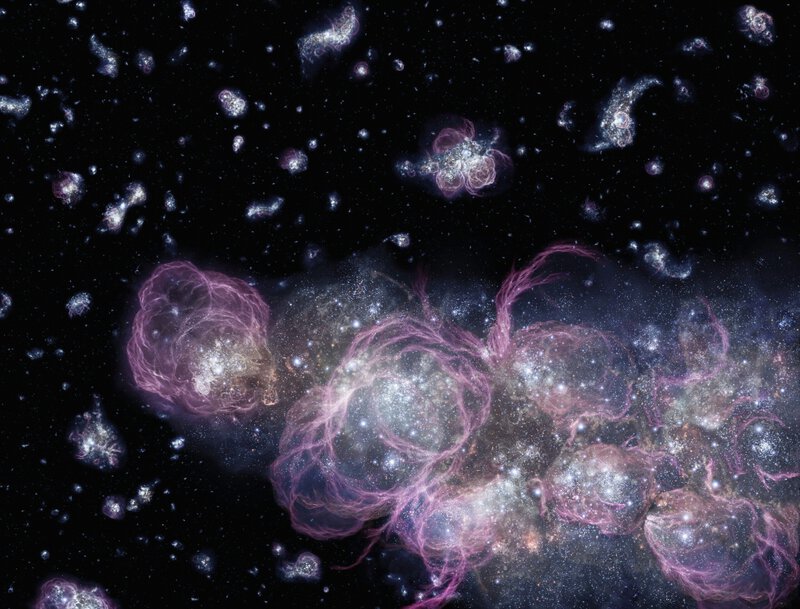
To appreciate why MXDFz4.4 matters, it helps to understand the problem it helps solve. Reionization is the epoch during which ultraviolet light from the first stars and galaxies stripped electrons from neutral hydrogen atoms throughout the cosmos — converting a fog-like, opaque universe into one through which light could travel freely. Before reionization was complete, the intergalactic medium absorbed ultraviolet and visible light much as thick smoke obscures a distant fire. Reconstructing what cleared that fog is one of the central unsolved problems in observational cosmology.
MXDFz4.4’s episodic starbursts demonstrate a plausible and now observationally grounded mechanism. Intense, repeated episodes of star formation in a compact dwarf galaxy can produce a sufficient flux of ionizing photons — high-energy ultraviolet light capable of knocking electrons free from hydrogen atoms — to carve expanding bubbles of ionized, transparent gas around the host galaxy. Once those bubbles form and grow, they begin to overlap with bubbles from neighboring galaxies, eventually stitching together the transparent universe we inhabit today.
It is important to draw a clear line between what is established and what remains contested. Scientific consensus holds that reionization was largely complete by roughly one billion years after the Big Bang. What remains actively debated is the relative contribution of different source populations: small dwarf galaxies like MXDFz4.4, more massive and luminous galaxies, and quasars — the intensely bright cores of galaxies powered by accreting supermassive black holes. MXDFz4.4 strongly supports the case for dwarf starburst galaxies as major contributors, but the full accounting of ionizing sources is ongoing and contested. The STScI findings do not claim to have solved reionization; they offer a concrete, spatially resolved example of the process in action.
Meet MXDFz4.4: A Dwarf Galaxy With an Outsized Role
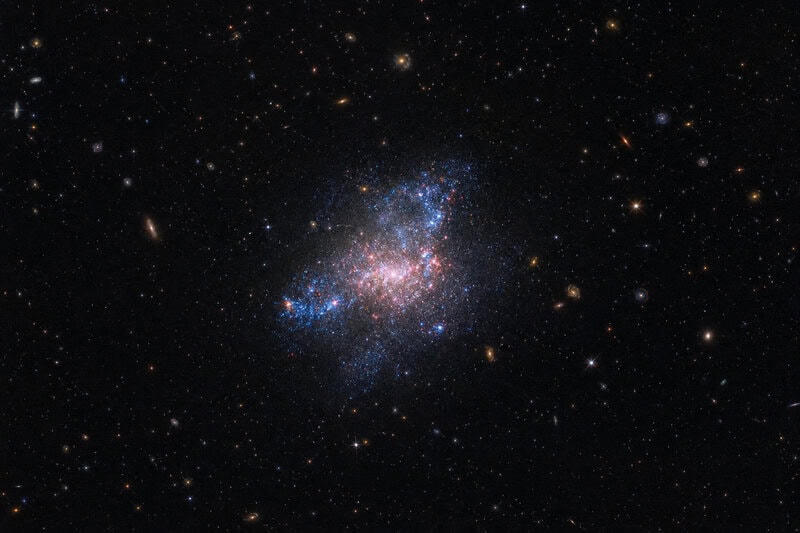
MXDFz4.4 is classified as a dwarf-like galaxy, meaning it contains far fewer stars and far less mass than the Milky Way. Its small stature makes its ionizing output all the more striking. Rather than steady, continuous growth, Hubble’s imaging shows the galaxy experienced a bursty, episodic star-formation history — a pattern increasingly reproduced in computer simulations of early low-mass galaxies. Each burst produced a fresh population of massive, short-lived stars that radiated intensely in the ultraviolet before exploding as supernovae, further disrupting surrounding gas and opening channels through which ionizing photons could escape.
The galaxy existed when the cosmos was only 1.4 billion years old, placing it squarely within what astronomers call the Epoch of Reionization — the period, roughly spanning the first billion years after the Big Bang, during which the universe transitioned from opaque to transparent. Within that window, astronomers studying early galaxy neighborhoods have long sought the specific sources responsible for driving that transition. MXDFz4.4 now stands as one of the best-characterized examples of such a source: a named, imaged, spatially mapped contributor to cosmic dawn.
Astronomers used MXDFz4.4 as a case study to demonstrate, with direct observational evidence, how a single galaxy of this type could transform the gas both inside itself and in its immediate cosmic neighborhood. The galaxy went from being an anonymous data point in statistical surveys to what will likely become a reference object — a well-documented benchmark that theoretical models of the early universe will need to reproduce.
Why Hubble Remains Irreplaceable for This Work
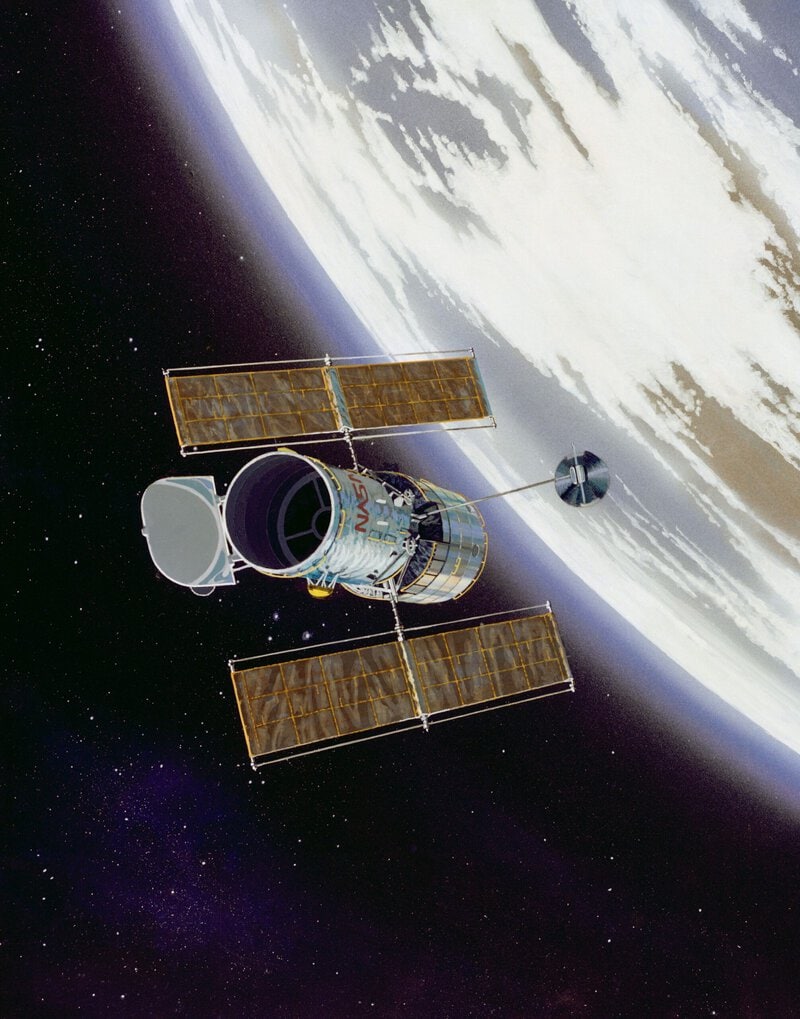
Hubble’s position above Earth’s atmosphere gives it a capability no ground-based telescope can match: clean, distortion-free imaging in ultraviolet and visible light. That capability is precisely what resolving the compact stellar clusters within MXDFz4.4 requires. The observations were made as part of deep-field legacy imaging that placed MXDFz4.4 in context against thousands of other early galaxies, providing the comparative backdrop needed to interpret its properties with confidence.
A common and reasonable question is how Hubble’s role compares to that of the James Webb Space Telescope, which has drawn significant attention for its infrared detections of extremely distant galaxies. The two observatories are complementary, not competitive. Webb excels at identifying the most distant galaxies through their redshifted infrared light and at characterizing chemical compositions. Hubble’s ultraviolet and visible-light capabilities remain essential for diagnosing stellar populations and mapping ionization structures — the specific evidence needed to understand the reionization mechanism at work in galaxies like MXDFz4.4. Together, they cover the electromagnetic windows required to reconstruct how the early universe transformed itself.
What This Changes — and What Remains Open
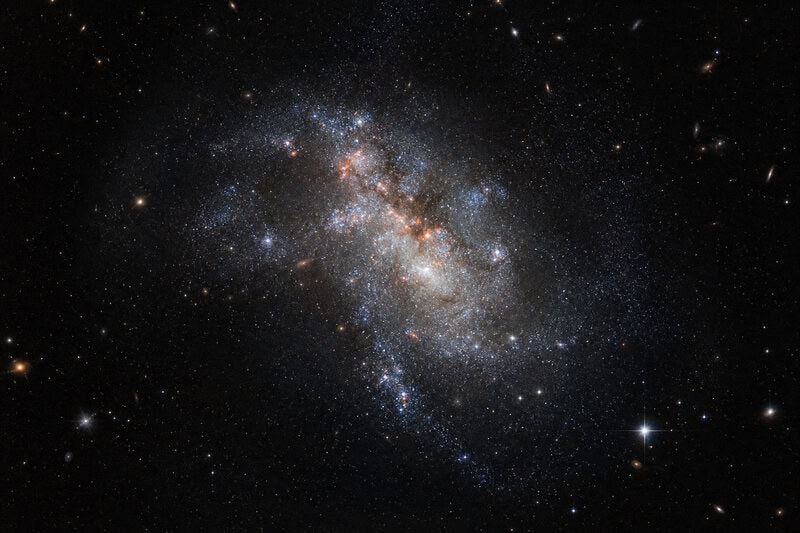
The STScI findings provide the most direct observational evidence to date that a dwarf starburst galaxy’s episodic star formation was sufficient to ionize its local intergalactic gas. This strengthens a hypothesis that has been gaining traction in the field: that small galaxies — not just the brightest quasars or the most massive galactic structures — were major architects of reionization. The spatial resolution of the evidence is what elevates this from plausible argument to concrete demonstration.
At the same time, MXDFz4.4 is a single data point, and the researchers are careful to say so. Extrapolating from one well-characterized galaxy to a universal conclusion requires statistically larger samples. Future Hubble and Webb surveys are expected to test whether the bursty, high-escape-fraction behavior documented here is typical of its class or an outlier. The efficiency with which ionizing photons escaped MXDFz4.4 — a quantity called the Lyman-continuum escape fraction — is a key variable that differs significantly from galaxy to galaxy, and understanding its distribution across early galaxy populations remains an open problem.
- Established: Reionization was largely complete by about one billion years after the Big Bang, and ultraviolet radiation from early stars and galaxies was its primary driver.
- Strongly supported by this study: Dwarf starburst galaxies with episodic star formation can produce sufficient ionizing photon flux to clear local intergalactic gas, contributing meaningfully to reionization.
- Actively debated: The precise relative contributions of dwarf galaxies, massive galaxies, and quasars to the total reionization budget remain unresolved and are a focus of ongoing observational campaigns.
The Bigger Picture: Why Cosmic Dawn Still Matters Now
Reionization is not merely a chapter in cosmic history. It set the physical conditions for everything that came after — every galaxy, star, planetary system, and ultimately every form of chemistry that depends on a universe through which light can freely travel. Understanding which sources drove that transition constrains models of structure formation, informs theories about dark matter’s behavior in the early universe, and shapes our understanding of the first generations of stars. The stakes of getting this right extend well beyond any single galaxy.
MXDFz4.4’s story also reframes how scientists think about small galaxies more broadly. Long considered too faint and too low-mass to matter much in cosmic history, dwarf starburst galaxies are now credible candidates for some of the most consequential events the universe has undergone. The STScI release of these Hubble findings marks a shift in how astronomers approach cosmic dawn — moving from statistical averages and theoretical models toward named, characterized, spatially resolved actors. The question is no longer only “how did reionization happen?” but increasingly “here is one galaxy that helped make it happen, and here is exactly how.”
As next-generation surveys extend the census of early galaxies, MXDFz4.4 is likely to serve as exactly that kind of reference object — a concrete example of what a reionizing source looked like, how its star formation unfolded in episodes, and what it did to the gas in its neighborhood at the universe’s most transformative hour. The full NASA account of the Hubble early galaxy discovery represents one of the clearest windows yet opened onto the moment the universe switched its lights on.