
Four decades after it first roared to life beneath Space Shuttle Columbia in 1981, the RS-25 rocket engine is once again at the center of American human spaceflight — this time as the propulsion core of NASA’s most powerful rocket ever built. That engineering continuity runs directly through a roughly 350-person facility in Mason, Ohio, where Aerojet Rocketdyne workers build and refine the engines NASA has publicly described as central to “so many of our most critical missions.”
The Engine That Refused to Retire
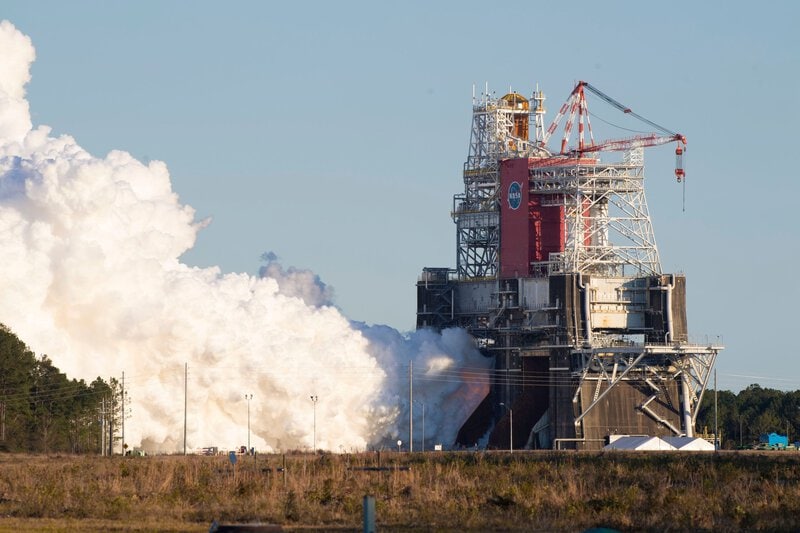
When NASA needed propulsion for the Space Launch System (SLS) — the heavy-lift rocket designed to carry astronauts back to the Moon under the Artemis program — engineers did not start from scratch. They returned to a design they already trusted. Each SLS core stage burns four RS-25 engines simultaneously, generating a combined 1.6 million pounds of thrust at liftoff, enough to push more than 5.75 million pounds of rocket and payload off the pad and onto a trajectory toward the Moon.
That institutional confidence in a mature design was underscored when NASA Administrator Jared Isaacman made a personal visit to the Mason facility. In aerospace circles, a sitting administrator traveling to a production site carries a clear signal: the agency regards what happens inside that building as strategically important, not incidental. Axios reported on Isaacman’s visit and NASA’s assessment of the Mason workforce’s mission-critical role, noting the agency’s explicit framing of Rocketdyne as a cornerstone of current and future exploration ambitions.
What the RS-25 Is — and Why Propulsion Engineers Keep Coming Back to It
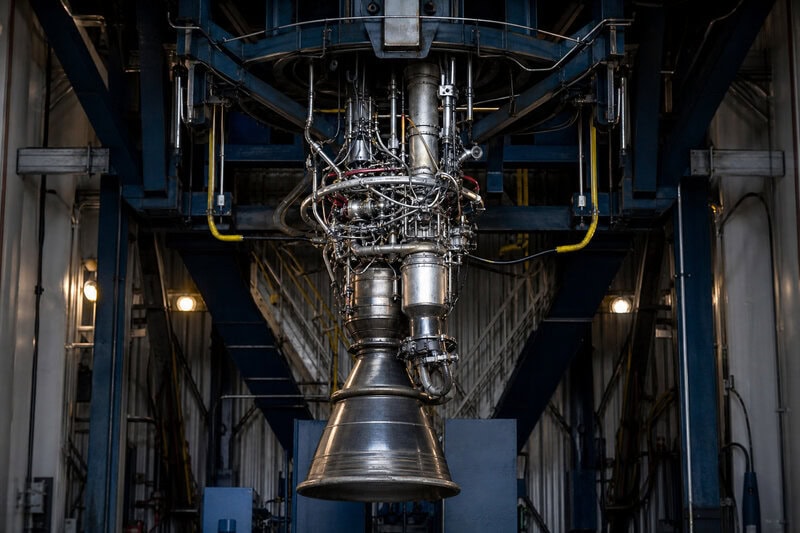
The RS-25 is formally classified as a staged-combustion, liquid-hydrogen/liquid-oxygen rocket engine. Among propulsion engineers, it holds a reputation as one of the most thermodynamically efficient chemical rocket engines ever flown. NASA program documentation credits it with a vacuum specific impulse of approximately 453 seconds — a figure that functions, conceptually, like miles-per-gallon for rocket engines, measuring how much thrust an engine extracts from each pound of propellant consumed per second.
Staged combustion is what makes that efficiency possible. Rather than igniting fuel and oxidizer in a single chamber, the engine first pre-burns a small portion of its propellant to drive high-speed turbopumps that force cryogenic liquids into the combustion chamber at enormous flow rates. The hot gas from that pre-burn then enters the main combustion chamber, where it contributes additional energy. The result is that almost none of the available energy in the propellant goes to waste — a thermodynamic achievement that simpler engine cycles, such as the gas-generator cycle used in many other rockets, cannot match.
Rocketdyne, now operating as part of Aerojet Rocketdyne (an L3Harris company), originally developed the RS-25 under NASA contract in the 1970s. The Mason facility became a key hub for production, refurbishment, and testing across both the Space Shuttle program and, later, SLS. One important distinction separates the two eras: during the Shuttle program, RS-25 engines were recovered after each flight, refurbished, and reflown. Under the current SLS architecture, the engines are expended — lost to the ocean — after each mission. NASA accepts this trade-off because SLS is not designed for booster recovery. Future production contracts include upgraded, cost-optimized controllers and components intended to reduce the per-unit price of engines built going forward.
How a Liquid Rocket Engine Actually Works

At its most fundamental level, a liquid-propellant rocket engine is a precisely controlled explosion. Liquid hydrogen and liquid oxygen are pumped into a combustion chamber, ignited, and the resulting superheated gas expands violently through a bell-shaped nozzle. By Newton’s third law — for every action, an equal and opposite reaction — gas expelled downward at high velocity pushes the rocket upward.
The engineering challenge lies in the extremes involved. The RS-25 operates at a chamber pressure of roughly 3,000 pounds per square inch, approximately 200 times the pressure inside a car tire. To force propellants into the chamber against that pressure, the engine’s turbopumps spin at up to 35,000 revolutions per minute, placing them among the most mechanically stressed rotating components in any human-made machine.
Thermal management presents an equally demanding problem. Liquid hydrogen enters the engine at around minus 423 degrees Fahrenheit — just above absolute zero — while combustion temperatures exceed 6,000 degrees Fahrenheit. Those two extremes exist within the same machine, managed through engineered materials and a regenerative cooling system that routes cryogenic propellant through thousands of small channels machined into the nozzle wall. The cold propellant absorbs heat before reaching the combustion chamber, preventing the nozzle from melting while simultaneously pre-warming the fuel for more efficient combustion.
Engineers at the Mason facility are responsible for precision assembly, quality verification, and software updates to the engine controller — the onboard computer that governs RS-25 behavior in real time. That controller allows the engine to throttle between 67 percent and 109 percent of its rated power level, a flexibility NASA uses to manage aerodynamic loads during the period of maximum dynamic pressure every SLS vehicle experiences shortly after liftoff.
The Artemis Connection: Propulsion for the Return to the Moon
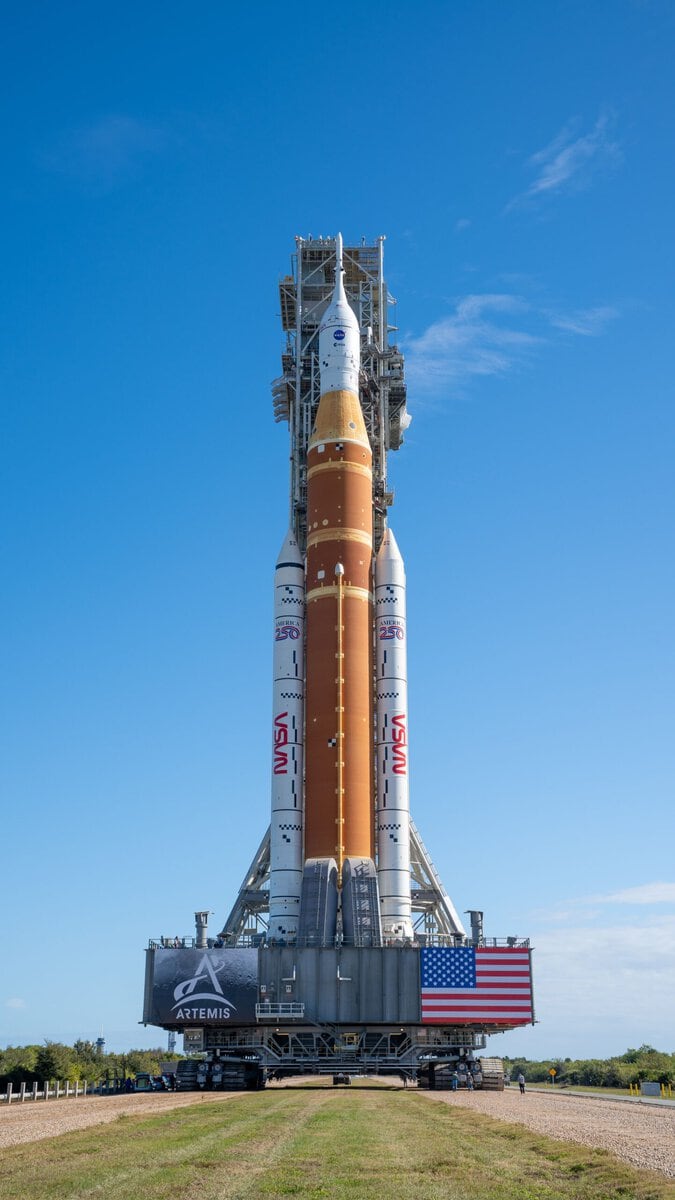
NASA’s Artemis program carries a straightforward but historically significant goal: return humans to the lunar surface and begin building a sustained presence there. The Space Launch System — powered by four RS-25 engines on the core stage plus a pair of solid rocket boosters derived from Space Shuttle hardware — is the only rocket NASA has certified for crewed lunar-class missions.
Artemis I, launched in November 2022, provided the first integrated test of that full propulsion stack. The uncrewed Orion capsule reached a distant retrograde orbit around the Moon — an extreme trajectory chosen to stress-test navigation and life-support systems — and returned safely to Earth. NASA’s post-flight assessment confirmed that the SLS and RS-25 combination performed as designed, clearing the path for crewed Artemis missions.
The Mason workforce’s contribution extends beyond assembling hardware. Aerojet Rocketdyne engineers there have worked on the updated RS-25 engine controller, which NASA describes as a modernized brain for the engine — one that improves reliability diagnostics and is designed to reduce manufacturing costs for future units. NASA has contracted Aerojet Rocketdyne to produce 24 new RS-25 engines to sustain SLS flights through Artemis IX and beyond, a commitment that makes the Mason facility’s continued operation a programmatic necessity rather than a symbolic gesture. Aero-News Network has covered the strategic significance of NASA’s relationship with the Mason Rocketdyne operation and what it means for the broader SLS propulsion architecture.
NASA’s Assessment: A Facility at the Center of American Space Ambitions
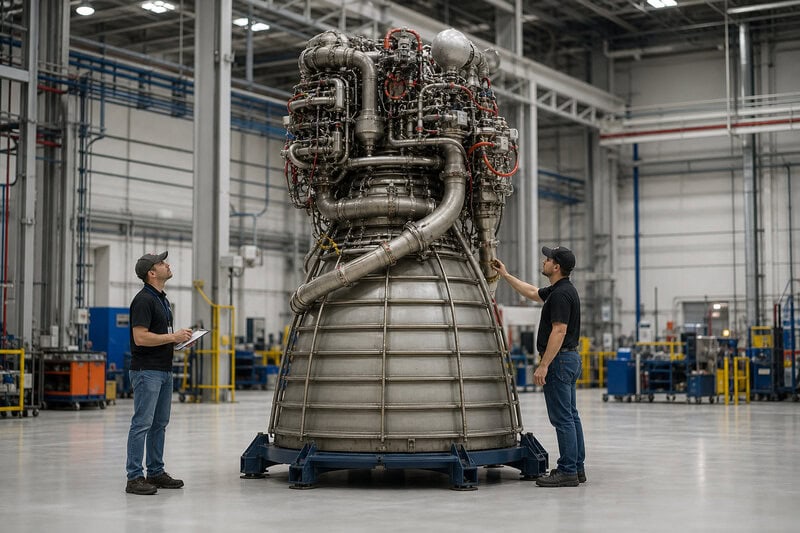
When Administrator Isaacman visited Mason, NASA issued a statement describing Rocketdyne as touching “so many of our most critical missions.” Language of that specificity, from an agency’s top official at a production facility, carries institutional weight. It signals that NASA views the Mason workforce not merely as a supplier managing a legacy contract, but as a strategic asset embedded in the agency’s long-term plans.
That framing reflects a broader reality in the current American launch landscape. Commercial providers — most prominently SpaceX — have fundamentally reshaped launch economics and demonstrated capabilities that were unimaginable a decade ago. But the RS-25’s human-rating heritage represents something that cannot be quickly replicated: decades of rigorous certification, failure analysis, and performance data accumulated across 135 Space Shuttle flights. The industrial knowledge concentrated in Mason’s roughly 350-person workforce, spanning disciplines from turbopump machining to cryogenic system integration to hot-fire test data analysis, represents what aerospace policy analysts have identified as a shrinking pool of domestic liquid-rocket expertise.
Sustaining that expertise is, by NASA’s own implicit acknowledgment, as much a policy challenge as a procurement one. Specialized manufacturing knowledge does not survive workforce gaps or facility closures easily. The agency’s public posture toward Mason reflects an awareness that the industrial base capable of building human-rated liquid rocket engines is finite and must be deliberately maintained.
The Mars Horizon: Nuclear Propulsion and What Comes Next
NASA has indicated that propulsion technology connected to Mason-based Rocketdyne could contribute to missions far beyond the Moon — potentially including a crewed journey to Mars. That claim deserves careful context about where the relevant technology currently stands.
The leading concept for deep-space crewed transit is nuclear thermal propulsion (NTP). Rather than burning chemical propellants, an NTP system uses a nuclear reactor to heat a propellant — typically hydrogen — to extreme temperatures before expelling it through a nozzle to generate thrust. Theoretical specific impulse figures for NTP roughly double those of the RS-25, which could translate into significantly shorter transit times between Earth and Mars, reducing crew exposure to deep-space radiation and the other hazards of long-duration spaceflight.
NASA and DARPA are jointly developing the DRACO program — the Demonstration Rocket for Agile Cislunar Operations — to test a nuclear thermal rocket engine in space. Aerojet Rocketdyne holds propulsion expertise relevant to that effort. However, NTP remains an emerging technology that has not been demonstrated in flight. NASA’s own roadmaps present operational nuclear propulsion as a 2030s-era capability at the earliest, contingent on sustained funding, regulatory approvals for a reactor launch, and successful ground demonstration programs. The gap between the engineering maturity of the RS-25 — a flight-proven, human-rated system with a four-decade record — and an operational nuclear propulsion system remains substantial, and technical experts are careful to frame them accordingly.
Why Mason, Ohio Matters Beyond Its Zip Code
The Mason facility exemplifies a pattern that recurs throughout American aerospace: mission-critical capability concentrated in relatively small, highly specialized workforces whose institutional knowledge — built across decades of Shuttle and SLS work — is genuinely difficult to transfer or rebuild quickly. A supply chain disruption, a budget cut, or the loss of key personnel can produce consequences that ripple far beyond a single program.
For the Artemis generation, the RS-25 engines assembled and refined in Mason represent a deliberate bridge between two eras of human spaceflight. The same engine family that carried astronauts to orbit for thirty years now forms the propulsion core of humanity’s return to the Moon. Whether the Mason workforce ultimately contributes to propulsion for Mars missions or remains anchored to SLS lunar flights for the foreseeable future, NASA’s own words have made the strategic calculus explicit: this facility, and the engines it produces, sit at the center of American ambitions beyond Earth orbit.