
Twenty columns of ancient text — more than a metre of charred papyrus — have just been read for the first time in roughly two thousand years, and not a single layer of the scroll was physically peeled back to do it. Reuters reported on June 25, 2026 that researchers have achieved the complete decipherment of a carbonized Herculaneum scroll known as Pherc. 1667 — the first intact, burned scroll from the ancient Roman town of Herculaneum to be fully unlocked — using a combination of particle accelerator imaging and artificial intelligence. The achievement closes a deadlock that has frustrated scholars for nearly three centuries and opens a credible path toward reading hundreds more sealed scrolls that survive from the same buried library.
The Library That Vesuvius Froze in Time
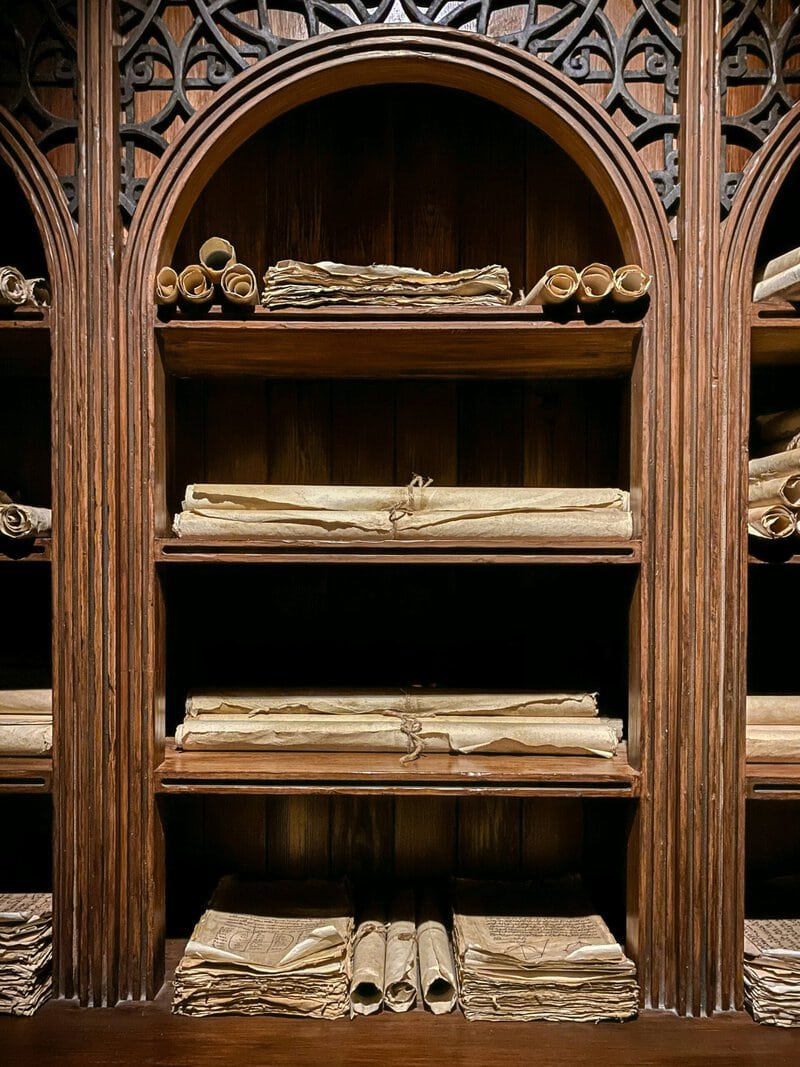
When Mount Vesuvius erupted in 79 AD, Herculaneum was not simply buried under ash. The town was engulfed by a superheated pyroclastic surge — a fast-moving current of gas and volcanic matter — that carbonized organic material almost instantaneously, including an entire private library housed in what archaeologists now call the Villa of the Papyri. The scrolls inside were not incinerated into powder. They were transformed into brittle carbon husks that retained their shape, their fiber structure, and crucially, their text.
This is the central paradox of the Herculaneum papyri: the eruption that should have destroyed the scrolls is precisely what preserved them. The extreme heat drove off moisture and organic compounds, converting the papyrus cellulose into a carbon matrix — structurally similar to charcoal — that is chemically stable enough to persist for millennia. That same transformation, however, made the scrolls physically impossible to open. The layers fused and stiffened; any attempt to unroll them caused them to shatter. For the roughly 270 years since their eighteenth-century rediscovery, that deadlock held.
The Herculaneum papyri are the only surviving intact library from the Greco-Roman world. Approximately 600 scrolls remain unopened. The collection skews heavily toward Epicurean philosophy, particularly works associated with the philosopher Philodemus of Gadara, and in many cases the texts it contains are the sole surviving versions of those works — not duplicates of anything preserved in medieval manuscripts. Each decoded column is a genuine historical recovery of words that exist nowhere else on Earth.
The Technology Stack: Particle Accelerators Meet Machine Learning
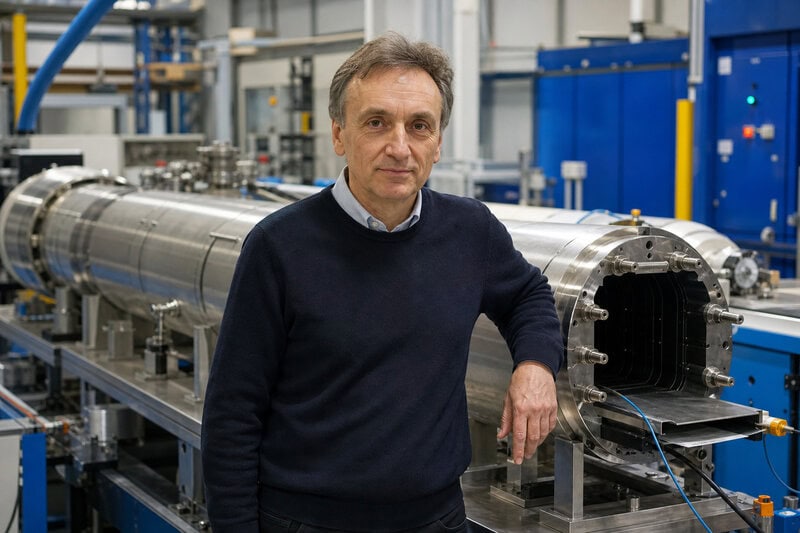
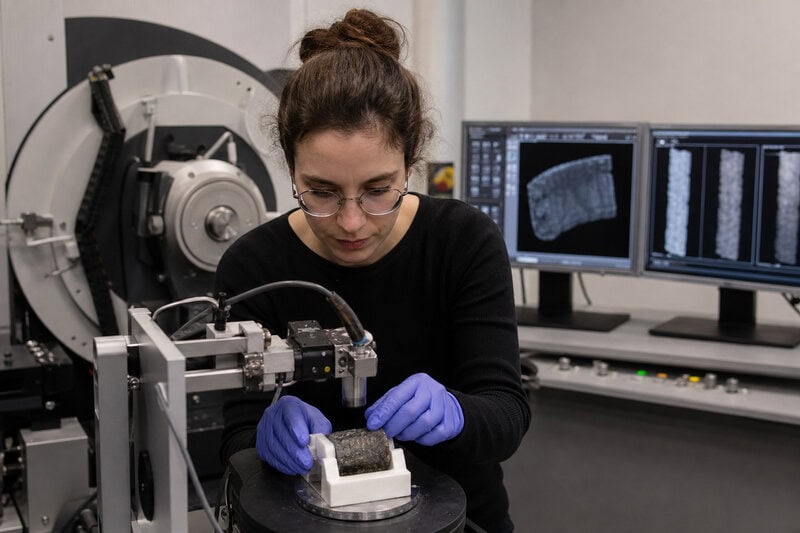
The method that broke the deadlock is called virtual unwrapping, and it works in two stages. First, researchers use high-energy X-ray scans produced by particle accelerators to image the interior of a tightly coiled scroll in three dimensions without touching it. The result is a volumetric map — a digital anatomy of every compressed layer inside the scroll. Second, artificial intelligence algorithms computationally unwrap that three-dimensional data, flattening each layer into a legible two-dimensional rendering of the text, as if the scroll had been opened without ever being physically disturbed.
The AI component addresses what had been the most stubborn technical obstacle. Ancient Herculaneum scribes wrote in carbon-based ink — the same elemental material as the carbonized papyrus beneath it. The contrast difference between ink and background in scan data is vanishingly small, far too subtle for conventional imaging or the unaided human eye to resolve reliably. AI models trained to detect minute texture and surface variations in the scan data can identify where ink sits on a fiber surface even when that difference registers as near-invisible noise. Researchers in the field are consistent on one point: ink detection is an area of active development, not a fully solved problem, and accuracy varies depending on scroll condition, scan resolution, and the specific region being analyzed.
The scale of what the Herculaneum collection demands — hundreds of sealed scrolls, each requiring intensive computational processing — has pushed the development of these tools into unusually public and collaborative territory, accelerating progress that more conventional academic timelines would not have produced.
The Vesuvius Challenge: Crowdsourcing a Two-Thousand-Year-Old Problem
Much of the accelerated progress in virtual unwrapping can be traced to a structured prize competition called the Vesuvius Challenge, which offers $1 million in prize money to incentivize open, competitive development of scroll-deciphering technology. The competition has drawn computer scientists, classicists, and imaging specialists into a form of scientific collaboration that is less common in humanities-adjacent research: many independent teams test different algorithmic approaches against the same shared dataset and publish results openly, allowing incremental advances to compound across groups.
The format suits the problem. Detecting near-invisible ink in noisy volumetric scan data is precisely the kind of task that benefits from many parallel attempts using different machine-learning architectures. Earlier milestones produced legible fragments — tantalizing glimpses into scroll contents — but not a continuous, complete text. The full decipherment of Pherc. 1667 represents a qualitative shift: the technology has demonstrably crossed a threshold from partial recovery to whole-scroll reading, at least under favorable conditions.
As The Guardian details, the combination of particle accelerator imaging and AI-driven analysis has moved from proof-of-concept to operational capability — a transition with significant implications for the remaining 600 unopened scrolls.
What Twenty Columns of Pherc. 1667 Actually Represent
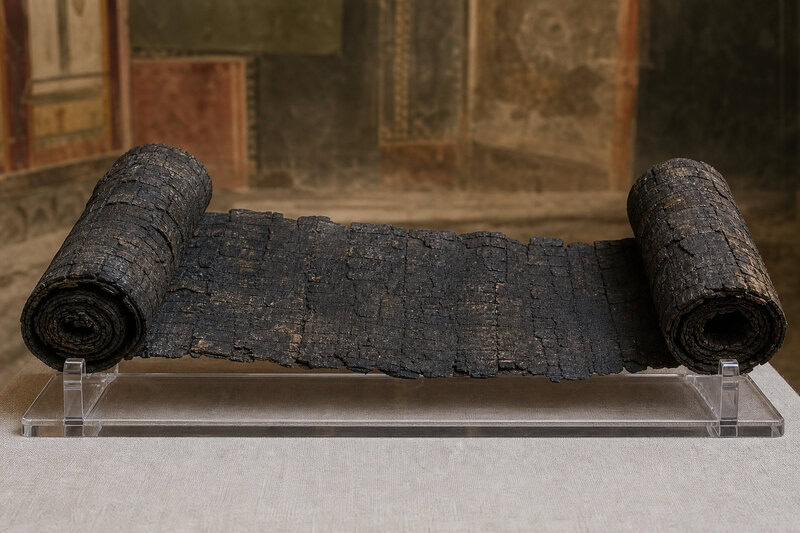
The 20 decoded columns cover more than a metre of continuous charred papyrus — a span that, in physical terms, constitutes a meaningful portion of a philosophical treatise. The Villa of the Papyri’s known profile makes it likely that newly decoded scrolls illuminate Epicurean or Hellenistic thought that survives in no other source. But definitive conclusions about authorship and meaning require sustained scholarly interpretation that takes years of peer-reviewed study to establish. Computational decipherment produces a rendered text; what that text means, and how it fits into the intellectual history of the ancient world, is a separate and ongoing scholarly process. The rendering is the beginning of the work, not its conclusion.
What is not in dispute is the significance of the category of recovery. As NBC News reports, the texts unlocked from the Herculaneum scrolls were previously lost — not misplaced in an archive or overlooked in a catalog, but genuinely absent from the historical record for approximately two millennia. A decoded column that requires expert translation and years of contextual interpretation is still an incomparably valuable object. Its recovery is the precondition for everything that follows.
What Could Still Go Wrong: Real Limits on a Real Breakthrough
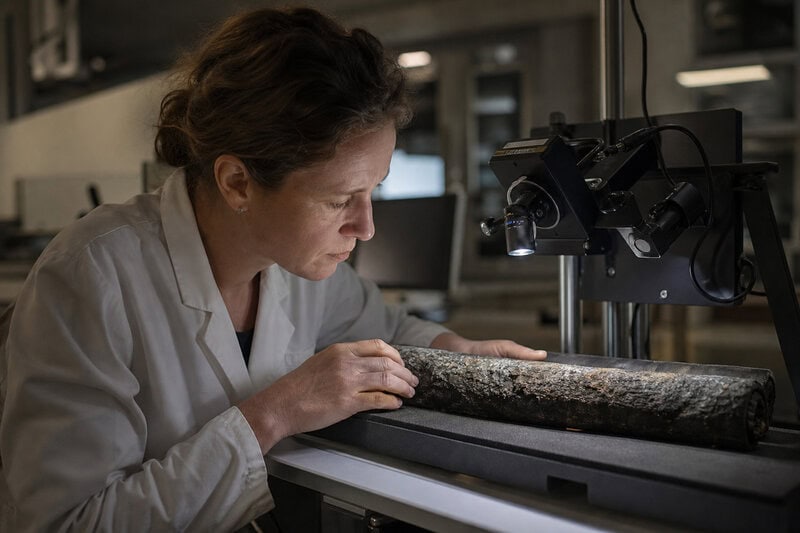
The success with Pherc. 1667 should not be read as a guarantee that the remaining 600 scrolls will yield equally clear results. The resolution and contrast achievable by particle accelerator imaging depend on scroll condition, ink composition, and the amount of scanner time that can be allocated — factors that vary considerably across a collection damaged by a geological catastrophe nearly two thousand years ago. Some scrolls are more compressed, more fragile, or more degraded than others, and an AI pipeline that performed well on one scroll may perform differently on another.
The carbon-ink problem remains a persistent technical challenge. Unlike the iron-gall inks used in medieval manuscripts, which contain metallic compounds that appear with relative clarity in X-ray imaging, the carbon-based ink of the Herculaneum scribes is elementally indistinguishable from the carbonized papyrus surrounding it. The AI models that detected it in Pherc. 1667 represent genuine progress, but researchers consistently describe this as an area of active development rather than a settled technique.
There are also institutional and logistical constraints that will shape the pace of future breakthroughs. The Herculaneum scrolls are held across multiple institutions, including the National Library of Naples and the British Library. Coordinating access to high-energy particle accelerator facilities for conservation objects of this fragility involves scientific, diplomatic, and conservation considerations that do not resolve quickly. Algorithmic advances alone will not determine how fast the remaining scrolls are read.
The Larger Stakes: What Six Hundred Scrolls Could Mean for Ancient Knowledge
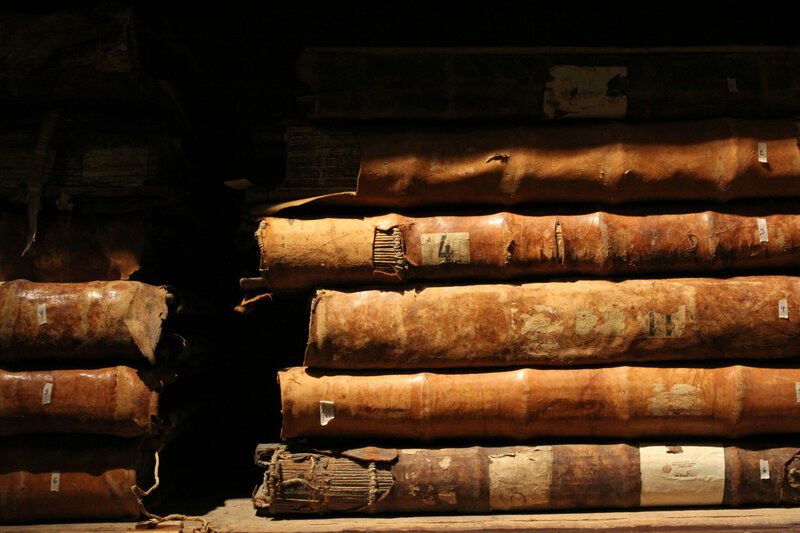
Classical scholars estimate that only a small fraction of ancient Greek and Roman literature survived the medieval period, preserved through a narrow chain of manuscript copying that excluded enormous amounts of philosophical, scientific, literary, and historical writing. If the Herculaneum collection contains works by authors known only by name or reputation — and given the Villa’s intellectual profile, there is a reasonable scholarly basis to consider this possible — successfully decoding the full collection would represent the most significant recovery of lost classical texts since the Renaissance.
The method itself carries implications beyond Herculaneum. The virtual unwrapping and AI ink-detection pipeline developed for these scrolls has potential applications to other damaged or sealed manuscript collections worldwide — documents too fragile to open, too degraded to read conventionally, or too valuable to risk physical intervention. The Washington Post’s coverage of the breakthrough situates the Pherc. 1667 achievement within this broader technological trajectory: tools developed for one extraordinary problem that may prove applicable to many others.
The complete reading of Pherc. 1667 — 20 columns, more than a metre of text, zero physical contact — demonstrates that the deadlock between preservation and legibility that defined the Herculaneum scrolls for nearly three centuries is now, at least in principle, broken. The thoughts encoded in that scroll were composed before Vesuvius buried Herculaneum in 79 AD. They have been silent for two thousand years. The technology that recovered them is twenty-first century. The work of understanding what they say has just begun.