
NASA’s Artemis 3 program — the agency’s planned mission to return humans to the lunar surface for the first time in more than half a century — hit an unexpected obstacle not in the vacuum of space, but in a crawlspace on Earth so narrow that no conventional inspection tool could fit inside it. The agency’s solution came from one of the most unlikely addresses in American aerospace: a small startup in Laramie, Wyoming, building robots with oversized, compliant wheels.
When the Most Advanced Space Program on Earth Needed a Tiny Wyoming Startup
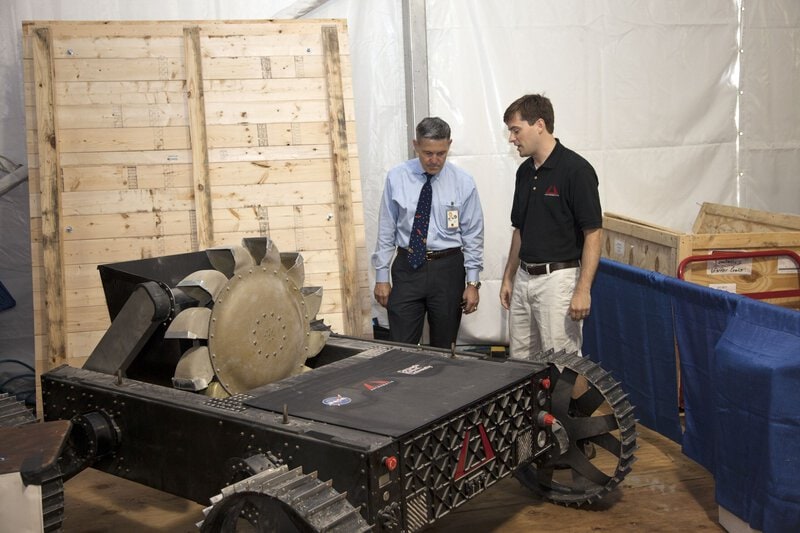
NASA — an agency that has landed rovers on Mars, flown a helicopter on another planet, and is actively developing the most powerful rocket ever built — found itself stopped by a confined void in terrestrial infrastructure that exceeded the dimensional limits of every inspection tool in its existing toolkit. Not orbital mechanics. Not cryogenic fuel dynamics. A crawlspace.
The agency’s response was to look outside its traditional contractor network. What it found, according to reporting by Cowboy State Daily, was a deceptively simple robot: low-slung, rolling on large compliant wheels, capable of squeezing through pinch points, flipping itself upright, and recovering from positions that would permanently strand a more sophisticated machine.
The stakes are real. Artemis 3 is designed to land the first woman and the first person of color on the lunar surface. Every piece of supporting infrastructure — ground systems, launchpad structures, facility hardware — must be verified before human spaceflight proceeds. An uninspected void is not a paperwork gap; it is a known unknown inside a program that cannot afford unknown failures.
The Problem: Why Confined Spaces Defeat Conventional Inspection Tools
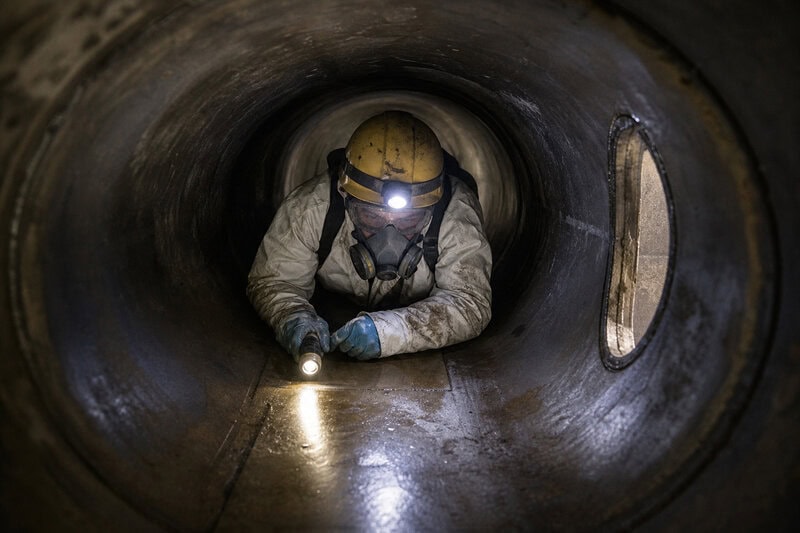
A confined space, in the engineering and occupational safety sense, is any enclosed area too small or geometrically complex for a person to enter safely and maneuver freely. The category is broader than most people realize: it includes industrial boilers, structural voids beneath launchpads, ship ballast tanks, bridge interiors, and infrastructure crawlspaces that accumulate in large facilities over decades of construction and modification.
Standard robotic inspection tools fail in confined spaces for well-understood reasons. Wheeled ground rovers require a minimum turning radius — most multi-wheeled platforms cannot pivot in place, so a corridor too short to execute a turn becomes a dead end. Quadrupedal robots require vertical clearance for leg articulation; a space tall enough for the body but not for a raised leg renders them immobile. Aerial drones need rotor-tip clearance and struggle with turbulent, recirculating airflow inside enclosed volumes, making stable flight difficult or impossible.
NASA determined that the crawlspace associated with its Artemis 3 infrastructure exceeded the dimensional limits of all these categories simultaneously. That is a specific and meaningful finding: the agency’s own operational requirements created a gap its entire existing toolkit could not bridge.
This is not an isolated challenge. The more critical the infrastructure, the more likely it contains legacy voids — spaces designed and built before robotic inspection existed as a discipline. As hardware ages and inspection requirements tighten, the gap between what must be examined and what can be examined grows. NASA’s situation is a high-profile instance of a structural inspection problem that exists across aerospace, energy, and civil infrastructure worldwide.
The Robot: Big Wheels, Simple Body, Real Capability
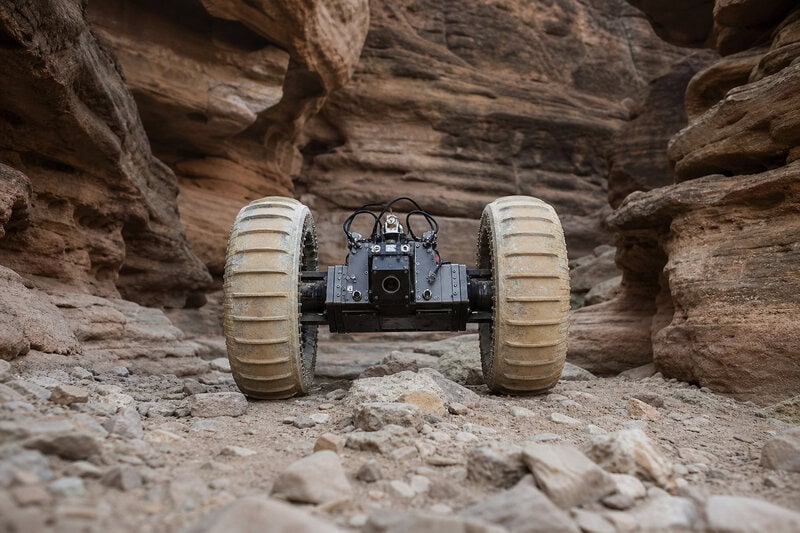
The Laramie company’s robot does not look like most people’s image of NASA technology. It has no articulated arms, no multi-jointed spine, no legs. Its defining feature is its wheels: large in diameter, soft in construction, and designed to deform around contact points rather than roll rigidly over them.
The engineering logic is straightforward once stated. A large-diameter wheel reduces the effective angle at which it encounters an obstacle — where a small rigid wheel must climb steeply over a lip or edge, a large wheel rolls over it at a shallower approach angle, requiring less torque and producing less chassis disruption. When that wheel is also compliant — deforming around contact points rather than transmitting surface irregularity directly to the frame — it maintains traction on irregular surfaces and absorbs impacts without the weight and complexity of a dedicated suspension system.
The robot’s low-profile body geometry completes the design logic. By keeping the chassis close to the ground and minimizing lateral protrusions, the robot passes through gaps that would physically trap articulated or multi-limbed machines. Roboticists sometimes describe this as morphological simplicity: a body shaped to be compact and regular in cross-section can navigate complex confined environments more reliably than a more capable machine that is geometrically incompatible with those environments.
The practical result directly addresses the confined-space inspection problem. The robot can flip — and because its large wheels function identically whether it is upright or inverted, a flip is a recoverable event rather than a mission-ending failure. It can execute tight turns that conventional wheeled drivetrains cannot manage. When wedged in a pinch point, wheel compliance provides enough torsional contact force to torque it free without external intervention.
NASA sought out this specific firm, according to coverage shared by Cowboy State Daily on Facebook, precisely because the crawlspace requirement matched the robot’s documented capability profile.
How NASA Found a Laramie Startup
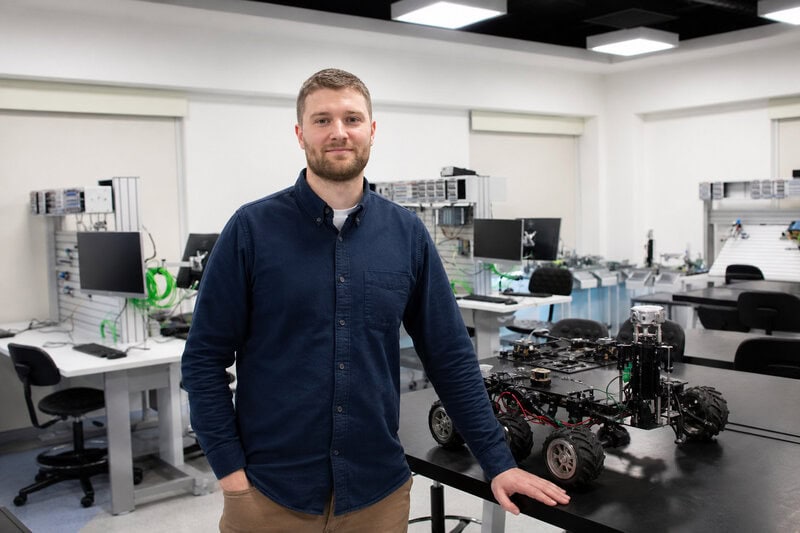
Laramie does not appear on most aerospace supply-chain maps. The city sits on Wyoming’s high plains, anchored by the University of Wyoming. The university’s engineering programs have developed a modest regional technology ecosystem, but Wyoming is not traditionally associated with NASA contracting.
That NASA engineers conducting a capability search for a mission-critical task ended up at a Laramie startup reflects the agency’s documented strategy of broadening its vendor base for specialized niche problems. NASA’s Small Business Innovation Research program exists specifically to surface non-traditional suppliers with capabilities that larger contractors may not have developed. The confined-space inspection gap is precisely the kind of niche problem that program is designed to address.
What is confirmed: NASA contacted the Laramie company, and the robot was deployed for Artemis 3 crawlspace inspection work. What remains unspecified in available public reporting is the contract value, the detailed inspection results, and whether NASA intends to formalize an ongoing relationship beyond this specific task. Those distinctions matter — a single-task deployment and a long-term partnership represent very different levels of institutional commitment, and available evidence supports only the former.
The University of Wyoming’s engineering community has noted the collaboration with visible pride, as reflected in a post from UWyo Engineering on Instagram highlighting the Laramie connection to the NASA assignment.
The Engineering Case for Compliant Wheels
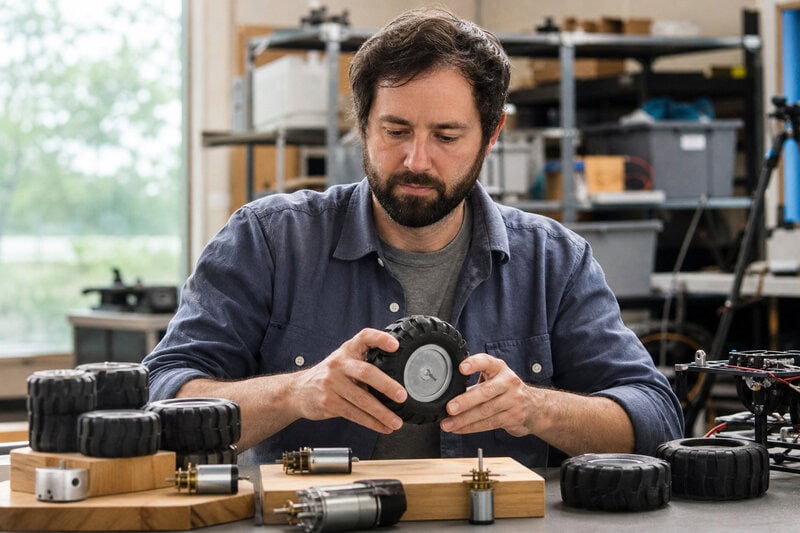
Compliant wheel technology — soft, large-diameter wheels that deform under load — is not new, but it remains underappreciated in robotics design relative to more mechanically complex approaches. The physics are well-documented: a wheel that deforms around an obstacle effectively reduces that obstacle’s height from the wheel’s perspective, maintaining forward momentum without requiring the chassis to pitch or the suspension to absorb a hard impact.
NASA’s Mars rover program has produced hard-won lessons about wheel-terrain interaction. Curiosity’s aluminum wheels suffered unexpected puncture damage from sharp Martian rocks, leading to route-planning changes and prompting design revisions for subsequent missions. Perseverance incorporated thicker, more robust wheel construction partly in response. Compliant large-diameter wheels represent a different engineering philosophy — trading some precision of control for greater resilience across unpredictable, irregular terrain.
There is a meaningful physical connection between the confined-space inspection problem and planetary exploration. A wheel optimized for crawling through a narrow earthbound crawlspace and a wheel optimized for loose lunar regolith or sharp Martian rocks share fundamental physics: both benefit from large contact patches, deformation around point obstacles, and compliance under load. This makes terrestrial confined-space inspection robotics a legitimate technical adjacency to planetary rover development — not a metaphorical connection, but a mechanical one rooted in the same wheel-terrain interaction principles.
One important qualification: the general physics of compliant wheel-terrain interaction are well-established in the mechanical engineering literature. The specific performance claims of this particular robot in confined-space conditions have not, to date, been independently validated in peer-reviewed scientific literature. The robot’s capabilities are documented through operational deployment and manufacturer reporting — meaningful evidence, but different in kind from controlled experimental peer review.
Artemis 3 and the Inspection Chain
Artemis 3 occupies a specific and symbolically significant position in NASA’s exploration timeline. As the third Artemis mission, it is designed to achieve the crewed lunar landing that Artemis 1 (an uncrewed test flight) and Artemis 2 (a crewed lunar flyby) are intended to build toward. The historical weight of its goals — landing the first woman and first person of color on the Moon — amplifies the consequences of any infrastructure failure in the pre-mission verification chain.
In that context, a crawlspace inspection is not peripheral work. Mission safety protocols for human spaceflight require that known unknowns be resolved before launch. A void that cannot be inspected cannot be certified. A void that cannot be certified is a gap in the verification chain that human spaceflight programs are not permitted to carry. The Laramie robot’s role was, in the most direct operational sense, to close that gap.
The broader implication extends beyond this assignment. If a compliant-wheeled robot can inspect confined spaces in NASA’s terrestrial launch and support facilities, adapted variants become credible candidates for structurally analogous environments: lava tubes on the Moon or Mars, subsurface voids in planetary regolith, enclosed sections of future human outpost habitats. These are not confirmed NASA plans — they are emerging and contested technology pathways. But the physical reasoning that made the robot useful in a Laramie-to-launchpad context is the same reasoning that would make similar systems relevant in a lunar or Martian one, which is why confined-space inspection robotics and planetary exploration increasingly appear in the same technical conversations.
As Cowboy State Daily noted on X, a Wyoming startup solving a problem that defeated NASA’s conventional toolkit is a story worth understanding precisely because niche capability — not scale or complexity — determined the outcome.
Open Questions and What This Deployment Actually Proves
The confirmed takeaway is narrow but significant: a Laramie company’s compliant-wheeled robot solved a real, mission-critical inspection problem for NASA’s Artemis 3 program, demonstrating that unconventional wheel geometry and morphological simplicity can outperform more complex systems in confined environments. That is a verifiable result, and it stands on its own regardless of what follows.
The open questions will determine whether it becomes a replicable model. Can the design be scaled or adapted for different confined-space geometries — wider but shorter voids, curved passages, spaces with debris or standing water? Will NASA formalize a longer-term relationship with the Laramie firm, or was this a one-time capability match? How do the inspection results affect Artemis 3 infrastructure certification and mission timelines? None of these questions have public answers yet, and readers should be skeptical of reporting that treats the deployment as proof of a broader ongoing partnership without evidence for one.
What this assignment does establish clearly is a principle with implications well beyond Wyoming or even NASA: when standard tools reach their geometric limits, the answer may come not from the largest contractors or the most complex systems, but from a small company in an unlikely place, doing one specific thing exceptionally well. For an agency planning to send humans back to the Moon and eventually to Mars — environments defined by confined spaces, unpredictable terrain, and zero tolerance for mission-ending failures — that is a lesson worth taking seriously.