
A satellite no larger than a carry-on suitcase drifts 500 kilometers above an oil field, detecting a methane plume that ground inspectors missed — the kind of measurement that once required a dedicated NASA research mission costing hundreds of millions of dollars. That capability is now being purchased as a commercial data product, and NASA’s recent contract award to Satlantis U.S. is one of the clearest signs yet that briefcase-sized satellites have crossed from technology novelty into genuine scientific infrastructure.
A NASA Contract That Signals a Structural Shift
NASA has selected Satlantis U.S. as one of eight new companies awarded positions under the Commercial SmallSat Data Acquisition (CSDA) On-Ramp 2 Multiple Award Contract, according to reporting by SpaceWatch Global. The program carries a maximum ceiling value of $476 million and runs through November 15, 2028. Satlantis U.S. operates from the University of Florida’s Innovation Hub at 747 SW 2nd Avenue — a university-based technology incubator that has now produced a company capable of competing for federal space contracts alongside established aerospace players.
The selection is not merely a business milestone. It is evidence of a structural change in how NASA procures Earth-observation science. Rather than designing, launching, and operating its own spacecraft for every measurement need, the agency is increasingly buying data from commercial smallsat operators the way a researcher buys reagents — as a commodity, evaluated on quality and price. That shift has consequences for climate monitoring, for the commercial space industry, and for the scientific questions humanity can afford to ask from orbit.
What Is a SmallSat — and Why Does Size Suddenly Matter?
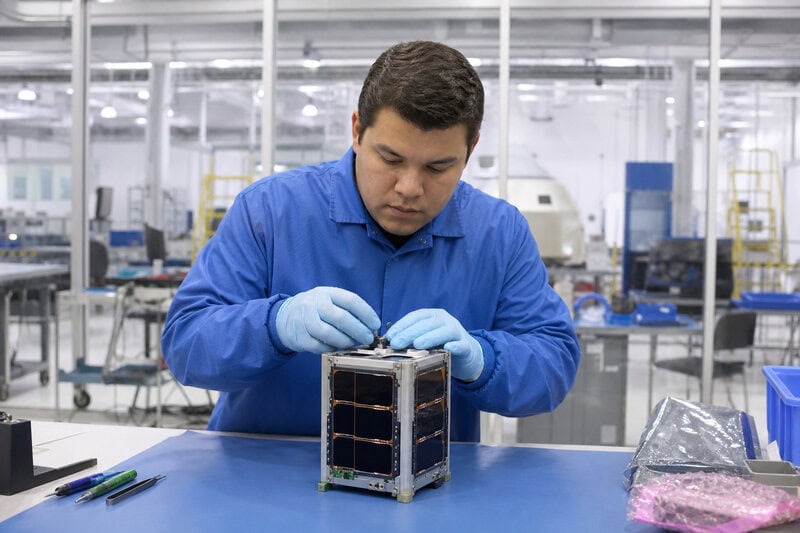
A smallsat is broadly defined as any satellite under 600 kilograms. The most compact class, CubeSats, are standardized in units of 10 centimeters × 10 centimeters × 10 centimeters — a single unit weighs roughly 1.3 kilograms, and satellites are commonly built as stacks of two, three, or six units. Satlantis’s iSIM imaging payload is engineered to deliver sub-meter-class optical performance within these tightly constrained form factors, a feat that would have been considered implausible a decade ago.
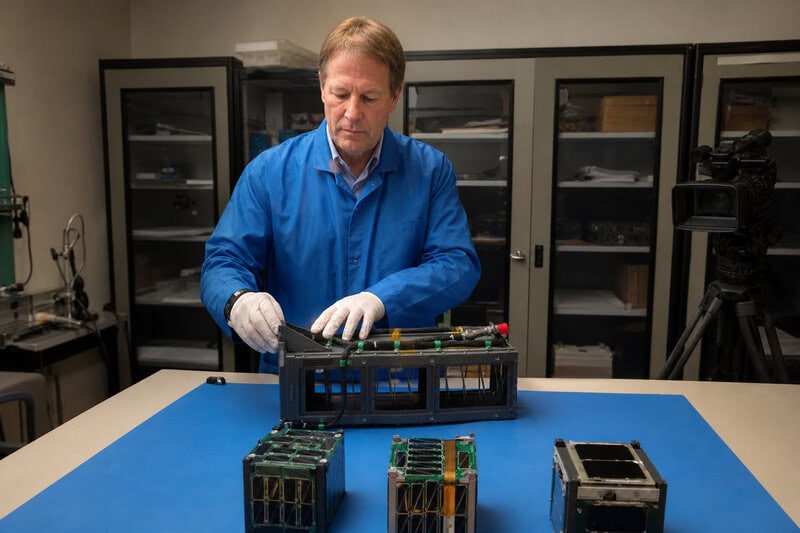
Three converging forces made it plausible. First, miniaturized CMOS image sensors — the same fundamental technology that enables smartphone cameras — have reached resolutions and sensitivities suitable for orbital Earth observation. Second, commercial off-the-shelf processors, originally developed for consumer electronics, can now be radiation-hardened or fault-tolerant enough for the space environment. Third, rideshare launch programs — including NASA’s own CubeSat Launch Initiative and SpaceX’s Transporter series — have collapsed the cost per kilogram to orbit, making it economically rational to build constellations of dozens of small satellites rather than a single large, expensive one.
The honest caveat is that smallsats trade aperture size for revisit frequency and cost. A smaller optical aperture gathers less light, which limits spectral resolution and performance in low-light conditions. For applications like high-precision gravity mapping or ice-sheet altimetry, that trade is currently unacceptable. But for applications like greenhouse-gas monitoring, where catching the same emitter on multiple passes matters more than the finest possible spatial detail on any single pass, emerging research suggests that high revisit cadence may be the more critical parameter — though this remains an active area of debate among remote-sensing scientists. The CSDA program is explicitly designed to accelerate the transition of smallsat technology from technology-demonstration curiosities into operationally viable science platforms.
The CSDA Contract Model: NASA Buying Data, Not Spacecraft
Under the CSDA On-Ramp 2 Multiple Award Contract, NASA does not own or operate any of the satellites involved. Instead, the agency issues task orders to commercial vendors — paying for data products such as imagery, atmospheric measurements, or derived analytics — against the $476 million program ceiling. The vendors own their infrastructure; NASA buys the output.
The logic of this model is straightforward: by purchasing routine Earth-observation data commercially, NASA can redirect its own engineering talent and capital toward missions that the private sector cannot yet replicate — deep-space science, crewed exploration, and the specialized measurements that only government-scale engineering can produce. NASA’s Earth Science Division, which administers the program through its CSDA program office, has stated publicly that the program’s goal is to evaluate whether commercial data can meet the rigorous scientific quality standards equivalent to data from NASA’s own Earth-observing fleet. The verdict on that question is not yet in, and it is worth being clear about that uncertainty.
The competitive field for On-Ramp 2 is deliberately diverse. Eight new companies were added in this round. Satellogic, a separate awardee, will supply high-resolution multispectral imagery under the same contract vehicle through the same November 2028 end date. That pairing — Satellogic providing optical imagery, Satlantis U.S. targeting methane detection — illustrates that NASA is segmenting the smallsat market by sensor type and application domain rather than treating commercial smallsat data as a single undifferentiated commodity. The agency is, in effect, running a prolonged competitive experiment to determine which commercial data products prove most scientifically credible by 2028.
Satlantis U.S., Encino, and the EmSat™ Methane Detection Mission
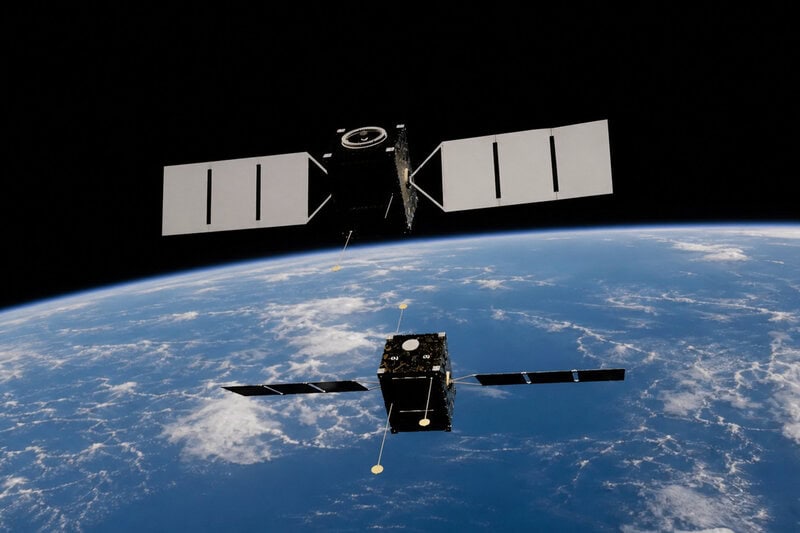
Satlantis U.S.’s distinctive scientific focus is methane detection. The company is partnered with Encino in the EmSat™ Satellite Methane Detection program, positioning it in one of the most policy-relevant corners of commercial smallsat remote sensing.
Why methane? Methane (CH₄) is a greenhouse gas approximately 80 times more potent than carbon dioxide over a 20-year horizon, according to the Intergovernmental Panel on Climate Change. It is also, crucially, detectable from orbit and attributable to specific point sources — individual wellheads, pipeline segments, landfill cells — in ways that make targeted intervention feasible. Climate scientists broadly consider satellite-based methane attribution to be among the highest-leverage near-term tools available for reducing the rate of warming, because identified leaks can often be repaired at relatively low cost compared with their climate impact.
The EmSat™ approach uses shortwave infrared (SWIR) spectroscopy. Sunlight reflected off Earth’s surface passes through the atmosphere on its way to the satellite’s sensor. Methane molecules absorb light at specific, characteristic wavelengths within the shortwave infrared band. By measuring those absorption signatures precisely, the instrument can infer the concentration of methane in the atmospheric column below. This technique has been validated at larger scale by the European Space Agency’s Sentinel-5P satellite and by NASA’s own EMIT instrument aboard the International Space Station. EmSat™ aims to deliver comparable detection capability from a much smaller, commercially operated platform — though independent validation of its measurement accuracy at the claimed sensitivity will be essential before the data can anchor authoritative emissions inventories.
Satlantis U.S.’s location at the University of Florida’s Innovation Hub is itself a data point. University-based innovation hubs serve as a federally recognized model for technology transfer from academic research into commercial application. The company’s presence there signals its early-stage character and illustrates how academic infrastructure is increasingly serving as an on-ramp for commercial space ventures capable of eventually competing for significant federal contracts.
The Science That Used to Require a Space Shuttle

To appreciate how far the field has traveled, consider the Shuttle Imaging Radar series. Flown on multiple Space Shuttle missions between 1981 and 2000, those missions represented NASA’s flagship approach to orbital remote sensing of Earth’s surface. Each mission required years of preparation, produced data over a narrow window of days, and carried costs that, adjusted for inflation, ran into the hundreds of millions of dollars per flight. The data were scientifically invaluable — and entirely irreplaceable by any other means available at the time.
A commercial smallsat constellation can now provide continuous, revisit-rich coverage of comparable target areas at a fraction of that cost. The CSDA program formalizes NASA’s recognition that this commercial capability has crossed a scientific quality threshold worth paying for through a formal procurement mechanism rather than treating it as a supplementary curiosity.
It is equally important, however, to be precise about what smallsats cannot do. High-precision gravity mapping, as performed by the GRACE-FO mission, requires two spacecraft flying in precise formation and measuring the gravitational tug between them — a measurement geometry with no smallsat equivalent on the current horizon. Lidar-based ice-sheet altimetry, as performed by ICESat-2, requires laser power budgets and pointing precision that remain beyond compact platforms. Deep ultraviolet atmospheric chemistry, hyperspectral ocean-color measurements, and several other observational needs remain firmly in the domain of government-scale flagship missions. The smallsat revolution is real; it is not a wholesale replacement for NASA’s Earth-observing fleet.
What the CSDA program represents is a deliberate division of scientific labor. Commercial smallsats handle what they can do cheaply and well — frequent optical imaging, methane monitoring, maritime vessel tracking, radio-occultation atmospheric sounding. NASA’s science budget is then freed for the measurements that only government-scale engineering can produce. That division, if it holds, is a more efficient allocation of public resources than the alternative.
What the Eight-Company Roster Signals — and What Comes Next
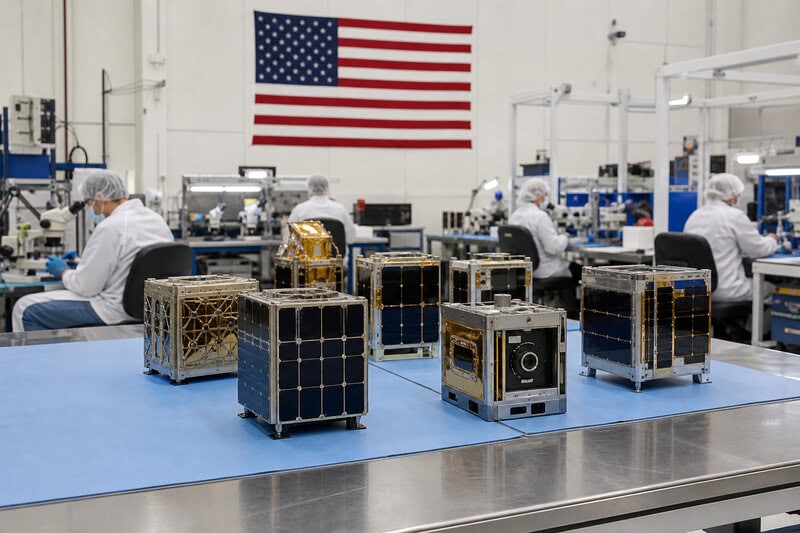
Selecting eight new companies in a single on-ramp round is a deliberate strategy, not an accident of procurement. NASA is stress-testing the commercial smallsat market rather than anointing a single supplier. The agency will learn, through actual task-order spending patterns over the next several years, which data types it finds credible, which vendors deliver consistent quality, and which remote-sensing applications genuinely benefit from commercial revisit cadence. Those spending patterns, once public, will be a leading indicator of where the smallsat industry’s scientific credibility actually lies.
One tension the program must navigate honestly involves calibration and validation standards. Critics within the scientific community have questioned whether commercially acquired data can meet the rigorous, long-term consistency requirements needed for authoritative climate records — requirements that NASA’s own Earth-observing instruments are engineered and characterized to meet from the outset. The CSDA program is partly an empirical answer to that question, and the answer will not be fully available until well into the contract period. Independent observers, including commentators tracking the program through channels such as NASA Watch, have noted the significance of the on-ramp’s breadth as a signal of how seriously the agency is treating the commercial data market.
The methane-monitoring application carries a particular policy urgency. The U.S. Environmental Protection Agency’s updated methane regulations, associated with the Inflation Reduction Act, create a parallel commercial and regulatory demand for the precise detection capability that Satlantis U.S. and Encino are developing through EmSat™. If EPA enforcement mechanisms create a compliance market for satellite-based methane attribution data, regulatory demand may combine with NASA’s procurement demand to accelerate EmSat™ deployment timelines beyond what either driver alone would produce.
Looking further out, if the CSDA model proves scientifically valid at scale by 2028, it is reasonable to expect that other space agencies — the European Space Agency, JAXA in Japan — will examine similar commercial data procurement structures for their own Earth-observation programs. Policy diffusion of this kind is historically common but inherently uncertain in its pace and form, and it would be an overstatement to treat that outcome as inevitable.
NASA’s selection of eight new commercial smallsat data providers under a $476 million contract through 2028 marks the clearest institutional signal yet that briefcase-sized satellites have crossed from technology novelty into genuine scientific infrastructure — not by replacing the spacecraft NASA once needed a Space Shuttle to carry, but by handling a growing share of the work that falls within their reach, and doing it at a cost the market can now sustain.