
Phobos is falling. Every year, Mars’s inner moon creeps 1.8 centimeters closer to the planet — a slow-motion death spiral that will end in the moon’s total destruction in roughly 50 million years. The crawl is imperceptible on any human timescale, yet the physics behind it is as relentless as gravity itself.
The Night Asaph Hall Found Fear Orbiting Mars
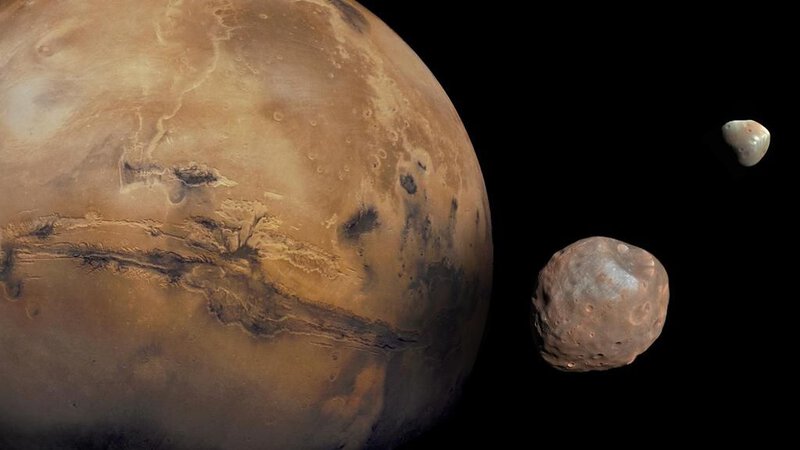
The story begins on the night of August 17, 1877, when American astronomer Asaph Hall pointed the U.S. Naval Observatory’s 26-inch refractor telescope toward Mars from his post in Washington, D.C., and detected a faint pinprick of light orbiting the planet. Hall had already spotted Deimos — the outer of the two Martian moons — six days earlier on August 11, after years of fruitless searching. By some accounts, he had been on the verge of abandoning the effort entirely before his wife, Angelina Stickney, urged him to continue. He did, and Phobos rewarded his persistence.
Hall named both moons for the mythological sons of Ares, the Greek counterpart of the Roman god Mars, drawing from a passage in Homer’s Iliad. Phobos represented fear and panic; Deimos, dread. The names were apt — small, dark, irregular bodies attending a planet long associated with war. The discovery made Hall internationally famous and resolved a debate that had lingered for centuries: Mars does, in fact, have moons. It also opened a deeper puzzle that planetary scientists are still working through today: where did these two small, oddly shaped worlds actually come from?
The leading hypotheses include a captured asteroid, debris ejected by a giant impact on early Mars, or material that coalesced directly in Martian orbit. None has been conclusively confirmed. JAXA’s Mars Moons eXploration (MMX) mission, currently scheduled to launch in 2026, is designed to land on Phobos, collect surface samples, and return them to Earth by the early 2030s — data that could finally settle the origin question while also sharpening predictions about the moon’s ultimate fate.
Meet Phobos: A Battered, Porous World Already Under Strain
According to NASA, Phobos spans just 27 by 22 by 18 kilometers — compact enough to fit within the Washington, D.C. Beltway — and completes three full orbits of Mars within a single Martian day, a pace that makes it unique among the larger moons of the solar system. Standing on its surface, a visitor would watch Mars fill nearly a quarter of the sky and see the sun rise and set multiple times before the Martian day ended.
Its most visually dramatic feature is Stickney Crater, a 9-kilometer-wide impact scar named in honor of Angelina Stickney Hall. The collision that gouged it out was powerful enough that it nearly shattered the entire moon. Radiating outward from the crater and across much of Phobos’s surface is a network of parallel grooves and striations — linear features that, for decades, scientists attributed to secondary impacts from the Stickney event. More recent analysis has reframed that interpretation significantly.
Data from the European Space Agency’s Mars Express orbiter indicate that Phobos is highly porous, with roughly 25 to 35 percent of its interior consisting of empty space. That finding points to a rubble-pile structure — a loosely aggregated body held together more by its own weak gravity than by solid, cohesive rock. A 2015 paper by Terry Hurford and colleagues at NASA Goddard Space Flight Center concluded that the surface grooves are consistent with tidal stress fractures rather than impact ejecta, suggesting that Phobos is not merely falling toward Mars but is already structurally cracking under the gravitational strain of the journey. The moon, in other words, is showing its wounds.
The Mechanism: How Tidal Forces Are Writing Phobos’s Obituary
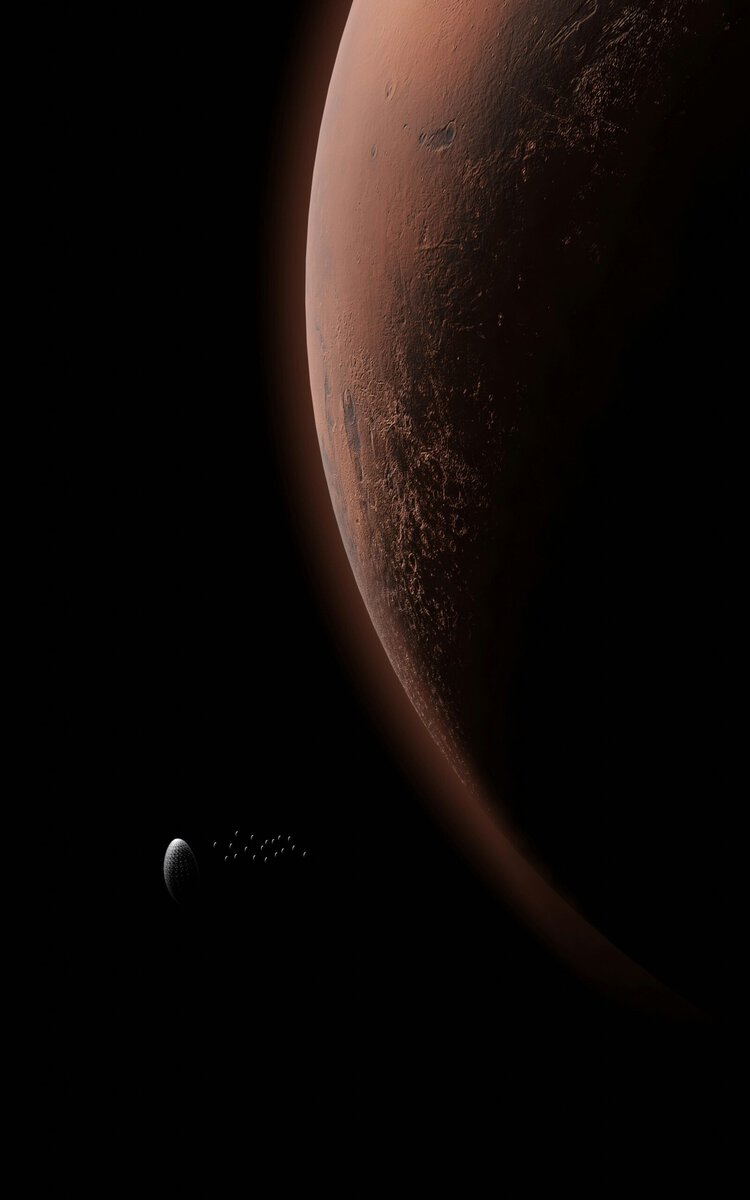
To understand why Phobos is doomed, it helps to understand tidal forces. As Mars’s gravity pulls on Phobos, it does not pull uniformly: the near side of the moon, being closer to Mars, feels a stronger tug than the far side. This difference — called tidal stress — stretches and compresses the moon with every orbit, dissipating orbital energy in the process and steadily dragging Phobos inward.
The geometry of Phobos’s orbit amplifies this effect in a way that has no parallel with Earth’s Moon. Phobos circles Mars in just 7 hours and 39 minutes — far faster than Mars itself rotates, which takes roughly 24 hours and 37 minutes. Because the moon outpaces the planet’s rotation, the slight tidal bulge that Phobos raises on Mars is dragged to a position slightly behind the moon rather than ahead of it. Mars’s gravity then pulls on that misaligned bulge, exerting a backward and downward drag on Phobos — slowing it, lowering its orbit, and feeding the inward spiral. This stands in direct contrast to the Earth-Moon system, where the Moon orbits more slowly than Earth rotates, causing the Moon to be pulled gently forward and outward, slowly increasing its distance from Earth.
The result is the 1.8-centimeter-per-year inward drift that NASA has measured and confirmed. Compounded across millions of years, that modest annual figure becomes a sentence of destruction.
The Roche Limit and Two Possible Ends
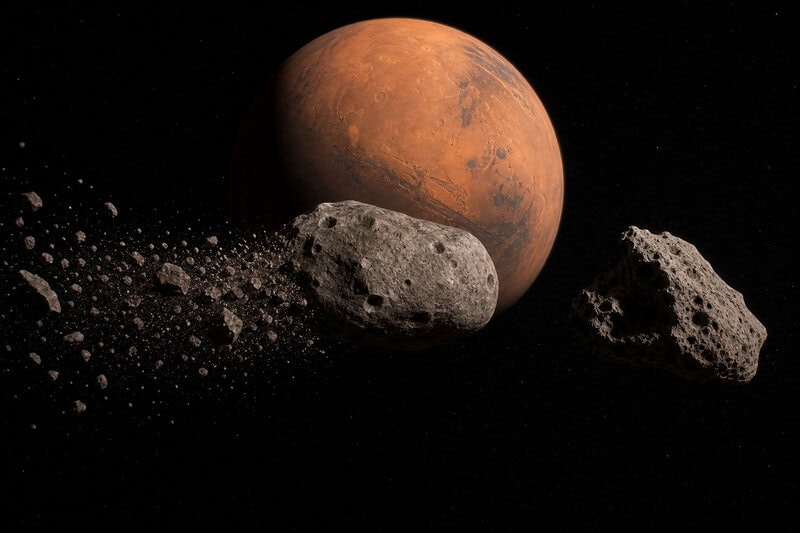
The critical threshold in Phobos’s future is known as the Roche limit — a concept named after French astronomer Édouard Roche, who calculated it in 1848. The Roche limit is the orbital distance inside which tidal forces from a planet overpower the self-gravity holding a loosely bound moon together. Cross that boundary, and disintegration becomes inevitable for a rubble-pile body.
A 2015 study published in Nature Geoscience by Benjamin Black and Tushar Mittal of the University of California, Berkeley, calculated that Phobos will cross the Roche limit in approximately 20 to 40 million years. At that point, according to their modeling, the moon is most likely to disintegrate into a debris ring encircling Mars — a ring that could persist for up to 100 million years before the particles gradually rain down onto the Martian surface, leaving an arc of craters as their final signature. Black and Mittal’s central estimate places the moon’s effective destruction at around 50 million years from now.
A second possibility exists, however, and the same study acknowledges it. If Phobos’s interior is structurally stronger or more cohesive than current models suggest — a meaningful uncertainty given how poorly constrained its internal composition remains — the moon could survive past the Roche limit and strike Mars directly. A direct impact of that scale would excavate a crater hundreds of kilometers wide, profoundly reshaping the Martian surface. Both outcomes are, on geological timescales, relatively near-term events: 50 million years represents barely more than one percent of the solar system’s 4.6-billion-year history.
Some planetary scientists working with Mars Express gravity data have proposed a third, more gradual scenario: that Phobos’s porous, fragile interior could cause it to begin breaking apart earlier than catastrophic breakup models predict, producing a more diffuse and extended ring rather than a dramatic planetary impact. These competing scenarios underscore a broader point — the 50-million-year figure is a well-supported estimate, not a precise countdown, and the error bars carry real scientific weight.
What Separates Phobos From Deimos — and Why It Matters
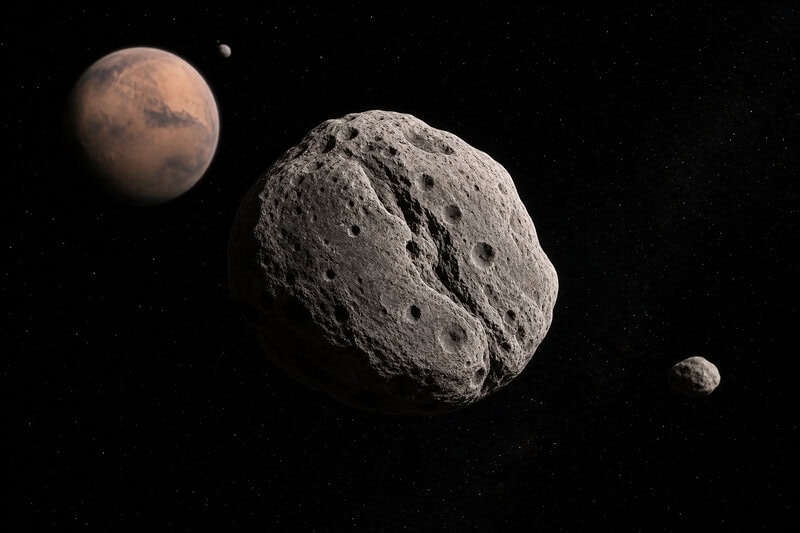
The contrast between the two moons Hall discovered in the same August week could hardly be sharper in terms of destiny. Deimos, the smaller and more distant of the pair, orbits Mars slowly enough that it experiences the tidal interaction in reverse: rather than being dragged inward, it is very slowly drifting outward, mirroring the behavior of Earth’s Moon. Deimos faces no tidal destruction. The two moons that Hall found within six days of each other are headed in opposite directions across deep time — one toward oblivion, one toward a quieter, indefinite future.
That difference matters beyond the purely scientific. Phobos’s low gravity and close orbit make it an attractive candidate for a crewed staging post in future Mars exploration. Landing on and departing from Phobos requires far less propulsive energy than descending to the Martian surface and climbing back out of its gravity well. Several mission concepts studied by NASA and ESA have identified Phobos as a strategically valuable waypoint for human missions to the Martian system — a base camp that, on any timescale relevant to human civilization, remains perfectly stable.
147 Years of Inquiry — and the Questions Still Open

Hall’s 1877 discovery, made with careful observation and clear Washington skies, launched nearly a century and a half of scientific inquiry into two of the solar system’s most unusual small bodies. The questions he could not have anticipated — Where did these moons form? What are they made of? How will they end? — remain among the most actively debated in planetary science.
Phobos now stands as one of the solar system’s most vivid, observable examples of tidal orbital decay in real time. The same physical process has shaped the histories of moons around Jupiter, Saturn, and Neptune, and it will, tens of millions of years from now, write the final chapter of the Martian moon system. Whether that ending takes the form of a diffuse ring slowly settling onto Mars or a single catastrophic impact reshaping the planet’s northern plains, the mechanism is already in motion — and it has been since long before Asaph Hall, on a summer night in 1877, became the first human being to see it.