
Walk down the toddler food aisle of any major grocery store and the packaging tells one story — smiling babies, farm-fresh imagery, the word “organic” in reassuring green letters. The nutrition science tells another: of 2,783 toddler food products recently analyzed by researchers at the University of Texas at Austin, 81% were classified as ultraprocessed, meaning the overwhelming majority of what lines those shelves was formulated from industrial ingredients rather than anything resembling a whole food.
The Number That Should Alarm Every Parent in the Baby-Food Aisle

The University of Texas at Austin finding is striking on its own, but it becomes more urgent when placed alongside population data. Peer-reviewed research published in PMC shows that toddlers already obtain roughly 47% of their daily calories from ultraprocessed foods (UPFs) — and that figure climbs to approximately 59.4% by school age. In other words, the trajectory runs in the wrong direction: early exposure appears to set habits and environmental conditions that push consumption higher, not lower, as children grow.
The timing matters enormously. The first 1,000 days of life — from conception through roughly age two — represent a singular biological window during which the brain is undergoing explosive growth, the gut microbiome is being seeded for the first time, and taste preferences are being calibrated in ways that can persist for decades. What a toddler eats during this window is not simply a matter of daily nutrition; it is, in a meaningful sense, a matter of developmental architecture. This is a data story, and the data are now specific enough to act on.
What ‘Ultraprocessed’ Actually Means — And What It Doesn’t
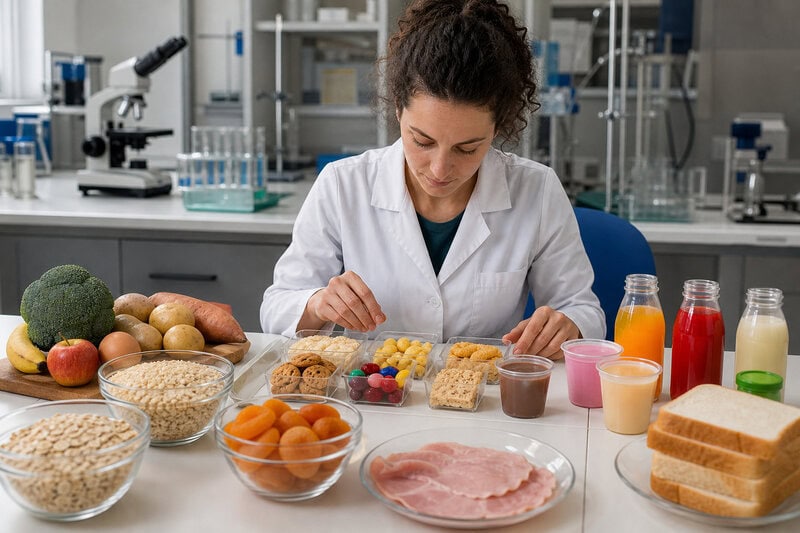
The term “ultraprocessed” has a precise scientific definition that is frequently lost in popular coverage. The NOVA classification system, developed by researchers at the University of São Paulo, sorts foods into four groups based on the extent and purpose of industrial processing — not simply whether a food was cooked, canned, or preserved. NOVA Group 1 covers unprocessed or minimally processed foods (fresh fruit, plain meat, eggs). Group 2 includes culinary ingredients like oils and salt. Group 3 covers processed foods such as canned beans or pasteurized cheese. Group 4 — the ultraprocessed category — describes products formulated from industrial substances largely absent from home kitchens: hydrolyzed proteins, modified starches, synthetic flavors, emulsifiers, and color additives. The University of Texas at Austin study applied this framework to all 2,783 products it examined.
The distinction matters because “processed” is not a synonym for “harmful.” Pasteurized milk is processed; canned tomatoes are processed; both are nutritionally sound. Ultraprocessed is a categorically different designation, defined by industrial reformulation that typically strips dietary fiber, concentrates sugars and sodium, and introduces additives whose long-term effects on the developing gut-brain axis are still being studied. The problem is not convenience — it is the degree of industrial transformation and what that transformation removes or adds.
What the New Study Found, and How It Was Done
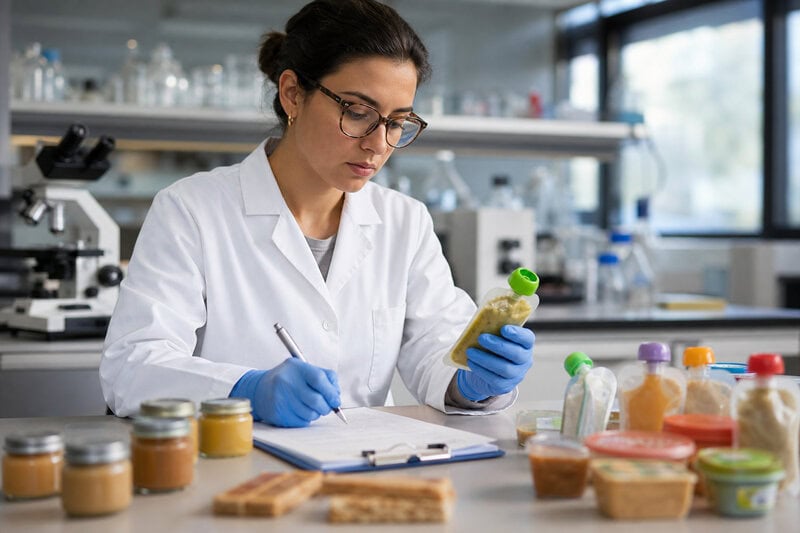
The University of Texas at Austin analysis examined 2,783 toddler food products found in grocery stores across Austin, Texas, applying NOVA criteria to each product’s ingredient list. Eighty-one percent met the definition for ultraprocessed (NOVA Group 4); 17% fell into a less-processed NOVA category. The remaining products were distributed across other groups.
A parallel nutrient analysis compounds the concern: reporting on the study notes that almost half of the toddler food products sampled also exceeded recommended levels of sugar, sodium, fat, or calories — meaning the issue is not only one of industrial formulation but of raw nutrient profile as well. A product can be ultraprocessed and technically low in sugar, or it can be both ultraprocessed and high in added sugars; a significant share of this market appears to be both simultaneously.
One geographic caveat deserves acknowledgment: the sampling frame was Austin grocery stores, which makes the findings highly representative of a large, diverse U.S. market but not automatically generalizable to every region or retail environment. Replication in other geographic and socioeconomic contexts would strengthen the conclusions. What the 17% figure does confirm, however, is that less-processed toddler food exists commercially — the market problem is one of proportion and accessibility, not of absolute impossibility.
How Ultraprocessed Food Interacts With a Toddler’s Developing Biology
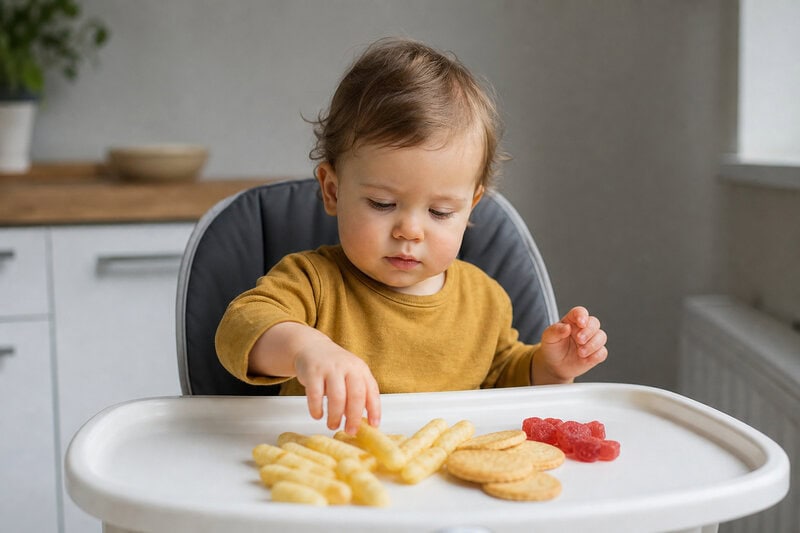
Between ages one and three, the brain is engaged in several nutritionally sensitive processes simultaneously: synaptic pruning (the selective elimination of excess neural connections to improve efficiency), myelination (the fatty insulation of nerve fibers that accelerates signaling), and the early maturation of the prefrontal cortex, which governs executive function and emotional regulation. These processes depend on adequate supplies of iron, zinc, long-chain omega-3 fatty acids, and choline. When roughly half of a toddler’s daily calories come from ultraprocessed foods — which tend to be poor sources of all four — the risk is not one dramatic deficiency event but a chronic, low-grade nutrient inadequacy during a window when the brain cannot afford it.
A second biological pathway involves the gut-brain axis. The infant and toddler microbiome is still being established, and its composition during early life has been associated with immune function, metabolism, and even behavioral outcomes. Emerging — though not yet consensus — research suggests that emulsifiers and artificial sweeteners common in ultraprocessed foods may alter microbial diversity in ways that influence neuroinflammation and mood regulation. Causality in human populations has not been definitively established, and this area of inquiry should be understood as promising rather than settled.
A third mechanism is perhaps the most straightforward: taste-preference programming. Repeated early exposure to hyper-palatable combinations of sugar, salt, and fat appears to calibrate a child’s hedonic set point upward, making minimally processed whole foods comparatively less rewarding by contrast. This pattern is well-documented in animal models and is supported by observational studies in children, though the precise degree to which early exposure locks in later preferences — versus merely influencing them — remains an active area of research.
What is not emerging or contested is the harm associated with UPF-heavy diets in children more broadly. UNICEF’s systematic review of ultraprocessed foods and children identifies strong evidence linking UPF intake to poor overall diet quality, overweight and obesity, and dental caries. These are consensus findings supported by multiple independent lines of evidence.
The Trajectory Problem: From 47% to 59.4% — and Why It Compounds

The escalation from 47% of daily calories from UPFs in toddlerhood to 59.4% by school age is not merely a statistic — it describes a reinforcing system. Early taste calibration makes whole foods less appealing. Institutional food environments — daycare, preschool, school cafeterias — often amplify rather than correct early patterns. And marketing continues to work on both children and caregivers throughout childhood, using the same health-halo signals — “organic,” “natural,” “made for growing bodies” — that proved misleading in the toddler aisle.
The harm compounds not only through exposure but through displacement. Every percentage point of daily calories provided by an ultraprocessed product is a percentage point not occupied by the iron, calcium, and docosahexaenoic acid (DHA, a critical omega-3 fatty acid) that the developing brain and skeleton require. The damage is as much about what is crowded out as about any single harmful ingredient.
There is also an equity dimension that the aggregate numbers obscure. Lower-income families face disproportionate exposure to ultraprocessed foods through food-desert geography, the product composition of SNAP-eligible items, and more aggressive in-store marketing in lower-income retail environments. The burden of this study’s findings is not evenly distributed, and any policy response that addresses only individual consumer choice will necessarily be incomplete.
What Caregivers and Pediatricians Can Do Right Now

The American Academy of Pediatrics recommends that toddler diets prioritize whole or minimally processed foods — fruits, vegetables, legumes, whole grains, eggs, and plain dairy — as the foundation of daily eating. That guidance does not require the elimination of every packaged product from a child’s diet, nor does it expect perfection from caregivers navigating real constraints of time, cost, and availability. The goal is proportion, not purity.
A practical heuristic for label reading: if a toddler snack’s ingredient list includes substances that would not be found in a home kitchen — carrageenan, maltodextrin, acesulfame potassium, or three or more distinct types of added sugars — the product likely qualifies as ultraprocessed under NOVA criteria. Shorter ingredient lists composed of recognizable whole-food components are a reliable signal of lower industrial processing, even when a product is packaged for convenience.
Pediatricians have a role to play as well. Dietary screening at well-child visits has traditionally focused on quantity — is the child eating enough? — rather than quality — what is the child actually eating? Parents should feel empowered to raise the question of UPF intake specifically with their child’s provider, and pediatric professional organizations are increasingly recognizing that food-quality assessment belongs in routine developmental surveillance.
Individual choices, however, operate at the margins of a structural problem. UNICEF’s review and pediatric nutrition researchers broadly agree that regulatory action — mandatory front-of-pack labeling that accurately signals NOVA classification, marketing restrictions on toddler-targeted UPFs, and updated product standards for WIC and SNAP — is necessary to shift outcomes at the population level. Consumer literacy is a complement to policy, not a substitute for it.
The Bottom Line: A Solvable Problem With an Urgent Timeline
The scientific record at this point supports two tiers of conclusion. The first tier is well-established: the majority of commercially available toddler foods are ultraprocessed, UPF-heavy diets in early childhood are linked to poor diet quality, overweight, obesity, and dental disease, and the proportion of calories children obtain from UPFs increases rather than decreases as they age. The second tier is important but still developing: the precise neurological and microbiome mechanisms by which early UPF exposure shapes long-term brain development are an active area of investigation, not yet settled science.
The asymmetry between those two tiers matters for how urgency is framed. Because the first three years of life are biologically irreplaceable for brain and metabolic development, the cost of waiting for complete mechanistic evidence before acting is meaningfully higher here than in almost any other public-health context. The biological window closes whether or not the research is finished.
Eighty-one percent is not a verdict on individual parents making difficult decisions in difficult circumstances. It is a verdict on a food system that has filled the toddler aisle with products formulated for palatability, shelf stability, and profit margin — products that were never designed with neurodevelopment as a primary consideration. That number is specific enough, and the developmental stakes are high enough, to demand a response that is equally specific.