
Imagine a world where rivers of liquid methane carve canyons into orange-tinted plains, where the air is thick enough to breathe through a mask but cold enough to freeze you solid in seconds — and where, just possibly, something is alive. That world is Titan, Saturn’s largest moon, and NASA is sending a nuclear-powered rotorcraft to explore it. Better yet, your name can go along for the ride.
A Moon Unlike Anything Else in the Solar System
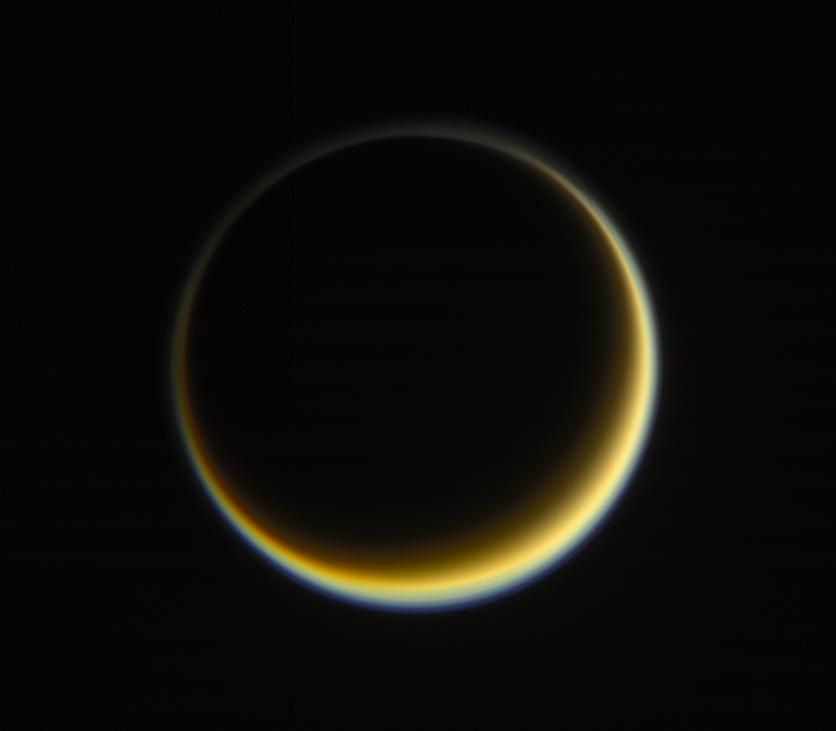
Titan is extraordinary by almost every measure. It is the only moon in our solar system with a dense, planet-like atmosphere — a thick nitrogen-rich haze that gives it a burnt-orange glow visible from space. It is larger than the planet Mercury. And unlike every other moon we know of, Titan has stable liquid pooled on its surface in the form of lakes, rivers, and wide methane seas.
Those seas are not water. Titan’s surface temperatures hover around −179°C, cold enough to keep methane and ethane in liquid form the way water stays liquid on Earth. The result is a hydrological cycle eerily parallel to our own — clouds form, rain falls, rivers flow — except the working fluid is hydrocarbon, not H₂O. The methane lakes clustered near Titan’s poles are among the most alien landscapes scientists have ever studied from afar, and they raise a question that drives serious astrobiological inquiry: could something live in them?
Could Titan’s Methane Seas Host Life?

Mainstream astrobiology has long treated liquid water as the essential ingredient for life. Titan challenges that assumption in a scientifically credible way. Researchers have theorized that cell-like structures called azotosomes could form in liquid methane, functioning much the way lipid membranes function in water-based life on Earth. The chemistry would be radically different from anything we know, but it would not necessarily violate the laws of physics or biochemistry.
Adding to Titan’s intrigue is the presence of tholins — complex organic molecules that form when nitrogen and methane in the atmosphere are energized by sunlight and cosmic radiation. Tholins are chemically similar to the kinds of prebiotic molecules scientists believe existed on early Earth before life emerged. Titan, in this sense, may be a deep-frozen snapshot of Earth’s distant past, preserving a chemistry that eventually led to biology here but may not yet have done so there — or may have, in some form we have not yet detected.
Even if life turns out to be absent, the data gathered at Titan will be invaluable. Understanding how far organic chemistry can progress without crossing into biology would itself be a landmark discovery for understanding life’s origins across the cosmos.
Meet Dragonfly: The Rotorcraft NASA Is Sending to Saturn’s Moon

The NASA Dragonfly mission is designed to solve a fundamental problem: how do you explore a world this complex and this varied from the surface? A traditional rover would struggle. Titan’s terrain shifts from wind-sculpted dunes to flat plains to the shattered floors of ancient impact craters — environments separated by distances no rover could efficiently cross. A rotorcraft can.
Dragonfly is a car-sized rotorcraft lander with eight rotors, built to take off, fly, and land repeatedly across Titan’s surface. Titan’s thick atmosphere and relatively low gravity create favorable flying conditions — far better than Mars, where NASA’s Ingenuity helicopter contended with an extremely thin atmosphere to achieve lift. On Titan, Dragonfly is designed to travel dozens of miles in a single flight, covering more scientific ground in one hop than a rover might manage in years of slow surface travel.
The mission’s targets are scientifically rich by design. Dragonfly will sample organic-laden dune fields and explore the Selk impact crater, where liquid water and complex organics may have briefly mixed billions of years ago, potentially creating habitable conditions. Its instrument suite is built to detect biosignatures and map surface chemistry with a precision that orbital missions cannot achieve.
Power comes from a Multi-Mission Radioisotope Thermoelectric Generator — the same nuclear battery technology used on Mars rovers. Sunlight at Titan is too weak and too intermittent for solar panels to be practical, making nuclear power the proven choice for a mission of this ambition and duration.
The NASA Dragonfly mission is scheduled to launch in 2027, after which the spacecraft will travel to Titan. It represents one of the most technically ambitious planetary science endeavors of this decade and a genuine first in the history of space exploration: a powered aerial vehicle operating on another world beyond Mars.
Send Your Name to Titan — Here’s How

NASA has a long tradition of inviting the public to participate in its missions in a tangible way, and Dragonfly is no exception. Through the Journey to Titan campaign, anyone in the world can submit their name to be encoded on a microchip that will fly aboard the Dragonfly spacecraft. Your name will make the same journey as the rotorcraft itself, eventually arriving on the surface of Saturn’s largest moon.
Signing up takes only a few minutes, costs nothing, and is open to participants of all ages worldwide. After submitting, you receive a personalized Boarding Pass — a shareable digital keepsake confirming your place on the mission. You can send your name with Dragonfly directly through NASA’s official campaign page.
Why This Mission Deserves Your Attention Now
The 2027 launch window may feel distant, but in the context of planetary science, preparation and public engagement begin years before a spacecraft leaves the ground. The discoveries Dragonfly makes could reshape how humanity thinks about habitable worlds for generations. If life — even microbial, even chemically alien — exists in Titan’s methane lakes, it would rank among the most significant discoveries in human history. If it does not, we will still have learned something profound about the boundaries of biology and the conditions that give rise to it.
Either outcome advances our understanding in ways that matter.
Registering for a Boarding Pass now is more than a novelty. It is a way to connect yourself to one of the great scientific adventures of the century from its very beginning — before the launch, before the landing, before whatever Dragonfly finds waiting on those cold, orange shores. The door to participate, at least symbolically, is open to everyone.
Learn more about the NASA Dragonfly mission and the Journey to Titan campaign on NASA’s official website.