
A supermassive black hole in the early universe is consuming material at a rate that pushes against what physicists thought was physically possible — and NASA’s James Webb Space Telescope captured the entire process in extraordinary detail, from the cold gas filaments delivering raw fuel to the blazing disk where matter disappears forever. The findings, published around July 14, 2026, by a team at the University of Nottingham, are already reshaping how astronomers think about the universe’s first billion years.
A Cosmic Engine Caught in the Act
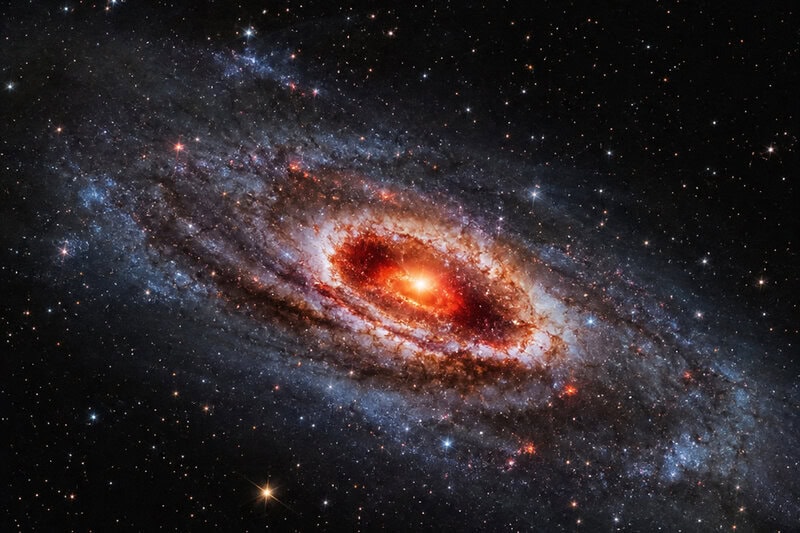
The object at the center of this discovery is designated CANUCS-LRD-z8.6 — a compact, high-redshift galaxy whose name reflects the survey that found it and its approximate redshift of 8.6. That number is not just a catalog label: it means the light Webb detected left this galaxy when the universe was less than 600 million years old, roughly four percent of its current age. Observing CANUCS-LRD-z8.6 is, in practical terms, looking 13 billion years into the past.
What Webb found there was not a quiet, dormant core. It found a supermassive black hole — defined as any black hole exceeding one million solar masses — in a state of vigorous, structured feeding, with observable signatures that no earlier telescope could have isolated against the glow of the surrounding host galaxy. According to the University of Nottingham research team, this detection was made possible by Webb’s ability to capture faint infrared light that would have been entirely invisible to its predecessors. The discovery raises an immediate and uncomfortable question for theorists: how does a black hole this massive even exist so early, and how did it grow so fast?
What “Feeding” Actually Means: The Mechanics of a Hungry Black Hole
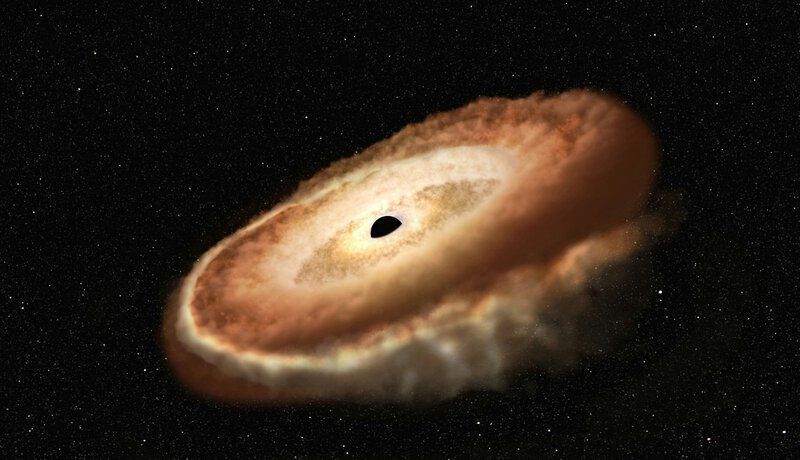
The popular image of a black hole as a cosmic vacuum cleaner is misleading in one important way. Gravity does not pull infalling matter straight down into the abyss. Instead, angular momentum — the same physics that keeps water spiraling around a drain — torques the gas into a flat, spinning structure called an accretion disk. Webb’s observations revealed just such a disk around CANUCS-LRD-z8.6, measuring an extraordinary 800 light-years across.
Gas does not arrive at that disk on its own. Webb detected gas filaments — long, structured threads of cold gas stretching across thousands of light-years — acting as gravitationally guided delivery channels, funneling raw material from the outer reaches of the host galaxy toward the hot inner disk. This filamentary feeding mechanism had been predicted by cosmological simulations for decades, but Webb’s observation of CANUCS-LRD-z8.6 represents one of the first times the structure has been traced observationally at such an early cosmic epoch.
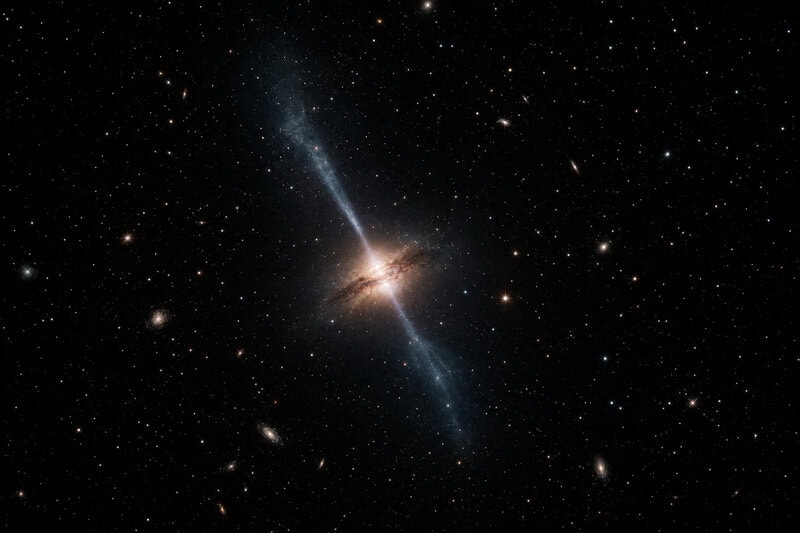
Inside the accretion disk, friction heats gas to millions of degrees. That heated gas radiates brilliantly across the electromagnetic spectrum, producing the phenomenon astronomers call an Active Galactic Nucleus (AGN) — the technical designation for a galaxy whose central black hole is actively consuming material and powering a luminous core. When feeding intensifies, the system activates like a cosmic engine, blasting powerful jets of energy back into the surrounding galaxy. This outflow is not a side effect; it is a fundamental part of the feeding cycle, and understanding it is one of the primary reasons this observation matters.
What Webb and Chandra Actually Saw
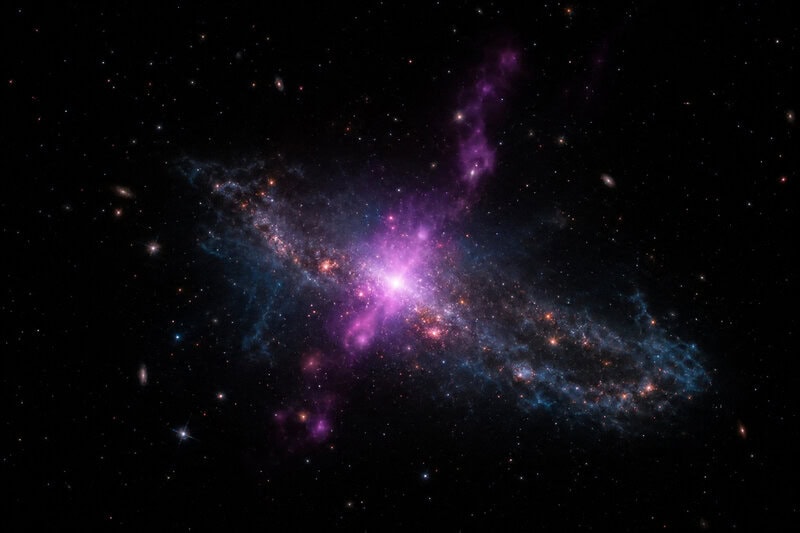
No single telescope could have produced this picture alone. Astronomers combined data from NASA’s James Webb Space Telescope and NASA’s Chandra X-ray Observatory to characterize the black hole and its feeding environment. The pairing was strategically essential: Webb’s infrared sensitivity revealed the warm gas structures — the filaments and the disk — while Chandra’s X-ray vision exposed the high-energy outflows generated as the black hole fed. Seeing both simultaneously gave researchers an end-to-end picture of inflow and outflow within the same observational window, something that has not been achieved before at this cosmic distance.
Webb’s detection of the faint light signature from CANUCS-LRD-z8.6 was the critical breakthrough. Earlier observatories simply lacked the sensitivity to separate that signal from the ambient glow of the host galaxy. The 800-light-year-wide spinning disk that emerged from the data is not merely an impressive measurement — it is a geometric map of how matter spirals inward, giving theorists observational constraints they have never had before at this redshift.
In complementary work, NASA’s Webb also delivered an unprecedented look into the heart of the Circinus Galaxy, a well-studied AGN located far closer to Earth. Because the Circinus Galaxy is nearby, Webb can resolve its feeding structures in far greater detail than is possible at cosmological distances. This makes it a valuable local benchmark — a control case that allows astronomers to test whether the same feeding physics operate across 13 billion years of cosmic history.
Why the Early Universe Is the Hardest — and Most Important — Place to Look
Standard galaxy-formation models face a genuine difficulty with objects like CANUCS-LRD-z8.6. Building a supermassive black hole takes time: a seed black hole must accrete mass continuously, and there are physical limits on how fast that can happen. The most important of these is the Eddington limit — the point at which radiation pressure from heated infalling gas becomes strong enough to push that same gas outward, effectively choking further infall. Sustained feeding at or above this limit is considered physically difficult, and the rates implied by this discovery push hard against that boundary.
The University of Nottingham team’s findings are consistent with an emerging — though not yet consensus — hypothesis that early black holes fed in short, intense bursts rather than at steady rates. This burst-feeding model could resolve what has become known as the “overmassive black hole” problem: the repeated discovery, since Webb began science operations in 2022, of black holes that are simply too large for the age of the universe under standard continuous-accretion models. This discovery adds to a growing body of evidence challenging existing formation timelines.
It is important to be clear that this remains an actively debated area of astrophysics. Some researchers argue that exotic “seed” black holes — formed through the direct collapse of massive gas clouds rather than through the death of individual stars — may be required to explain how such massive objects existed so early. Others contend that revised accretion physics alone, without exotic formation mechanisms, can account for the observations. Webb is now generating the empirical data needed to adjudicate between these competing frameworks, but no single discovery settles the question, and the field should be understood as genuinely unsettled.
Jets, Feedback, and Why This Matters for Every Galaxy — Including the Milky Way
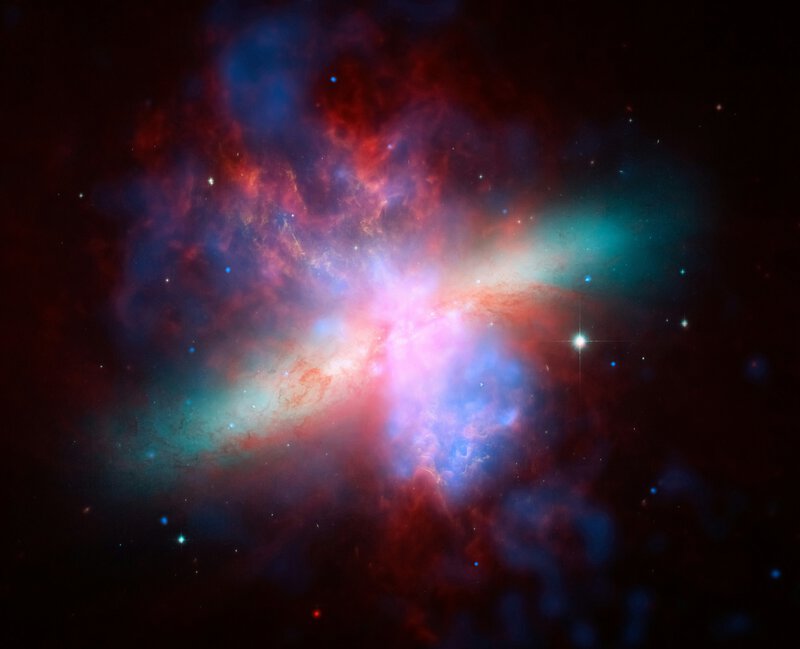
The jets that erupt from an intensely feeding black hole are among the most energetic phenomena in the observable universe, and they do not simply dissipate into empty space. When this energy is deposited into the surrounding galaxy, it can heat gas to temperatures at which it can no longer gravitationally collapse into new stars — a process called AGN feedback. AGN feedback is now considered a cornerstone mechanism by which galaxies self-regulate their own growth: the black hole feeds, launches energy outward, suppresses star formation, and thereby limits the future supply of stars and gas that would otherwise continue fueling the cycle.
Webb’s ability to trace both inflow and outflow in the same observation provides an end-to-end picture of this feedback cycle at early cosmic epochs for the first time. The geometry of the gas filaments is directly relevant: the angle and rate at which gas arrives at the accretion disk influences whether jets form, how powerful they are, and ultimately whether the host galaxy is quenched or continues forming stars. That level of observational detail was simply unavailable before Webb.
The implications extend to our own cosmic neighborhood. The Milky Way’s central black hole, Sagittarius A*, is currently dormant — but structural evidence in its surroundings suggests it experienced intense feeding episodes in the geologically recent past. Understanding actively feeding systems like CANUCS-LRD-z8.6 directly informs models of what our own galactic center once looked like and may look like again.
A key open question — clearly unresolved as of this writing — is whether the energy jets deposit into a galaxy is net destructive, permanently shutting off star formation, or whether it can also compress cold gas clouds and trigger new star-formation episodes in localized regions. Webb’s multi-epoch survey programs are designed to accumulate the statistical samples needed to distinguish between these outcomes.
What Comes Next
The University of Nottingham team’s July 2026 publication is a foundation, not an endpoint. Follow-up spectroscopy is planned to measure the precise chemical composition of the infalling gas filaments detected around CANUCS-LRD-z8.6. That data will reveal whether the material is pristine primordial gas — composed almost entirely of hydrogen and helium left over from the Big Bang — or whether it has already been chemically enriched by earlier generations of stars. The distinction carries significant implications for how early the universe’s first stellar populations formed and died.
Additional high-redshift targets are already in Webb’s observing queue, with the goal of determining whether CANUCS-LRD-z8.6’s feeding rate is genuinely exceptional or representative of a broader population. Webb has repeatedly flagged a class of objects called “little red dots” — compact, red, high-redshift AGN — that appear far more numerous in the early universe than models predicted. Whether CANUCS-LRD-z8.6 belongs to this class, and whether all little red dots share its unusual feeding characteristics, is an open and active area of investigation.
Combined Webb-Chandra observational programs will continue mapping X-ray jet structures to quantify how much energy is being deposited into the surrounding intergalactic medium — a number that feeds directly into next-generation cosmological simulations. Taken together, these efforts point toward a broader ambition: Webb is not merely cataloging exotic objects. It is assembling, piece by piece, an empirical framework for how the universe built its largest structures — one feeding black hole at a time.