
The Milky Way just got a little bigger — or at least it may have. A team of astronomers using NASA’s Chandra X-ray Observatory has found that the galaxy’s outer spiral arms may extend as much as 10% farther from the galactic center than previous measurements have indicated. If confirmed through independent observation, the result would require scientists to redraw the structural map of our own cosmic home and revise a cascade of models built upon it.
What 10% Farther Actually Means at Galactic Scale
Ten percent sounds modest until you apply it to an object roughly 100,000 light-years across. At that scale, a 10% outward revision adds a band of space tens of thousands of light-years wide to the Milky Way’s outer disk — a region so vast that light itself would take tens of thousands of years to cross it. That is not a rounding error. It is an entire zone of the galaxy that previous maps did not fully account for.
The stakes extend well beyond cartography. The outer spiral arms of the Milky Way are active zones of star formation, reservoirs of interstellar gas, and critical anchors for models of galactic mass. Pushing those arms outward would force astronomers to revise estimates of the galaxy’s total mass, recalibrate the distribution of dark matter in its outer regions, and reassess the Milky Way’s gravitational relationship with neighboring galaxies — including the Andromeda galaxy, with which it is expected to eventually merge. The researchers describe the finding as an emerging result: a compelling data point that requires further observation and independent replication before it can reshape the scientific consensus.
How Chandra Made This Measurement
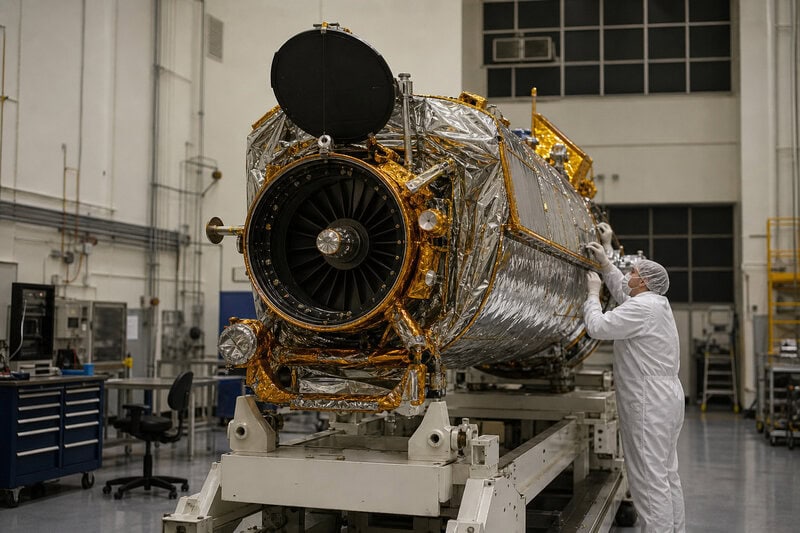
NASA’s Chandra X-ray Observatory, launched in 1999, is a space-based telescope that detects X-ray emissions invisible to ordinary optical telescopes. Because X-rays can penetrate dust and gas that block visible light, Chandra can probe the hidden architecture of the galaxy in ways that ground-based and infrared observatories cannot. That capability is especially valuable when studying the Milky Way’s outer disk, which is partially obscured by dense material concentrated along the galactic plane.
The new study combined Chandra’s X-ray sensitivity with observations of gamma-ray bursts — violent, short-lived cosmic explosions typically associated with the collapse of massive stars or the merger of neutron stars. Gamma-ray bursts are among the most energetic events in the known universe, and their light travels billions of light-years before reaching Earth. That extraordinary reach makes them natural probes of intervening galactic structure: as gamma-ray burst light passes through different regions of the Milky Way, it is absorbed and scattered in measurable ways that reveal the density and location of the material it has traveled through.
By analyzing how gamma-ray burst light interacted with the Milky Way’s outer spiral arms, the research team was able to infer where those arms actually lie. That constitutes an independent line of evidence, cross-checking decades of older radio and infrared measurements — and the result suggests the outer arms sit measurably farther out than those earlier surveys indicated.
The Old Map: What Scientists Previously Believed
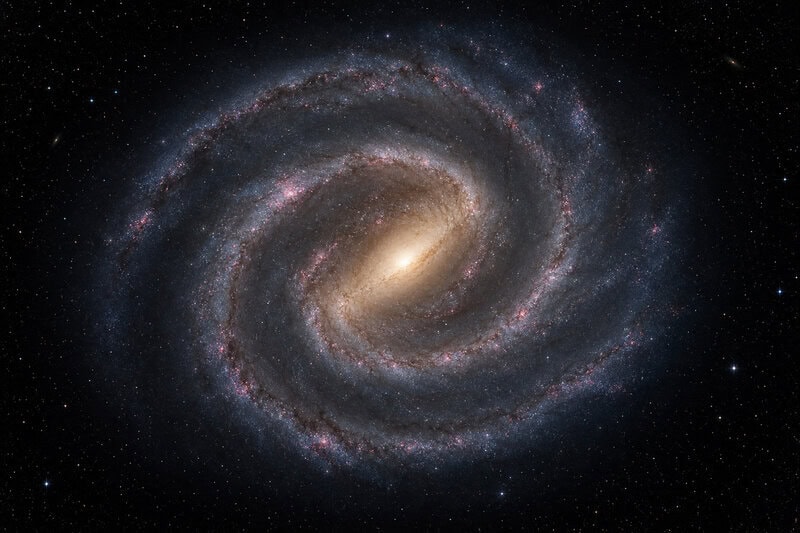
Before this study, the scientific consensus held that the Milky Way is a barred spiral galaxy — a disk of stars, gas, and dust anchored by a central bar-shaped structure, with several major spiral arms radiating outward. Those arms, including the Outer Arm and the Scutum-Centaurus Arm, had been mapped primarily through radio telescope surveys tracking neutral hydrogen gas emissions and through infrared studies of stellar distribution across the disk.
Those methods produced a coherent and widely accepted picture, but they carry a fundamental limitation: Earth sits inside the Milky Way’s disk, roughly 26,000 light-years from the galactic center. Mapping the galaxy’s full structure from that vantage point is analogous to trying to draw a city’s street map while standing in the middle of one neighborhood. Distant spiral arms overlap with closer structures along the same line of sight, and dust clouds absorb the very light that would otherwise reveal what lies behind them.
As a result, previous estimates of the galaxy’s outer dimensions relied on indirect tracers whose precision was always understood to have limits. Revising those estimates by even 10% carries real scientific weight, because the models built upon them extend far beyond galactic cartography. Calculations of dark matter distribution in the Milky Way’s outer regions, the timeline and dynamics of its eventual merger with Andromeda, and the galaxy’s total baryonic mass all depend, in part, on knowing where the outer disk actually ends.
The Galactic Halo — and Why Its Boundaries Now Matter More
Closely connected to the question of the outer spiral arms is the structure of the Milky Way’s galactic halo — a vast, roughly spherical region of diffuse gas, ancient stars, and dark matter that envelops the galactic disk and extends far beyond its visible edge. The halo is not a sharp boundary but a gradual transition zone, and its inner edge is defined in part by where the disk’s spiral structure gives way to more diffuse material.
If the outer spiral arms extend farther than previously mapped, astronomers must also reassess where the disk ends and the halo begins. That boundary matters because the halo is believed to hold a substantial fraction of the Milky Way’s ordinary matter in the form of hot, diffuse gas — precisely the kind of high-temperature, low-density material that Chandra’s X-ray instruments are uniquely equipped to detect and characterize.
Understanding the halo’s extent and gas content has direct implications for models of how the Milky Way sustains star formation over cosmic time. Galaxies are thought to replenish the gas consumed by star formation by drawing fresh material from their halos, a process sometimes described as cosmic recycling. If the halo’s boundaries and mass must be revised upward to accommodate a larger disk, those accretion models would need updating as well — making this not merely a question of galactic dimensions but one tied to the long-term evolutionary fate of the galaxy itself.
Caveats, Contested Ground, and What Comes Next

It is important to be precise about what this study does and does not claim. The core structure of the Milky Way as a barred spiral galaxy with several named spiral arms is well-established consensus, supported by decades of independent observations across multiple wavelengths. What is new — and not yet confirmed — is the specific finding that the outer arms may be located as much as 10% farther from the galactic center than previous measurements indicated. That result is emerging, not settled.
One inherent constraint involves the gamma-ray bursts used as distance probes. Such bursts are rare and occur at unpredictable locations across the sky. The sample of bursts available to anchor this measurement is limited, and a smaller sample means greater statistical uncertainty. The researchers themselves acknowledge this as a boundary condition on the result’s current precision.
Independent replication through different observational approaches will be necessary before this finding reshapes the consensus map. Data from the European Space Agency’s Gaia space observatory — which is building a highly detailed three-dimensional catalog of stellar positions within the Milky Way — could provide an important cross-check. Next-generation radio surveys capable of tracing hydrogen gas with greater sensitivity may also help confirm or refine the outer arm positions the Chandra study identified.
It is equally important to avoid overstating the result. The outer spiral arms are estimated to reach as much as 10% farther from the galactic center — a meaningful and scientifically significant revision, but an incremental one. Multiple outlets covering the discovery have emphasized that the finding opens new questions rather than closing old ones. Characterizing it as proof that the Milky Way is dramatically larger would misrepresent what the data actually show.
Redrawing Our Place in the Universe
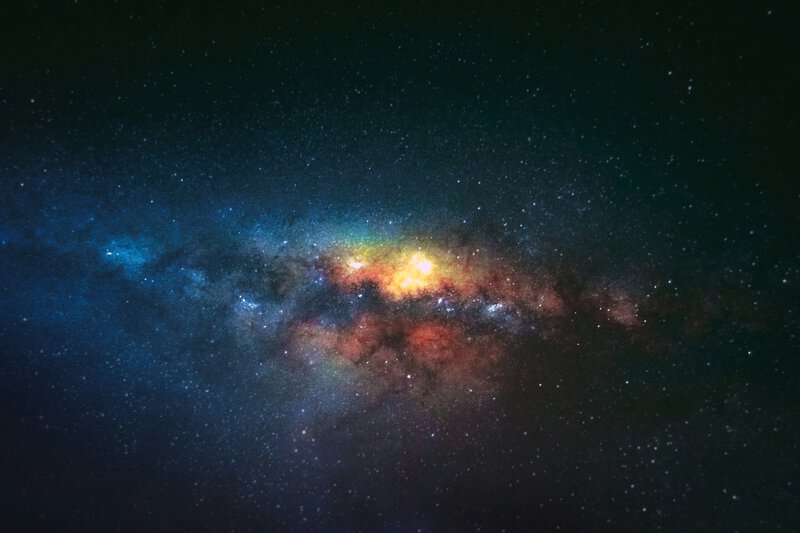
Every revision to the Milky Way’s map is a reminder of how early humanity still is in understanding its own cosmic neighborhood. The galaxy is so large that light, traveling at approximately 186,000 miles per second, takes roughly 100,000 years to cross it from edge to edge — yet no spacecraft has ever left it, and no external photograph of it exists. Everything known about the galaxy’s structure has been inferred from observations made within it, using instruments of steadily improving precision.
Chandra represents one of the most powerful tools in that effort. Since its launch in 1999, the observatory has delivered discoveries that optical telescopes cannot replicate, probing the high-energy phenomena — from supernova remnants to black hole jets — that define the hidden architecture of galaxies. Its application to mapping the Milky Way’s own spiral structure represents a relatively new and productive use of its capabilities, one that complements rather than competes with the radio and infrared surveys that built the existing consensus.
If the outer spiral arms are confirmed to extend farther than previously mapped, the result would prompt revisions not just to models of galactic structure but to the broader astronomical frameworks built upon them — including dark matter halo estimates, galactic mass calculations, and the long-range dynamics of the Local Group. The finding, pending independent confirmation, would make our galaxy measurably larger than the maps scientists have relied upon for decades, and would underscore a point that astronomy keeps returning to: the universe consistently turns out to be more than our best instruments, at any given moment, have yet revealed.