
In 2022, a rose-colored stone pulled from the sands of the Sahara Desert turned out to be one of the most extraordinary rocks on Earth — because it did not originate here. It came from Mars, and it is more than 4.1 billion years old, predating nearly everything scientists currently understand about the red planet’s earliest chapter.
A Rock With a 4-Billion-Year Secret
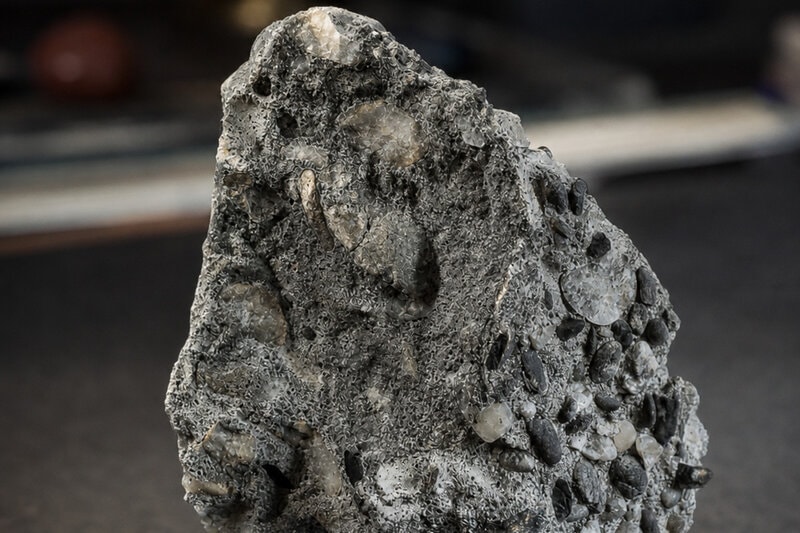
The meteorite, named Teghaza 001, sits in a remarkable and tiny category. Of all the Martian meteorites ever catalogued, only two or three are known to have formed before 4 billion years ago. That places Teghaza 001 on exceptionally rare footing — a physical artifact from a time when Mars was still geologically young, volcanically restless, and possibly capable of supporting life.
A NASA-funded study has now detailed what is inside this ancient Mars rock, and the findings are already reshaping how scientists think about the planet’s earliest crust. What follows is what this rock is, what researchers found within it, and why it matters — not just for understanding Mars, but for the broader question of whether life ever existed there.
What Is a Mars Meteorite — and How Does One End Up in the Sahara?

The journey from Mars to Earth is violent and improbable. When a large asteroid strikes the Martian surface with enough force, it can eject chunks of rock at speeds exceeding the planet’s escape velocity. Those fragments then drift through space, sometimes for millions of years, until gravitational mechanics bring them into Earth’s path. Most burn up during atmospheric entry. Some do not.
Of roughly 70,000 meteorites humans have ever catalogued, only a few hundred are confirmed to be Martian in origin. Scientists identify them by analyzing their chemical signatures and trapped gases, which match measurements taken directly from the Martian atmosphere by spacecraft. The match has to be precise — and when it is, the origin is unmistakable.
The Sahara Desert is one of the best natural collection sites on Earth for exactly this kind of discovery. Dark rocks stand out sharply against pale desert sand, making finds that might go unnoticed elsewhere far easier to spot. Teghaza 001 was recovered there in 2022 and rapidly identified as Martian, setting the stage for the detailed scientific investigation that would follow.
Meet Teghaza 001: A Rose-Colored Relic of Young Mars
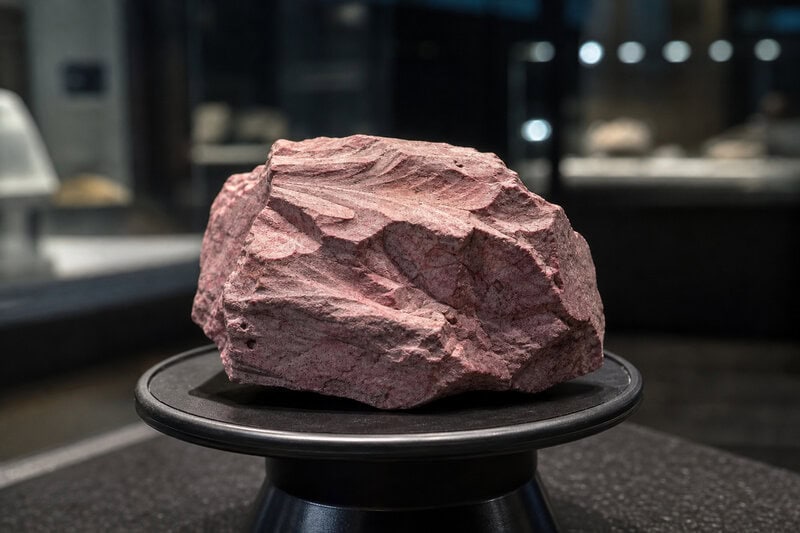
The rock’s distinctive rose coloration is not merely cosmetic — it hints at the mineral composition locked inside, reflecting the chemistry of an ancient Martian crust that no longer exists in the same form on the planet’s surface today. Its age of more than 4.1 billion years means it formed during what geologists call the Noachian period, or even earlier, when Mars looked nothing like the cold, thin-aired desert world observed by modern spacecraft.
To put that age in perspective: Earth itself is approximately 4.5 billion years old. Teghaza 001 formed when the solar system was still relatively young — when Mars may have had a thicker atmosphere, flowing liquid water, and active volcanoes reshaping its surface. The rock is, in a very real sense, a frozen moment from a vanished world.
Its rarity is underscored by the fact that it joins only two or three other known Mars meteorites from this era. Understanding rocks like these is not an academic exercise — it is one of the only ways scientists can study the deep past of another planet using physical samples rather than data relayed from orbit or interpreted from a rover’s instrument suite hundreds of millions of kilometers away.
What Scientists Found Inside the Rock
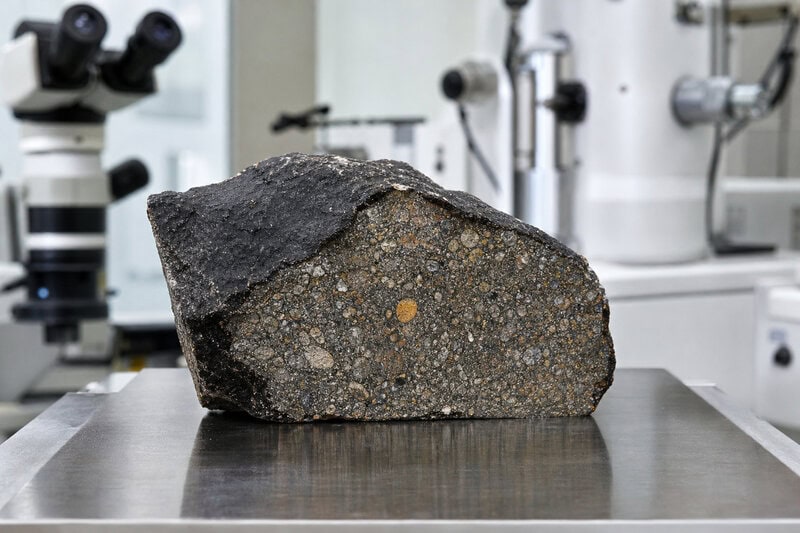
The NASA-funded study subjected Teghaza 001 to detailed mineralogical and chemical analysis, producing a rare and direct snapshot of what Mars’s ancient crust was actually made of more than four billion years ago. That kind of ground-truth data cannot be fully replicated by orbiters or rovers, which observe the surface from a distance or sample only the material directly accessible to their instruments at one location.
Among the study’s most significant findings was the identification of 13 specific locations on the Martian surface whose mineralogy and chemistry closely match those of Teghaza 001. This effectively gave researchers a shortlist — a set of candidate regions where rocks from the same ancient crust may still be accessible today.
The rock’s composition also helps scientists reconstruct the geological conditions of early Mars in concrete terms: what minerals were present, how the crust was structured, and how different that environment was from the Mars that exists now. These data points anchor theoretical models to physical reality in a way that remote sensing alone cannot achieve.
Crucially, the study also examined how much of the rock’s original Martian chemistry has been altered by its time on Earth. Terrestrial contamination is a persistent concern with meteorite analysis — water, salts, and biological material in the recovery environment can infiltrate a sample over time, complicating the picture. Establishing what is genuinely Martian in Teghaza 001 is essential groundwork before any deeper interpretations can be drawn.
Why Early Mars Matters
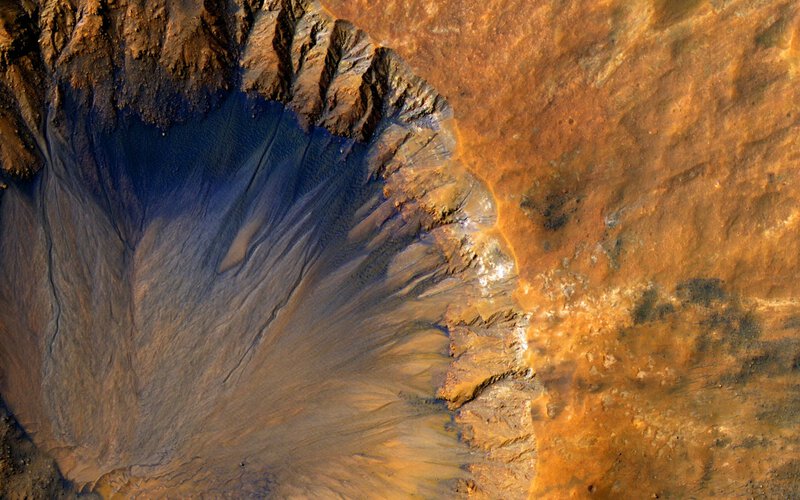
Mars before 4 billion years ago is thought to have been a fundamentally different planet. Evidence gathered by orbiters and rovers suggests it once had liquid water on its surface, a denser atmosphere, and volcanic activity that released heat and gases into the environment. These are, broadly speaking, the kinds of conditions that on Earth gave rise to microbial life.
Most of what scientists know about this period comes from instruments hundreds of millions of kilometers away. A physical sample like Teghaza 001 offers something no spacecraft can transmit: the actual chemistry, locked in crystal structures and mineral grains, of what that early Mars was made of. Scientists describe meteorites like this one as offering ground truth that orbital data simply cannot replicate.
The 13 matched surface locations identified in the study also carry practical implications. Future Mars missions — including ongoing sample-return efforts — could potentially prioritize those regions, dramatically increasing the scientific value of whatever samples they retrieve. Knowing where to look, and why, is half the mission.
What This Rock Does — and Doesn’t — Tell Us About Life on Mars
Teghaza 001 has not yielded direct evidence of ancient Martian life. That is an important clarification, and scientists are careful to make it. The study was not designed to search for biosignatures, and drawing conclusions the data does not support would undermine the careful work the research represents.
What the rock does offer is something equally essential: a chemical and mineralogical baseline for what early Mars actually looked like. Before asking whether life could have existed in a given environment, scientists need to understand what that environment was. Teghaza 001 provides precisely that — a reference point for the conditions that existed on Mars during the period when life, if it ever arose there, would most plausibly have done so.
The identification of 13 candidate source regions means future missions could retrieve rocks from the same ancient crust — rocks that might be better preserved, more accessible, or richer in the kinds of organic chemistry that biosignature searches depend on. Understanding the broader context of Mars’s habitability is the necessary foundation for any credible search for life, past or present. Teghaza 001 contributes meaningfully to that foundation — without overstepping what its chemistry can actually confirm.
A Piece of Another Planet, Hiding in Plain Sight
There is something quietly astonishing about the fact that Mars has delivered a piece of its ancient crust to a Saharan sand field, where a person walking across the desert could theoretically have kicked it aside without a second thought. The physics that made it possible — a catastrophic impact, a long drift through space, an unlikely atmospheric descent — are improbable enough to feel almost implausible.
And yet there it was. The NASA-funded study turns that cosmic accident into science, and Teghaza 001 now joins an extraordinarily exclusive group of ancient Mars rocks that are rewriting the opening pages of the red planet’s story. Each one is a primary source document from a chapter of Martian history that no mission has yet visited directly.
As Mars exploration advances — with sample-return missions on the horizon and increasingly sophisticated rovers already on the surface — rocks like Teghaza 001 will serve as chemical benchmarks against which new discoveries are measured. The value of these meteorites is not static: every rover traverse, every orbital scan, and every future sample return will be interpreted partly in light of what ancient rocks like this one have already revealed. The oldest Mars meteorite stories are never really only about the past. Quietly, persistently, they are about what comes next.