
Around 2300 BCE, a walled urban complex covering roughly 6.3 square kilometers — larger than the contemporary walled city of Rome — was swallowed by floodwaters in what is now Zhejiang Province, China. The people who built it left behind more than 15,000 jade artifacts, a dam network spanning 100 kilometers, and a mystery that archaeologists are only now beginning to fully decode.
A Neolithic Jade City That Predates the Dynasties
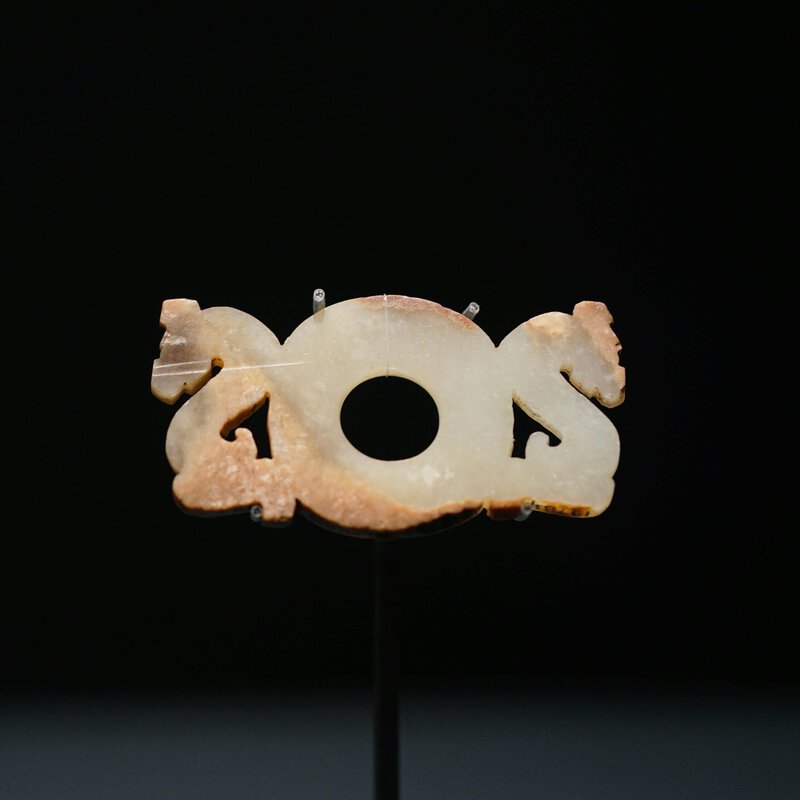
Liangzhu (良渚, roughly translated as “good reed marsh”) was a Neolithic — pre-bronze-age, stone-tool-using — urban civilization that flourished along the Yangtze River Delta from approximately 3300 to 2300 BCE. That timeline places it more than a millennium before the traditionally recognized founding dynasties of Chinese history, making it one of the earliest complex societies yet identified in East Asia. UNESCO inscribed the Liangzhu Archaeological Ruins as a World Heritage Site in 2019, citing the site as “a major contribution to the early history of urban civilization.”
The civilization’s most recognizable signature is its jade. Jade culture at Liangzhu was not ornamental in any simple sense — it was cosmological. Ceremonial blades called yue (钺) and ritual cylinders called cong (琮) appear in elite burials across the site in extraordinary concentrations. Archaeologists at the Zhejiang Provincial Institute of Cultural Relics and Archaeology interpret the cong‘s distinctive form — a square exterior with a circular bore — as a physical representation of the boundary between earth and heaven, encoding a belief system in stone.
Near-identical iconography appears on jade objects excavated from sites stretching from the Yangtze Delta to Guangdong and Shandong provinces, indicating that Liangzhu exerted a sphere of cultural influence — sometimes called the “Liangzhu cultural sphere” — comparable in geographic scope to what archaeologists trace through Mesopotamian or Indus Valley artifact distributions. The nephrite used to craft these objects was sourced from mountains up to 100 kilometers away, implying organized long-distance trade networks. Elite burial clusters at Fanshan and Yaoshan contain hundreds of jade pieces alongside lacquerware and silk remnants — evidence of ranked social hierarchy, agricultural surplus, and specialist craft production, the standard markers scholars use to define early civilization. Liangzhu was not a village. It was a proto-state.
The Engineering Marvel That Could Not Hold
A 2015 study published in PNAS, led by researchers at Zhejiang University, identified a hydraulic infrastructure at Liangzhu comprising at least 11 dams and reservoirs collectively capable of storing an estimated 46 million cubic meters of water. This network — the oldest large-scale water-control system yet confirmed in East Asia — protected the city’s low-lying urban areas from seasonal flooding for nearly a millennium. The sheer labor required to construct and maintain it implies a centralized governing authority capable of coordinating thousands of workers, reinforcing the characterization of Liangzhu as an early state rather than a loosely affiliated set of villages.
The engineering was remarkable. It was not, however, sufficient for what came next.
Thick layers of yellow clay — a flood-deposit signature geologically distinct from the dark organic soil of Liangzhu’s occupation layers — overlie the final habitation strata uniformly across the site. This stratigraphic evidence, combined with climate proxy data, forms the backbone of a 2021 study published in Science Advances by a team including Christoph Spötl of the University of Innsbruck. The study used speleothem records — chemical signatures preserved in cave stalagmites and stalactites that function as precise natural climate archives — alongside radiocarbon dating to link Liangzhu’s abrupt abandonment to catastrophic monsoon flooding. The culprit, the researchers concluded, was not war, internal political collapse, or epidemic, but a prolonged, anomalously intense monsoon season consistent with a documented destabilization of the East Asian Summer Monsoon system around 2300 BCE. The dams failed. The city drowned.
The Flood That May Have Seeded a Legend
Ancient Chinese texts, including the Shujing (Book of Documents) — traditionally dated to around 1000 BCE but understood to record older oral traditions — describe catastrophic flooding tamed by the culture hero Yu the Great, a narrative long catalogued as mythology. The timing and geography of the Liangzhu collapse have renewed scientific scrutiny of whether such legends encode genuine environmental memory.
A separate 2016 study in Science, led by Qinglong Wu of Peking University, identified a massive outburst flood on the Yellow River around 1920 BCE and proposed it as a candidate event underlying the Yu the Great legend. The Liangzhu inundation, roughly 400 years earlier and geographically centered farther south, represents a distinct and currently contested candidate for a different stratum of flood memory in the ancient Chinese tradition. The two events are not mutually exclusive; composite legends frequently absorb multiple historical catastrophes across generations of oral transmission.
The Science Advances authors are careful not to overstate the connection. The study describes the temporal and geographic overlap between the Liangzhu collapse and ancient flood narratives as “consistent with” — not proof of — a shared cultural memory of catastrophic inundation in Neolithic China. The proposal that displaced Liangzhu populations migrating north and west may have carried flood-memory traditions that eventually merged with Yellow River cultures remains speculative and should be treated as such. What is not speculative is the archaeological record’s blunt conclusion: when Liangzhu collapsed, its distinctive jade iconography largely vanished from the regional record — evidence to some researchers that the collapse was total, a population displaced or destroyed rather than simply reorganized under new governance.
Reading a Civilization Through What It Left Behind
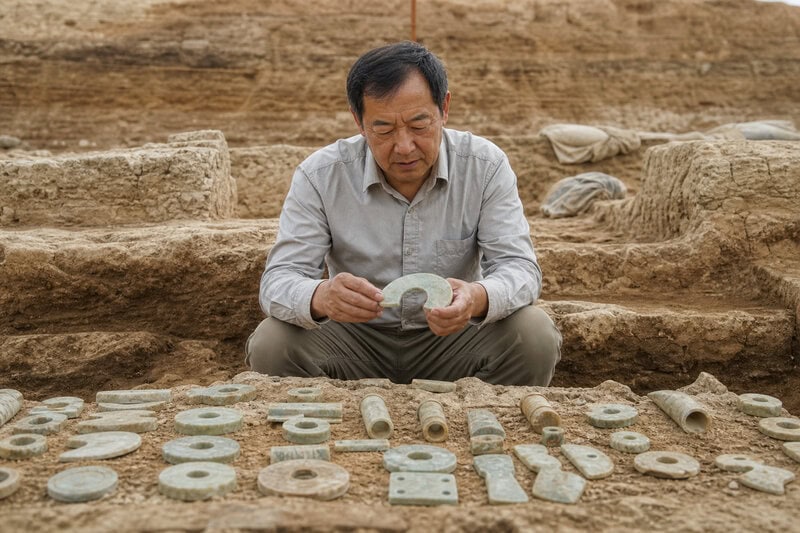
Liangzhu’s legacy reaches the present primarily through its objects and its infrastructure. The more than 15,000 jade artifacts excavated from its graves represent an industrial scale of craft production involving nephrite quarried, transported, and worked with stone tools — a technical achievement that still draws admiration from materials scientists. The dam network identified in the 2015 PNAS study predates comparable hydraulic engineering across much of the ancient world.
The methodological approach used to reconstruct Liangzhu’s collapse is itself significant. Combining speleothem climate proxies, radiocarbon dating, and stratigraphic archaeology, the Science Advances study represents an interdisciplinary model for resolving questions that neither geology nor history alone could answer — a template now being applied to other contested collapse events in the ancient world.
Perhaps most consequentially for how Chinese history is understood and taught, UNESCO’s 2019 recognition of Liangzhu as an independently developed civilization — not derived from or dependent on the Yellow River cultures long positioned as the singular cradle of Chinese culture — challenges a monocentric view of Chinese cultural origins that dominated scholarship for decades. Neolithic China archaeology is actively revising that timeline, and Liangzhu sits at the center of the revision.
LIANGZHU CODE 5000: Unlocking the Past With a Mobile Phone

The academic significance of Liangzhu has, until recently, remained largely confined to specialist journals and Chinese-language museum exhibits. That is changing. The Hangzhou Municipal Bureau of Culture, Radio, Television and Tourism has launched LIANGZHU CODE 5000, an international cultural campaign designed to bring the story of Liangzhu civilization to a global audience. The campaign invites participants worldwide — whether visiting Hangzhou in person or engaging digitally — to decode the secrets of the civilization, with a mobile phone positioned as the primary key to unlocking the experience.
The framing is deliberately evocative: a code to be broken, a civilization to be unlocked. It mirrors, in accessible form, the actual archaeological process — piecing together fragmentary evidence from jade objects, pollen cores, flood sediment layers, and cave deposits into a coherent account of who these people were, how they organized their society, and what ultimately ended them. The campaign reflects a broader shift in heritage tourism toward participatory, digitally mediated experiences that lower the barrier of entry for international visitors and remote audiences alike.
The initiative arrives at a moment of heightened global interest in non-Western origins of urban civilization. Mesopotamia has long anchored popular narratives about where cities and states first emerged; Liangzhu offers a geographically and culturally distinct data point that complicates any single-origin account. By positioning ancient Chinese jade culture and cutting-edge climate archaeology as simultaneously accessible through a smartphone, the LIANGZHU CODE 5000 campaign makes Hangzhou legible to a global audience that may never have encountered the name Liangzhu before.
What a Drowned City Teaches the Present
The core finding of the Science Advances study carries an uncomfortable contemporary resonance: a civilization sophisticated enough to engineer the oldest confirmed large-scale dam network in East Asia was nonetheless destroyed by climate-driven flooding that exceeded the design parameters of its own infrastructure. The lesson is not that engineering is futile, but that the relationship between human hydraulic ambition and climate variability has always been contingent — and that the climatic baseline on which infrastructure is designed can shift in ways that render even impressive engineering inadequate.
Liangzhu flourished for roughly 1,000 years. Its jade objects encoded a cosmology. Its dams moved tens of millions of cubic meters of water. Its artisans worked nephrite into forms that traveled hundreds of kilometers and persisted in the cultural memory of neighboring societies for generations after the city itself was gone. And then the rains came in a quantity and duration its builders could not have anticipated, and the city drowned.
As the LIANGZHU CODE 5000 campaign opens this story to global audiences, Liangzhu stands as more than an archaeological curiosity or a tourist destination. It stands as a reminder, supported by peer-reviewed climate science and half a century of careful excavation, that civilization is neither inevitable nor permanent — and that the most enduring legacy of a city swallowed by water may be the questions its absence forces us to ask about the ones we are still building.