
One hundred and twenty-four light-years from Earth, a planet roughly nine times the mass of our own orbits a dim red star — and in 2023, NASA’s James Webb Space Telescope detected a faint chemical signal in its atmosphere that made scientists around the world stop and pay very careful attention. The molecule in question, dimethyl sulfide, is produced on Earth almost exclusively by living marine organisms. What followed was not a press conference announcing the discovery of alien life, but something arguably more consequential: a rigorous, ongoing scientific argument about what that signal actually means, and whether our instruments are yet capable of resolving it.
What K2-18b Is — and Why It Defies Easy Comparison
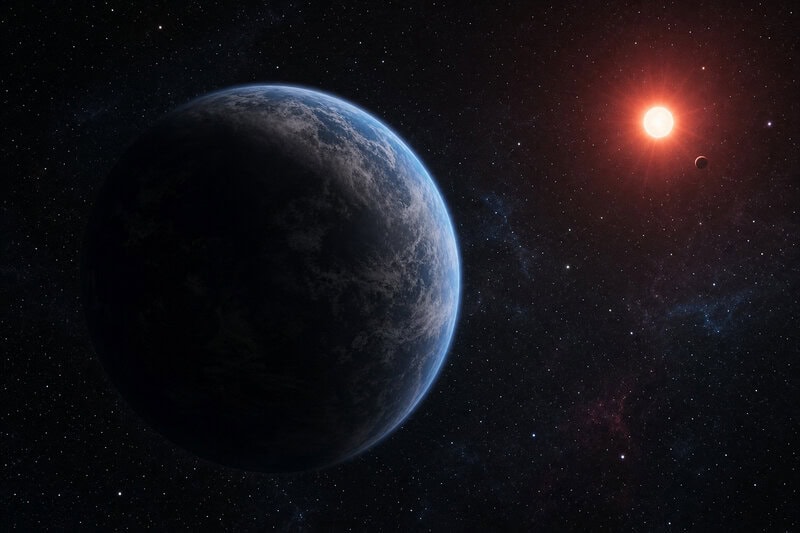
K2-18b, also catalogued as EPIC 201912552 b, orbits the cool red dwarf star K2-18 in the constellation Leo. Discovered through NASA’s K2 mission via the transit method — detecting the slight dimming of starlight as the planet crossed in front of its star — it has since become one of the most intensively studied worlds outside our solar system. At 8.92 times Earth’s mass and approximately 2.6 times Earth’s radius, it occupies a size category called sub-Neptunes or super-Earths, a class of planet our solar system offers no local example of, leaving scientists without a nearby analogue to anchor their models.
K2-18b completes one orbit every 32.9 days, a period that sounds brief by Earth’s standards. But K2-18 is an M-type red dwarf that emits far less energy than our Sun, so that relatively tight orbit still places the planet squarely within the star’s habitable zone — the band of orbital distances where a planet receives enough stellar warmth that liquid water could theoretically persist on its surface without permanently freezing or boiling away. That designation carries an important qualification: a habitable zone is a calculation of distance and energy input, not a finding about actual surface conditions. Whether liquid water truly exists on any given planet depends on atmospheric pressure, composition, internal heat, and a cascade of other factors that remain difficult to constrain at interstellar distances.
The K2-18 system also contains at least one additional planet, a warmer super-Earth on a shorter orbit around the same star. How that multi-planet system formed and evolved informs — and complicates — models of K2-18b’s interior structure and long-term history.
The Hycean Hypothesis: A New Category of Potentially Habitable World
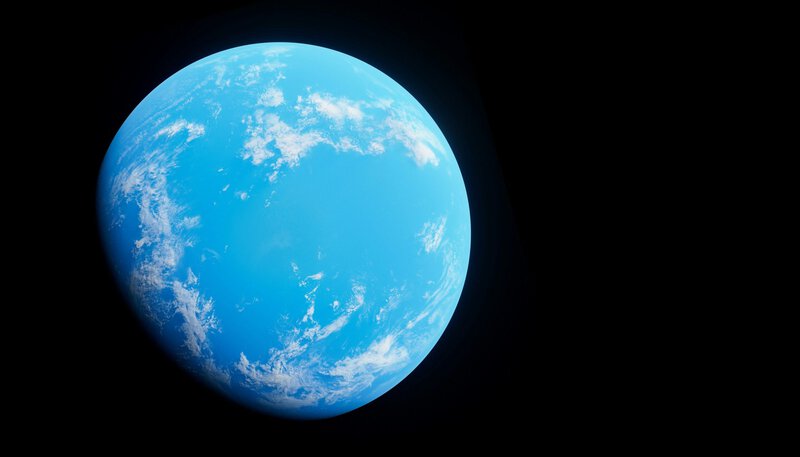
In 2021, University of Cambridge planetary scientist Nikku Madhusudhan and colleagues proposed a new class of planet they called Hycean worlds: bodies with hydrogen-rich atmospheres blanketing a global liquid-water ocean, with surface conditions potentially compatible with microbial life. K2-18b quickly became the flagship candidate for this hypothetical category. The Hycean model is scientifically attractive in part because such worlds could sustain habitable conditions across a far wider range of stellar distances than rocky, Earth-like planets, which would substantially expand the theoretical census of potentially life-bearing worlds throughout the galaxy.
A critical caveat applies: Hycean planets remain hypothetical constructs. No confirmed Hycean world has ever been directly observed or verified. Whether K2-18b’s interior actually matches the model depends on density estimates that carry substantial uncertainty, because we cannot image the planet’s surface or sample its interior directly. An equally plausible competing interpretation holds that K2-18b is a mini-Neptune — a planet with a rocky core, a deep high-pressure water-ice mantle, and a thick hydrogen envelope — under which surface liquid water and any known form of life would be physically impossible. Both models remain consistent with the available data, and distinguishing between them is one of the central open problems in the field.
What Webb Actually Found: Methane, Carbon Dioxide, and a Contested DMS Signal
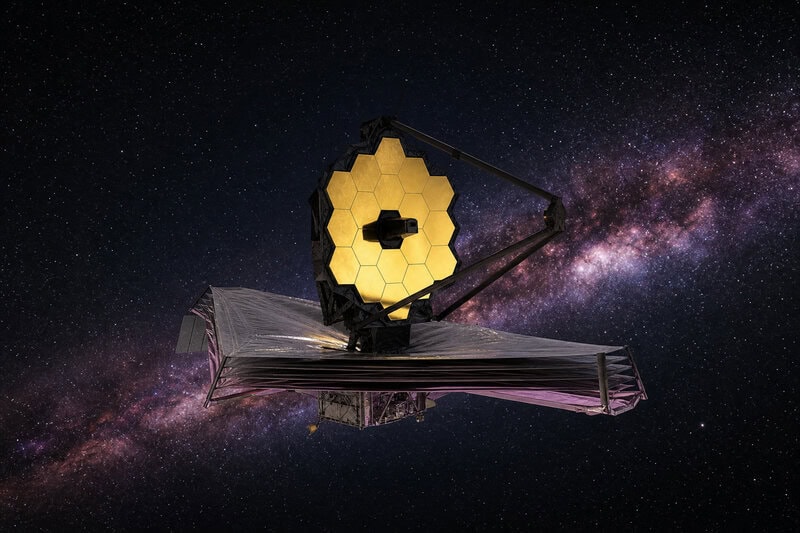
Webb observes exoplanet atmospheres through transmission spectroscopy. When a planet transits its host star, a small fraction of starlight filters through the planet’s outer atmosphere. Different molecules absorb light at characteristic wavelengths, leaving distinctive dips in the star’s spectrum that astronomers can read from across interstellar distances. Using this method, Webb detected abundant methane and carbon dioxide in K2-18b’s atmosphere — a chemical combination that Madhusudhan’s team argued in a 2023 paper published in The Astrophysical Journal Letters is consistent with a Hycean-type world.
That same paper reported a tentative signal consistent with dimethyl sulfide, or DMS — a sulfur-containing organic compound with the chemical formula (CH₃)₂S. On Earth, DMS enters the atmosphere almost entirely through the metabolic activity of marine phytoplankton, microscopic organisms that form the base of ocean food chains. That near-exclusive biological origin on our own planet is what makes DMS a candidate biosignature: a chemical marker that, in principle, could indicate biological activity elsewhere.
The paper’s authors were explicit about the signal’s fragility. The DMS detection sits at low statistical significance — roughly one sigma, far below the five-sigma threshold that the scientific community conventionally requires before claiming a discovery. The spectral feature overlaps with signatures from other molecules, and the data collected so far cannot definitively attribute the signal to DMS rather than to abiotic, non-living chemical sources. The Cambridge team also noted the apparent absence of ammonia in K2-18b’s upper atmosphere, interpreting this as circumstantial support for a liquid-water layer beneath — their reasoning being that ammonia would dissolve into such an ocean rather than accumulating in detectable quantities above it. Independent researchers have noted this inference, while suggestive, rests on modelling assumptions that require further testing.
Why “Biosignature” Does Not Mean “Life Found”
A biosignature is any chemical or physical feature that could, in principle, be produced by living organisms. The word describes a possibility, not a confirmation. Abiotic geological and photochemical processes can generate many molecules associated with life, and DMS is no exception. Laboratory studies have shown that ultraviolet radiation acting on simple carbon and sulfur compounds can produce DMS through purely chemical reactions, with no biology required. Until non-biological pathways are rigorously ruled out, a DMS detection — even a statistically robust one — cannot responsibly be interpreted as evidence of life.
Planetary scientists outside the Cambridge group urged strong caution in response to the 2023 paper, noting that the DMS signal is weak enough that additional Webb observations could plausibly cause it to disappear into statistical noise. The detection relies on subtracting multiple overlapping spectral signals using atmospheric retrieval codes — computational models that must make assumptions about cloud layers, temperature profiles, and molecular abundances throughout a planetary atmosphere. Each assumption introduces uncertainty, and those uncertainties compound in ways that are difficult to fully quantify. The Planetary Society’s analysis of the finding reflects this carefully measured tone, which is broadly shared across the scientific community.
History offers a pointed cautionary example. In 2020, a team of astronomers reported the detection of phosphine — another potential biosignature — in the atmosphere of Venus. The announcement generated enormous scientific excitement and widespread media coverage. Within months, independent researchers identified the signal as a combination of instrumental artefact and data-processing errors. The claimed detection was revised substantially downward, then largely withdrawn. Scientists actively reference that episode when discussing the K2-18b DMS signal, not to dismiss the finding out of hand, but to underline why thorough verification must precede any interpretation offered with confidence.
The Broader Stakes: Remote Detection of Ocean-World Chemistry
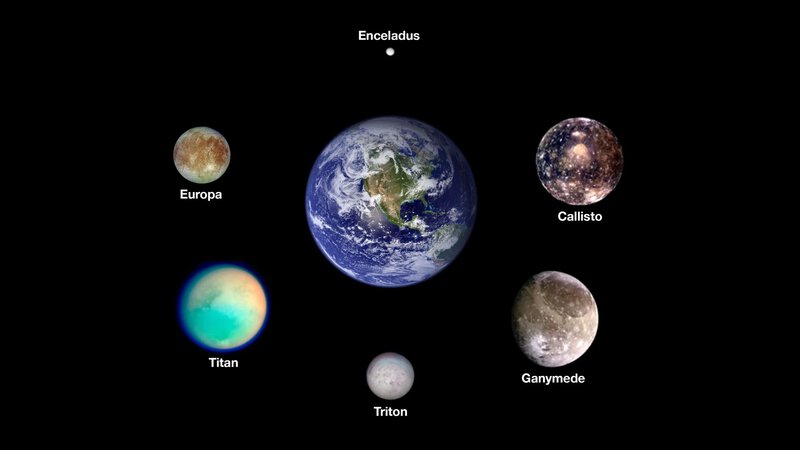
K2-18b sits at the intersection of two rapidly developing areas of research. The study of ocean worlds — planets or moons with substantial bodies of liquid water — has long concentrated on targets within our own solar system. Europa, a moon of Jupiter sealed beneath a thick ice shell, and Enceladus, a moon of Saturn that actively vents water vapour into space, are both considered credible candidates for subsurface microbial life. K2-18b represents the first serious opportunity to test whether ocean-world biosignature chemistry could be detected remotely at interstellar distances, extending that search from our solar neighbourhood to the broader galaxy.
Red dwarf stars like K2-18 are the most common stellar type in the Milky Way and host the majority of known exoplanets. Their extraordinarily long lifespans — potentially stretching into the trillions of years, compared to the Sun’s roughly ten billion — mean that any life arising around them would have vast geological time in which to emerge and evolve. That prospect makes M-dwarf planetary systems high-priority scientific targets. Whether the intense ultraviolet and X-ray flares common in young red dwarfs are capable of sterilising planetary surfaces, or whether they merely apply selective pressure that drives life toward more resilient forms, remains an open and actively contested research question with direct relevance to K2-18b’s prospects.
According to NASA’s exoplanet catalog entry for K2-18b, the planet remains a priority target for ongoing atmospheric characterisation. Future Webb observation cycles, alongside next-generation ground-based instruments such as the Extremely Large Telescope currently under construction in Chile’s Atacama Desert, are expected either to strengthen the DMS signal or to rule it out within the next several years.
Three Thresholds — and Where the Evidence Currently Stands
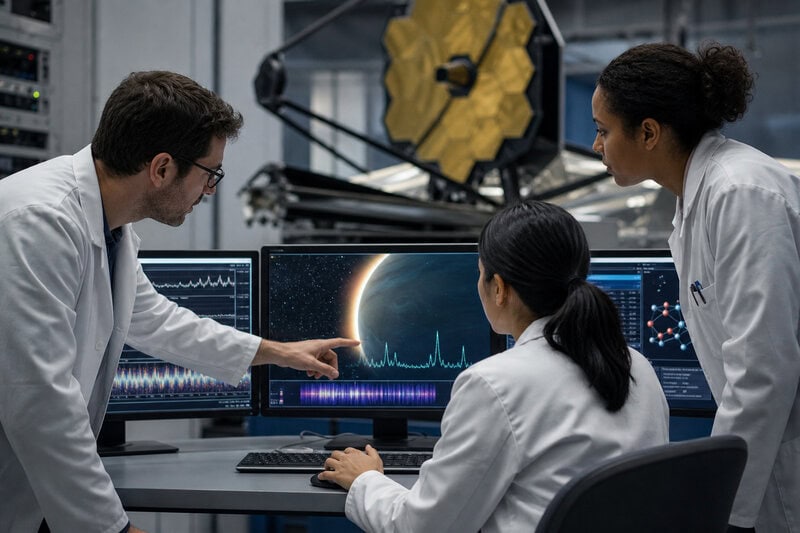
Scientists working on atmospheric biosignatures draw a careful distinction between three sequential stages of any potential discovery. Detection means establishing that a signal is present in the data. Attribution means confirming with confidence which specific molecule is responsible for that signal. Interpretation means determining whether the source of that molecule is biological or abiotic. For K2-18b’s dimethyl sulfide signal, the scientific community currently sits in the early and contested stages of step one. Attribution and interpretation remain distant goals that depend on data not yet collected and methods not yet fully validated.
The Cambridge team has stated publicly that confirming or refuting the DMS detection will require substantially more Webb telescope time, and that even a robust statistical confirmation would demand independent corroboration through different instruments and observational approaches before any consensus around a biological origin could responsibly form. That sequence — detection, independent replication, exhaustive consideration of alternative explanations, and only then cautious interpretation — is exactly the evidentiary standard that extraordinary claims require, and it reflects how the scientific community at large expects this investigation to proceed.
K2-18b may ultimately teach scientists as much about the limits of remote sensing and the difficulty of chemical attribution as it does about life beyond Earth. A planet that turns out to harbour no biology whatsoever could still reshape understanding of how hydrogen-rich atmospheres behave, how Hycean-class worlds form and evolve, and how carefully the tools of modern astronomy must be applied before a spectral feature becomes a headline. In a field where the stakes are as high as they can possibly be, that kind of hard-won methodological clarity is — as researchers themselves consistently argue — precisely how trustworthy science is built. You can explore the full observational record for K2-18b at NASA’s Exoplanet Archive as new data continue to accumulate.