
Callisto’s ancient wounds are still broadcasting. When the James Webb Space Telescope trained its infrared gaze on Jupiter’s most battered moon, it detected a faint, patchy veil of carbon dioxide clinging to the surface — concentrated not uniformly, but in a localized region that scientists suspect may be releasing chemistry locked inside impact craters for billions of years. The finding reframes a moon long dismissed as scientifically inert and raises pointed questions about what the solar system’s most cratered world is still actively doing.
Meet the Forgotten Galilean
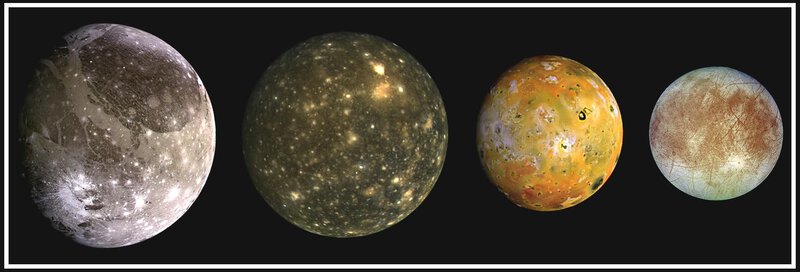
Callisto is one of Jupiter’s four Galilean moons — the quartet that Galileo Galilei first observed in 1610, alongside the volcanic Io, the ocean-harboring Europa, and the massive Ganymede. Yet despite sharing that celebrated company, Callisto receives the least scientific attention of the four. Io commands fascination for its relentless volcanic resurfacing, which makes it the most geologically active world in the solar system. Europa generates headlines for its subsurface ocean and the possibility that it could support microbial life. Ganymede, the largest moon in the solar system, has its own magnetic field and layered geology. Callisto, by contrast, is typically described in terms of what it lacks.
That framing has always undersold it.
Orbiting Jupiter at the greatest distance of the four Galilean moons, Callisto sits largely outside the planet’s punishing radiation belts — an orbital position that spares it the intense tidal heating that drives volcanism on Io and ice-shell flexing on Europa. That same quietude has made Callisto a candidate for future human exploration staging posts, where astronauts could potentially operate without the radiation exposure they would face closer to Jupiter. But Callisto’s scientific importance runs deeper than logistical convenience: because it lacks the dramatic internal activity of its neighbors, its surface preserves the oldest readable record of the early solar system’s bombardment history, making it, in a real sense, the most historically valuable moon in the group. Studying it requires accepting that geological inactivity is itself a form of scientific richness.
The Most Cratered World: What Saturation Actually Means
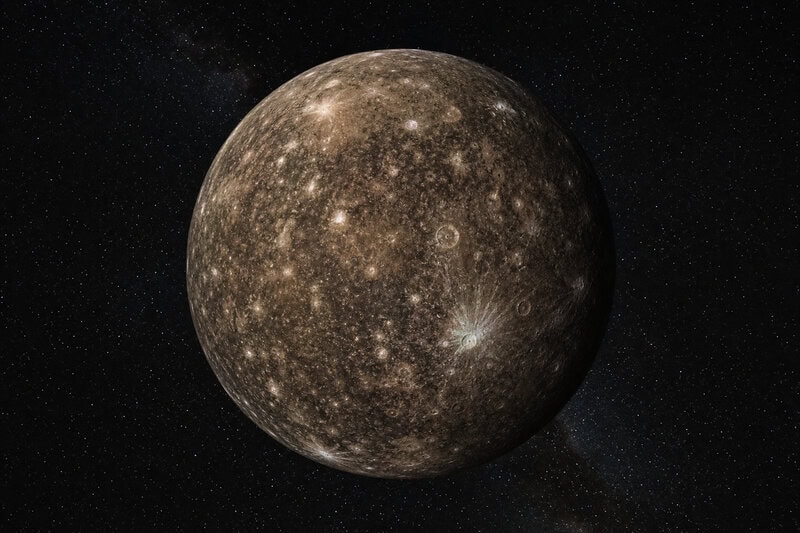
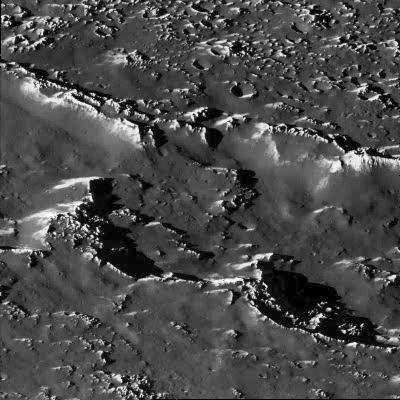
Describing Callisto as the most heavily cratered object in the solar system is not mere hyperbole — it reflects a precise geological condition. Callisto’s surface has reached what planetary scientists call saturation cratering: a state in which the surface is so densely covered with impact scars that new impacts tend to overlap or overprint old ones rather than find fresh, unmarked terrain. Every square kilometer of landscape tells the same story of relentless cosmic bombardment, repeated across billions of years without meaningful interruption from internal processes.
Other worlds lose their craters through a variety of erasure mechanisms. On Io, volcanic eruptions continuously bury and melt the surface, resetting the geological clock with fresh lava flows. On Europa, tidal heating from Jupiter flexes and refreezes the ice shell, smoothing and submerging ancient features beneath new ice. On Earth, the combined forces of plate tectonics, atmospheric erosion, and biological activity erase most impact scars within tens of millions of years — a geological eyeblink in a 4.5-billion-year planetary history. Even Ganymede shows regions of younger, resurfaced terrain where ancient records have been overwritten.
Callisto has experienced none of that erasure. According to the scientific consensus, its sibling satellites have scrubbed some or all of their surfaces free of the most ancient impact records, while Callisto’s geology preserves those oldest surface processes largely intact. Its cratered face is considered direct physical evidence of the Late Heavy Bombardment — a period roughly 4 billion years ago when the inner and outer solar system were pelted by debris left over from planetary formation — and possibly of even earlier epochs. In a solar system full of worlds that have rewritten their own histories, Callisto is one of the few that has kept the original manuscript.
A striking image of Callisto’s battered surface captured by NASA/JPL/DLR illustrates just how completely impact craters dominate its landscape — a visual that no amount of description fully replaces.
JWST and ALMA Train Their Eyes on a Battered World
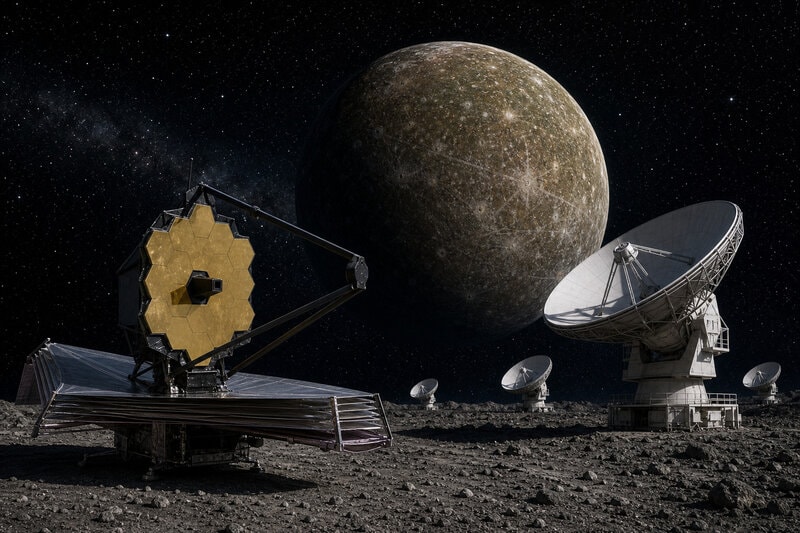
The new observations represent one of the most detailed spectroscopic examinations of Callisto to date, building on earlier data from NASA’s Galileo spacecraft, which orbited Jupiter from 1995 to 2003 and provided the foundational modern portrait of the Galilean moons. What distinguishes the current study is its dual-telescope approach: both JWST and ALMA — the Atacama Large Millimeter/submillimeter Array, a network of radio telescopes in the Chilean Atacama Desert — were trained on Callisto simultaneously, giving scientists complementary chemical and thermal portraits of the same world from two fundamentally different observational strategies.
The two instruments contribute different but interlocking types of information. JWST operates in the infrared, where it excels at detecting molecular fingerprints in reflected and emitted light, making it acutely sensitive to surface and near-surface chemistry. Its extraordinary sensitivity allows it to resolve signals that previous observatories could not cleanly distinguish — which is precisely how it captured the wisp of CO2 found in Callisto’s near-vacuum atmosphere. ALMA, operating at millimeter and submillimeter wavelengths, reads thermal emission from the surface itself, helping scientists map temperature gradients across the moon’s terrain. Together, the two observatories produce a picture that neither could generate alone: one reads the chemistry, the other reads the heat.
The full scientific context of this multi-wavelength campaign is detailed in the doctoral research catalogued in the NASA Astrophysics Data System examining ALMA and JWST perspectives of Callisto, which lays out the complementary observational strategies and their combined interpretive power.
The Patchy CO2 Atmosphere: A Clue Written in Craters
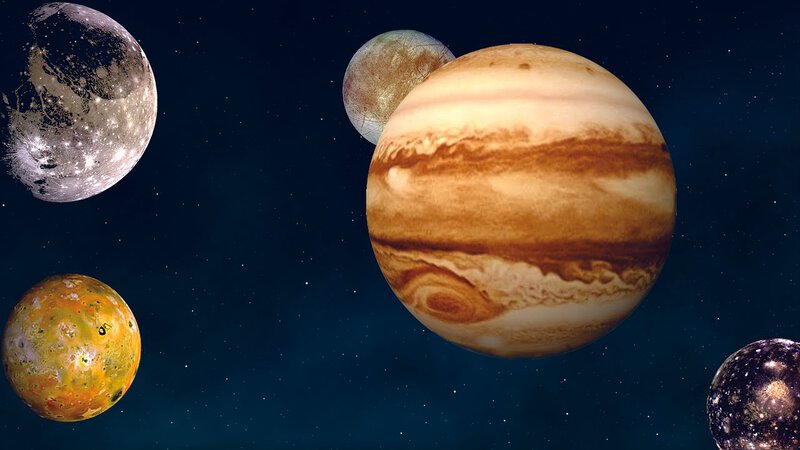
The central finding of the JWST observations is striking in its specificity. JWST detected a very faint atmosphere on Callisto composed primarily of carbon dioxide — a molecule that, in this context, functions not as evidence of a breathable environment but as a chemical tracer, a molecular fingerprint pointing to specific surface and subsurface processes. The atmosphere is, by any earthly standard, almost nothing: Callisto’s surface pressure is vanishingly thin compared to Earth’s, placing it in the category of a so-called surface-bound exosphere rather than a true planetary atmosphere. There is no weather here, no wind, no cycle of evaporation and rainfall. The CO2 simply clings, barely, to the surface.
What makes the detection scientifically significant is not the presence of CO2 itself — that molecule has been detected at Callisto before — but where it appeared and how it was distributed. The highest concentration was not spread evenly across Callisto’s surface. Instead, it was concentrated in a localized region, a patchiness that immediately raises the question of why that particular area is releasing more CO2 than the surrounding terrain.
The leading hypothesis, though not yet confirmed, is that the CO2 is being released from material exposed or disturbed by ancient impacts. Under this interpretation, the craters themselves may be venting chemistry that has been locked in ice and rock for billions of years — molecules shielded from the space environment by successive layers of debris, only to be exposed when large impactors excavated the surface and brought older material to light. The craters, in other words, may not merely be scars. They may be active sources of chemical information about the early solar system.
What remains genuinely contested is the precise origin mechanism. Whether the CO2 comes from radiation-driven chemistry on the surface — in which charged particles from Jupiter’s magnetosphere break apart and reassemble molecules in the ice — from slow outgassing from Callisto’s interior, or from ancient impact-exposed deposits is an open question. As Universe Today’s coverage of the JWST Callisto findings notes, the JWST data narrows the range of plausible explanations significantly, but does not yet definitively settle the debate. This is a distinction worth preserving: the observation is robust; the interpretation is ongoing science. Confusing the two would misrepresent what the data actually shows.
Why Callisto’s Scars Matter for the Whole Solar System
The CO2 finding connects to a broader scientific ambition: using Callisto as a reference archive for the early Jupiter system, and by extension the early solar system as a whole. If specific crater regions are indeed sources of CO2 outgassing, that would link atmospheric chemistry directly to impact history — potentially allowing scientists to read the timing and intensity of ancient bombardments from the distribution of gases across the surface. The moon would become not just a visual record of past violence, but a chemical one, with each gas plume serving as a potential timestamp.
This is the comparative planetology angle that makes Callisto uniquely valuable. Because Io, Europa, and Ganymede have each erased some or all of their ancient impact records through internal processes, studying Callisto’s intact surface — and now its tenuous atmosphere — gives planetary scientists a baseline for understanding what the early Jovian system actually looked like before those erasure processes took hold. Without Callisto, that baseline might be unrecoverable. The moon’s very inactivity is an archive.
The implications extend to future missions. The European Space Agency’s JUICE mission — the Jupiter Icy Moons Explorer, launched in April 2023 and currently en route to the Jovian system — is planned to conduct multiple flybys of Callisto before eventually entering orbit around Ganymede. The atmospheric and compositional data gathered by JWST will directly inform what JUICE’s instrument suite is calibrated to detect during those close encounters, making the telescope observations a practical planning resource rather than simply an academic exercise. Public outreach platforms such as Frosty Drew Observatory & Sky Theatre have helped communicate the significance of Jupiter system science to broader audiences as missions like JUICE build toward their eventual rendezvous.
For astrobiology, the implications are more cautious and should be stated precisely. Callisto lacks the subsurface liquid-water ocean that makes Europa a focus for life-related research, and the CO2 finding does not change that assessment. No one credible is suggesting that Callisto is a candidate for habitability. What the finding does contribute is a better understanding of how carbon dioxide and other volatile molecules behave on icy outer-solar-system bodies — how they are generated, stored, and released — which informs theoretical models applicable to Kuiper Belt objects, Saturn’s icy moons, and the similarly frigid worlds expected around other stars.
What Comes Next for the Most Battered Moon
The immediate scientific agenda involves cross-referencing JWST’s CO2 concentration map with high-resolution crater maps derived from Galileo mission data, testing whether the localized atmospheric concentration aligns precisely with specific impact features, terrain types, or regions of known surface composition. If the correspondence holds, it would substantially strengthen the hypothesis that craters are the primary source. If it does not, it would demand a different explanation entirely — and science would benefit from either outcome.
ALMA’s thermal data will play a complementary diagnostic role in that process. If the CO2 source regions are anomalously warm relative to surrounding terrain, that thermal signature would support an active outgassing or radiation-chemistry origin rather than simple sunlit evaporation of shallow surface deposits. The temperature map, in other words, can help distinguish between mechanisms that the spectral data alone cannot separate.
ESA’s JUICE spacecraft is expected to make its first Callisto flyby in the late 2020s. Scientists anticipate that in-situ measurements — gathered directly within the moon’s exosphere and immediately above its surface — will either confirm or substantially complicate the atmospheric picture that JWST and ALMA have built from hundreds of millions of miles away. Additional details on the observational campaign and its scientific framing are available through Renfrew & District Astronomical Society’s overview of the JWST Callisto study.
In a solar system where the most dramatic worlds tend to erase their own histories — where volcanoes, oceans, and tidal forces continuously overwrite the past — Callisto’s stubborn, battered face remains one of the very few places scientists can read what the early solar system was actually like. JWST, with its extraordinary sensitivity and its ability to detect chemistry written in infrared light across interplanetary distances, has just added a new layer of meaning to that record. The ancient scars, it turns out, are not merely silent monuments to past catastrophe. They may be actively narrating what happened, one molecule at a time.