
The Velociraptor that stalked children through a commercial kitchen in Jurassic Park was almost certainly covered in feathers. Paleontologists have now identified feathers or feather-like structures in more than 50 non-avian dinosaur species — and the film’s own hero, Dr. Alan Grant, was precisely the kind of field scientist whose career sat at the centre of that discovery. Sam Neill, the actor who made Grant one of cinema’s most beloved scientists, died on 13 July 2026, at age 78. His legacy and the science he popularised are inseparable, and one of the most interesting things about that science is how thoroughly it has overturned the visual world his most famous film created.
Sam Neill and the Character Who Made Paleontology Matter
Sam Neill, born on 14 September 1947 in New Zealand, appeared in more than 150 films and television productions across a career spanning five decades. His range was genuine and wide — from the psychological thriller Dead Calm to the prestige television of Peaky Blinders — but it was his performance as Dr. Alan Grant in Steven Spielberg’s Jurassic Park (1993) that became his most culturally durable contribution. Grant is not a theorist working from a blackboard. He is depicted excavating fossils in the Montana badlands, reading trackways, and inferring animal behaviour from bone structure. That specificity mattered, because the subspecialty Spielberg assigned him — dinosaur behaviour and ecology — was precisely the field most transformed by the feathered-dinosaur discoveries of the decade that followed the film’s release.
AP News noted in its obituary that Neill brought an intellectual credibility to Grant that transcended typical action-film scientist archetypes. That credibility is part of what made the film’s scientific choices lodge so firmly in the public imagination — and part of what makes the feather omission worth examining seriously, rather than dismissing as a minor Hollywood shortcut.
The Conversation has documented that Neill’s portrayal of Grant inspired a generation of real paleontologists — a rare cultural impact on a scientific discipline. The poignant irony is that the film which made paleontology cool for a generation got one of its most foundational visual details wrong, and the scientists it inspired have spent decades working to set the record straight.
What the Film Got Right — and Where the Science Stood in 1993
Fairness demands starting with what Jurassic Park did exceptionally well. The film’s dinosaurs reflect the so-called Dinosaur Renaissance — a scientific reassessment led by paleontologist Robert Bakker through the 1970s and 1980s that recast dinosaurs as active, fast-moving animals closely related to birds, rather than slow, cold-blooded reptiles. Upright gait, pack-hunting Velociraptors, and the suggestion of warm-blooded metabolism were all cutting-edge positions for 1993, not popularised clichés. Michael Crichton’s 1990 source novel and the film’s principal scientific advisor, paleontologist Jack Horner, reflected the best available consensus at the time of production.
The honest baseline on feathers is this: in 1993, the bird-dinosaur evolutionary link was theoretically well-established among specialists, but the fossil proof that would make feathers on non-avian dinosaurs an undeniable scientific consensus had not yet been published. Some researchers were actively theorising about integumentary structures — the term covering skin, scales, and feathers — on theropod dinosaurs, but the discipline was working from inference rather than direct physical evidence. The filmmakers were not ignoring a settled fact; they were, at best, choosing the more conservative interpretation of a debate that had not yet been resolved in the fossil record.
The Feathered-Dinosaur Revolution: What the Fossils Actually Show
The turning point arrived in 1996, when researchers described Sinosauropteryx in the journal Nature. The fossil, from China’s Yixian Formation, provided the first unambiguous evidence of feather-like filaments — sometimes called proto-feathers — on a non-avian dinosaur. Non-avian dinosaurs are the extinct lineages that did not survive to become modern birds; the T. rex, Velociraptor, and Brachiosaurus of Jurassic Park all fall into this category or closely related groups. Sinosauropteryx ignited a cascade of similar finds from the same Chinese fossil beds, and the scientific picture shifted rapidly and decisively.
The Velociraptor case is particularly direct. A 2007 paper in Science, by paleontologist Alan Turner and colleagues at the American Museum of Natural History, described quill knobs on a Velociraptor forearm bone — the same skeletal anchor points that attach flight feathers in modern birds. This was not an inference or a theoretical prediction; it was a physical structure preserved in fossil bone, confirming that Velociraptors bore feathers on their arms.
The picture for very large theropods is more nuanced, and honesty requires saying so. A 2017 study in Biology Letters, by Phil Bell and colleagues at the University of New England, reported skin impressions suggesting that large tyrannosaurs may have had predominantly scaly skin across much of their bodies. The extent of feathering in giant species like T. rex remains a genuinely contested question. What is not contested is the Velociraptor conclusion: the scientific consensus holds that Velociraptors were feathered animals roughly the size of a turkey, not the six-foot, scaly-skinned hunters depicted in Jurassic Park.
Why Dinosaurs Had Feathers — and What They Were For
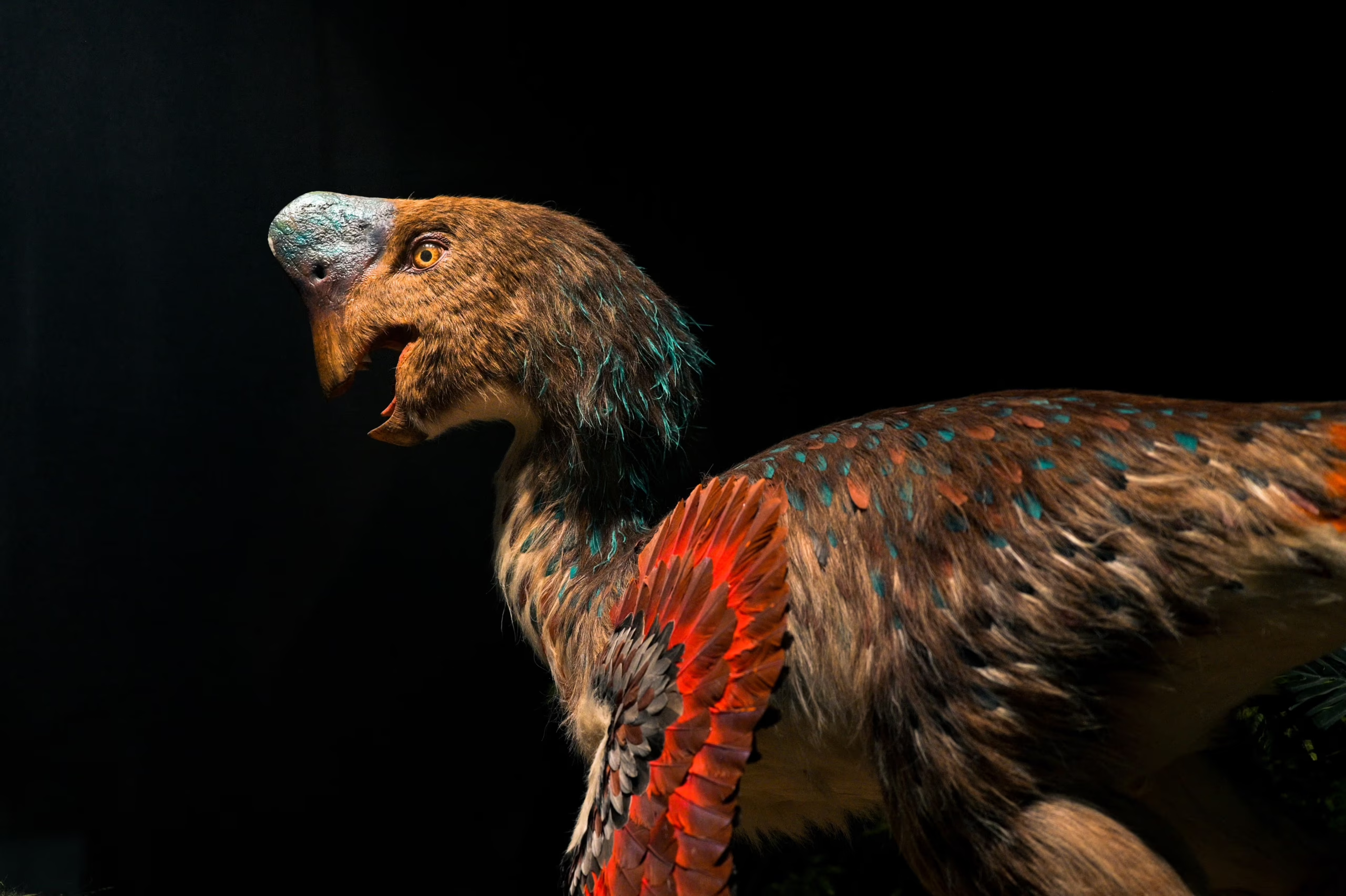
Understanding the mechanism helps clarify why the evidence is so strong. Feathers are now understood to be an ancestral trait of the theropod dinosaur lineage — the broad evolutionary group that includes Velociraptor, T. rex, and eventually modern birds. This means feathers were the biological default for this lineage, and the scaly skin observed in some larger species may represent a secondary evolutionary reduction rather than feathers being a novel addition. The logic runs opposite to intuition: the question is not why some dinosaurs had feathers, but why some may have lost them.
Crucially, the earliest feathers were almost certainly not for flight. Leading hypotheses point to three primary functions: insulation consistent with warm-blooded metabolism, display and mate attraction analogous to the elaborate plumage of modern peacocks, and camouflage. Flight appears to be a later, derived use of structures that evolved for entirely different purposes — a finding that reinforces, rather than contradicts, the warm-blooded, behaviourally complex dinosaurs that Jurassic Park otherwise depicted so well.
By the late 1980s, the bird-dinosaur link was already strong enough that a field paleontologist of Alan Grant’s expertise would have been actively theorising about integumentary structures even before Sinosauropteryx confirmed the fossils. Grant’s character, in other words, belonged to the professional community that was building the theoretical case for feathered dinosaurs at the very moment the film was being made. The creatures he marvels at on Isla Nublar are, by the standards of his own field, inaccurately rendered — an unintentional layer of irony that runs through every scene in which he encounters a living animal.
How the Film’s Own Logic Exposes the Omission
Jurassic Park‘s internal science makes the oversight harder to defend in retrospect. The film’s cloning mechanism explicitly acknowledges that ancient DNA is incomplete and that genetic gaps are filled with frog DNA — a concession to imperfect reconstruction built into the story’s premise. Yet the filmmakers preserved reptilian skin without equivalent scientific justification, treating the animals’ appearance as a given when their own narrative logic had already established that the reconstruction was necessarily approximate.
Jack Horner, the real paleontologist who advised the franchise, has stated publicly that the featherless design was a deliberate aesthetic and commercial choice, not a scientific one. The franchise has since made partial corrections: Jurassic World: Dominion (2022) included a feathered Pyroraptor, a quiet, decades-late acknowledgment of the scientific record. The original Velociraptors — the animals most directly associated with Grant’s character and with Neill’s performance — nonetheless remain frozen in the public imagination as sleek, scaly predators.
Legacy, Public Perception, and Where the Science Goes Next
Because Neill’s performance as Grant demonstrably inspired real paleontologists, the film’s visual inaccuracies carry measurable downstream weight. Public perception of dinosaur appearance continues to lag significantly behind the scientific literature, with featherless, reptilian dinosaurs remaining the dominant popular image decades after the fossil record moved on. When a cultural touchstone shapes career choices, its scientific errors travel with it — carried forward through public imagination, school projects, museum displays, and Halloween costumes.
The science is now moving into territory that makes accurate reconstruction both more achievable and more startling. Researchers are using synchrotron imaging and analysis of melanosomes — microscopic colour-producing structures preserved in some fossils — to reconstruct the actual colours and patterning of feathered dinosaurs. Early results suggest animals that were striped, iridescent, or counter-shaded in ways that parallel modern birds. Future dinosaur media built on this evidence, if it chooses accuracy over familiarity, will look radically different from the grey-green predators of Jurassic Park.
Sam Neill’s death in July 2026 closed the chapter on the actor whose face became synonymous with wonder at prehistoric life. Both truths about his legacy deserve to be held together: his Alan Grant made millions of people care about paleontology, and the science that field has produced in the three decades since 1993 has revealed a dinosaur world stranger, more colourful, and more thoroughly bird-like than even Spielberg dared to imagine. The feathered Velociraptor that Grant never got to see on screen may, in the end, be the most fitting measure of what his character’s discipline actually accomplished.