
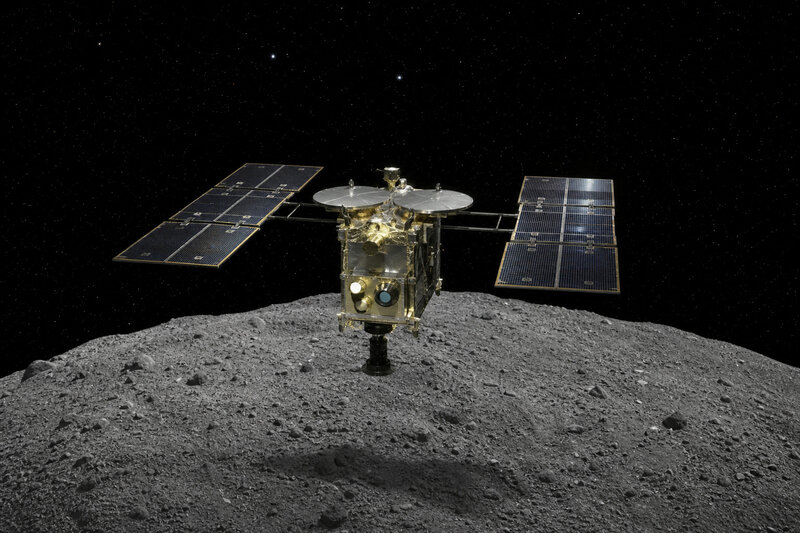
At 800 metres — roughly the length of eight football pitches laid end to end — Japan’s veteran deep-space probe Hayabusa2 skimmed past near-Earth asteroid Torifune on Sunday, July 5, 2026, in one of the closest approaches ever attempted to a space rock that could, under the wrong orbital circumstances, threaten Earth. The encounter is not merely a feat of precision navigation; it is a deliberate planetary defence test designed to gather intimate physical data that could one day inform a real asteroid deflection campaign.
Why 800 Metres Is an Extraordinary Number
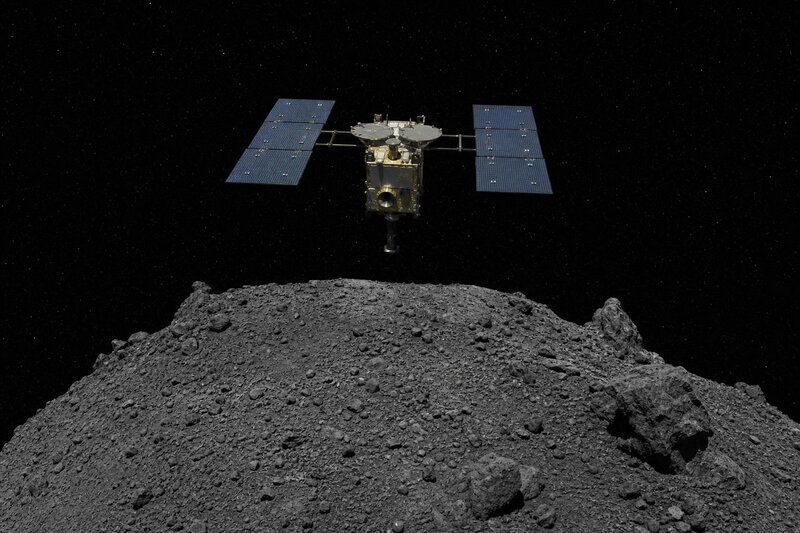
To appreciate the precision involved, consider that the International Space Station orbits approximately 400 kilometres above Earth’s surface. Hayabusa2 closed to a distance roughly 500 times smaller than that gap — threading a corridor so tight that engineers at JAXA had to account for every fraction of a degree in the probe’s trajectory months in advance. According to JAXA, if post-flyby telemetry confirms the planned approach distance, it would rank among the closest flybys ever recorded for a near-Earth asteroid.
The significance of that number extends well beyond spectacle. Ground-based telescopes, however powerful, cannot resolve surface features at the scale of individual boulders or craters on a small asteroid. At 800 metres, Hayabusa2’s cameras and sensors can. That resolution gap is the entire scientific and strategic rationale for flying so dangerously close, and it is why JAXA has explicitly framed the Torifune encounter as a planetary defence test rather than purely exploratory science.
What Is Hayabusa2 — and Why Is It Fridge-Sized?
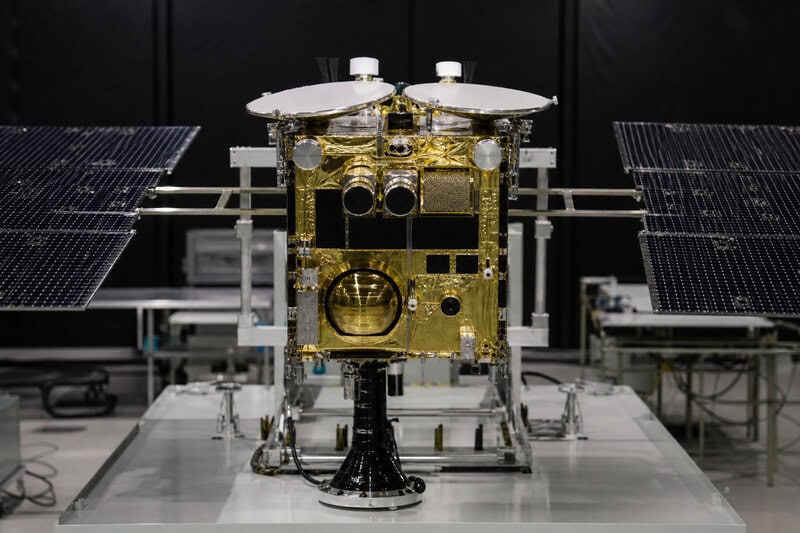
Hayabusa2 is a compact deep-space probe built and operated by JAXA, Japan’s national space agency. At roughly the dimensions of a domestic refrigerator, it is modest in size but exceptional in pedigree. The spacecraft previously rendezvoused with asteroid Ryugu, deployed surface rovers, collected physical samples from the asteroid’s surface, and returned those specimens to Earth in December 2020 — making it one of the most accomplished asteroid-mission platforms in the history of spaceflight.
Its compact form factor is an engineering choice, not a compromise. Smaller probes are cheaper to launch and easier to manoeuvre in the near-zero gravitational environments close to small bodies, where the gravitational pull is so faint that a spacecraft must fire its thrusters in carefully calculated bursts simply to maintain a stable position. For the Torifune flyby, Hayabusa2 carries updated instrumentation designed to characterise the asteroid’s surface composition, shape, and reflectivity — data directly relevant to calculating how a comparable asteroid might respond to a deflection attempt.
The spacecraft is also operating well beyond its original mission scope. Rather than retire the probe after the Ryugu sample return, JAXA approved an extended mission to maximise the spacecraft’s remaining fuel and operational lifespan through additional scientifically and strategically valuable encounters. The Torifune flyby is the centrepiece of that extended programme.
Meet Torifune: The Asteroid Under the Microscope
Torifune is classified as a near-Earth asteroid (NEA) — a category of space rock whose orbit brings it into the general neighbourhood of Earth’s path around the Sun. NEAs are not uniformly dangerous; the vast majority pose no imminent threat. However, planetary scientists broadly agree that understanding their physical properties is a prerequisite for any credible deflection campaign, because an asteroid’s response to a kinetic nudge depends heavily on what it is made of and how it is structured internally.
Before the July 5 flyby, Torifune’s surface composition, internal cohesion, and precise shape were poorly characterised. That gap is exactly what makes an 800-metre pass scientifically valuable: it transforms Torifune from a point of light in a telescope into a mapped, measured body. The asteroid’s name draws on Japanese mythology, continuing a tradition JAXA has maintained across its small-body mission portfolio — giving each target a culturally resonant identity alongside its catalogue designation.
How a Flyby Becomes a Planetary Defence Test
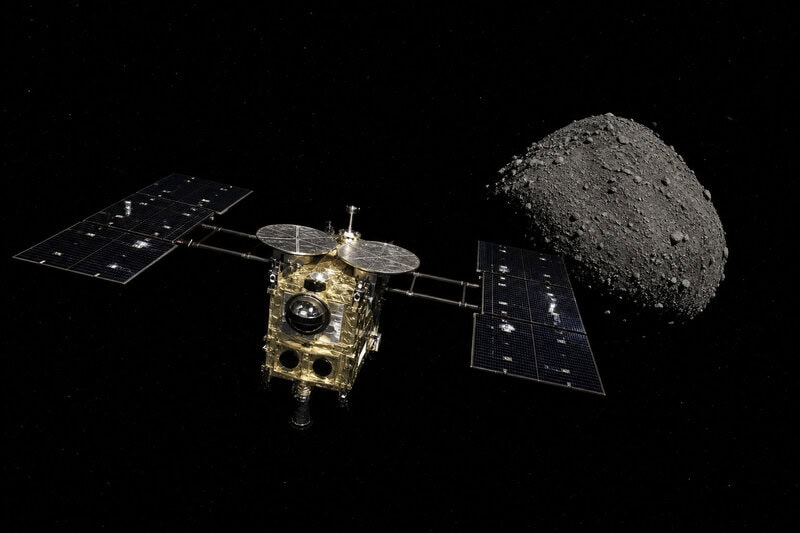
Planetary defence — the discipline dedicated to detecting, tracking, and potentially redirecting hazardous asteroids — depends critically on knowing what those asteroids are actually made of. A close flyby generates high-resolution imagery and spectral data that can reveal surface composition, porosity, and whether a given asteroid is a solid monolith or a loosely bound “rubble pile.” That distinction matters enormously for any deflection strategy: a kinetic impactor hitting a solid rock transfers momentum very differently from one striking an aggregate of boulders held together by little more than gravity and friction.
NASA’s Double Asteroid Redirection Test (DART) demonstrated in September 2022 that a spacecraft can successfully alter an asteroid’s orbit through deliberate collision. But the efficiency of that orbital change — specifically, how much momentum is transferred per unit of impactor energy — depends on variables such as mass distribution and material strength that only close-proximity observation can reliably measure. By flying within 800 metres of Torifune, Hayabusa2 aims to collect the ground-truth physical data that can transform theoretical deflection models into operationally reliable plans, which is precisely why JAXA characterises the encounter as a defence test rather than a purely scientific one.
What the Instruments Are Looking For
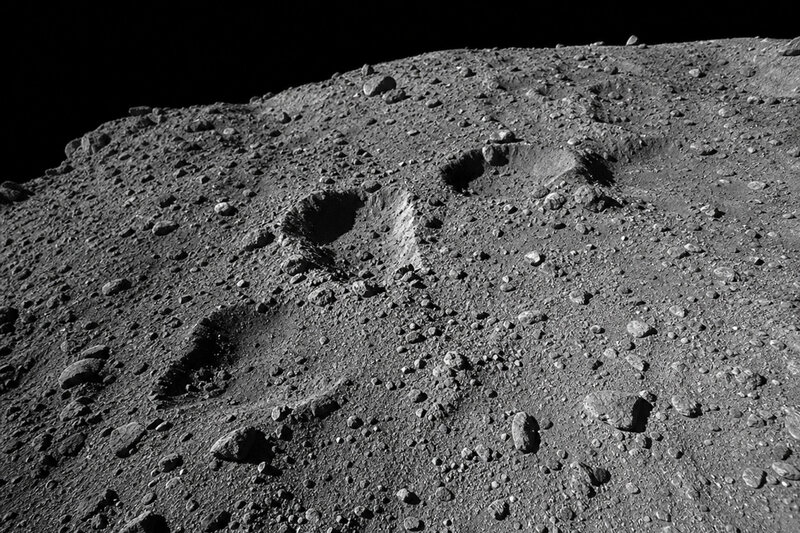
At 800 metres, Hayabusa2’s cameras can resolve surface features at scales that are simply impossible from Earth, mapping craters, boulders, and geological textures that encode the asteroid’s collision history and hint at its internal structure. A heavily cratered surface suggests an older body that has survived multiple impacts; a smoother surface may indicate a different composition or more recent surface processes.
Spectrometers aboard the probe analyse sunlight reflected from Torifune’s surface to fingerprint its mineral composition. This can distinguish between a primitive, carbon-rich body — a C-type asteroid — and a more processed, rocky S-type object, each of which carries different implications for any future deflection strategy. Scientists will also examine Torifune’s albedo, or surface reflectivity. How dark or bright an asteroid is affects how solar radiation pressure subtly pushes the object over decades — a phenomenon known as the Yarkovsky effect. This slow, cumulative drift must be factored into long-term impact probability calculations, making albedo not just an aesthetic measurement but a safety-critical one.
Navigation data from the close approach will additionally yield a refined mass estimate for Torifune. By precisely measuring the minute gravitational tug the asteroid exerts on Hayabusa2’s trajectory, scientists can calculate its mass — a figure essential for determining how much energy any future deflection attempt would need to deliver.
Japan’s Role in the Global Asteroid Defence Architecture
JAXA occupies a distinctive niche within the international planetary defence ecosystem. Where NASA’s recent focus has shifted toward impact demonstration — exemplified by the DART mission — and the European Space Agency’s Hera mission is designed to assess DART’s aftermath in forensic detail, Japan has specialised in close-proximity characterisation and sample return. This division of labour is strategically coherent: effective planetary defence requires both the capability to deflect an asteroid and the physical knowledge to do so correctly, and Japan’s missions have consistently supplied the latter.
Findings from the Torifune flyby are expected to feed into global threat-assessment databases maintained by organisations including NASA’s Planetary Defense Coordination Office and ESA’s Planetary Defence Office, extending the scientific return of a single Japanese spacecraft across the entire international community. Data-sharing agreements between these agencies mean that what Hayabusa2 learns at Torifune will directly inform how other nations plan and calibrate their own deflection capabilities.
What Comes Next — and What Remains Uncertain
According to an AFP dispatch filed from Tokyo on July 5, 2026, the flyby was reported as scheduled and imminent at the time of filing. Confirmation that Hayabusa2 achieved the planned 800-metre closest approach and successfully transmitted usable scientific data was still pending at the time of original publication. Space missions involve communication delays and the possibility of real-time anomalies, and results should be treated as preliminary until JAXA issues a formal post-flyby assessment.
Scientists caution, moreover, that a flyby — however close — is not equivalent to a sample-return mission. Remote sensing leaves interpretive uncertainties that only physical specimens can fully resolve; Torifune’s deeper interior will remain inaccessible to Hayabusa2’s instruments regardless of approach distance. Critically, the encounter does not constitute an active deflection test in the sense that DART was: no object will be nudged off course. It is, rather, a characterisation mission — essential groundwork for designing any credible future intervention against a comparable asteroid.
Pending full data downlink and peer-reviewed scientific analysis, any specific claims about Torifune’s composition, internal structure, or long-term threat level should be regarded as preliminary. The scientific community will require months of rigorous study before consensus findings can be published and independently verified. What is already clear, however, is that humanity’s ability to defend itself from asteroid impacts depends on exactly this kind of painstaking, proximity-tested knowledge — gathered one 800-metre pass at a time.