
Somewhere above the atmosphere, traveling at roughly 17,500 miles per hour, a piece of quantum hardware built by the Colorado-based company Infleqtion is circling Earth aboard the International Space Station — and the physics of that location may matter as much as the technology itself. Microgravity suppresses the thermal noise that undermines ground-based quantum sensors, potentially unlocking measurement precision that is physically impossible to achieve on the surface of the planet.
What Quantum Sensing Actually Means
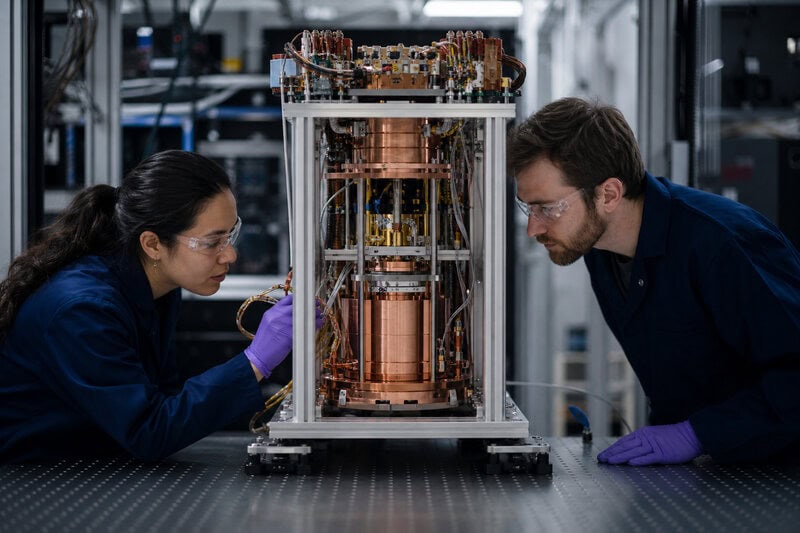
Before exploring why orbit matters, it helps to understand what a quantum sensor actually does — because the term is frequently misunderstood and often conflated with quantum computing, which is a separate technology entirely.
A quantum sensor exploits the behavior of atoms held in a precisely controlled quantum state. Those atoms respond to gravity, acceleration, rotation, time, and electromagnetic fields with extraordinary sensitivity — far exceeding what classical electronics can achieve. The underlying mechanism is quantum superposition: a cloud of ultracold atoms can exist in two energy states simultaneously. When that cloud is released, the two states interfere with each other like overlapping ripples on a pond, and the resulting interference pattern encodes a physical measurement with near-perfect repeatability. The technique is called atom interferometry, and it is the physical engine inside most advanced quantum sensors.
Timing is the most mature application. Atomic clocks already underpin the Global Positioning System, but next-generation quantum clocks promise stability improvements of several orders of magnitude beyond today’s GPS timing signals, according to research from the National Institute of Standards and Technology. Quantum sensors do not perform general computation — they measure the physical world with a precision governed by quantum mechanics rather than classical signal-to-noise limits. A quantum sensor cannot factor a large number or break an encryption key, but it can detect a change in gravitational acceleration smaller than any classical instrument can resolve.
Why Orbit Is the Ideal Quantum Laboratory
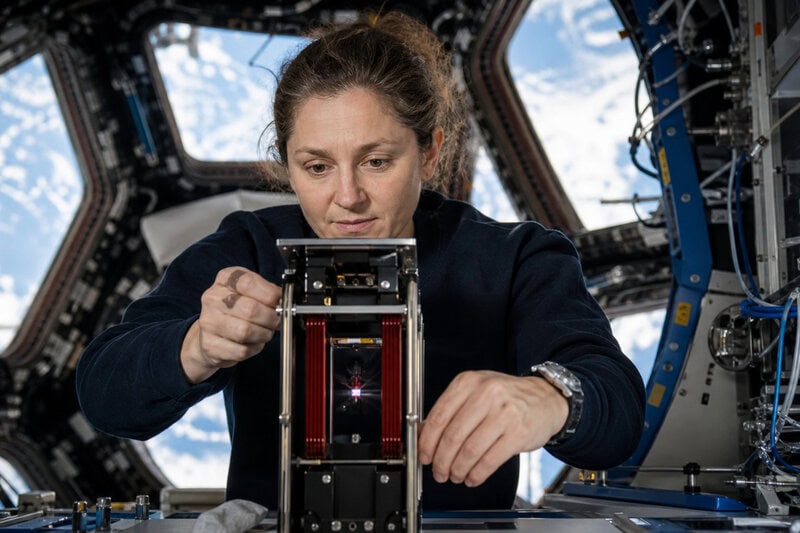
The ISS is not simply a convenient platform for Infleqtion’s hardware — it is, from a physics standpoint, one of the best quantum laboratories available, operating just above Earth rather than on it.
Microgravity allows cold-atom clouds to remain in free fall far longer than any ground-based drop tower permits. That extended free-fall window directly determines sensor sensitivity: the longer atoms can interfere undisturbed, the more precise the measurement. This principle has been validated by NASA’s Cold Atom Lab, which has operated continuously on the ISS since 2018 and has produced ultracold atomic gases at temperatures colder than anywhere else in the known universe.
The near-vacuum of space eliminates atmospheric turbulence that degrades optical quantum links — a key obstacle identified by researchers at the European Space Agency in ground-to-satellite quantum communication trials. From orbital altitude, a single quantum-sensor satellite can map gravitational anomalies, subsurface mass distributions, or ocean currents across an entire hemisphere in a single pass. And the harsh radiation and thermal cycling of the space environment serves as an accelerated stress test: hardware that survives orbit is, by definition, ruggedized for the most demanding terrestrial deployments as well.
America’s Quantum Space Initiative: What Infleqtion Is Building
On June 22, 2026, a White House Executive Order on Quantum Technology signaled that Washington now treats quantum space infrastructure as a national strategic priority. Infleqtion publicly welcomed the Executive Order, and the timing was not coincidental — the company had already announced what it calls America’s Quantum Space Initiative, an explicitly cross-sector program spanning industry, academia, and government.
According to Infleqtion’s announcement, the initiative is designed to accelerate the deployment of quantum sensing, timing, communications, navigation, and computing technologies for space — covering the full stack of quantum capabilities rather than targeting a single application. That breadth is deliberate. Modern space systems are growing more dependent on precision timing and absolute navigation, and GPS — a single-point-of-failure architecture — can be jammed, spoofed, or denied in contested environments. The initiative treats that operational vulnerability as the central problem to solve.
The program’s structure mirrors earlier national technology efforts, such as the semiconductor consortia of the 1980s, which combined public funding with private commercialization pathways. Infleqtion, trading under the ticker INFQ, frames the initiative as a foundation for quantum-enabled space infrastructure — not a single product launch, but a long-term architectural commitment to building the systems that future space operations will depend on.
A NASA cargo flight carried Infleqtion’s quantum hardware to the ISS, marking a concrete hardware milestone of the initiative and establishing that the company has moved beyond laboratory demonstration into operational orbital deployment.
Quantum Navigation: A GPS Alternative Taking Shape
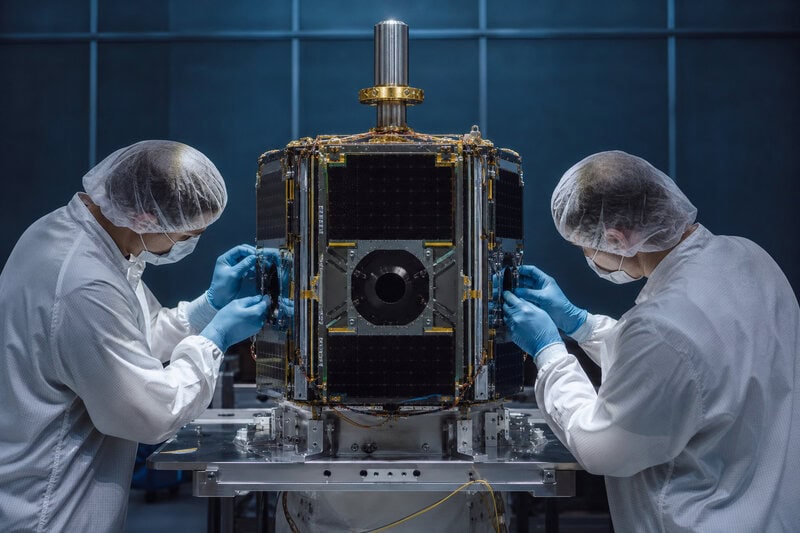
Of the five technology pillars Infleqtion has identified — sensing, timing, communications, navigation, and computing — navigation may carry the most immediate strategic weight, and it illustrates most clearly why quantum navigation as a GPS alternative is attracting serious defense and commercial interest.
A quantum inertial navigation system uses atom interferometry to measure how quantum matter waves shift when a platform accelerates or rotates. From those measurements, the system computes position continuously, without receiving any external signal. That signal-independence makes it inherently unjammable — there is nothing to jam, because the system never transmits or receives a positioning broadcast.
The UK Ministry of Defence and Imperial College London have jointly demonstrated quantum accelerometers that could, in principle, maintain positioning accuracy for extended periods without GPS input, work documented through the UK Quantum Technologies Programme. For space platforms, the stakes are even higher: satellites operating in GPS-denied deep-space environments, or during periods of ground-contact loss, need autonomous, drift-free positioning to maintain orbital mechanics and mission integrity. Infleqtion’s decision to frame quantum navigation as a core pillar — rather than a secondary feature — signals that the company views position-and-timing sovereignty as a national security imperative, not merely a commercial differentiator.
The Broader Quantum Space Race: Context and Honest Caveats
Infleqtion’s initiative does not exist in isolation. The competitive and scientific landscape around quantum space technology has been developing for nearly a decade, and understanding where established capability ends and aspiration begins is essential for anyone assessing near-term claims.
China’s Micius satellite, operated by the University of Science and Technology of China, demonstrated satellite-based quantum key distribution — a method of encrypting communications using quantum mechanical properties that make eavesdropping physically detectable — over 1,200 kilometers in 2017. That experiment established that quantum communications from orbit are physically achievable. It did not establish commercial viability at scale, which remains an open engineering challenge.
The European Quantum Flagship, a €1 billion initiative launched in 2018, includes a dedicated space workstream. ESA’s SAGA study has outlined a roadmap for operational quantum communication satellites by the early 2030s — timelines that experts describe as optimistic but not implausible, depending on sustained funding and engineering progress.
A clear line must be drawn between what has been demonstrated and what remains aspirational. Quantum key distribution from orbit has been demonstrated experimentally. Fault-tolerant quantum computing satellites — platforms capable of running general-purpose quantum algorithms in orbit — have not been achieved, and most researchers place that capability a decade or more away. Infleqtion’s ISS hardware represents an early-stage technology demonstration, and the company has not yet published peer-reviewed performance data from the orbital environment. Investors and policymakers should weigh near-term claims against that disclosure gap before drawing conclusions about commercial readiness.
What Comes Next — and Why It Matters Beyond Defense
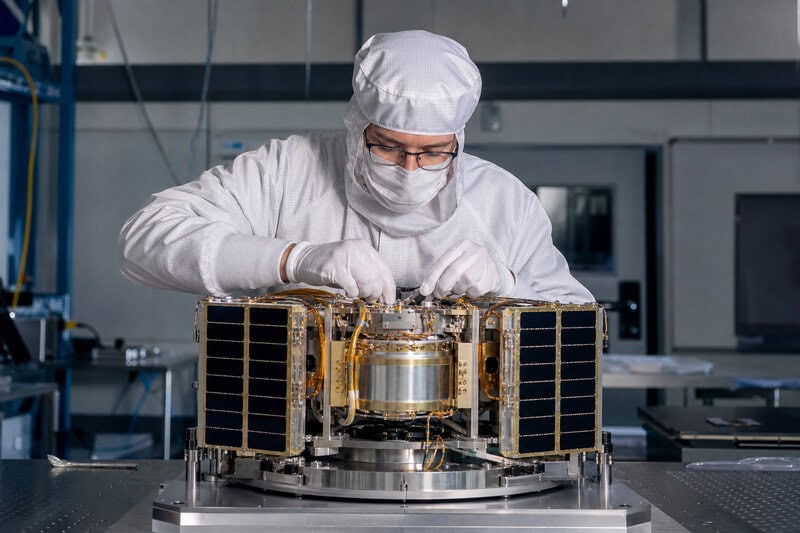
The applications that tend to dominate quantum space discussions are military: unjammable navigation, quantum-secured communications, and persistent surveillance. Those are real and significant. But the civilian implications deserve equal attention, and they extend into domains that affect daily life on the ground.
If quantum sensors in orbit can map Earth’s gravitational field with centimeter-level resolution — a capability that ground-based instruments cannot match — the downstream applications include precision agriculture, early earthquake detection, groundwater monitoring, and climate science. ESA’s GOCE mission science team has outlined projections for exactly these use cases based on improved gravitational mapping data. None of them require classified hardware or defense budgets; they require the same orbital quantum sensing infrastructure that strategic applications will drive into existence.
Quantum-secured satellite communications could eventually underpin a global internet backbone resilient against both classical cyberattacks and future quantum-computer-based decryption — the latter being the primary long-term threat that quantum key distribution is designed to neutralize. Coverage from The Quantum Insider and analysis from the Quantum Computing Report both situate Infleqtion’s initiative within this broader strategic context, noting that the program’s academic partnership component is explicitly designed to address the engineering talent pipeline gap that has historically slowed quantum technology programs.
The success of America’s Quantum Space Initiative will ultimately hinge on the same factors that have determined the outcome of every major technology program: sustained federal funding, open standards that prevent vendor lock-in, and a trained workforce large enough to staff the ambition. What is already evident is that quantum technology, long described purely as a laboratory phenomenon confined to university basements and government research centers, is giving way to quantum technology deployed as infrastructure. The hardware is already in orbit. The competition to define what gets built next is now operating in three dimensions.