
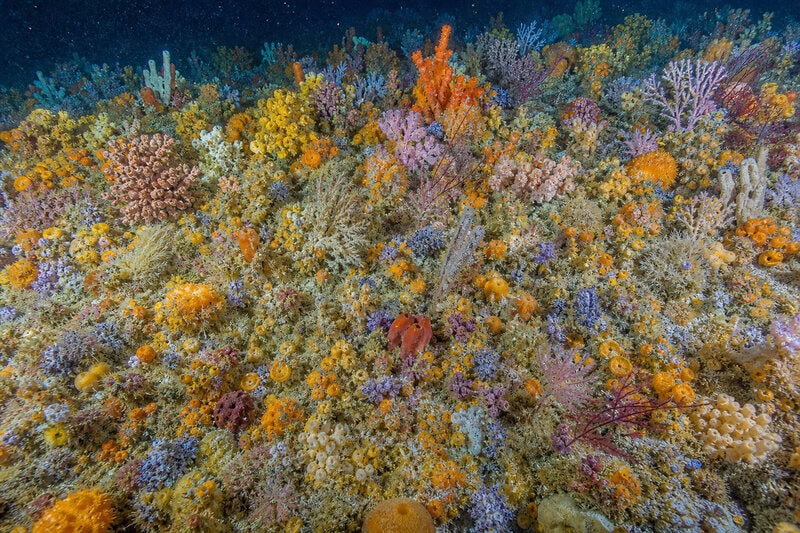
“In places, you couldn’t see a single rock because everything is so densely populated,” said scientists surveying a stretch of the Pacific seafloor — a single observation that upends decades of assumptions about what life can survive in one of Earth’s most hostile environments. What they found was not a curiosity at the margins of science; it was a blanket of animals so complete it erased the geology beneath them, raising a question researchers cannot yet answer: what on Earth is feeding them?
A Seafloor So Crowded the Rock Has Disappeared
The deep ocean below 200 meters covers roughly 65 percent of Earth’s surface, yet it remains less explored than the surface of Mars. For most of the history of marine science, the abyssal Pacific — the vast, lightless plain stretching between 3,000 and 6,000 meters below the waves — was treated as a near-desert: cold, dark, nutrient-starved, and only sparsely inhabited. Textbook diagrams showed thinly scattered sea cucumbers and the occasional brittle star separated by wide expanses of bare sediment. That picture is now harder to defend.
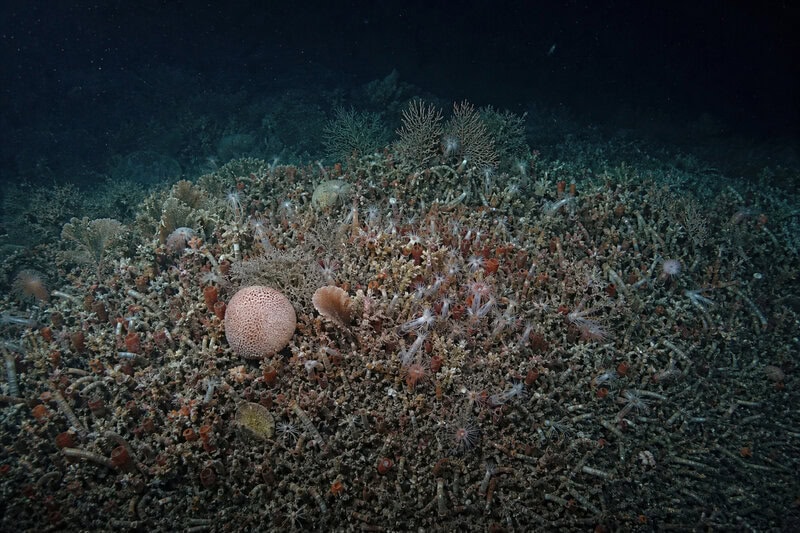
The discovery, made during a recent Pacific seafloor expedition, documented benthic (seafloor-dwelling) organisms packed so tightly across multiple survey areas that the underlying basalt rock substrate was completely obscured. Corals, sponges, sea cucumbers, and a range of invertebrates not yet fully catalogued were found covering the seafloor in what scientists described as dense, continuous aggregations. The imagery was captured by remotely operated vehicles — ROVs — fitted with high-definition cameras, tools that allow researchers to log density estimates across transects without physically disturbing the community below.
The central mystery driving the research is straightforward to state and difficult to solve: in one of the ocean’s most nutrient-poor regions, scientists cannot yet account for the food source sustaining populations this dense. That mismatch between observation and established model is precisely what makes the finding scientifically significant rather than merely visually striking.
What the Deep Pacific Should, In Theory, Look Like
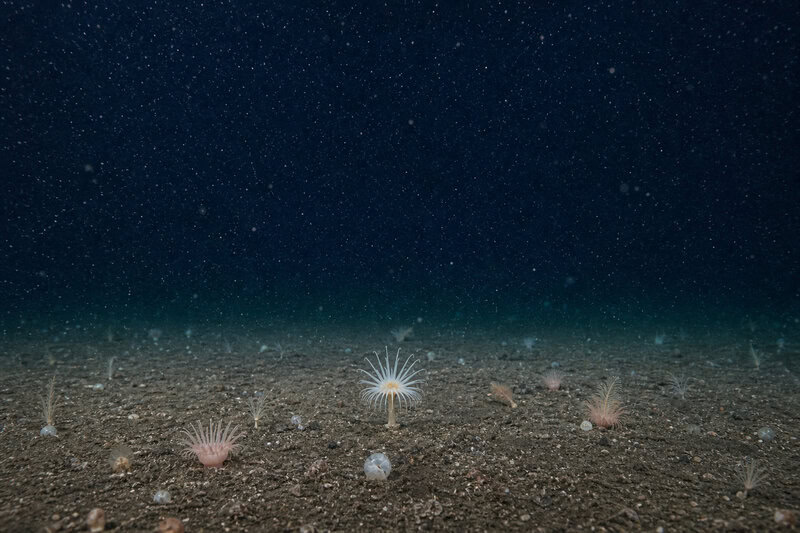
To understand why this discovery is so disorienting, it helps to understand how the deep sea is normally fed. Almost all energy in the deep ocean arrives from above in the form of what scientists call “marine snow” — a slow, continuous drift of dead organisms, fecal pellets, mucus aggregates, and other organic debris sinking from the sunlit surface layer. By the time this material reaches abyssal depths, it has been picked over by organisms at every intermediate level, leaving only a thin residue of nutrition at the bottom.
In oligotrophic — nutrient-poor — open-ocean regions such as the central Pacific gyre, primary productivity at the surface, meaning the rate at which phytoplankton convert sunlight into organic matter, can be ten to twenty times lower than in coastal or polar waters. Less productivity at the surface means less marine snow, which means less food at the bottom. Peer-reviewed research published in journals including Deep-Sea Research has consistently correlated deep-sea animal biomass with surface productivity, and those models predict sparse, widely dispersed communities in exactly the region where this dense aggregation was found.
The observation does not fit that model. That is not a flaw in the observation — it is an invitation to revise the model.
Competing Hypotheses: What Could Possibly Be Feeding Them?
Scientists working in deep-sea ecology are careful to distinguish between a surprising observation and an explained one. No confirmed mechanism has yet been identified for this specific aggregation. However, several working hypotheses are being considered, each grounded in documented phenomena from other parts of the deep ocean.
Polymetallic Nodule Fields as Accidental Oases
Parts of the Pacific abyssal plain are studded with polymetallic nodules — potato-sized, metal-rich concretions that form over millions of years on the seafloor. These nodules create hard substrate in an environment that is otherwise soft sediment, and hard substrate is a critical resource for filter-feeding organisms such as corals and sponges that need something to anchor to. Nodule fields may also concentrate microbial mats that form the base of a local food web. The International Seabed Authority, which regulates potential mining of these formations, has documented elevated biological diversity associated with nodule habitats, though the full energetic dynamics remain incompletely quantified.
Lateral Transport of Organic Matter
Deep-ocean currents do not simply sit still. They move horizontally across vast distances, carrying suspended organic particles far from where surface productivity would suggest they should arrive. Topographic features — seamount flanks, canyon walls, abyssal depressions — can trap and concentrate this laterally transported material, potentially creating localised nutrient hotspots that surface-productivity maps would never predict. This mechanism is documented in deep-sea ecology literature but has not been confirmed as the driver at this specific site.
Chemosynthetic Subsidy
At hydrothermal vents and cold seeps, communities of organisms bypass sunlight entirely, drawing energy from chemical reactions involving hydrogen sulfide and methane. While full vent or seep activity has not been confirmed at this specific site, low-level fluid seepage through the seafloor can support microbial communities that enter the broader food chain, supplementing the meagre rain of marine snow. Stable isotope studies — which trace the chemical fingerprints of carbon and nitrogen through animal tissue — can reveal whether an organism’s diet traces back to photosynthesis at the surface or to chemosynthesis at the seafloor. This technique will likely be central to testing this hypothesis.
None of these explanations has been confirmed for this aggregation. Researchers describe them as working hypotheses requiring sediment core analysis, isotopic sampling, and longer-term observation before any can be elevated to a conclusion.
The Broader Context: A Deep Ocean We Barely Know
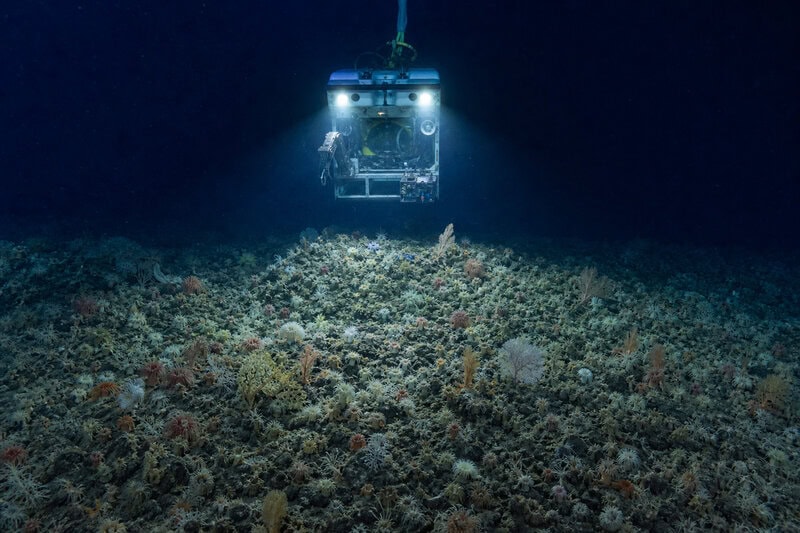
This discovery sits inside a much larger problem: humanity’s profound ignorance of its own planet’s largest living space. Deep-sea ecosystems of the Pacific have been documented in striking detail in recent years, yet scientists estimate that fewer than 20 percent of the deep ocean floor has been imaged at sufficient resolution to detect communities like the one described here. Similar aggregations could exist undetected across millions of square kilometres of abyssal terrain.
NOAA’s Ocean Exploration programme and the Seabed 2030 initiative, co-led by the General Bathymetric Chart of the Oceans (GEBCO), have both published progress reports underscoring how little of the seafloor has been mapped at meaningful resolution. Estimates of total deep-sea species richness remain rough approximations, and baseline surveys of deep Pacific animal communities have barely begun.
The conservation dimension is also real, though it requires careful framing. The Clarion-Clipperton Zone — a stretch of the central Pacific being assessed for potential commercial extraction of polymetallic nodules — overlaps with habitats where dense benthic communities have been documented. The International Seabed Authority is actively navigating the regulatory tension between resource extraction and ecosystem protection, a challenge that discoveries like this one make more complex, not less.
How Scientists Plan to Solve the Mystery
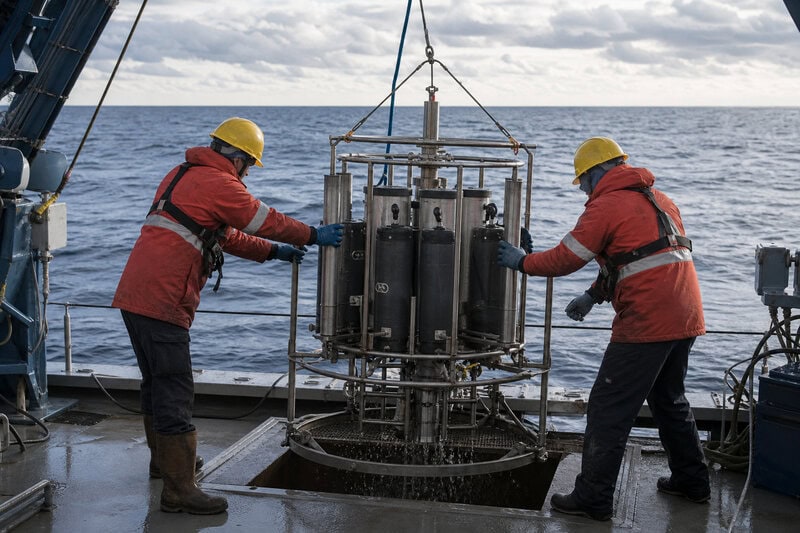
Visual confirmation from ROV footage is the beginning of a scientific investigation, not the conclusion. The standard next steps in deep-sea ecology involve deploying sediment cores and benthic landers — instruments placed on the seafloor to measure the actual flux of organic carbon arriving at the site over time. This gives researchers a quantitative figure for how much food is genuinely available, rather than one inferred from surface productivity models that may not apply in this location.
Stable isotope analysis of collected tissue samples will be particularly important. By examining the ratios of carbon-13 to carbon-12, and nitrogen-15 to nitrogen-14, in animal tissues, scientists can trace dietary sources with considerable precision — distinguishing between organisms that ultimately derive their energy from sunlit surface waters and those connected to chemosynthetic pathways below. This technique is well established in deep-sea ecology and has resolved similar mysteries in other abyssal communities.
Environmental DNA, or eDNA, analysis adds another layer. Water samples taken close to the seafloor can be filtered and sequenced in the laboratory, revealing the genetic signatures of organisms — including microbes — that cameras cannot detect. If chemosynthetic bacteria are anchoring the local food web, eDNA is likely to find them even before physical sampling confirms their presence.
Researchers are also still processing fundamental taxonomic data from the initial surveys. Species-level identification of the organisms observed is ongoing, and the number of species that may be new to science has not been formally published. That accounting alone could take years. Fully resolving what sustains a newly discovered deep-sea aggregation typically requires multiple expedition seasons and extended laboratory analysis. Definitive answers are not imminent — and scientists are honest about that.
Why This Finding Matters Beyond the Laboratory
The deep ocean is not a remote irrelevance. It regulates global carbon cycling by sequestering organic material that would otherwise return to the atmosphere; it supports fisheries indirectly through nutrient upwelling that fertilises surface waters; and it harbours genetic and chemical diversity with documented potential for pharmaceutical and biotechnological applications. Understanding how deep-sea ecosystems actually function — rather than how models predict they should — has practical consequences extending well beyond scientific curiosity.
The Pacific seafloor discovery does not overturn deep-sea ecology. It expands its boundaries. It demonstrates that dense biological communities can establish themselves in conditions scientists previously considered prohibitive, and that the models used to predict where life thrives in the abyss are incomplete in ways that will require new data, new tools, and new thinking to address.
What remains, in the end, is the image that opened this article: a seafloor so packed with life that not one patch of bare rock is visible beneath the animals covering it. That image is not a sensational anomaly to be marvelled at and forgotten. It is a scientific question mark planted in the darkness some 4,000 metres below the surface, waiting for the expeditions, the samples, and the years of analysis that will eventually explain it — or reveal something stranger still.