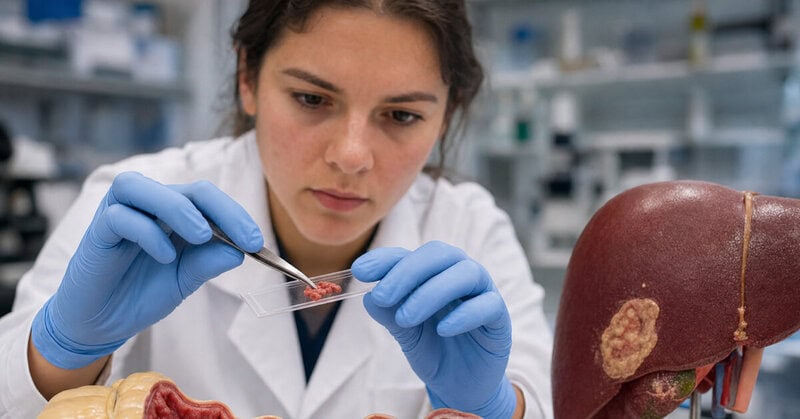
Every year, roughly 53,000 Americans die from colorectal cancer — and the vast majority of those deaths are not caused by the original tumor sitting in the colon, but by what happens after cancer cells escape it. Now, scientists at MIT and Memorial Sloan Kettering Cancer Center have identified a surprising mechanism behind that escape: colorectal cancer cells appear to hijack the gut’s own healing machinery, flipping a biological switch that was never meant to help them travel.
A Hijacked Healing Program, Not Just Bad Genes

The long-dominant explanation for how colon cancer spreads has centered on genetic mutation — the idea that tumor cells accumulate enough DNA damage over time to eventually break free from the primary tumor and colonize distant organs like the liver. That model is not wrong, but emerging research suggests it is incomplete. According to findings from MIT biologist Omer Yilmaz and collaborators, colorectal cancer cells can gain the ability to spread by co-opting a repair program the gut already uses to heal itself — without necessarily acquiring new DNA mutations.
The key player the MIT researchers identified is a protein called YAP1, short for Yes-Associated Protein 1. YAP1 is not a cancer gene in the traditional sense. Under normal circumstances, it functions as a master coordinator of tissue regeneration: when the gut lining is injured, YAP1 activates and temporarily endows cells with stem-cell-like qualities — the ability to migrate, divide rapidly, and rebuild damaged tissue. Once healing is complete, YAP1 switches back off and cells return to their specialized, stationary roles.
In colorectal cancer, that temporary flexibility becomes a permanent trap. Tumor cells lock YAP1 into an “on” state, essentially freezing themselves in wound-healing mode. The result is a population of cancer cells that behaves the way the gut behaves during an injury response: mobile, adaptable, and primed to invade — qualities that make them far more capable of surviving the journey from the colon to the liver.
The Role of Diet: A Concrete Molecular Link

One of the more striking details to emerge from research connected to Yilmaz’s lab is the role of diet in activating this switch. A high-fat diet appears to be one of the environmental triggers that drives colon cancer cells to switch on YAP1, linking dietary patterns to metastatic potential through a specific molecular mechanism rather than the vague, population-level correlations that have long characterized nutrition and cancer research.
This distinction matters. Telling patients that a poor diet raises cancer risk has limited clinical utility if the mechanism is unknown. Identifying that high-fat intake activates a specific, druggable protein involved in metastasis transforms the conversation: it raises the possibility that dietary intervention could one day be incorporated into metastasis-prevention strategies as a mechanistically justified clinical tool, not merely general wellness advice.
Scientists caution, however, that this connection has been established in laboratory and preclinical settings. Significant research is still needed to determine whether the effect is dose-dependent, reversible, and applicable to humans across the full range of colorectal cancer subtypes.
A Second Switch: What MSK Researchers Found
While the MIT work focused on YAP1 as an activator of the healing program, researchers at Memorial Sloan Kettering Cancer Center approached the same biological territory from a different angle. MSK scientists identified a protein called ZFP36L2 that acts as a critical molecular switch controlling how gut cells repair themselves. When ZFP36L2 is active, gut cells stay in their differentiated, specialized roles. When it is silenced — as appears to happen frequently in colorectal cancer — that brake releases, and cells revert to a more primitive, migratory state.
In effect, YAP1 and ZFP36L2 describe two sides of the same switch. YAP1 is the accelerator; ZFP36L2 appears to be the brake. Colorectal cancer may exploit both: activating YAP1 to push cells toward a migratory identity while simultaneously suppressing ZFP36L2 to prevent the body from pulling them back. The convergence of two independent research lines on the same conceptual framework — hijacked healing — strengthens the emerging picture, though scientists note that the precise molecular relationship between these two proteins within the same tumor remains an active area of investigation.
Researchers have also linked this switch activity specifically to the liver as a destination organ, offering a mechanistic explanation for a long-observed clinical pattern. The liver is by far the most common site of colorectal metastasis, and the new findings suggest this may be partly because liver tissue is particularly receptive to cells running a wound-healing program — cells that arrive already behaving like repair workers looking for a site to rebuild.
Why This Reframes the Science of Cancer Spread
The scientific significance of these findings extends beyond colorectal cancer. They suggest that cancer cells may change their functional identity — transforming from a specialized colon cell into a stem-like, migratory cell — through changes in gene expression rather than gene sequence. Scientists call this epigenetic or transcriptional reprogramming: the DNA blueprint stays the same, but the instructions being read from it change dramatically.
This distinction carries therapeutic implications. DNA mutations, once they occur, are essentially permanent features of a cancer cell. Epigenetic states, by contrast, are in principle reversible — meaning that cells locked into a metastatic identity through gene-expression changes might, theoretically, be reprogrammed back toward a non-invasive state. As reporting on the MIT findings has noted, colon cancer cells may “switch identity” to spread — and if they can switch one way, researchers want to know whether they can be switched back.
It is important not to overstate where the science currently stands. The field has not abandoned the mutation model of metastasis, and most researchers believe both mechanisms — mutation accumulation and transcriptional reprogramming — likely operate simultaneously in real tumors. These are emerging findings that require further validation, not settled consensus that overturns decades of cancer biology.
What This Could Mean for Treatment and Diagnosis
The therapeutic implications of identifying a hijacked healing switch are potentially significant, though clinical application remains years away. Because YAP1 is a structurally characterized protein, pharmaceutical researchers already have a starting framework for designing inhibitors. Several YAP1-targeting compounds are in early-stage investigation for other cancer types, though none are yet approved specifically for colorectal metastasis. The new findings may accelerate interest in moving some of those compounds toward colorectal-specific trials.
ZFP36L2’s role as a molecular switch points toward a different — and potentially complementary — therapeutic strategy. Rather than blocking an activating protein like YAP1, clinicians might eventually aim to restore suppressor proteins that keep the healing switch in the off position, effectively re-engaging the brakes that cancer has disabled. The two approaches are not mutually exclusive, and some researchers believe combination strategies targeting both sides of the switch simultaneously could prove more durable than either alone.
- YAP1 inhibition: Blocking the activating switch to prevent cancer cells from entering migratory, stem-like states
- ZFP36L2 restoration: Reactivating the molecular brake to return tumor cells to a stationary, differentiated identity
- Dietary and metabolic intervention: Targeting the high-fat diet connection as an adjunct metastasis-prevention strategy once human evidence matures
- Earlier risk stratification: Using switch activation as a biomarker to identify patients most likely to develop metastasis before it occurs
Experts consistently emphasize that translating basic-science mechanisms into approved therapies typically requires a decade or more of clinical validation. Patients currently living with colorectal cancer should not interpret these findings as immediately actionable treatment changes, and any questions about individual therapeutic options should be directed to their oncology team.
Open Questions and the Road Ahead
The most immediate clinical impact of these discoveries may be diagnostic rather than therapeutic. Understanding which tumors have already activated these healing-switch pathways could give oncologists a new tool for identifying patients at the highest risk of metastasis earlier in the disease course — allowing for more aggressive monitoring or preventive intervention before cancer cells reach the liver.
Key scientific questions still open include how YAP1 and ZFP36L2 interact with each other within the same tumor microenvironment, whether the same switches are equally active across the distinct genetic subtypes of colorectal cancer, and whether the dietary trigger for YAP1 activation is reversible through dietary change after a diagnosis has already been made. Each of those questions represents a discrete line of research that will require its own experimental validation before any clinical conclusions can be drawn.
More broadly, the discoveries add momentum to a growing movement in cancer biology toward studying what researchers call “cancer cell plasticity” — the ability of tumor cells to shift between functional identities — alongside the traditional focus on mutation accumulation. This framework is gaining traction across multiple tumor types and may eventually reshape how oncologists classify and treat cancers that have already begun to spread.
For now, what MIT and MSK researchers have given the field is something scientists prize above almost everything else: a concrete mechanism to pursue. The switch has been found. The harder work of learning to flip it back is just beginning.