
Every day, financial institutions, hospitals, and governments transmit sensitive data protected by encryption that a sufficiently powerful computer could theoretically crack. Quantum networking is designed to eliminate that vulnerability — not by writing better software, but by enlisting the laws of physics themselves as the enforcer. New York-based startup Qunnect is now translating that principle into hardware engineered to run on the telecommunications infrastructure already buried beneath our streets.
What Classical Networks Get Wrong About Security
Today’s internet secures data through mathematical complexity. Encryption standards like RSA rely on a straightforward asymmetry: multiplying two enormous prime numbers together is trivial, but working backwards — factoring the product — takes classical computers an impractical amount of time. That guarantee, however, is not permanent. It erodes as computing power grows, and it collapses entirely if sufficiently capable quantum computers arrive.
The threat is concrete enough that the U.S. National Institute of Standards and Technology finalized a new generation of post-quantum cryptographic standards in 2024, explicitly to get ahead of the problem. But post-quantum cryptography addresses only one of two structural weaknesses in classical networks. The second is a copy problem: data packets traveling across the internet can be intercepted and duplicated without the sender or receiver detecting anything, because copying classical bits leaves the original perfectly intact. Quantum networks address both vulnerabilities simultaneously — not through cleverer mathematics, but through physical phenomena that have no classical equivalent.
The Physics Behind Quantum Security: Superposition, Entanglement, and No-Cloning
Three properties of quantum mechanics underpin the security promises of quantum networking. Each is worth understanding on its own terms before seeing how they combine in practice.
- Superposition means a quantum particle — most often a photon, a single particle of light — can exist in multiple states simultaneously, representing both 0 and 1 at once, until the moment it is measured. That measurement forces the particle to resolve into a single definite value, destroying the ambiguity that made it useful as a carrier of quantum information.
- Entanglement is the phenomenon Albert Einstein famously called “spooky action at a distance.” Two particles can become correlated such that measuring one instantaneously determines the state of the other, regardless of the physical distance between them. This is not a theoretical curiosity: it is among the best-tested predictions in all of physics, confirmed experimentally by multiple independent research groups across decades.
- The no-cloning theorem is a proven mathematical result, first established by physicists William Wootters and Wojciech Zurek in 1982. It states that it is impossible to create a perfect copy of an unknown quantum state. Unlike classical bits, quantum information cannot be duplicated without disturbing the original — meaning any interception leaves physically detectable fingerprints.
Together, these three properties give quantum networks a security guarantee rooted in physics rather than computational difficulty. Researchers and engineers are careful to note, however, that practical implementations introduce their own vulnerabilities — imperfect detectors, hardware side-channels, timing attacks — that classical security disciplines must still manage. Physics sets the theoretical ceiling; engineering determines how close real systems come to it.
How Quantum Key Distribution Actually Works
The most mature application of quantum networking is quantum key distribution, or QKD. The concept is elegant in principle: rather than transmitting encrypted data directly, two parties — conventionally called Alice and Bob — exchange a cryptographic key encoded in quantum states, most often the polarization of individual photons.
The foundational protocol, known as BB84, was proposed by Charles Bennett and Gilles Brassard in 1984. Because of the no-cloning theorem, any eavesdropper — call her Eve — attempting to intercept those photons must measure them, and that measurement inevitably disturbs their quantum states. When Alice and Bob later compare a sample of their results over a classical channel, the statistical errors Eve introduced appear as anomalies. If the error rate falls below an agreed threshold, the key is clean and usable; if not, both parties discard it and start again. No valid key means no decryption — and no silent interception.
Entanglement-based QKD, developed theoretically by physicist Artur Ekert in 1991, adds a further layer of assurance. The correlations between entangled particles can be tested against mathematical constraints called Bell inequalities, providing a device-independent confirmation that no third party has interfered with the key generation process. This is a stronger guarantee than prepare-and-measure protocols can offer on their own.
QKD has been demonstrated over fiber-optic links and via satellite. China’s Micius satellite program transmitted entangled photons over intercontinental distances, and companies including Toshiba and ID Quantique have operated fiber-based QKD links in live network environments. Scaling to a global network, however, remains an active and difficult engineering problem. Photons are lost to absorption and scattering over long fiber runs, and amplifying a quantum signal the way classical repeaters boost a classical signal is forbidden by the no-cloning theorem itself. This constraint makes quantum repeaters — devices that extend entanglement over distance without measuring and destroying it — one of the most intensely researched problems in the field. As of mid-2025, no commercially deployed quantum repeater exists, though laboratory demonstrations have been reported by research groups including those at Delft University of Technology in the Netherlands.
The U.S. Department of Energy’s quantum networks explainer outlines the staged vision the research community is working toward: near-term trusted-node QKD networks, followed by entanglement-distribution networks, and ultimately a fully quantum-coherent internet capable of connecting quantum processors across great distances.
Qunnect’s Approach: From University Research to Deployable Infrastructure
Qunnect occupies an unusual position in the quantum networking landscape. The company was founded to commercialize student research and close the gap between quantum networking theory and practical, deployable hardware. Led by CEO Noel Goddard and Chief Scientist Mehdi Namazi, Qunnect has organized its work around a constraint that many academic demonstrations ignore: the telecommunications fiber already in the ground.
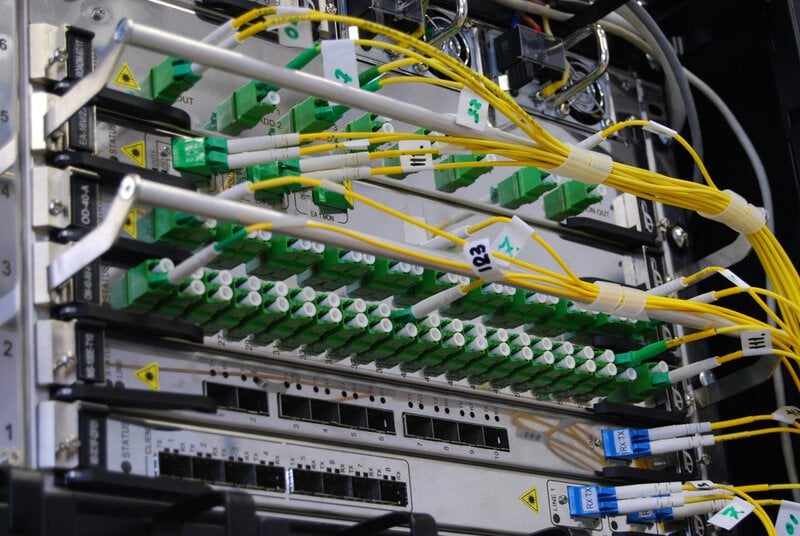
Rather than proposing a parallel quantum internet built from scratch, Qunnect designs hardware intended to transform existing fiber-optic infrastructure into scalable quantum networks. Working within deployed systems dramatically lowers the barrier to adoption. Utilities and enterprises do not need to replace physical plant; they need only add compatible quantum hardware at endpoints and at strategic nodes along existing routes. That compatibility with incumbents’ sunk infrastructure is a deliberate commercial strategy, not an accident of engineering.
Cisco Investments’ decision to back Qunnect carries weight precisely because of who Cisco is. As one of the largest players in classical networking infrastructure globally, Cisco’s investment reflects an institutional judgment that quantum-secured communication is a credible near-term direction for enterprise and government networks — not a distant research ambition. When infrastructure incumbents begin allocating capital to a technology, it typically marks the transition from proof-of-concept to active deployment planning.
Qunnect has also attracted attention from the intellectual property community. As Wolf Greenfield notes in its client spotlight, protecting the underlying innovations in quantum hardware through rigorous patent strategy is itself a competitive consideration as the field matures and commercial stakes rise.
Qunnect frames its roadmap around two parallel goals: building foundational infrastructure for quantum-secured communication in the near term, and enabling networked quantum computing over a longer horizon. The second goal remains firmly in early research stages across the entire industry. The first — quantum-secured key distribution over existing fiber — is considerably closer to practical deployment.
What Quantum Network Security Actually Guarantees — and What It Does Not
A common misconception deserves direct correction: a quantum network does not make all hacking physically impossible. More precisely, it makes one specific and critical attack — eavesdropping on the key exchange — detectable with high probability, because the laws of physics require it. Other attack surfaces, including software vulnerabilities, hardware side-channels, and human factors, remain classical security problems that quantum mechanics does not touch.
This distinction matters for realistic planning. Security analysts and researchers broadly agree that hybrid classical-quantum architectures — combining NIST’s new post-quantum cryptographic standards with QKD where feasible — represent the most prudent near-term posture for sensitive networks. As Qunnect itself has noted, quantum networking addresses threats that quantum computing alone does not — the two fields are complementary, not competing answers to the same problem. Neither approach alone is sufficient; together, they address distinct and complementary threat vectors.
The quantum networking market is attracting substantial government investment globally. The U.S. National Quantum Initiative Act and the European Quantum Flagship program both allocate significant funding toward quantum communication research and infrastructure, reflecting a policy consensus that reliable quantum communication carries strategic and economic weight extending well beyond any single commercial application.
The Road Ahead: Honest Timelines, Unsolved Problems, and Why the Stakes Are High
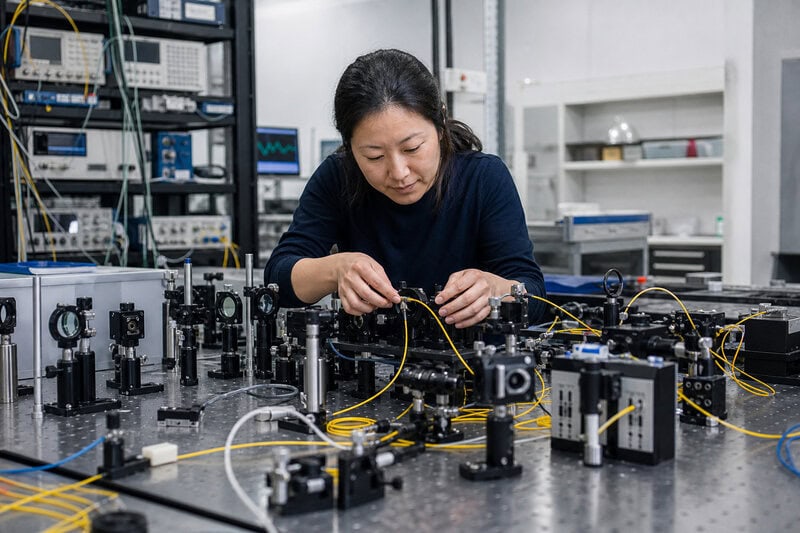
Companies like Qunnect occupy a critical but genuinely difficult position. The underlying science is validated; the engineering is hard. Building a cost-effective, low-loss quantum networking stack suitable for widespread deployment involves unsolved problems in quantum memory design, repeater architecture, and error correction — challenges that require continued research advances running in parallel with commercialization efforts, and that will not yield to investment capital alone.
For organizations making security decisions today, the practical takeaway is a horizon question. Classical encryption, augmented by NIST’s finalized post-quantum standards, remains the appropriate foundation for the present. Quantum networking infrastructure being built by companies including Qunnect is laying groundwork for a more fundamental security upgrade over the coming decade — one that addresses the copy problem and the eavesdropping problem at the physical level rather than the mathematical one.
The deeper significance of quantum networking may not reside in any single product or protocol. It lies in the precedent: that security can be grounded in immutable laws of nature rather than the temporary limits of computational power. If that shift is realized at scale — across financial networks, healthcare systems, and government communications — the consequences reach every institution that depends on private communication remaining private. Qunnect’s vision for the quantum internet is one serious, hardware-grounded attempt to make that precedent into permanent infrastructure.