
Nearly one in two riders who ends up in a hospital emergency department after an e-scooter crash has sustained an injury to the head or face. That single statistic — a pooled frequency of 42.1% across multiple studies reviewed in a PMC meta-analysis of e-scooter-associated injury types and severity — reframes what many people still treat as a minor urban inconvenience into a public health pattern serious enough to reshape trauma medicine.
A Transformation of the Trauma Ward in Five Years

The speed of change inside hospital emergency departments has been striking. As recently as 2018, e-bikes and e-scooters accounted for just 8% of all trauma cases linked to bikes or scooters. By 2023, that share had crossed 50%, according to hospital data cited by ABC News on the growing number of trauma and brain injuries linked to e-bikes and scooters. That is not a gradual drift — it is a structural change in what emergency physicians encounter on any given shift in a city with an active scooter-share program.
The aggregate numbers reinforce the trend. The U.S. Consumer Product Safety Commission documented a 22% rise in e-scooter injuries in 2022 compared to the prior year, and its 2024 report on soaring e-scooter and e-bike injuries found that nearly half (46%) of all tracked incidents clustered in specific anatomical categories — a concentration suggesting the danger follows a predictable physical logic rather than random chance.
Part of the explanation is simple physics. E-scooters can reach speeds of 15 to 20 miles per hour with no pedaling effort required, meaning a first-time or occasional rider can be traveling at speeds their balance and reflexes have never been conditioned to handle. The industry term for these vehicles — micromobility — carries a prefix that somewhat undersells the velocity involved. Deployments of shared micromobility vehicles in U.S. cities roughly tripled between 2019 and 2023, creating what epidemiologists describe as a natural experiment: a rapid, widespread behavioral change whose health consequences are only now being systematically measured.
The Injury Map: What Researchers Have Found

The 42.1% head-and-face figure from the PMC meta-analysis is not a rough estimate. The study reports a 95% confidence interval of 38.7 to 45.4 percentage points — statistical language meaning researchers are highly confident the true value falls within that narrow band, reflecting a genuine, stable pattern across multiple datasets rather than noise from a single unusual sample. For clinicians reading injury literature, a confidence interval of that precision is a signal to take a finding seriously.
Upper extremity injuries — fractures and soft tissue damage to the wrists, forearms, and hands — rank among the next most common categories documented in the same PMC analysis. The mechanism is straightforward and well understood in trauma medicine: when a person pitches forward, the instinctive response is to extend both arms and catch the fall. On an e-scooter, where the rider stands upright with no saddle, no pedals to brace against, and no seatbelt, that outstretched-arm reflex sends the hands directly toward asphalt at whatever speed the vehicle was traveling.
The orthopedic consequences are not trivial. A study published in the Journal of Orthopaedic Business examining the financial burden of e-scooter-related injuries found that orthopedic injuries — broken bones and joint damage — are common enough and serious enough to frequently require surgical intervention, with significant cost-per-patient implications for health systems. The financial burden documented in that research is prompting hospital administrators in high-deployment cities to advocate for upstream prevention rather than continuing to absorb downstream costs.
The anatomical clustering is not coincidental. The standing posture on an e-scooter, combined with wheels typically only four to five inches in diameter, creates a specific failure mode: a small wheel catching a pavement crack, a raised manhole cover, or a tram track arrests the wheel’s forward motion while the rider’s body mass continues forward. Trauma surgeons refer to this as a forward-pitch fall, and it is the underlying mechanism connecting the head injuries, facial lacerations, and wrist fractures that dominate e-scooter injury databases.
The Pediatric Problem: A Demographic Skew That Demands Attention

Children are not simply small adults when it comes to trauma — they are physiologically distinct patients — and the pediatric e-scooter injury picture is emerging as a particular area of concern. Johns Hopkins researchers studying rising rates of electric scooter injuries and racial and ethnic disparities among those harmed identified 2,117 recorded pediatric e-scooter injuries between 2020 and 2024 — a dataset large enough to surface demographic patterns that smaller case studies cannot resolve.
Boys under 18 accounted for 70.7% of those pediatric cases, a skew that mirrors broader risk-taking behavior literature but also raises practical questions about whether rental platforms and parents are applying age restrictions consistently. Many shared scooter services nominally require users to be 18 or older, but enforcement relies primarily on self-reported age at account creation — a verification gap that makes it difficult to determine how many injured minors were riding legally versus without authorization.
Children also face amplified consequences from the forward-pitch fall pattern. Their center of gravity sits higher relative to total body height than in adults, making balance recovery harder. Their skulls are thinner and their brains are still actively developing — factors that increase both the likelihood of concussion and the potential duration of recovery from any given head impact. These physiological differences make the 42.1% head-injury figure especially consequential when applied to younger riders.
The Hopkins study also identified racial and ethnic disparities among injured riders, a finding that adds another dimension to the public health picture. If injury risk is not evenly distributed across demographic groups — whether because of differences in helmet access, road surface quality in different neighborhoods, or rider experience — then interventions designed as one-size-fits-all solutions may leave the most vulnerable riders underprotected. That dimension of the research is still being investigated, but it argues against treating e-scooter safety as a uniform engineering problem with a single universal fix.
Why Scooters Fail the Way They Do: The Physics of Small Wheels and Standing Posture
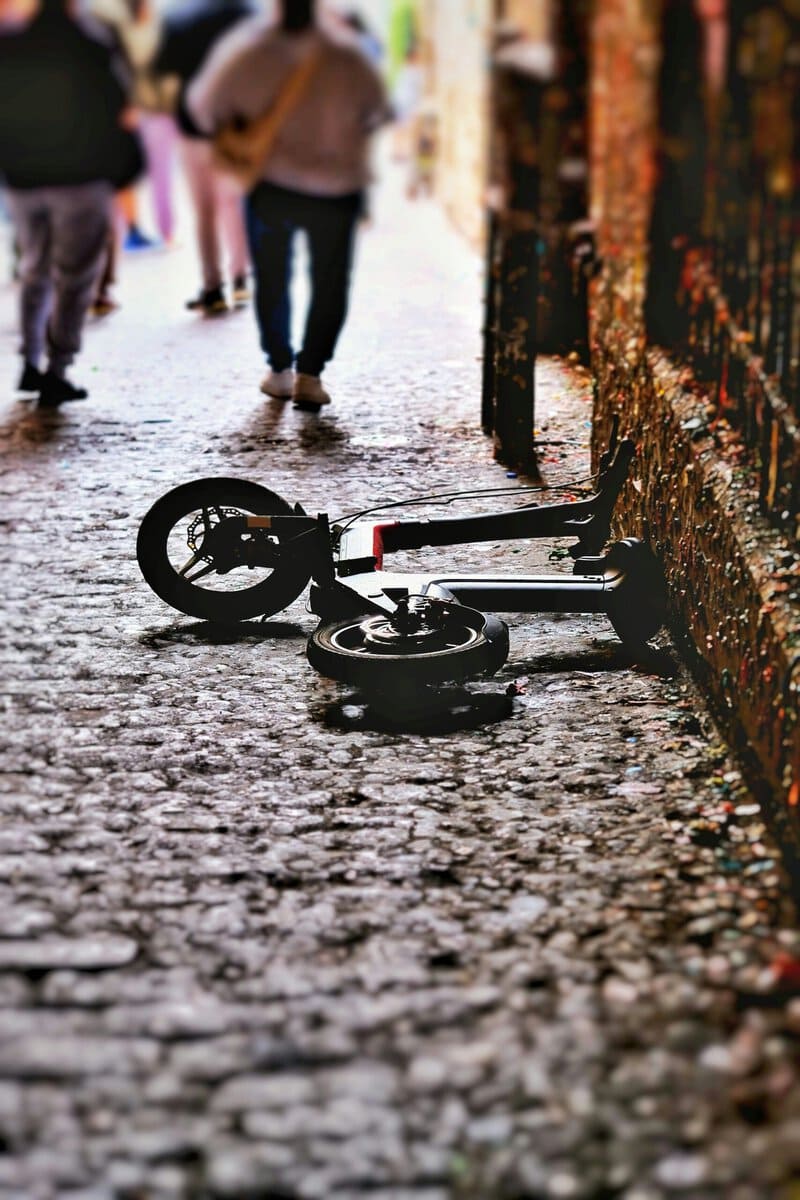
Understanding the injury map requires understanding what makes e-scooters mechanically different from bicycles. A bicycle rider sits lower, benefits from large-diameter wheels that roll over surface irregularities more smoothly, and can instinctively brace through the pedals and saddle during sudden deceleration. An e-scooter rider stands fully upright, has no pedals to push against, and relies on wheels whose small circumference interacts poorly with the cracked, patched, and uneven surfaces common to real urban streets.
Speed asymmetry is a concept gaining traction in micromobility safety research. Because e-scooters accelerate electrically — without the physical effort that gives a cyclist proprioceptive feedback about how fast they are moving — riders’ perceived speed often lags their actual speed. A casual rider who feels comfortable at what seems like a moderate pace may be moving at 15 miles per hour with reaction time and stopping distance calibrated for half that speed. This situational awareness gap is a key factor in why seemingly minor obstacles produce high-severity crashes.
Road surface quality interacts with small-wheel design in ways that safety engineers are only beginning to model systematically. Injury risk on an e-scooter is not uniform across a single city, let alone across the country — a smooth protected lane and a deteriorated asphalt strip shared with buses present fundamentally different hazard profiles for the same vehicle and the same rider.
What Cities, Hospitals, and Riders Can Do With This Information
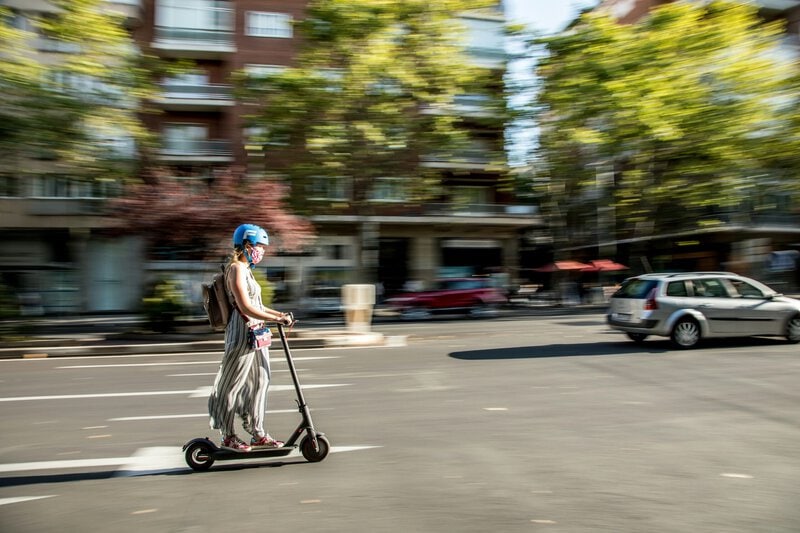
Trauma centers in cities with large scooter deployments are beginning to track micromobility as a distinct injury mechanism in their intake records — a shift that sounds administrative but carries real scientific value. When e-scooter crashes are logged as a generic fall or lumped with bicycle injuries, the epidemiological signal is lost. Cleaner categorization will make future studies more precise and give policymakers better data to act on.
Several cities have introduced geofenced speed reductions that automatically slow scooters in high-pedestrian zones, as well as helmet-sharing programs attached to rental fleets. These interventions are mechanistically sound given what the injury data show, but rigorous outcome studies on their effectiveness are still accumulating. No consensus best practice has yet emerged, and advocates for these measures should be transparent about the current limits of the evidence base.
Researchers studying the injury pipeline emphasize that a wrist fracture or a facial laceration appearing in an emergency department dataset needs to travel upstream — to the engineers specifying wheel diameter, the legislators drafting helmet laws, and the platform designers setting speed defaults. That pipeline currently has significant institutional gaps, and closing them requires coordination across sectors that rarely communicate with each other.
For individual riders, the evidence points to a clear hierarchy of protective actions. Helmet use directly addresses the modal injury: with 42.1% of e-scooter hospital cases involving the head or face, a helmet is not a precaution against a rare event — it is protection against the most common documented outcome. Yet observed helmet use on shared scooters in U.S. cities consistently runs below 5% in street-level studies, a gap between known risk and actual rider behavior that public health professionals describe as one of the most tractable problems in the entire e-scooter safety picture.
Wrist guards, while not yet supported by the same volume of e-scooter-specific trial data as helmets, are mechanistically logical given the prominence of upper extremity injuries and are recommended by several sports medicine organizations as a reasonable precautionary measure. Slowing before intersections, railroad tracks, drainage grates, and pavement transitions directly counters the small-wheel forward-pitch mechanism that underlies most severe crashes — a behavioral adjustment that costs nothing and requires no legislation to implement.
The science of e-scooter safety is young but accelerating. The injury patterns are now clear enough that riders, cities, and manufacturers have a working map of what goes wrong and why. The question that trauma physicians, epidemiologists, and urban planners are now pressing is whether that map will be used proactively — or whether it will take another sharp rise in the casualty numbers to force the issue.