
Look up at the night sky and you are gazing at a canvas that humans have been labeling — and arguing about — for thousands of years. It took a single decisive moment in 1930, engineered by an international body of scientists, to finally give every star pattern, mythological hero, and celestial bird the same name in every language of science. Understanding where those names came from, how they are structured, and why they still matter reveals a surprisingly rich story about astronomy, exploration, and the politics of knowledge.
The Night Sky Had a Naming Problem — Until Science Stepped In

For centuries, different cultures called the same star patterns by completely different names, creating genuine astronomical confusion. A sailor navigating by the Greek tradition and a scholar trained in Arabic astronomy might look at the same patch of sky and describe it in ways that bore almost no resemblance to each other. Traditions overlapped, contradicted one another, and left gaps — entire regions of the southern sky went unnamed in European catalogs simply because European observers had never seen them.
By the early 20th century, as professional astronomy became a truly global enterprise, researchers needed a universal system. Telescopes were growing more powerful, observatories were multiplying across continents, and coordinating scientific discoveries required a shared vocabulary. The solution arrived in 1930, when the International Astronomical Union formally established a definitive map of 88 official constellations — drawing precise boundaries across the entire celestial sphere and assigning each region a standardized Latin name.
What Is the IAU and Why Does Its Word Count?
The International Astronomical Union is the globally recognized authority for naming objects in the universe, from the constellations overhead to craters on Mars. Founded in 1919, the IAU brought together the world’s leading astronomers with the express goal of unifying a science that had grown fragmented across national traditions and competing catalogs.
It was Belgian astronomer Eugène Delporte who carried out the painstaking work of drawing the final constellation boundaries — a project the IAU formally approved in 1930. Delporte’s boundaries followed lines of right ascension and declination, the celestial equivalent of longitude and latitude, ensuring that every single point in the sky would belong to exactly one constellation with no gaps and no overlaps. That precision was not cosmetic. It meant any object discovered anywhere in the sky could be unambiguously assigned to a single region and reported in a way that any observatory in the world could instantly locate.
Today, that framework remains in force. Any star, galaxy, nebula, or transient event discovered anywhere in the sky is automatically assigned to one of the IAU’s 88 official constellation regions, making the system an indispensable scaffold for modern astronomy.
Why Latin? The Elegant Logic Behind the Naming Standard
The IAU standardizes all constellation names using Latin designations, and the reasoning is both practical and diplomatic. Latin had served as the shared scientific language of European astronomy for centuries, appearing in the works of scholars from Ptolemy’s translators to Renaissance cartographers. Crucially, it was politically neutral — no single modern nation could claim it as its own, which made it an acceptable common ground for scientists from dozens of countries.
Each constellation carries two official Latin forms that serve distinct functions. The nominative is used when referring to the constellation as a whole — Andromeda, Aquila, Orion. The genitive form is used when naming individual stars within it. This distinction matters enormously in practice, because the standard method for labeling a constellation’s stars combines a Greek letter with the genitive of the constellation’s name. That system was originally devised by German astronomer Johann Bayer in his 1603 star atlas Uranometria, and the IAU later formalized it into the global standard. The result is a naming grammar that any astronomer anywhere in the world can read and interpret without ambiguity — the star Alpha Orionis, for example, immediately identifies itself as the brightest or most prominent star in Orion, with no translation required.
Myths, Machines, and Animals: Where the Names Come From
The 88 officially recognized constellations draw their names from three broad categories: figures from mythology, animals, and scientific instruments. Taken together, they form a compressed history of human civilization and curiosity spanning roughly three thousand years.
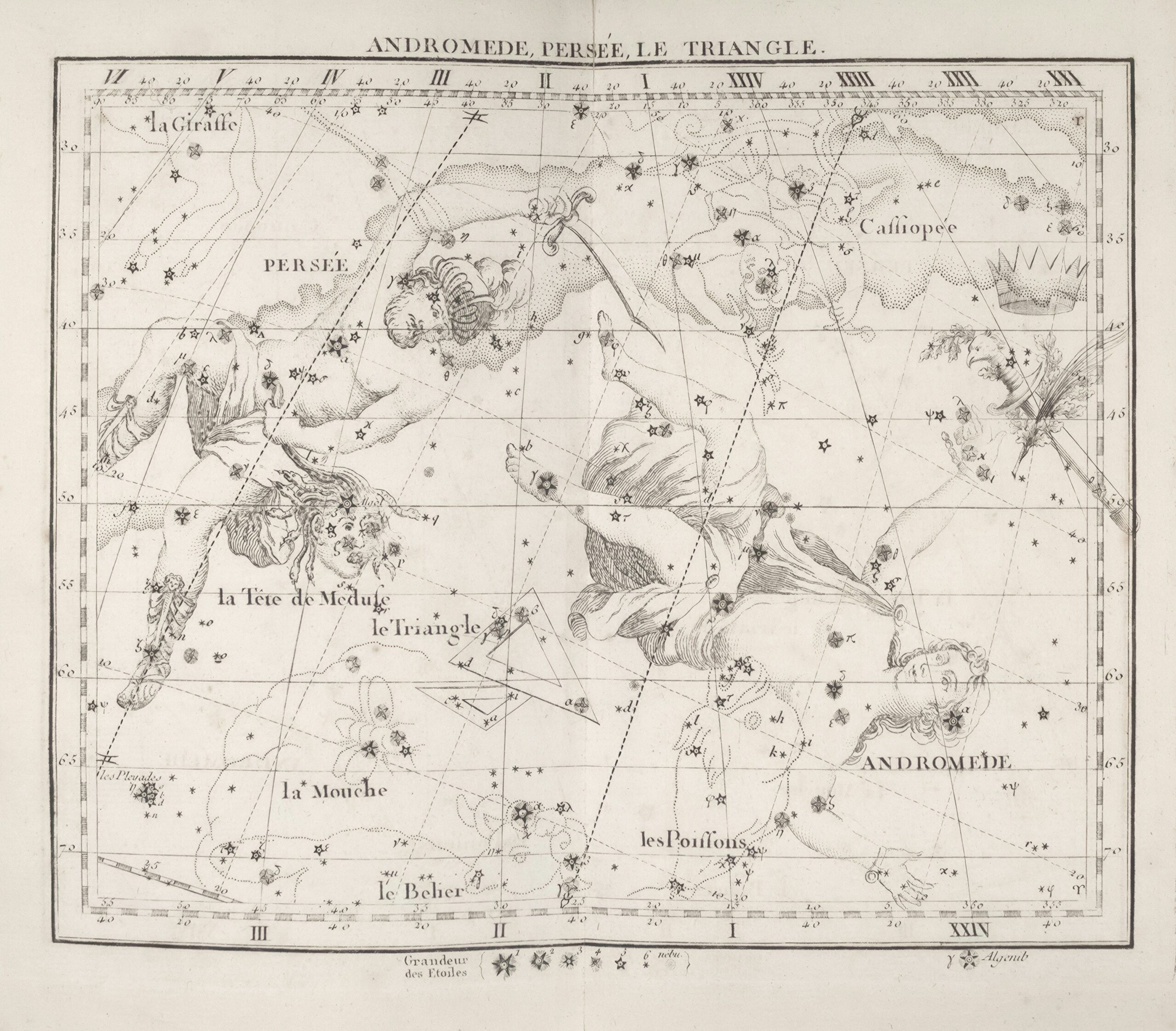
Ancient mythology dominates the list. Andromeda, named after the princess of Ethiopia from Greek legend, carries a story thousands of years old directly into the modern scientific record. Orion, the great hunter, is among the most recognizable star patterns in the sky and one of the oldest documented constellations in human history, with references traceable to ancient Babylonian astronomical records. Ursa Major, the Great Bear, appears in the traditions of cultures as widely separated as ancient Greece, Indigenous peoples of North America, and early Chinese astronomers — a striking reminder that different civilizations independently saw shapes in the same stars. These names were not invented by the IAU; they were inherited from cultures stretching back millennia and then preserved through the standardization process.
The age of exploration and the scientific revolution added an entirely different wave of names. Antlia honors the air pump, a significant invention of 17th-century experimental physics. It was coined by French astronomer Nicolas Louis de Lacaille in the 1750s as part of a deliberate effort to celebrate the instruments of science on the celestial map. Lacaille was responsible for introducing fourteen new constellations during his survey of the southern sky from the Cape of Good Hope — a single observer doing more to reshape the southern celestial map than anyone before or since. Apus, the Bird of Paradise, tells a different story: Dutch navigators Pieter Dirkszoon Keyser and Frederick de Houtman charted the southern skies around 1597 and named unfamiliar star fields after the exotic creatures they encountered on their voyages. These newer constellations fill in the southern hemisphere, which ancient Mediterranean civilizations never saw.
A Guided Tour: Six Names That Tell the Whole Story

Looking at a handful of individual names reveals just how much history is compressed into the official list:
- Andromeda — Named for the mythological Ethiopian princess chained to a rock as a sacrifice in Greek legend, its nominative form is used when discussing the constellation itself, while its genitive form, Andromedae, appears in the names of its stars. The Andromeda Galaxy, the nearest large galaxy to our own, takes its popular name from this constellation — a useful reminder that constellation names extend well beyond the stars that define their outlines.
- Aquila — Latin for the Eagle, this is one of the oldest recognized constellations, appearing in Babylonian records and later described by the Greek astronomer Ptolemy in his second-century catalog the Almagest. Its brightest star, Altair, is one of the three stars forming the prominent Summer Triangle asterism. The IAU formalized the name without changing a letter.
- Aquarius — The Water Bearer is among the most ancient of all constellations, traced to Babylonian star catalogs dating back more than three thousand years. Its Latin name is a direct translation that preserves the original meaning intact across time and language, and it is one of the thirteen constellations through which the ecliptic — the Sun’s apparent annual path — passes.
- Antlia — Invented by Lacaille during his 1751-1752 southern sky survey, it represents the scientific revolution’s ambition to map the practical world of laboratory instruments onto the celestial sphere. Unlike mythological constellations with stories stretching back centuries, Antlia is entirely a product of Enlightenment rationalism.
- Apus — Charted by Keyser and de Houtman on their expedition to the East Indies in the late 16th century, it documents a moment when European exploration suddenly doubled the visible sky for European astronomers and demanded entirely new names for what lay to the south.
- Crux — The Southern Cross is the smallest of all 88 constellations by area but among the most culturally significant. Visible only from the southern hemisphere, it appears on the national flags of Australia, New Zealand, Brazil, Papua New Guinea, and Samoa, giving a constellation name a reach into everyday civic life that few others can match.
What the Official List Actually Tells Us
The full list of the 88 constellations is far more than a simple catalog of names. Each entry includes the Latin nominative and genitive forms, the constellation’s associated mythology and history, and other details such as the genitive form and brightest star. That richness transforms the list into a layered timeline of human observation, revealing which civilizations watched which skies and what stories they chose to write across them.
The precise boundary coordinates attached to each constellation mean that every point in the sky belongs to exactly one region — a system that allows astronomers to report the location of any celestial event, from a newly discovered comet to a gamma-ray burst, with complete clarity. The Sun itself moves through 13 constellation regions over the course of a year, following the ecliptic through Ophiuchus in addition to the 12 traditionally associated with the zodiac — a fact that often surprises people who encounter it for the first time. Far from being a historical relic, the boundary system is maintained by the IAU and remains the global standard for astronomers working from observatories in Beijing, Buenos Aires, or Antarctica.
Why Standardization Still Matters in the Age of Telescopes
When a new asteroid is spotted or a supernova suddenly flares into visibility, its constellation location is the first piece of shorthand that astronomers share across observatories. Without a common framework, coordinating rapid follow-up observations across institutions and continents would become an exercise in confusion. That need is not abstract: when gravitational wave detectors identify a candidate merger event, the constellation in which it appears is among the first coordinates broadcast to observatories worldwide so that telescopes can be trained on the right region of sky within minutes.
Amateur astronomers, satellite operators, and space agencies all navigate by the same map. The Latin names carry an unexpected democratic quality as well: they give every person on Earth access to the same shared reference points, regardless of what language they speak at home. No single culture’s tradition was elevated above another’s; instead, a neutral classical language became the shared medium through which a genuinely international science could function.
In a universe of staggering complexity, the 88 official constellation names stand as a reminder that some of science’s most durable achievements are, at their core, acts of human agreement — the collective decision to finally look up at the same stars and call them by the same name.