
Sometime in the early 1400s, people living at a stone settlement in central Angola cremated one of their dead, sealed the remains inside a ceramic urn, and buried it — a ritual that would remain hidden for roughly six centuries, until archaeologists pulled it from the earth just ahead of a rising reservoir. That single urn cremation, the only one of its kind ever documented in Angola’s ancient archaeological record, is now among the most significant finds from Caculo Cabaça — a 15th-century stone settlement that will soon disappear forever beneath a hydroelectric dam.
What Is Caculo Cabaça?
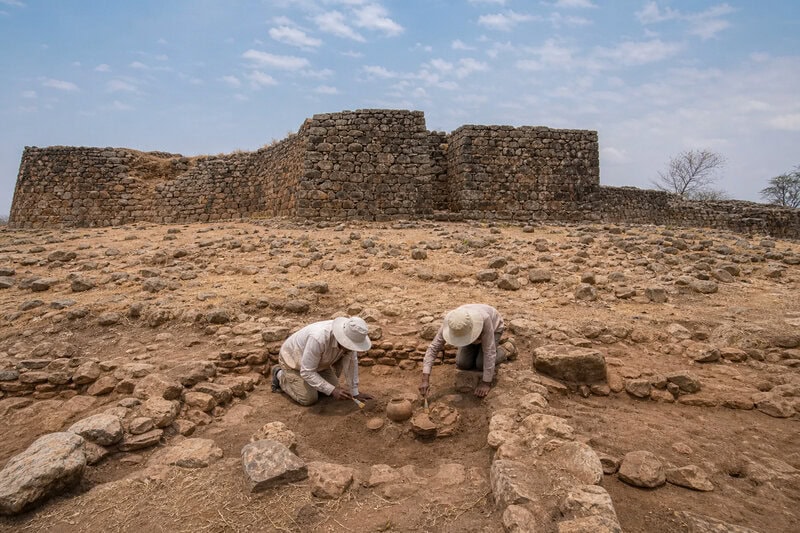
Caculo Cabaça is a stone-walled settlement in central Angola whose construction and use archaeologists have traced to the 15th century, making its stone architecture the oldest yet confirmed anywhere in the region. Stone structures carry particular weight in archaeology because they preserve the spatial organization of a community — the layout of walls, enclosures, and living areas — in ways that organic materials like wood or thatch rarely survive to do. A settlement built in stone also signals a level of social complexity and coordinated labor: someone had to organize the quarrying, transport, and erection of durable building materials, which points to a community with enough internal structure to sustain collective projects at that scale.
Before infrastructure pressure created urgency, the site had gone largely undocumented at this depth of analysis. That gap reflects a broader reality about pre-colonial African archaeology: an enormous amount of evidence about how people organized their lives before European contact remains, quite literally, below the surface. When infrastructure projects threaten known archaeological sites, institutions conduct what is called a rescue excavation — emergency fieldwork carried out under time pressure to recover as much data as possible before a site is permanently altered or destroyed. Many countries govern this practice through cultural heritage legislation, but the closing window is always tight, the budget always finite, and the site nearly always larger than the time available.
The Burials: Radiocarbon Dating and What the Early 1400s Anchor Means
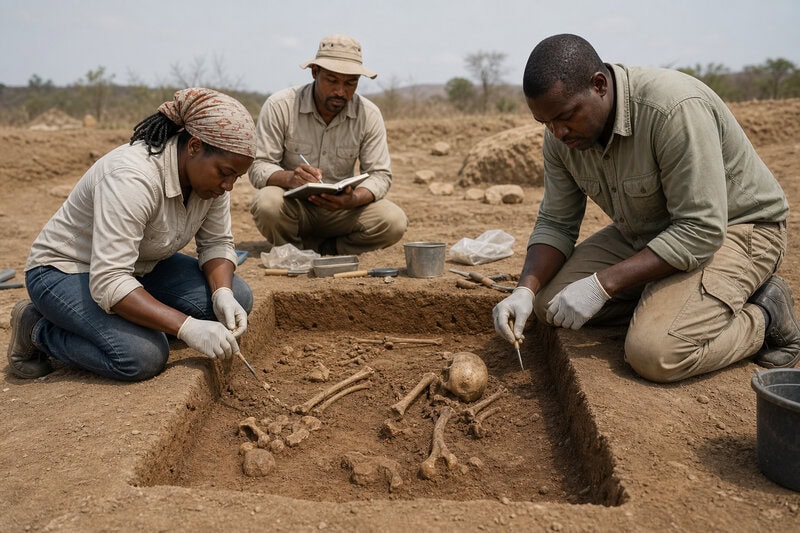
The burials at Caculo Cabaça have been radiocarbon-dated to the early 1400s, making them the earliest scientifically confirmed pre-colonial burials in Angola. Radiocarbon dating works by measuring the decay of carbon-14, a mildly radioactive isotope present in all living organisms, within organic material such as bone or charcoal. Because carbon-14 decays at a known, steady rate after an organism dies, scientists can calculate how long ago that death occurred — though results are always expressed as a date range rather than a single year, a precision limit worth stating plainly.
The early-1400s dates matter for a specific historical reason: they anchor the site firmly before sustained European contact along that stretch of the African Atlantic coast, which did not begin in earnest until Portuguese traders and missionaries arrived in the late 15th century. These are not colonial-era burials filtered through outside cultural influence. They represent an indigenous community conducting its mortuary rituals entirely on its own terms. Each burial — its body positioning, any accompanying grave goods, the style of interment — functions as a data point about social structure, belief systems, and potentially inter-regional exchange. An individual buried alongside ceramics from a distant region, for example, would suggest trade connections that written records from this period fail entirely to capture.
It is important to be clear about what is established and what remains open. The radiocarbon dates are confirmed. Which specific ethnic, linguistic, or political community built and used Caculo Cabaça is a question that ongoing archaeological and historical interpretation has not yet resolved — and may never fully resolve if the site is submerged before the work is complete.
The Urn Cremation: Angola’s Only Known Ancient Cremation and Why It Matters
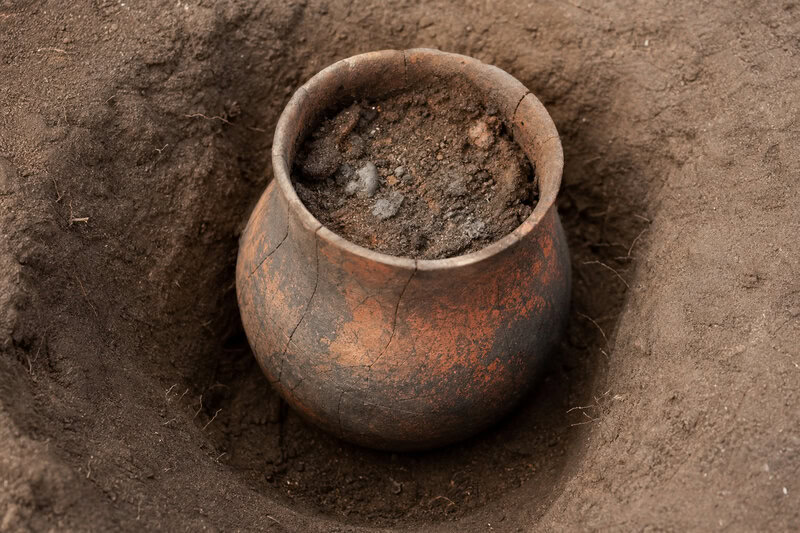
Among all the burials at Caculo Cabaça, one stands apart in the archaeological record. An urn cremation — in which the remains of a cremated individual are placed inside a ceramic vessel before secondary burial — has been documented at the site, a mortuary practice with no previously known parallel in Angola’s ancient archaeological record. This single find represents Angola’s only known ancient cremation, and its significance within the country’s pre-colonial history is difficult to overstate.
Urn cremation is a multi-stage ritual that demands both technological and cultural investment. The body must first be cremated at high temperatures — a process requiring sustained, controlled fire — and then the remains must be carefully gathered, placed in a prepared container, and interred in a deliberate location. This is not a simple disposal of the dead. It reflects a cultural framework that assigns specific meaning to the containment and reburial of cremated remains, treating the urn itself as a meaningful object in the transition between life and whatever the community believed came after it.
Cremation is documented in other parts of ancient Africa and across the ancient world, so the practice itself is not globally unusual. What makes this find significant is its complete absence from Angola’s prior archaeological record. That said, a single example is not sufficient to establish urn cremation as a regional tradition. The honest scientific position is that one find raises questions more than it answers them. Did the practice arrive through trade contact or migration from communities where cremation was more common? Did it develop independently within this community? Was this individual an exception within Caculo Cabaça itself, cremated for reasons specific to their status or circumstances? These are precisely the questions the submerging of the site may leave permanently unanswerable.
The Dam: How Hydroelectric Infrastructure Erases Archaeological Heritage
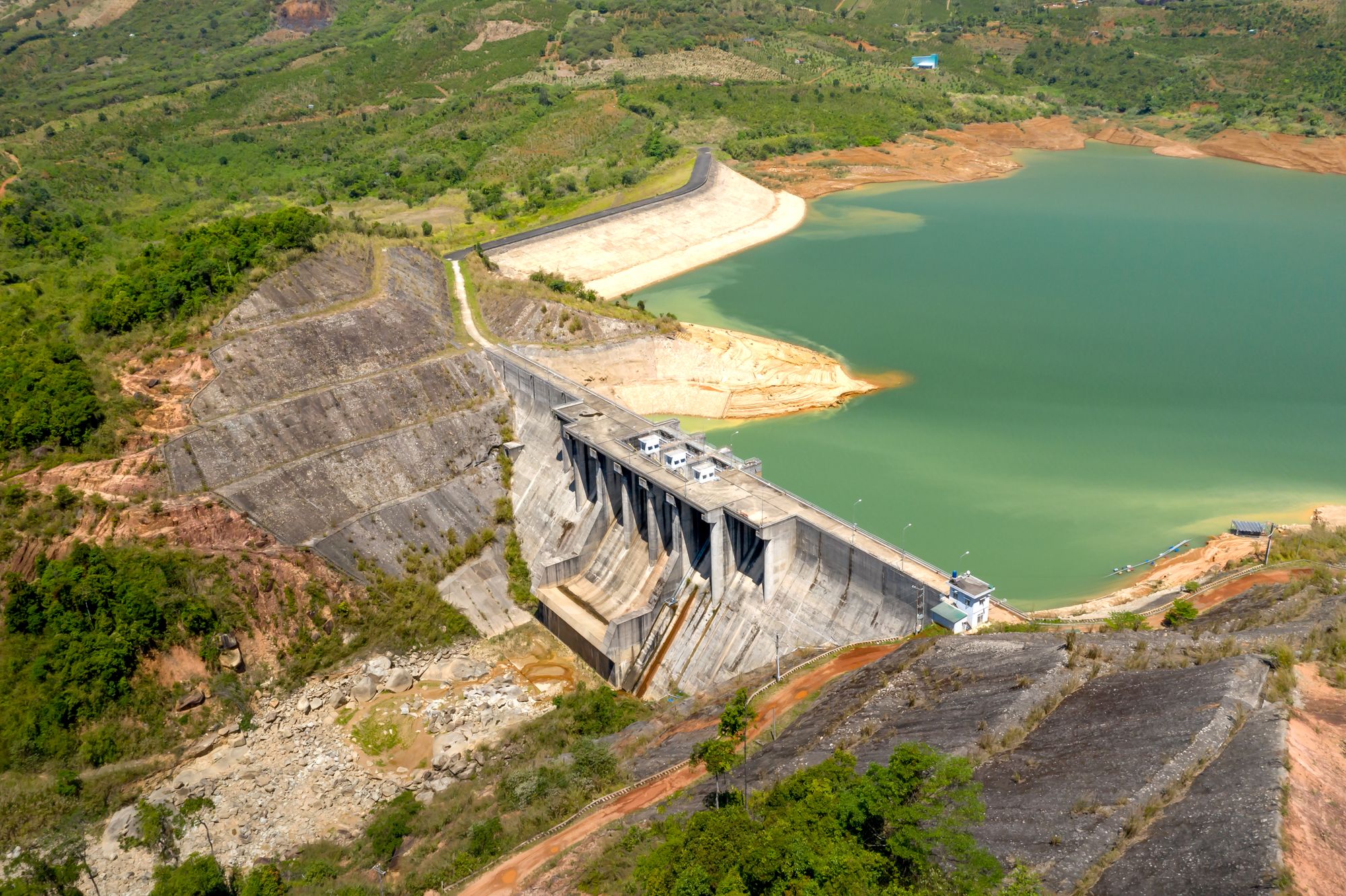
A hydroelectric dam generates electricity by controlling water flow through turbines, and in doing so creates a reservoir upstream that permanently floods everything the water reaches. Once an archaeological site is inundated, it is effectively destroyed for any future excavation using current technology. Sediment shifts, water pressure degrades organic materials, and the spatial relationships between features — the precise positional data that gives archaeological context its meaning — are disrupted beyond recovery.
Caculo Cabaça is part of a documented global pattern in which energy infrastructure and cultural heritage come into direct conflict. Dam construction has threatened or destroyed major archaeological sites on multiple continents. The tension, however, is not a simple case of negligence against preservation. Hydroelectric power represents a significant energy source for Angola’s developing economy, and the rationale behind the dam is legitimate. The loss of Caculo Cabaça is not a story of villains; it is a story of competing goods that could not both be fully honored.
What makes the loss particularly sharp in archaeological terms is not only what we know now but what we are foreclosing for the future. Analytical techniques that do not yet exist — refined isotopic analyses, ancient DNA methods, advanced subsurface imaging — may one day extract information from undisturbed archaeological stratigraphy that current science cannot. Once the site is submerged, those future methods have nothing to work with. The dam does not merely destroy what we can learn today; it eliminates what future science could have learned from the same ground.
What Rescue Archaeology Can and Cannot Save
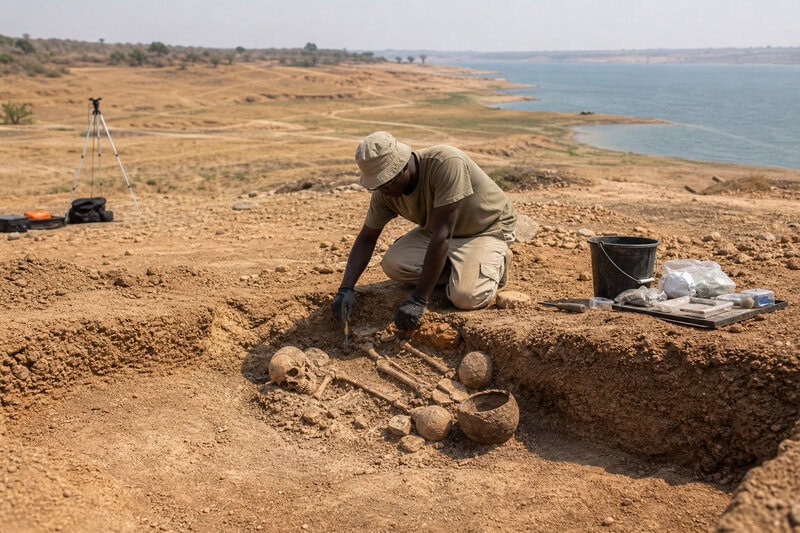
Rescue excavations produce a specific kind of record: photographs, measured drawings, three-dimensional photogrammetric models, soil samples, radiocarbon samples, and removed artifacts that can be analyzed in laboratory settings long after the physical site is gone. This is not a trivial yield. Digital and physical archives of a destroyed site can support research for decades, and materials removed before inundation remain available for future study.
But rescue archaeology is triage, not salvation. Excavators work under time pressure with finite budgets, which means portions of large sites inevitably go unexcavated. Contextual relationships between features — the kind that can only be fully understood by observing how one stratigraphic layer relates to another in the ground — are harder to reconstruct once the physical site cannot be revisited. What the Caculo Cabaça rescue campaign accomplished within those constraints is nonetheless remarkable: the documentation of Angola’s oldest stone architecture, its earliest radiocarbon-dated burials, and its only known ancient cremation, all within a single excavation effort.
What remains unknown — and may stay unknown — is how extensive the settlement actually was, how many burials were never reached, and what the full range of mortuary practices at the site looked like across its period of use. The rising water will likely seal those questions permanently.
Why This Matters: Pre-Colonial African History and the Archaeology Gap
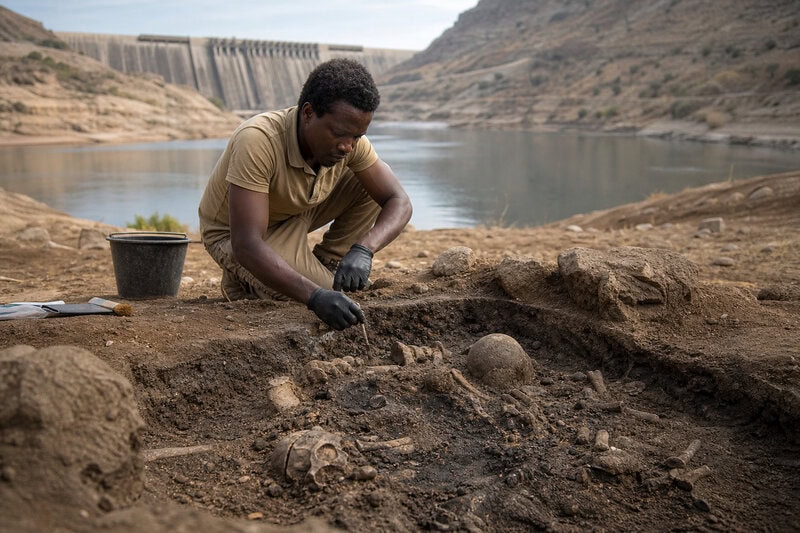
Written records of pre-colonial Angola are sparse, and those that exist are largely filtered through the perspectives of Portuguese traders and missionaries who arrived in the late 15th century. Archaeological sites like Caculo Cabaça are among the few sources of direct, unmediated evidence about how people organized their lives, honored their dead, and connected with neighboring communities before colonial contact reshaped the region. Scholars have long noted that pre-colonial sub-Saharan Africa is systematically underrepresented in global archaeological literature relative to its population and historical complexity. Each destroyed site widens that gap rather than narrowing it.
The data already recovered from Caculo Cabaça will continue to be analyzed, and future publications may yield additional findings from materials already removed from the ground. The site’s physical destruction does not end its scientific life entirely, and that is a genuine consolation. The researchers who conducted the rescue excavations have produced a record that would not otherwise exist at all.
Caculo Cabaça is simultaneously a discovery and a loss — proof that Angola’s pre-colonial past is richer and more complex than the written record suggests, and a reminder that the archaeology needed to understand that past is disappearing faster than it can be studied. A fire lit six hundred years ago to honor one person’s passing now illuminates something much larger: the fragility of the evidence on which our understanding of ancient African burial rituals, social organization, and cultural identity ultimately depends — and the urgency of documenting it before the water rises.