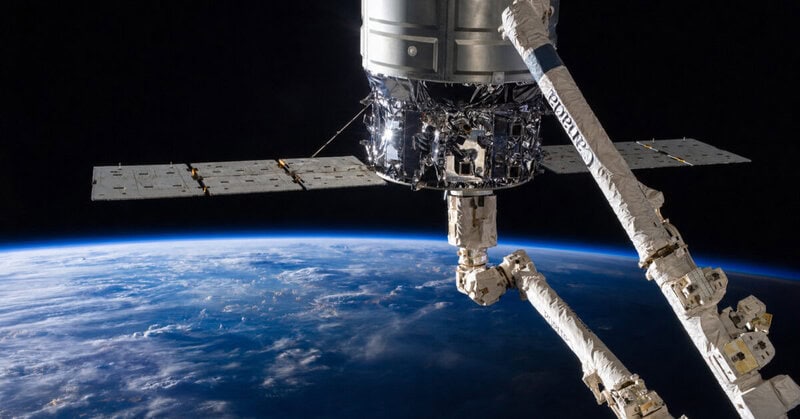
Six people are living 250 miles above Earth right now, and every breath they take, every meal they eat, and every drop of water they drink depends on a supply chain that runs through a rocket launchpad in Florida. On Sunday, November 29, a SpaceX Falcon 9 rocket lifted off carrying Northrop Grumman’s Cygnus XL spacecraft — packed with more than 11,000 pounds of supplies for the International Space Station — on a mission that makes the quiet difference between a functioning outpost and a crisis.
What CRS-NG-25 Actually Carries
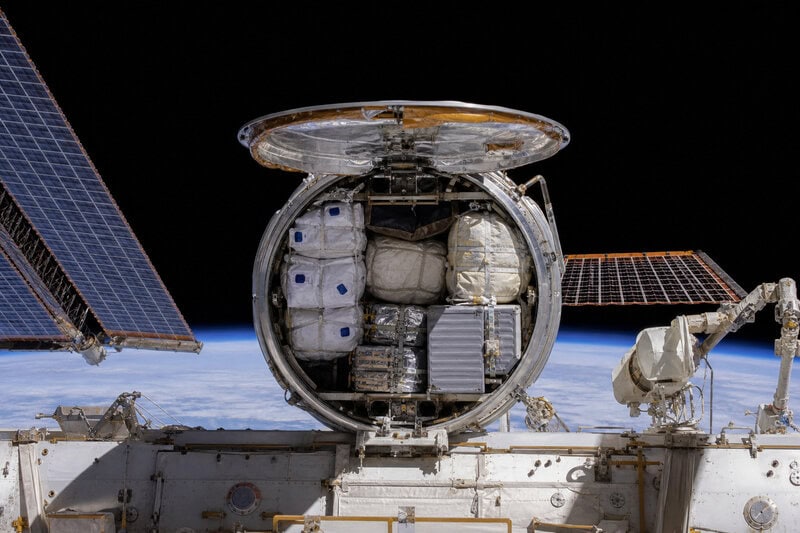
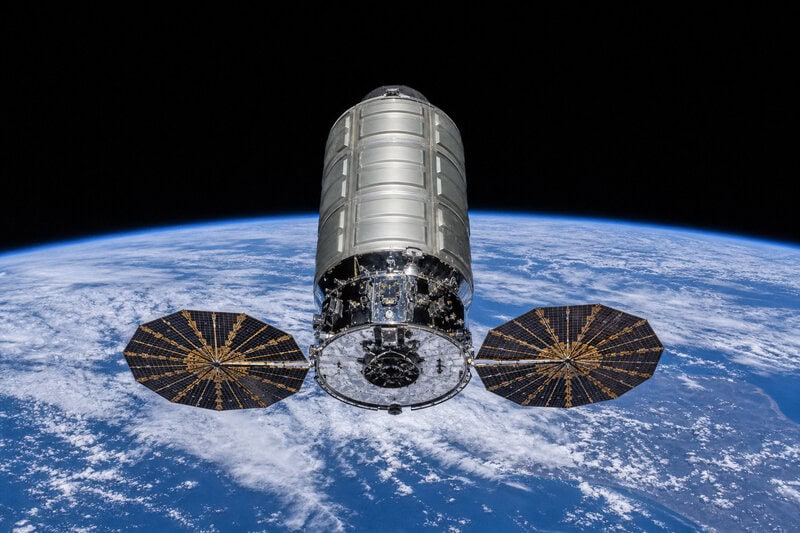
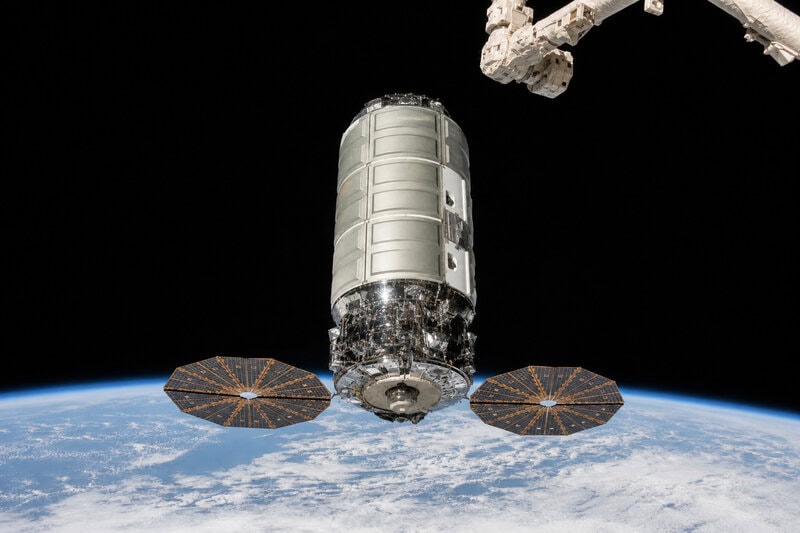
The mission, designated CRS-NG-25 — short for Cargo Resupply Services Northrop Grumman, mission 25 — is the 25th dedicated cargo flight Northrop Grumman has completed to the ISS under NASA’s Commercial Resupply Services program. The Cygnus XL is a robotic, uncrewed freighter: no pilot, no passengers, just cargo. That design simplicity makes it one of the most cost-efficient ways NASA has yet devised to keep humans alive in low Earth orbit.
NASA and Northrop Grumman have confirmed the CRS-NG-25 manifest spans four broad categories: crew provisions (food, clothing, and personal hygiene items), life support hardware, scientific experiment materials, and vehicle maintenance equipment. The manifest also includes holiday treats for the crew — a tradition on resupply flights that is less frivolous than it sounds. NASA’s Human Research Program has documented that psychological well-being and crew cohesion are mission-critical factors on long-duration spaceflight, placing morale cargo in the same operational category as a spare pump or a replacement filter.
The food alone accounts for a substantial fraction of the manifest’s weight. According to NASA, a single astronaut on the ISS requires roughly 1.83 pounds of packaged food per day. Scaled to a crew of six over a standard six-month expedition, that figure runs into thousands of pounds before a single piece of hardware is loaded. Beyond food, a typical Cygnus manifest includes lithium hydroxide canisters — chemical scrubbers that remove carbon dioxide from cabin air — replacement water-processing membranes, spare parts for the Environmental Control and Life Support System (ECLSS), and research payloads whose experimental timelines cannot absorb a delayed delivery without invalidating ongoing work.
The spacecraft was expected to arrive at the station in the early hours of Tuesday, December 1, at approximately 2:35 AM EST (07:35 UTC) — roughly 48 hours after liftoff. That two-day transit reflects the minimum time needed to safely execute a series of engine burns called a phasing sequence, which gradually raises Cygnus’s orbit until the two vehicles are close enough for proximity operations.
How a Cargo Ship Actually Reaches the Space Station
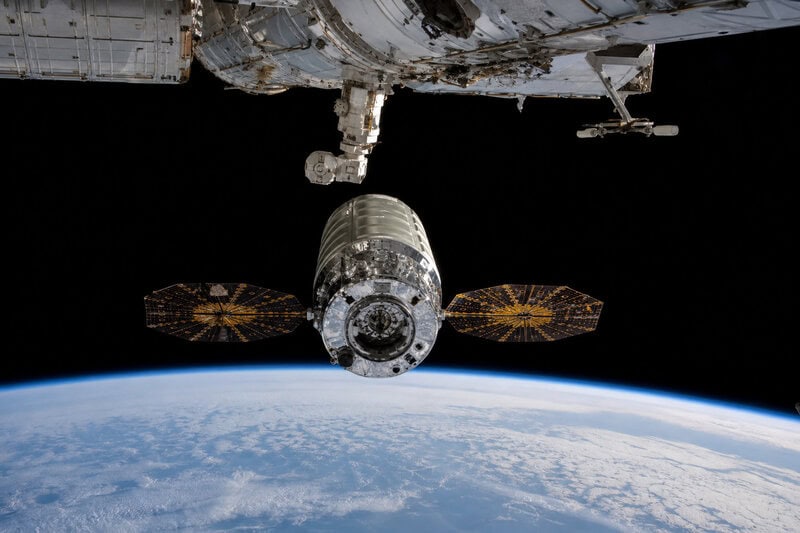
A cargo ship cannot simply point itself at the ISS and fly straight there. Both the station and the approaching spacecraft are traveling at roughly 17,500 miles per hour in low Earth orbit, which means that any change in speed also changes altitude. To close the gap, Cygnus executes a carefully choreographed sequence of burns over approximately 48 hours, raising its orbit in stages while ground controllers at Northrop Grumman’s operations center and NASA’s Mission Control in Houston monitor vehicle health at every step.
Unlike SpaceX’s Dragon capsule, which can dock autonomously to the ISS, Cygnus does not dock under its own power. Instead, ISS crew members use the station’s Canadarm2 — a 57-foot robotic arm originally contributed by the Canadian Space Agency — to grapple the free-flying spacecraft and berth it to the Unity node. The process requires millimeter-level positioning accuracy, performed by astronauts operating a robotic arm the length of a school bus while traveling at five miles per second.
Once berthed, Cygnus remains attached to the ISS for several months, functioning simultaneously as a supply depot and a trash receptacle. Crew members unload cargo in staged transfers, carefully tracking inventory against the station’s consumption rates. When Cygnus finally undocks, it is loaded with station waste — used equipment, packaging, and other refuse — and commanded to reenter Earth’s atmosphere, burning up over the Pacific Ocean. The spacecraft is not recovered; it is a one-way delivery vehicle by design, a tradeoff that reduces cost and mechanical complexity while accepting the limitation that any hardware needing to return to Earth must wait for a SpaceX Dragon or a Soyuz crew vehicle.
What “Breathable Air” Looks Like as Cargo
The ISS Environmental Control and Life Support System (ECLSS), developed by NASA’s Marshall Space Flight Center, is a closed-loop engineering achievement — but it is not perfectly closed, and the gap between what it recycles and what the crew consumes must be filled by resupply missions. Understanding that gap explains why ISS cargo manifests carry items that might seem redundant on a station with its own air and water systems.
Oxygen aboard the station is generated primarily by the Oxygen Generation System (OGS), which electrolyzes water — splitting H₂O molecules into hydrogen (vented to space) and oxygen (released into the cabin). The OGS requires a steady supply of replacement parts and distilled water to function, both of which arrive via cargo ships like Cygnus. When the system is offline for maintenance, the station draws on stored oxygen reserves that must themselves be periodically replenished from the ground.
Carbon dioxide removal presents a parallel challenge. The Carbon Dioxide Removal Assembly (CDRA) uses zeolite-based molecular sieve beds — essentially highly porous mineral filters — to capture CO₂ before it accumulates to dangerous concentrations. Those sieve beds degrade with use and must be periodically replaced, creating a maintenance dependency that ties the station’s breathable atmosphere directly to the resupply schedule.
Water recycling illustrates the same principle at scale. According to NASA’s ISS Program Science Office, the station recycles approximately 93 percent of crew-generated water, including urine processed through the Urine Processor Assembly. That figure represents a genuine engineering achievement. But the remaining 7 percent is lost to the system through inefficiencies and must be topped up from cargo — meaning even water, the most elementary of human requirements, is partly a supply-chain problem 250 miles above Earth.
Northrop Grumman’s Role — and the Unusual Partnership Behind the Launch
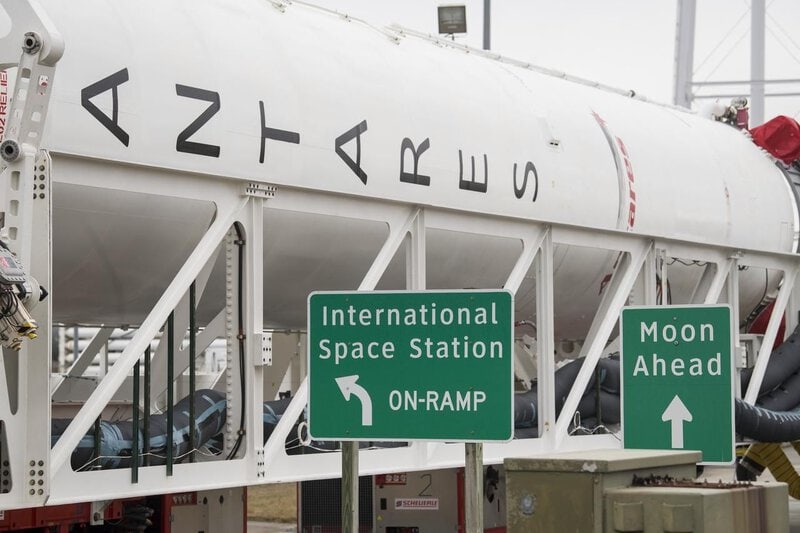
NASA initiated the Commercial Resupply Services program in 2008 with a deliberate goal: transfer routine station logistics to private industry and redirect agency resources toward deep-space exploration. CRS-NG-25 is the 25th mission delivered under that framework, representing more than 15 years of operational continuity.
Northrop Grumman designed the Cygnus spacecraft around a pressurized cargo module manufactured by Thales Alenia Space in Turin, Italy. The XL variant — the larger of two Cygnus configurations — provides roughly 27 cubic meters (953 cubic feet) of pressurized internal volume, optimized to maximize cargo density rather than reusability. The spacecraft’s solar arrays, communications systems, and propulsion are integrated by Northrop Grumman, while the pressurized module itself reflects a genuinely international supply chain.
The launch vehicle for CRS-NG-25 is a SpaceX Falcon 9 — notable because SpaceX and Northrop Grumman compete in other segments of the commercial space market. The use of a Falcon 9 to carry a Northrop Grumman spacecraft reflects the pragmatic, vendor-agnostic logistics approach NASA has pursued since the Space Shuttle’s retirement in 2011. The agency contracts for outcomes — cargo delivered to orbit — rather than mandating which company’s rocket achieves them. It is an arrangement that has quietly kept launch costs competitive while maintaining schedule reliability across more than two dozen missions.
The Science Riding Alongside the Groceries
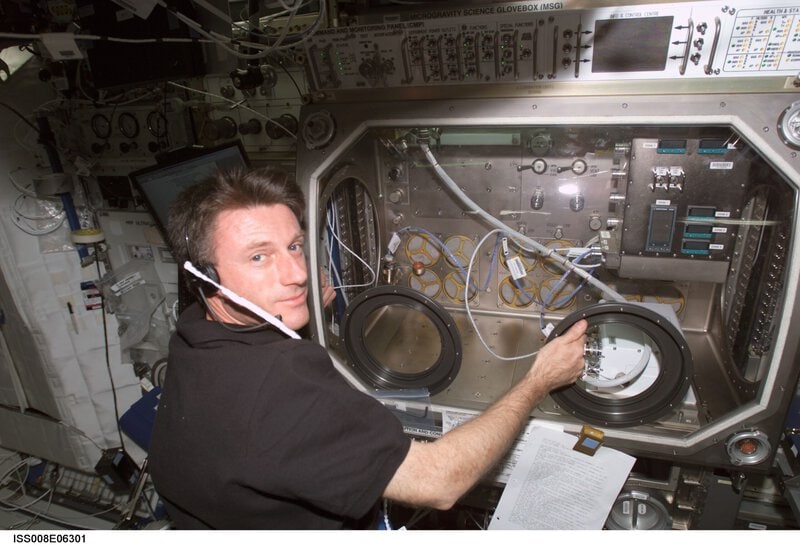
Research payloads tucked inside a Cygnus manifest operate under time constraints that ground-based science rarely faces. A cell-culture experiment may require delivery within a specific window to synchronize with a crew member’s scheduled lab time and a downstream sample-return flight. Miss the window, and months of preparation on the ground can be invalidated by a scheduling misalignment 250 miles up.
The ISS National Lab, managed by the Center for the Advancement of Science in Space (CASIS) under a cooperative agreement with NASA, coordinates commercial and academic research aboard the station. That arrangement means some CRS-NG-25 payloads were proposed not by government agencies but by universities and biotechnology firms, paying for access to microgravity conditions that cannot be replicated on Earth for more than a few seconds at a time.
The practical returns from that research are tangible. Studies on bone-density loss in astronauts — accelerated in microgravity at rates that would take decades to observe in aging populations on Earth — have informed pharmaceutical research into osteoporosis treatments, according to the ISS National Lab. Each resupply mission that delivers a new batch of experiments extends that pipeline of discovery.
Every kilogram of science hardware launched on a resupply mission displaces a kilogram of consumables, and NASA logistics planners must continuously balance the station’s immediate survival requirements against its long-term research mission. That tension grows more acute as the ISS approaches its planned decommissioning around 2030, with competing pressures to maximize science return before the platform disappears.
Why These Missions Will Only Become More Important
NASA’s long-term goal, articulated in its Moon to Mars Architecture documents, is to progressively increase the self-sufficiency of crewed outposts through in-situ resource utilization — producing water, oxygen, and eventually food from local materials rather than launching them from Earth. Current technology readiness levels mean that vision remains years away from operational reality, leaving resupply missions as the primary and irreplaceable lifeline for every crewed outpost humanity currently operates.
The logistics architecture built around Cygnus and Dragon is not a temporary workaround. It is a template — refined over 25 missions and counting — for how humanity will sustain off-world outposts for decades to come. Each CRS mission generates operational data that NASA cannot obtain any other way: how cargo degrades in transit, how crew members interact with new hardware, how life support systems respond to new consumable batches. That data is already informing resupply logistics for the Artemis program’s planned lunar Gateway station.
CRS-NG-25 is, in the most immediate sense, a supply run — food, air filters, water membranes, and holiday candy traveling 250 miles up on a column of fire. In a broader sense, it is the 25th repetition of a proof-of-concept: that human beings can be kept alive in space by a commercial logistics network operating with the reliability of a scheduled cargo service. Every future step in human spaceflight — to the Moon, to Mars, and wherever comes after — depends quietly on that capability remaining exactly as routine as it has become.