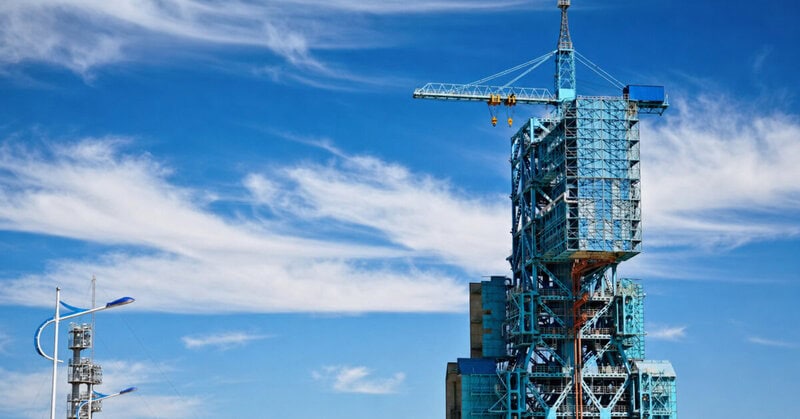
On a Wednesday in 2025, a 40-year-old Pakistani astronaut named Muhammad Zeeshan Ali floated through a hatch into China’s Tiangong space station — becoming the first foreign national in history to board China’s orbital outpost, arriving aboard the Shenzhou 24 spacecraft after a successful automated docking maneuver. That single crossing of a threshold, unremarkable in its physics and extraordinary in its precedent, sharpens a question that extends well beyond one mission: who gets to use space, and on whose terms?
What Actually Happened: The Shenzhou 24 Mission
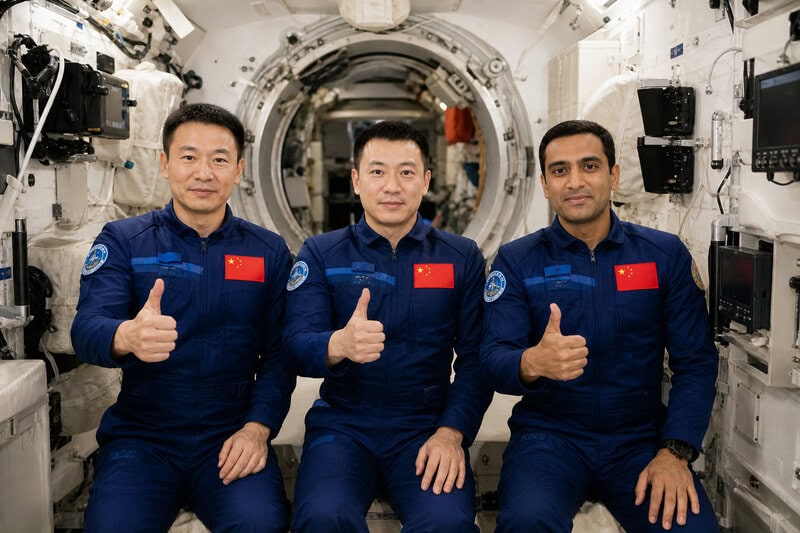
The China Manned Space Agency identified the three-person crew precisely. Tang Hongbo, 51, served as mission commander — a career astronaut-pilot with prior spaceflight experience. Wu Yi, 39, flew as a crew member. Muhammad Zeeshan Ali, 40, joined as a payload specialist, a designation with specific meaning in crewed spaceflight: unlike a commander or flight engineer, who trains extensively across all spacecraft systems, a payload specialist is selected primarily for expertise in a defined set of experiments or instruments. NASA used the category extensively during Space Shuttle missions to fly scientists and engineers whose expertise was mission-critical but whose role did not require full astronaut certification. China’s Manned Space Agency now applies the same title to Ali, signaling a training pipeline focused on scientific operations rather than vehicle command.
The Shenzhou 24 docking with Tiangong is worth describing plainly for readers who may conflate orbital rendezvous with landing. Shenzhou spacecraft use an automated rendezvous-and-docking system to align with Tiangong’s core module in low-Earth orbit, at an altitude of roughly 340 to 450 kilometers above Earth’s surface. The spacecraft does not land on the station; it connects to a docking port, equalizes pressure between the two pressurized volumes, and then allows crew to transfer through a hatch. Multiple outlets, including AFP, characterized the mission as historic — a framing the China Manned Space Agency’s official communications echoed. This article uses that word with the same care the evidence supports: it is historic in the precise sense that nothing equivalent had previously occurred, not in the sense of guaranteed long-term consequence.
Several details remain unconfirmed at the time of publication. The full duration of Ali’s stay aboard Tiangong has not been publicly specified. The specific scientific payloads he will operate have not been fully disclosed. Whether Pakistan’s national space agency, SUPARCO, or another body formally sponsored the seat — and under what financial or diplomatic arrangement — has not been officially clarified. These are not minor gaps; they are precisely the details that will determine whether this mission represents a replicable model or a singular diplomatic gesture.
Why Tiangong Matters: China’s Station in Context
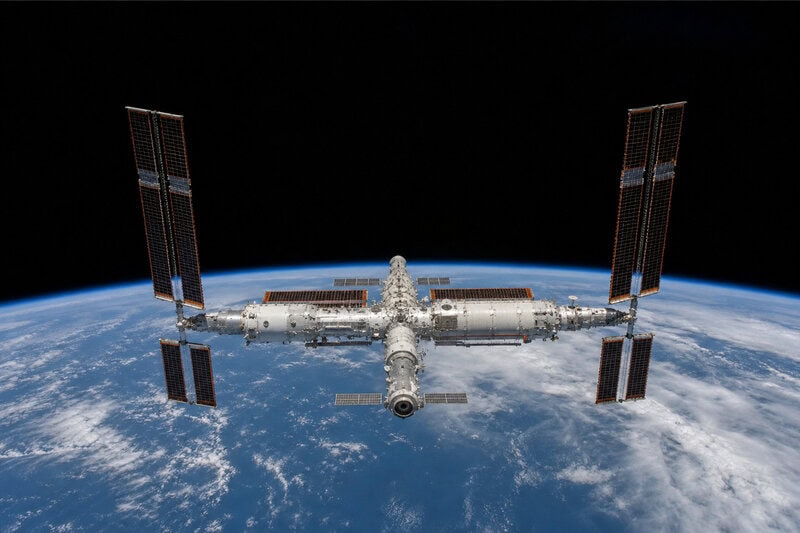
Tiangong — a Mandarin term meaning “Heavenly Palace” — is China’s independently built, permanently crewed modular space station, completed in its current three-module configuration in late 2022. It was constructed entirely without U.S. partnership, a direct consequence of the Wolf Amendment, a 2011 U.S. law that prohibits NASA from engaging in bilateral cooperation with China’s space program without explicit congressional approval. That legal restriction did not prevent China from building a station; it ensured that China built one alone, and on its own design philosophy.
The contrast with the International Space Station illuminates what is at stake. The ISS is a partnership of NASA, Roscosmos, the European Space Agency, the Japan Aerospace Exploration Agency, and the Canadian Space Agency — a multilateral treaty-based architecture in which more than 20 nations have sent astronauts over more than two decades of continuous human presence. Tiangong, until this mission, had admitted none. The ISS is currently scheduled for a controlled deorbit no earlier than 2030, which creates a structural reality rather than a speculative one: there will be a period in which Tiangong may be the only crewed space station in low-Earth orbit, and China will control who boards it.
Access to Tiangong is governed entirely by the China Manned Space Agency, which selects, trains, and approves all crew. There is no multilateral oversight body, no treaty framework analogous to the ISS intergovernmental agreements, and no published open application process. That is not a criticism — it is a geopolitical fact with direct consequences for how other nations evaluate their options. Tiangong is not merely a scientific platform; it is a demonstration that China can sustain long-duration human spaceflight independently and, now, can extend that capability to partner nations entirely on its own terms.
The Geopolitics of the Guest Seat: Why Pakistan, Why Now
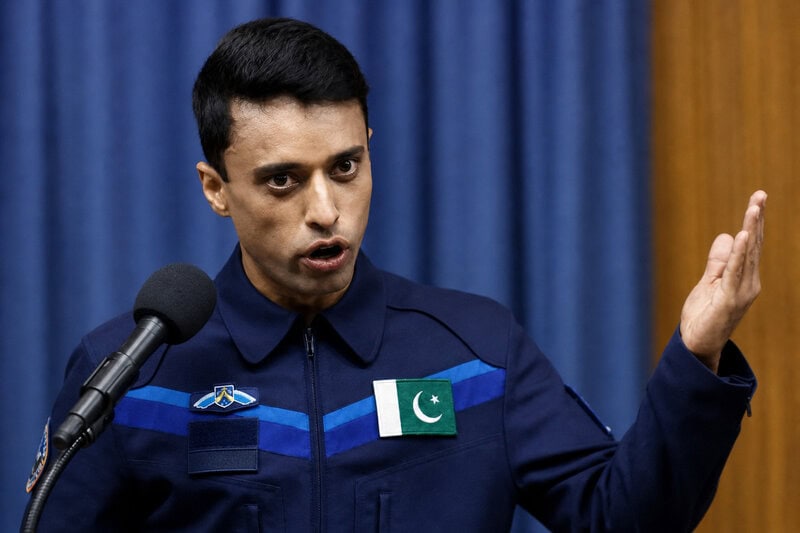
The choice of Pakistan as the first nation to place an astronaut aboard Tiangong is analytically significant, though the official framing from the China Manned Space Agency focuses on the mission’s scientific character rather than its diplomatic one. Flying a Pakistani astronaut on Tiangong is consistent with the broader pattern of the China-Pakistan Economic Corridor, a multi-decade infrastructure and investment partnership that represents one of Beijing’s most extensive bilateral relationships. Attributing intent to that alignment is contested interpretation, not established fact, and should be read as such.
What is confirmed is the role: payload specialist, per the China Manned Space Agency. What remains analytically contested is whether this mission represents the opening of a formal guest-astronaut program — with published criteria, open applications, and replicable terms — or a one-off diplomatic arrangement specific to the China-Pakistan relationship. NBC News covered the mission’s significance in the context of China’s expanding space ambitions, but the question of program versus gesture remains open.
History offers a measured parallel. Beginning in 1978, the Soviet Union flew astronauts from allied nations on Soyuz spacecraft under the Intercosmos program — a deliberate use of space access as a tool of geopolitical alliance-building that sent cosmonauts from Czechoslovakia, Poland, East Germany, Cuba, Mongolia, and other Soviet-aligned states into orbit. The program was simultaneously scientifically productive and diplomatically purposeful; there is no reason those two functions must be mutually exclusive. Whether China’s approach to Tiangong access follows a similar model is a question the next several years will answer.
For nations currently outside the ISS partnership framework — which excludes most of the world’s emerging space programs — Tiangong now represents a demonstrated alternative. Space policy analysts at institutions including the Secure World Foundation and the Center for Strategic and International Studies have flagged China’s expanding space partnerships as strategically significant, though the specific implications of a formal Tiangong guest-astronaut program remain an emerging and contested area of analysis.
The Science Aboard: What a Payload Specialist Actually Does
The payload specialist designation places Muhammad Zeeshan Ali in a specific and historically grounded category of spaceflight participant. Where a mission commander must be capable of operating the spacecraft across all contingencies, a payload specialist’s training centers on the instruments and experiments they will operate — a narrower scope, but one requiring genuine scientific expertise.
Tiangong hosts a range of microgravity research facilities, including life sciences laboratories, materials science experiments, and Earth observation instruments, based on publicly available China Manned Space Agency documentation. Microgravity — the condition of near-weightlessness experienced in orbital freefall, which is not the absence of gravity but rather a state of continuous free fall around Earth — allows researchers to isolate physical and biological variables that gravity on Earth’s surface confounds. Fluid behavior, cell growth patterns, combustion dynamics, and protein crystal formation all behave differently in microgravity in ways that have produced practical applications in medicine and materials science.
The specific experiments Ali will operate have not been fully disclosed at the time of writing. Direct claims about his mission’s scientific contribution should await official post-mission reporting. What can be noted, drawing on decades of ISS research literature, is that physiological data collected from a broader demographic range of crew members — across different genetic backgrounds, fitness baselines, and geographic origins — expands the scientific value of human spaceflight research. That is a general statement about research methodology, not a specific claim about this mission’s design.
Two Stations, Two Philosophies: The Broader Competitive Landscape
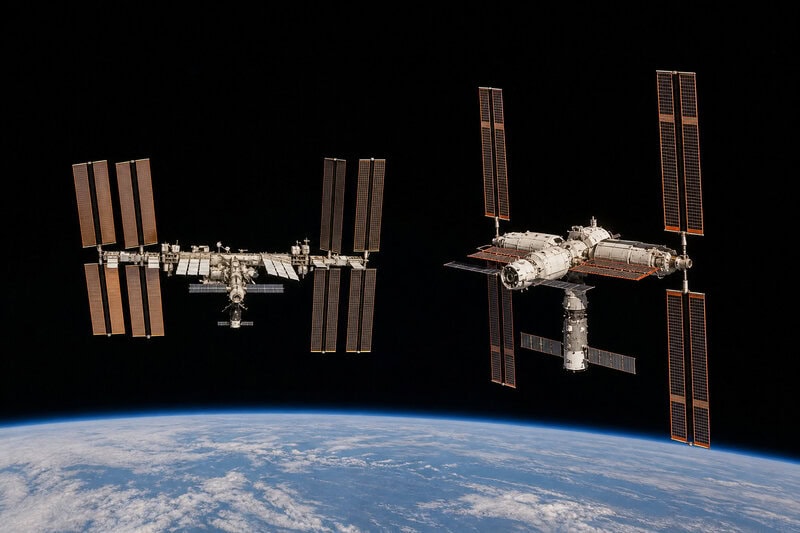
The phrase “space race” is analytically useful as shorthand and misleading as a framework. The U.S.-China dynamic in space is better understood as two parallel programs operating under fundamentally different partnership philosophies. NASA functions within a multilateral treaty-based architecture in which cooperation is governed by intergovernmental agreements, shared standards, and mutual oversight. China’s Manned Space Agency operates through bilateral agreements it controls, with partner access determined by Beijing rather than by a collective body. That structural difference matters more than any single launch or milestone.
The current state of low-Earth orbit is factually straightforward: NASA’s commercial partners — SpaceX’s Crew Dragon and Boeing’s Starliner — provide crew transport to the ISS; China operates Shenzhou independently to Tiangong; no other nation currently operates a crewed station. DD News reported on the Shenzhou 24 docking and its significance for China’s space program in the context of that competitive landscape. Tiangong is, at present, the only alternative crewed orbital architecture to the ISS.
The Wolf Amendment’s restrictions on NASA-China cooperation do not bind allied space agencies. The European Space Agency has maintained dialogue with China on non-crewed science missions and in earlier years trained European astronauts in Mandarin, though no European has flown to Tiangong. That nuance complicates a simple U.S.-China binary and suggests the landscape of international space cooperation is more fragmented — and more negotiable — than headlines imply.
The Shenzhou 24 milestone does not by itself shift the balance of space capability or geopolitical power. What it signals, more precisely, is China’s demonstrated willingness and operational capability to build a parallel international human spaceflight ecosystem — to extend access to its station on its own terms, to nations of its choosing, under arrangements it controls. Space policy analysts have identified that capability as strategically significant regardless of how one assesses its current scale.
What Comes Next: The Questions That Matter
The most consequential unknowns are structural rather than technical. Will China’s Manned Space Agency announce a formal international crew program with published eligibility criteria, training requirements, and application processes? Will nations currently excluded from ISS access — a category that includes most of the world’s emerging space programs — formally seek Tiangong seats? Will the scientific output of Ali’s payload work justify a continued Pakistani presence on future Tiangong missions? None of these questions have answers at publication.
The ISS succession timeline provides the structural backdrop against which those questions will be answered. With the station’s controlled deorbit planned for the late 2020s to 2030, the window in which Tiangong may be the only crewed outpost in low-Earth orbit is not speculative but scheduled. The partner-access decisions China makes in the next five years will shape the long-term geography of human spaceflight in ways that extend well beyond any single mission.
Muhammad Zeeshan Ali’s mission will ultimately be judged on three metrics that require time to assess: the scientific output of his payload operations, the diplomatic follow-through between China and Pakistan on space cooperation, and whether the mission catalyzes a broader, replicable Tiangong partnership framework. The drama of the docking moment — the first foreign national crossing the threshold of a Chinese space station — is real, but it is the precedent that carries the weight. Space stations, like ports and trade routes before them, derive their strategic value not from their engineering alone but from who is permitted to use them, under what conditions, and at whose invitation.