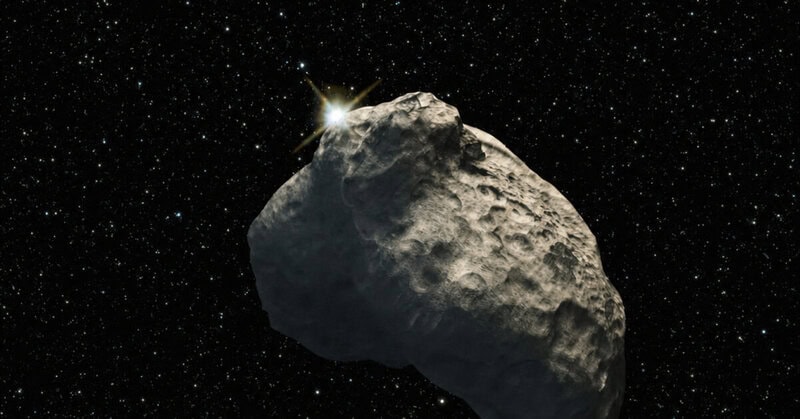
Asteroid 1998 KY26 is drifting off course — not because of a gravitational nudge from a nearby planet, but for reasons that have forced planetary scientists to revisit some of their most basic assumptions about how small rocky bodies move through space. The discrepancy is not instrument noise or a rounding error; it is a persistent, statistically robust deviation in the object’s orbital path that standard gravitational models cannot account for. With a Japanese spacecraft already en route to the rock, the pressure to find an explanation is no longer purely theoretical.
The Rock That Broke the Rules
In the language of orbital mechanics, any push or pull on an asteroid that gravity alone does not explain is called a non-gravitational force. Detecting one on a small, dim near-Earth object requires years of precise positional measurements — the kind of painstaking work that reveals only a hairline crack in what astronomers thought was a clean prediction. For 1998 KY26, that crack has widened into something that cannot be ignored. Researchers tracking the object have confirmed its anomalous acceleration, and the signal is now strong enough that dismissing it is no longer scientifically defensible.
What makes this more than an academic puzzle is timing. Japan’s Hayabusa2 spacecraft — the same probe that successfully returned samples from asteroid Ryugu in 2020 — is already en route to rendezvous with 1998 KY26 as part of an extended mission. Scientists need to understand what is driving this rock’s unusual behavior before their spacecraft arrives, both to plan the encounter safely and to interpret whatever data it sends back.
1998 KY26 is also not alone. A growing catalogue of near-Earth objects are exhibiting similarly unexplained accelerations, earning a provocative new label from some researchers: dark comets. The term signals a genuine scientific puzzle — bodies that behave dynamically like comets but look, through every telescope astronomers have pointed at them, like ordinary asteroids.
Why an Accelerating Asteroid Is Actually a Big Deal
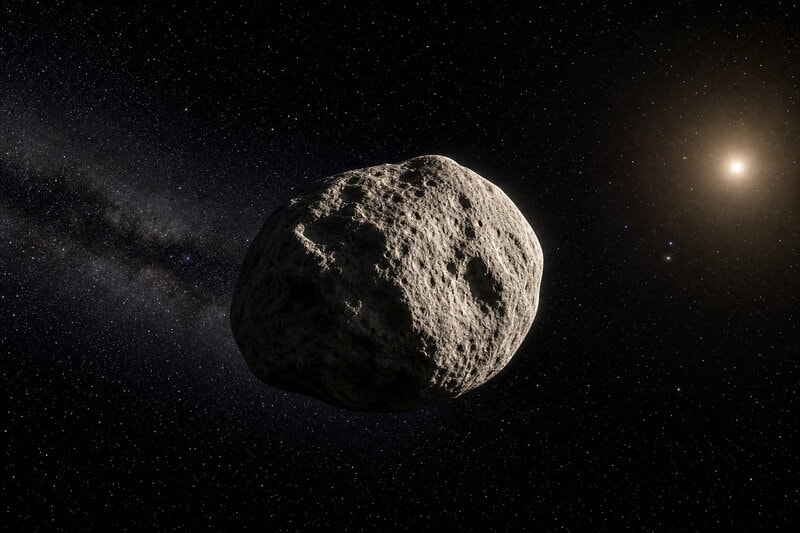
To appreciate why this matters, it helps to understand how asteroid trajectory prediction works. Astronomers calculate where a space rock will be years or decades from now by feeding its current position, velocity, and all known gravitational influences — the Sun, the planets, even large moons — into increasingly refined models. When observations consistently place the rock somewhere slightly different from where the model predicts, the difference is treated as evidence of a non-gravitational force.
The practical stakes are significant. Trajectory-prediction models feed directly into planetary-defense risk assessments conducted by institutions including NASA’s Center for Near Earth Object Studies (CNEOS) and ESA’s Planetary Defence Office. An unexplained acceleration that shifts an asteroid’s path by just a few hundred meters per year sounds trivial on a human timescale — but over the decades-long windows that matter for Earth-impact calculations, that drift compounds into something that can move a nominally safe flyby into a collision scenario, or vice versa. Getting the physics right is not optional.
The stakes extend beyond any single object. Near-Earth asteroid surveys have catalogued more than 35,000 objects to date, and trajectory predictions for the most hazardous among them are only as reliable as the force models underpinning them. A systematic gap in those models — one that affects a whole population of objects rather than just one anomalous rock — would require revising risk estimates across a substantial portion of that catalogue.
The Yarkovsky Effect: The Best Explanation We Have — and Its Limits
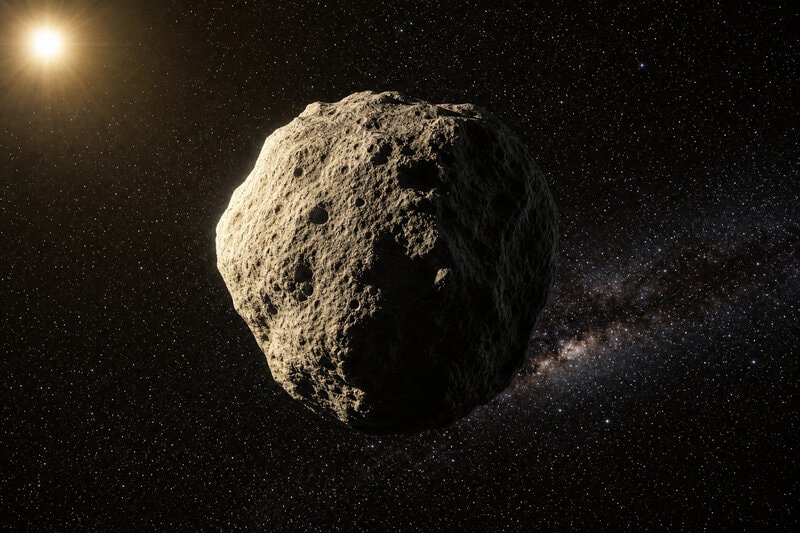
The leading candidate for most asteroid accelerations is the Yarkovsky effect — a well-understood non-gravitational force that is now standard in professional asteroid-tracking calculations. Here is how it works: sunlight heats a rotating asteroid unevenly. The side facing the Sun warms up, while the side that has rotated away gradually cools and radiates that stored heat back into space as infrared photons. Because photons carry momentum, that radiation produces a tiny but continuous thrust — essentially a photon rocket powered by the Sun itself.
The effect was first proposed by Ivan Yarkovsky, a 19th-century Polish engineer, and remained theoretical for decades before observational confirmation elevated it to scientific consensus. NASA and ESA now routinely factor the Yarkovsky effect into risk assessments for potentially hazardous asteroids, including the well-publicized recalculations for Apophis. For most rocky bodies, the effect is predictable once researchers know the object’s size, shape, rotation rate, and surface thermal properties.
The problem with 1998 KY26 is that its measured acceleration appears inconsistent with what those parameters would predict. The standard Yarkovsky model, applied faithfully to what astronomers know about the rock, does not reproduce the observed drift. That gap is what has pushed researchers toward more exotic explanations.
Closely related is the YORP effect (Yarkovsky-O’Keefe-Radzievskii-Paddack), a companion process by which uneven sunlight also alters an asteroid’s spin rate over time. Because the spin rate directly controls how the Yarkovsky thrust is expressed, the two effects are tightly coupled — changing one changes the other — and accurate modeling requires treating them together. For an object like 1998 KY26, whose spin state is not yet fully characterized, that coupling introduces additional uncertainty that makes a clean Yarkovsky-only explanation even harder to defend.
The Ice Hypothesis — and Why It May Not Hold
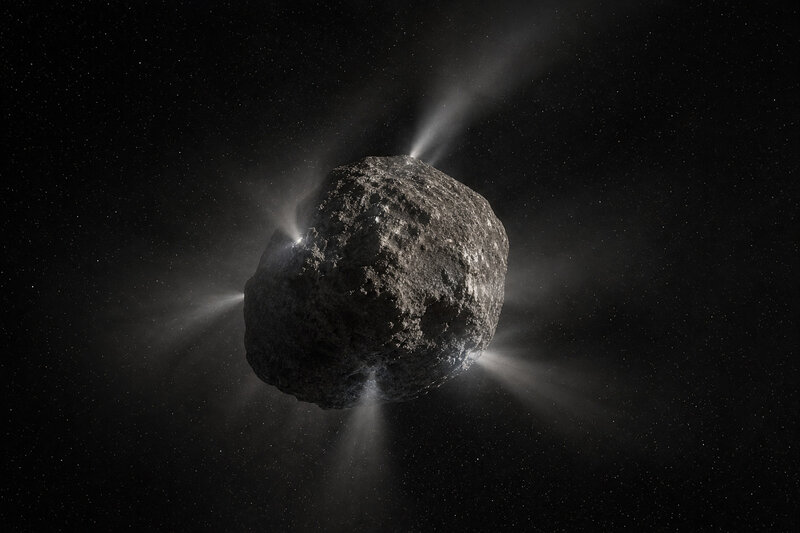
When an object accelerates in a way that thermal radiation cannot cleanly explain, the next hypothesis astronomers reach for is outgassing: buried ice sublimating in sunlight and venting as gas jets, exactly the mechanism that drives cometary tails and cometary non-gravitational forces. It was a reasonable first guess for 1998 KY26.
The difficulty is that no confirmed outgassing signature has been detected from the object. Cometary activity leaves observable traces — a coma of gas and dust surrounding the nucleus, spectral signatures of water vapor or other volatiles, sometimes a visible tail. 1998 KY26 shows none of these. Scientists initially thought hidden ice might explain the strange acceleration, but newer research suggests something else is at work — leaving researchers without a confirmed physical mechanism.
The unresolved question carries direct implications for the Hayabusa2 extended mission. If the spacecraft arrives at 1998 KY26 and detects unexpected volatile material beneath the surface, it would redraw the boundary between asteroid and comet — two categories that planetary science has long treated as physically distinct. That would be a significant result even setting aside the acceleration puzzle entirely.
Dark Comets: A New and Contested Category
The term “dark comet” was introduced to describe objects that occupy an uncomfortable middle ground: they exhibit non-gravitational accelerations characteristic of active comets, yet show no optical evidence of cometary activity — no coma, no tail, no detectable outgassing. 1998 KY26 fits that description, as do several other near-Earth objects now under scrutiny.
At least one near-Earth object previously catalogued as a standard asteroid has been formally reclassified as a dark comet in peer-reviewed literature, illustrating that the phenomenon is not confined to a single anomalous case. The reclassification challenges the assumption that the solar system’s small-body population sorts neatly into two bins — icy comets from the outer solar system and dry rocky asteroids from the inner belt.
It is important to be precise about what the dark-comet label does and does not mean. It is an emerging, not fully settled, classification that describes a dynamical behavior rather than a confirmed physical mechanism. Several researchers have urged caution before treating it as an established category, noting that the sample of confirmed dark comets remains small and that alternative explanations — including poorly constrained Yarkovsky parameters — have not been entirely ruled out for every candidate.
If dark comets are as prevalent as the current detection rate tentatively suggests, they represent a hidden population that existing planetary-defense surveys were not specifically designed to detect or characterize. Survey telescopes optimized to find asteroids look for objects with asteroid-like brightness profiles; a body behaving like a comet in its orbital dynamics but appearing photometrically like a rock could slip through screening designed to flag either category, but not both simultaneously. That is a gap with real risk implications that institutions are only beginning to quantify.
‘Oumuamua: An Interstellar Parallel
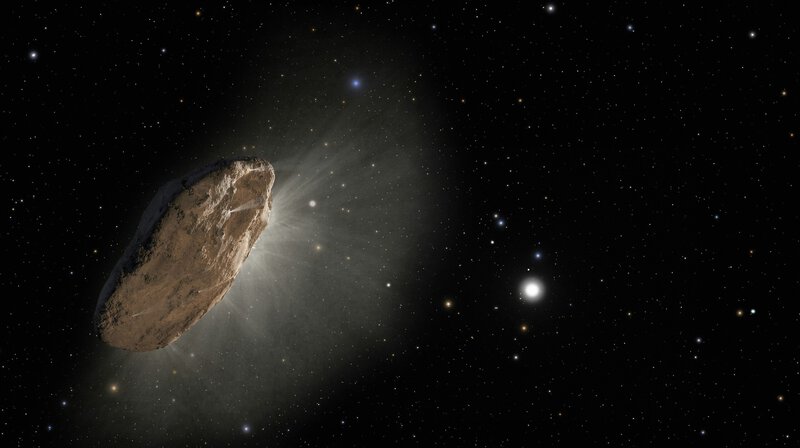
Any discussion of unexplained small-body accelerations eventually arrives at ‘Oumuamua — the first confirmed interstellar object detected passing through the solar system, observed in 2017. ‘Oumuamua accelerated away from the Sun more than gravity alone predicted, showed no detected water or ice, produced no coma or dust tail, and baffled researchers who published the anomaly in Nature.
Current scientific thinking describes ‘Oumuamua as a rocky, cigar-shaped object that is dense and composed of rock and possibly metals, with a surface consistent with long exposure to cosmic-ray irradiation during interstellar travel. The leading hypothesis for its excess acceleration involves outgassing of hydrogen or the pressure of solar radiation acting on an unusually thin geometry — but no explanation has achieved consensus, and the object has long since left the solar system, placing it permanently beyond further direct study.
‘Oumuamua is interstellar and 1998 KY26 is a solar-system native, so they are not the same kind of object, and drawing a direct causal line between them would be premature. But together, they suggest that non-gravitational forces on small rocky bodies are more varied and less well understood than the textbook Yarkovsky framework implies. The parallel is useful precisely because it widens the question: if objects from outside the solar system can accelerate in ways that resist clean explanation, and objects from within it can too, the phenomenon points toward a gap in fundamental models rather than an isolated quirk of any single unusual rock.
What Comes Next
The most direct path to answers runs through the Hayabusa2 extended mission. Close-up measurements of 1998 KY26’s surface composition, thermal properties, and rotation state will either confirm or rule out several competing explanations for its anomalous behavior. The spacecraft’s rendezvous is one of the most anticipated small-body encounters of this decade, carrying expectations that go well beyond the original Ryugu mission’s already impressive sample-return results.
At the institutional level, NASA’s CNEOS and ESA’s Planetary Defence Office are actively revising trajectory-prediction pipelines to better account for non-gravitational forces across the broader near-Earth object population — not just for well-characterized cases where the Yarkovsky effect can be cleanly modeled, but for the growing list of objects where the physics remains uncertain. Next-generation infrared survey assets, including those planned under NASA’s NEO Surveyor mission, are expected to improve thermal characterization for thousands of objects that are currently modeled with significant assumptions about their surface properties.
The broader scientific picture, as consensus currently stands, is that the solar system’s small-body population is more dynamically complex than textbook models suggest, and that the boundary between “asteroid” and “comet” is better understood as a spectrum than a sharp divide. For anyone following planetary defense, the practical upshot is straightforward: the same forces making 1998 KY26 hard to predict are precisely the reason astronomers are investing in longer observing baselines, more sensitive thermal-infrared surveys, and spacecraft visits to objects that raise unanswered questions. Understanding these rocks is not purely scientific curiosity — it is preparation for the possibility that one of them is headed our way and the models we rely on to know it are not yet good enough to tell us so with confidence.