Forty-nine small circles, each roughly the width of a human finger, arranged in a seven-by-seven grid: at first glance, NASA’s collage of drill holes Curiosity has made on Mars looks almost unremarkable. Look closer, and those pale gray circles represent the most detailed chemical investigation ever conducted on another planet’s surface — a decade-plus record that has quietly forced scientists to revise what they thought they knew about Mars’s capacity to support life.
A Seven-by-Seven Grid That Rewrote Planetary Science
As of November 2026, NASA’s Curiosity rover had drilled 49 distinct holes into Martian rock, making it the first robotic mission in history to use a drill carried at the end of its robotic arm to bore into a rock on Mars and collect a sample for onboard chemical analysis. The collage image, designated PIA26804, arranges all 49 overhead close-ups into a tidy seven-by-seven grid, compressing an enormous span of Martian geological history into a single frame. Each hole represents a moment when Mars gave up a secret it had kept for billions of years — a small cylinder of powdered rock carrying chemical signatures that no human hand, and no previous spacecraft, had ever touched.
The central tension the image embodies is this: the holes look mundane, yet the chemistry locked inside the powder they yielded has forced scientists to revise long-held assumptions about whether Mars was ever capable of sustaining microbial life. No life has been found. But what has been found — evidence of persistent liquid water, complex organic molecules, and a mineral record of a world gradually drying out — means that the absence of life, if it is ultimately confirmed, will itself demand an explanation. The chemistry, by almost every measurable account, was right.
The Drill Itself: A First That Changed Everything
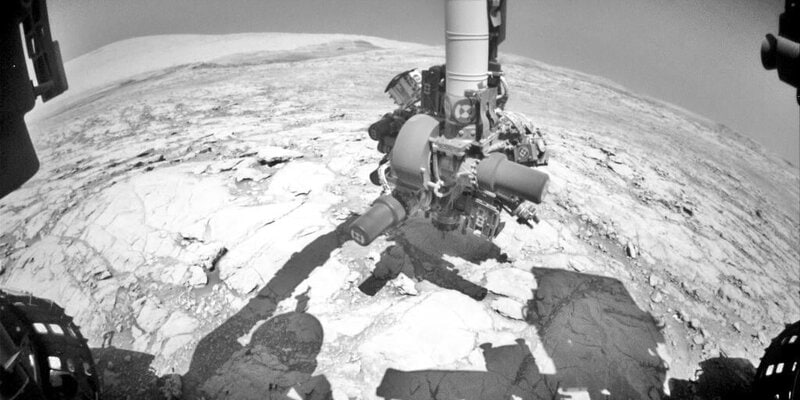
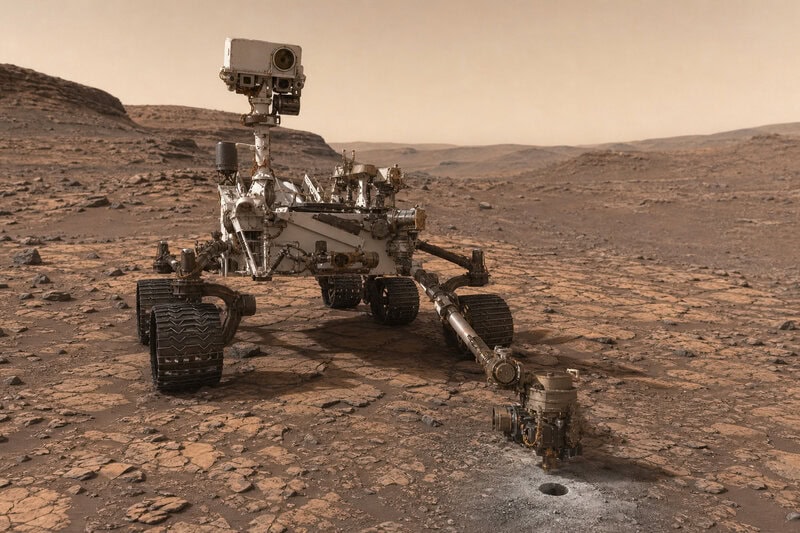
Before Curiosity landed in Gale Crater in August 2012, every Mars rover could only scratch or abrade a rock’s outer surface — useful, but limited to weathered rinds that bear little resemblance to a rock’s unaltered interior. Curiosity was the first spacecraft to use a drill mounted at the end of a robotic arm to bore directly into a Martian rock and collect a fresh sample — an engineering milestone that opened an entirely new chapter in planetary geology.
The mechanism works like this: the drill spins and hammers simultaneously, pulverizing rock into a fine powder. That powder travels up flutes — spiral grooves machined along the drill bit — into a sample chamber, where it is portioned out to Curiosity’s two onboard laboratories. The first is SAM (Sample Analysis at Mars), which uses gas chromatography and mass spectrometry — techniques that separate and identify molecules by their chemical properties and mass — to detect organic compounds and gases. The second is CheMin (Chemistry and Mineralogy instrument), which uses X-ray diffraction, a method that identifies minerals by the characteristic way they scatter X-rays, to determine the precise mineral composition of each powdered sample.
Drilling on Mars also required solving an unglamorous engineering problem: the communication delay between Earth and Mars means that human controllers cannot intervene in real time during drilling operations. Curiosity’s autonomous software must therefore manage drill pressure and rotation speed on its own, adjusting to unexpected rock hardness without moment-to-moment human input. That autonomy was not an afterthought — it was a prerequisite for doing geology on another world.
Reading the Collage: What 49 Holes Look Like and Why Location Matters
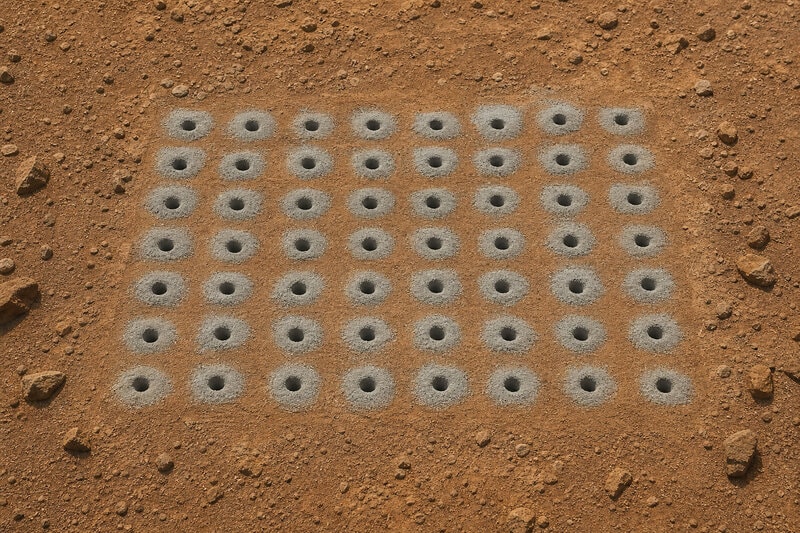
Each of the 49 overhead close-up images in the collage captures a circular hole approximately 1.6 centimeters in diameter and up to 6 centimeters deep, surrounded by pale gray drill tailings — the powdered rock pushed aside during boring — set against a rust-red or buff-colored Martian surface. The visual variation across the grid is itself informative: some holes sit in dark, fine-grained mudstone; others pierce lighter, coarser-grained sandstone. Those differences in color and texture are not cosmetic. They reflect fundamentally different depositional environments — some formed at the bottom of a lake, others in drier, windier conditions.
Location is not arbitrary. Each drill site was chosen after Curiosity’s cameras and onboard spectrometers identified rocks with textures, colors, or chemical signatures suggesting they formed in or near ancient water. The spatial distribution of the 49 holes therefore constitutes a deliberate stratigraphic record — stratigraphy being the study of rock layers as a timeline, where older layers lie beneath younger ones. By drilling at progressively higher elevations on Mount Sharp, the five-kilometer-high mound at Gale Crater’s center, scientists are effectively reading successive chapters of Mars’s geological biography. According to NASA’s Mars Science Laboratory mission records, the 49 samples span a vertical climb of more than 700 meters up Mount Sharp’s slopes, meaning the collage compresses a vast stretch of Martian geological history into a grid that fits on a screen.
The Chemistry: What the Rock Samples Revealed
The most firmly established finding from Curiosity’s drill record is this: Gale Crater once held a persistent freshwater lake with a neutral pH and low salinity. Data from drill samples, published across multiple peer-reviewed studies in journals including Science and Nature Geoscience, led NASA scientists to describe the ancient lake environment as “habitable” for microbial life as it is understood on Earth. That word carries a precise scientific meaning — the conditions were compatible with life — and it carries an equally precise limitation: compatible is not the same as inhabited, and no life has been detected.
The organic chemistry findings added complexity to that picture. In 2018, NASA scientists announced that Curiosity’s SAM instrument had detected complex organic molecules — including thiophenes, benzene, and toluene — preserved in 3.5-billion-year-old mudstone drilled at a site called Mojave 2. These molecules are consistent with biological processes, but NASA explicitly stated they could also have an abiotic, or non-living, origin. The question remains scientifically open, and responsible reporting requires treating it that way.
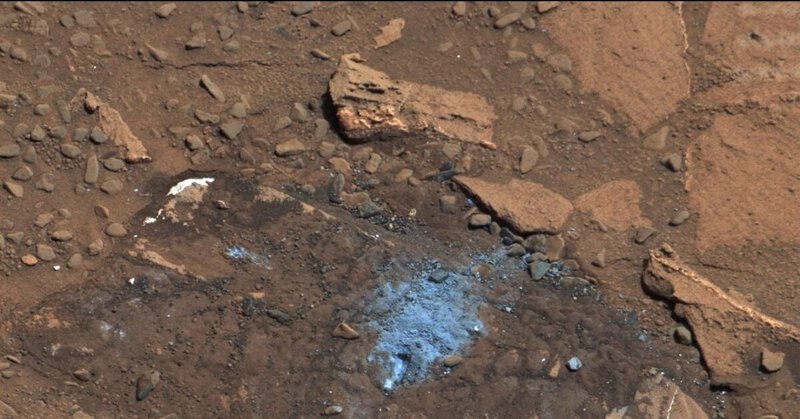
CheMin analysis of the 49 samples added a geological narrative to the chemical one. The instrument revealed a clear progression from clay minerals — technically called phyllosilicates, which form through prolonged contact with liquid water — in the lower, older rock layers, to sulfate minerals in higher, younger layers. In a 2022 paper in Science, NASA’s Mars Science Laboratory team interpreted this clay-to-sulfate transition as evidence that Mars dried out gradually rather than catastrophically, a finding with significant implications for how long habitable conditions may have persisted.
One emerging and contested finding deserves careful treatment. Some drill samples returned unexpectedly high concentrations of manganese oxides — minerals that on Earth typically form only in oxygen-rich environments. Researchers at the University of Hawaiʻi and Los Alamos National Laboratory suggested, in a 2024 paper in the Journal of Geophysical Research, that early Mars may have had more atmospheric oxygen than current models predict. Other planetary scientists have urged caution, noting that non-biological redox chemistry — chemical reactions involving electron transfer that do not require living organisms — could also produce manganese oxides under certain conditions. This is an area of active scientific debate, not settled consensus.
The Methane Question: A Complication the Drill Holes Did Not Resolve
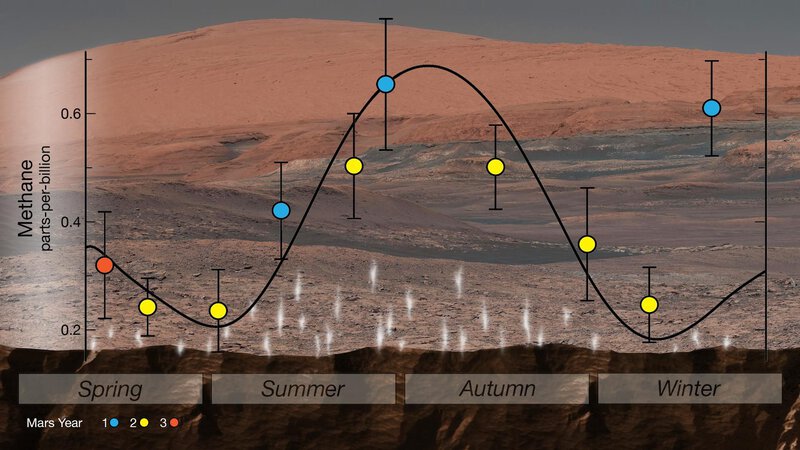
Curiosity’s SAM instrument has periodically detected spikes in atmospheric methane — a gas that on Earth is produced predominantly by biology or by geological processes involving liquid water and heat. The drill samples themselves, however, have not identified a definitive subsurface source for these spikes. It is important to distinguish clearly: the methane detections are atmospheric measurements, not direct findings from drilled rock. NASA’s official position, as stated in a 2019 Nature Geoscience paper co-authored by researchers at NASA Goddard Space Flight Center, is that the source of the methane remains unknown.
Sensational claims framing methane as a confirmed biosignature are not supported by current evidence. Multiple researchers, including members of the ESA-NASA ExoMars science team, have published alternative explanations involving ultraviolet-driven surface chemistry that could produce or release methane without any biological involvement. The gap between what the drill holes reveal — ancient habitability, preserved organics — and what the atmosphere hints at — possible ongoing chemistry — is precisely why NASA’s Perseverance rover and the planned Mars Sample Return mission are designed to push the investigation further.
What 49 Holes Mean as a Cumulative Dataset
A single drill hole is an anecdote. Forty-nine drill holes distributed across more than 700 meters of stratigraphy, collected over more than a decade of continuous operations, constitute a dataset — and it is the patterns across that dataset, not any single dramatic sample, that give scientists justified confidence in their conclusions. A 2023 review paper in Annual Review of Earth and Planetary Sciences, drawing on the full Curiosity drill record available at the time, concluded that Mars’s habitability was not a brief anomaly but a sustained geological condition lasting potentially hundreds of millions of years during the Noachian and Hesperian periods, roughly 4.1 to 3.0 billion years ago.
This is also why the collage image itself carries scientific communication value. Visualizing all 49 holes together makes the cumulative, systematic nature of the sampling strategy immediately legible to non-specialists. It reinforces, at a glance, that Curiosity’s science is built on methodical repetition rather than a single lucky find — a point that is easy to lose when any one sample dominates a news cycle.
Scientists at JPL acknowledge openly that the 49 holes sample only a narrow corridor of Gale Crater, and that generalizing these findings to all of Mars requires data from geologically distinct regions. That acknowledgment is a strength of the science, not a weakness. It is precisely why Perseverance’s work in Jezero Crater — a site with a different geological history — matters, and why the eventual return of physical Martian samples to Earth laboratories remains a priority.
What Comes Next: From Drill Holes to Earth Laboratories
However sophisticated SAM and CheMin are, they are miniaturized instruments operating inside a radiation-bathed rover on a planet that can be more than 200 million kilometers from Earth at its farthest point. The definitive tests for ancient biosignatures — the experiments that could move the needle from “consistent with life” to something more conclusive — require the sensitivity of terrestrial laboratories and instruments that simply cannot be miniaturized to fit on a rover. This is the core scientific rationale for NASA and ESA’s Mars Sample Return mission, which as of 2025 remained in a redesign phase due to cost and schedule pressures but continued to be described by both agencies as a long-term priority.
Curiosity’s 49-hole chemical roadmap has already proved useful in that future mission context. By identifying which mineral types and geological environments preserve organic molecules most reliably, the drill record effectively guided scientists toward the contexts most worth targeting when Perseverance — using a similar but improved drilling system — began sealing rock cores in titanium tubes for eventual Earth return. The two rovers’ work is cumulative and complementary, not redundant.
What the collage of 49 holes ultimately represents is a visual record of the most detailed chemical interrogation ever conducted on another planet’s surface — 49 moments when a robotic geologist reached into an alien world and asked, in the only language rocks speak, whether this place was ever alive. No hole has answered yes. None has answered no. What the cumulative record has established, according to NASA’s Mars Science Laboratory principal investigator team, is something perhaps more unsettling and more interesting than either answer: the chemistry was, by all measurable accounts, right for life — and explaining why life either thrived or failed to arise in those conditions may turn out to be one of the defining scientific questions of the century.