Two small spacecraft recently skimmed just 600 kilometers above Earth’s surface — lower than the International Space Station typically orbits — fired their engines at the precise mathematical sweet spot of maximum gravitational pull, and stole enough speed from our own planet to coast silently toward Mars. That maneuver marks a first for NASA, and it sets the stage for one of the most compelling planetary science missions in years.
Meet ESCAPADE: The Twin Spacecraft Heading to Mars
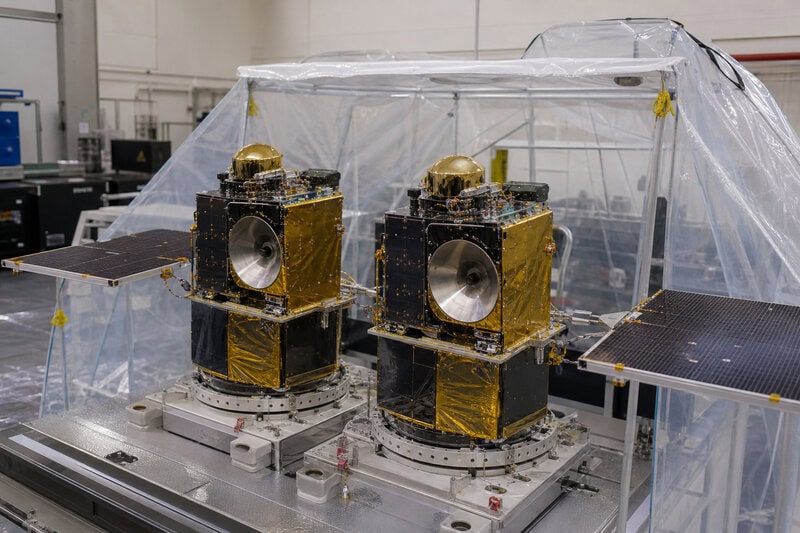
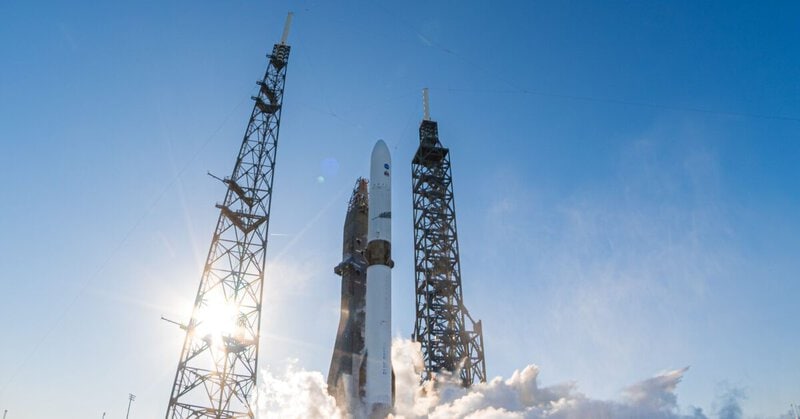
ESCAPADE — short for Escape and Plasma Acceleration and Dynamics Explorers — is a NASA smallsat mission built around a deceptively simple but scientifically powerful idea: send two spacecraft to Mars instead of one. The twin probes, named Blue and Gold, launched in November 2024 aboard a Blue Origin New Glenn rocket and are now on a confirmed trajectory toward the Red Planet, with arrival targeted for September 2027.
The reason for flying in pairs goes straight to the heart of the science. Mars has a complex, chaotic magnetic environment, and a single spacecraft can only sample one point in that environment at a time. Blue and Gold fly together but separately, allowing scientists to take simultaneous measurements at two different locations — revealing how solar wind pressure and magnetic fluctuations ripple across different regions of Mars at the same moment. It is a capability no solo probe could match.
Both spacecraft are compact by deep-space standards, making ESCAPADE a showcase for NASA’s growing ambition to tackle major planetary science questions with smaller, more affordable hardware. The full mission background, development history, and scientific objectives are documented on the ESCAPADE Wikipedia page.
Why Did the Spacecraft Spend Months Near Earth Before Leaving?
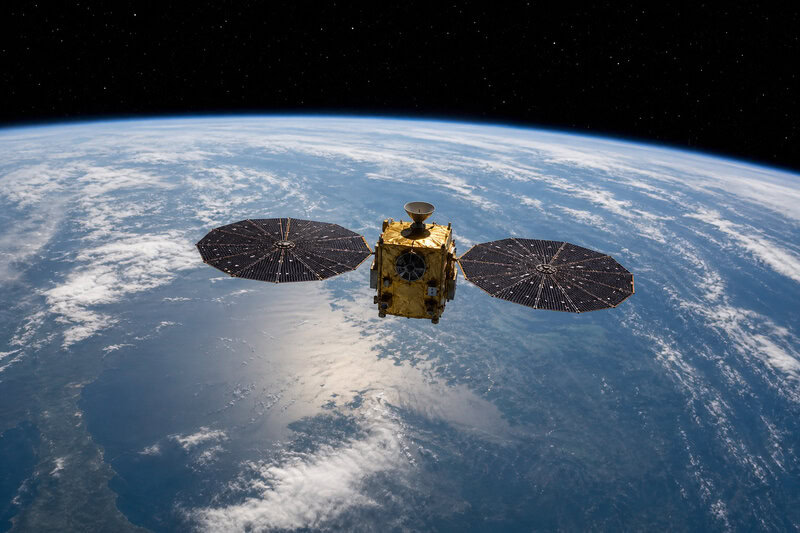
After launching in November 2024, Blue and Gold did not immediately depart for Mars. Instead, they looped in the vicinity of Earth for nearly a year — a detail that might seem puzzling at first glance but was planned from the very beginning.
Deep-space missions are governed by orbital mechanics, not convenience. Sending a spacecraft to Mars at the wrong moment in the planetary alignment cycle wastes enormous amounts of propellant and can make the journey technically impractical without a much larger rocket. The waiting period allowed the geometry of Earth, Mars, and the Sun to align into the optimal configuration for the flybys to be effective.
That time also gave mission teams an invaluable opportunity: to thoroughly check spacecraft systems while both probes were still in a relatively accessible environment. Any issue caught near Earth is far easier to diagnose and address than one discovered months into a deep-space cruise. When the alignment was correct and the hardware was confirmed healthy, both spacecraft dove back toward Earth — not to return home, but to borrow its speed.
The Powered Earth Flyby: A Gravity Assist With a Kick
A standard gravity assist is one of spaceflight’s most elegant techniques. A spacecraft swings around a planet, borrows a portion of that planet’s orbital momentum, and exits the encounter moving faster than it entered — all without burning propellant. Planetary engineers have used this approach for decades, dispatching probes to the outer solar system with trajectories that would otherwise be prohibitively expensive.
A powered flyby takes the concept further. At the exact moment of closest approach — the point of maximum gravitational acceleration — the spacecraft fires its engine. The timing is critical: burning at that instant amplifies the speed gain far beyond what gravity alone could deliver, because the spacecraft is traveling at its fastest and every unit of thrust produces the greatest possible change in velocity. Miss the window, and the advantage evaporates.
ESCAPADE executed this maneuver twice, once for Blue and once for Gold in close succession, with each spacecraft diving within 600 kilometers of Earth’s surface to maximize gravitational pull before igniting its engine. NASA confirmed this is the first time the agency has used a powered Earth flyby to propel a spacecraft toward Mars — a historic milestone tucked inside what might otherwise appear to be a routine navigational step.
Consider an analogy from athletics: a hammer throw. Earth’s gravity acts like the athlete spinning the hammer in a wide arc, building speed with every revolution. The engine burn is the moment of release — timed precisely to send the spacecraft flying outward at the greatest possible velocity. The result is a trajectory to Mars achieved with considerably less propellant than a direct departure would have required, a meaningful advantage for spacecraft with limited fuel budgets.
SpaceNews reported on ESCAPADE’s departure for Mars following the successful Earth flybys, confirming the mission is now firmly on course.
Mars’s 4-Billion-Year Magnetic Mystery

The destination matters as much as the journey. Roughly four billion years ago, Mars possessed a global magnetic field broadly similar to Earth’s — a planetary shield generated by a churning liquid metallic core. That field deflected the relentless stream of charged particles flowing outward from the Sun, known as the solar wind, and allowed Mars to retain a thick enough atmosphere for liquid water to exist on its surface.
Then the core cooled, internal convection slowed, and the global magnetic field collapsed. Without its protective shield, the solar wind gradually stripped away Mars’s atmosphere over hundreds of millions of years. The result is the thin, cold, radiation-scoured world observable today — a planet that may once have hosted conditions suitable for life, fundamentally transformed by the loss of an invisible force field.
What makes Mars’s current magnetic environment particularly challenging to study is its patchwork character. Unlike Earth’s continuous global field, Mars now has only fossilized magnetic signatures baked into its ancient crust — islands of remnant magnetism concentrated in the southern highlands. Where the solar wind crashes into these crustal remnants and into Mars’s thin upper atmosphere, it creates a turbulent boundary region called the induced magnetosphere. This zone is chaotic, incompletely mapped, and central to understanding how atmospheric loss continues on Mars to this day.
This is precisely where Blue and Gold will work. Flying through these boundary regions simultaneously, the twin spacecraft will measure electric fields, magnetic fields, and the flows of charged particles at two locations at once — constructing a three-dimensional picture of how atmospheric particles are being accelerated and lost into space in real time. That simultaneous two-point measurement is the scientific core of the entire mission, and it cannot be replicated by any single spacecraft no matter how sophisticated.
What ESCAPADE Could Mean for Science and Exploration

When both spacecraft settle into their complementary orbits around Mars in September 2027, the science phase will begin in earnest. The data they collect could resolve longstanding questions about the specific physical mechanisms driving atmospheric escape — not merely confirming that the solar wind is responsible in a general sense, but revealing precisely how and where the process operates at a mechanistic level.
That knowledge extends well beyond Mars. Understanding how a rocky planet loses its atmosphere — and whether a magnetic field is necessary to prevent that loss — is directly relevant to the broader search for habitable worlds. Magnetic shielding may be a prerequisite for long-term planetary habitability, and Mars offers a natural experiment that unfolded over billions of years at our nearest planetary neighbor. ESCAPADE’s findings could help scientists evaluate whether Earth-like planets around other stars are likely to retain their atmospheres long enough for life to emerge.
Closer to home, ESCAPADE’s atmospheric science directly complements the work of surface missions like NASA’s Perseverance rover, which is searching for signs of ancient life preserved in Martian rock. Understanding whether Mars was ever consistently habitable — not just transiently wet, but stably warm and atmospheric over geological timescales — requires understanding when the magnetic shield failed and how rapidly the atmosphere eroded afterward.
The powered flyby technique itself carries implications beyond this single mission. Demonstrating the maneuver for a Mars trajectory opens the door to applying it routinely for future low-cost missions that need to reach distant targets without expensive heavy-lift vehicles. The spacecraft are small; the methods they have validated are scalable.
- Dual-spacecraft design enables simultaneous multipoint measurements that a single probe cannot provide.
- Powered Earth flyby successfully demonstrated as a viable, propellant-efficient route to Mars for the first time in NASA history.
- Mars arrival targeted for September 2027, with science operations focused on the induced magnetosphere and ongoing atmospheric loss.
- Results relevant to planetary habitability research and the search for conditions capable of supporting life beyond Earth.
Blue and Gold are small spacecraft carrying an outsized question: what transformed a world that may once have harbored life into a frozen, desiccated desert? With the powered Earth flybys now complete and both spacecraft confirmed on trajectory, the data needed to answer that question is roughly two years away. Mars has kept this secret for four billion years. ESCAPADE is finally positioned to read it.