
Picture an ancient sea — not the quiet, filtered blue of a nature documentary, but a churning, violent world crowded with enormous hunters. For decades, evolutionary theory insisted such a place couldn’t last: nature, the thinking went, simply doesn’t allow multiple giants to share the throne. The fossil record begs to differ, and what it reveals has forced scientists to rethink one of ecology’s most foundational assumptions.
The Rule Scientists Thought Was Unbreakable

At the heart of classical ecology sits a principle known as competitive exclusion, formalized by the Soviet biologist Georgy Gause in the 1930s. The idea is straightforward: two species competing for exactly the same ecological niche cannot coexist indefinitely. One will outcompete the other, driving its rival toward extinction or forcing it into a different role. Applied to apex predators — the animals at the very top of the food chain — this logic seemed especially airtight. Ecosystems, the theory suggested, can sustain only one true dominant predator at a time.
In marine environments, this assumption felt particularly solid. The ocean, vast as it is, channels energy up a pyramid, and that pyramid was presumed to narrow sharply at its peak. Dominant predator rises, rivals fall, order is maintained. It was a tidy framework that shaped decades of thinking about how life organizes itself — and it held up reasonably well, right up until paleontologists started extracting fossils in greater numbers, with sharper tools and far better analytical techniques.
The ancient ocean stopped cooperating with the script.
A Prehistoric Sea Packed With Giants
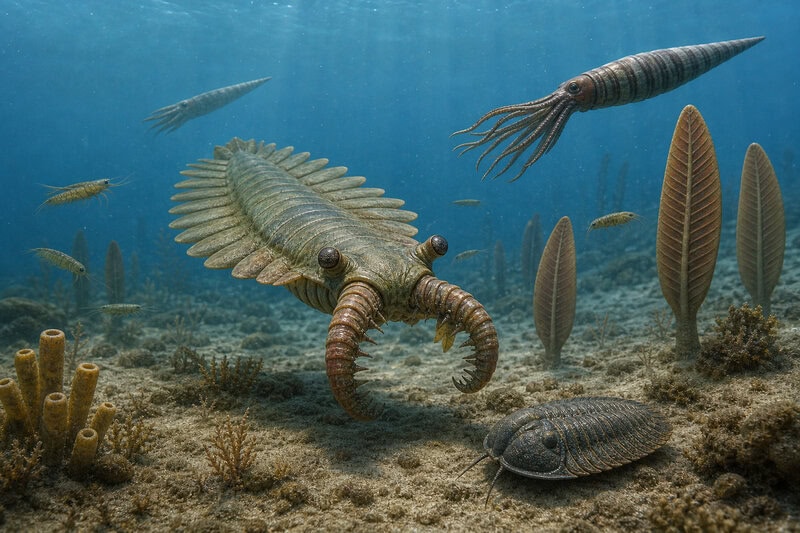
To understand why the fossil record is so disruptive, it helps to visit the prehistoric seas themselves. During the Cambrian explosion, roughly 538 million years ago, life on Earth underwent one of its most dramatic diversifications. Among the creatures that emerged were early predators like Anomalocaris, a segmented, shrimp-like hunter that reached lengths of around one meter — enormous by the standards of its time — and almost certainly occupied an apex predatory role in its ecosystem.
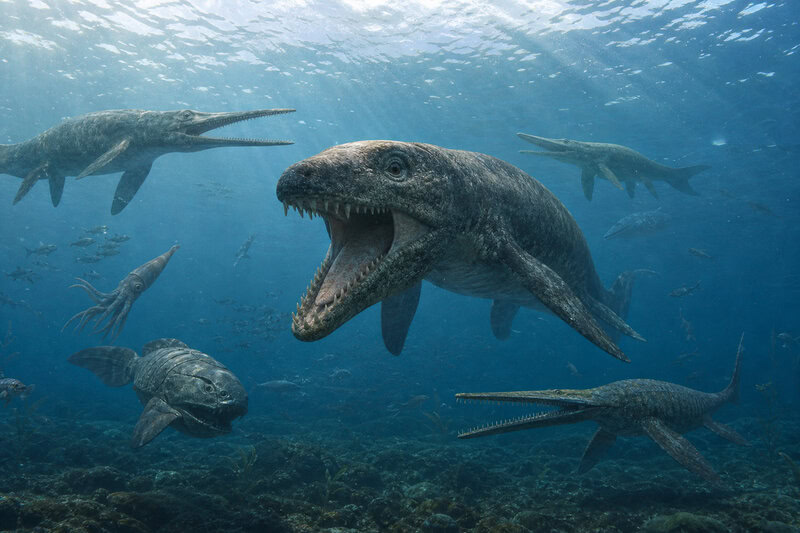
But the story didn’t stop there. The Devonian period, spanning roughly 419 to 359 million years ago, produced armored fish including Dunkleosteus, a placoderm with a bite force estimated among the most powerful of any fish in Earth’s history. Later, marine reptiles — mosasaurs, plesiosaurs, and ichthyosaurs — dominated Mesozoic seas, filling predatory roles with bodies that rivaled modern whales in size. These were not fringe creatures. They were the dominant hunters of their time, and crucially, they often shared their oceans with other large predators simultaneously.
Woven through nearly all of these eras is one of evolution’s most remarkable success stories: sharks. With an evolutionary timeline spanning approximately 450 million years, sharks predate the dinosaurs, the Atlantic Ocean, and almost every other recognizable feature of the modern world. Their persistence across five separate mass extinction events — events that eliminated the vast majority of species alive at the time — made them a constant presence in seas repeatedly reshaped by catastrophe. That kind of staying power is not an accident; it reflects genuine biological and ecological flexibility that paleontologists are only beginning to fully understand.
What the fossil record of these ancient oceans reveals is not a succession of lone rulers. It reveals something far more complicated: multiple giant predators occupying overlapping ecological roles at the same time, across the same waters. That is the first and most persistent crack in the one-apex-predator rule.
Megalodon: The Most Iconic Giant — and Its Unexpected Company
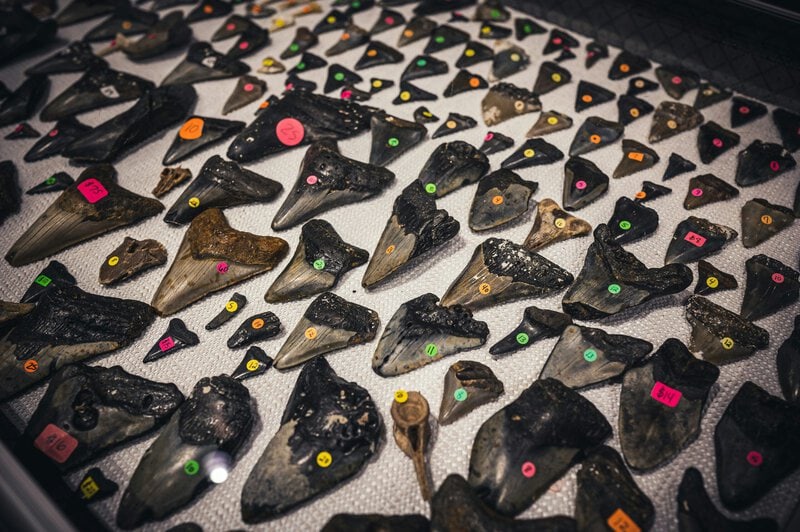
Carcharocles megalodon remains the most iconic example of prehistoric marine predator dominance. Living from roughly 23 to 3.6 million years ago during the Miocene and Pliocene epochs, megalodon patrolled nearly every ocean on Earth. Size estimates derived from tooth and vertebral fossil comparisons place it at up to approximately 50 to 60 feet in length. Its teeth — serrated, triangular, and large enough to fit in a human hand — were built for crushing the bones of large prey, including whales. It was, by almost any measure, one of the most formidable predators in the history of life on this planet.
And yet megalodon did not rule alone. Fossil evidence places it in contemporaneous ecosystems alongside other massive marine predators: large-bodied predatory sperm whales and highly capable predatory dolphins whose descendants still exist today. These were not minor species tolerated at the margins of megalodon’s domain. They were genuine ecological heavyweights, occupying overlapping territory and competing for some of the same prey.
This coexistence is one of the most compelling pieces of evidence that the ancient ocean operated by different rules than evolutionary theory predicted — or, more precisely, that the theory itself was always incomplete.
What the Fossil Record Actually Shows
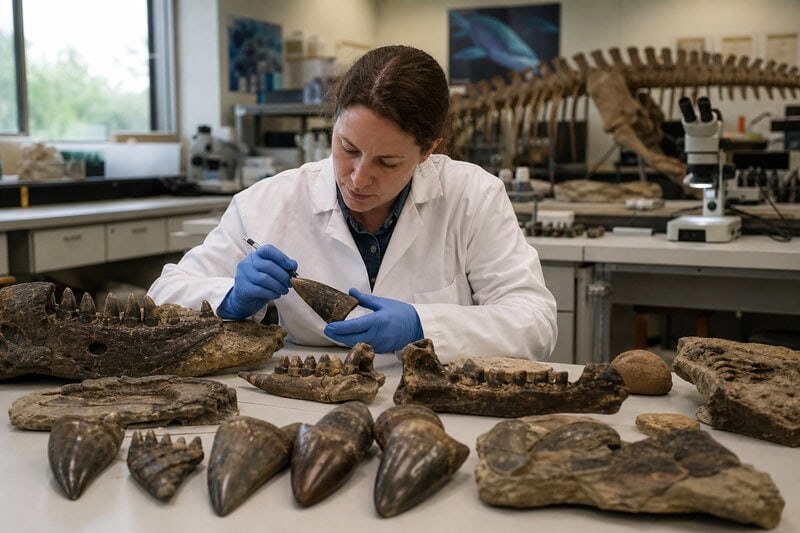
Advances in paleontology have transformed what scientists can extract from ancient bones and teeth. Stable isotope analysis — examining the chemical signatures locked inside fossil material, particularly ratios of carbon and nitrogen isotopes — now allows researchers to reconstruct diet, habitat depth, and in some cases migration patterns with a precision impossible a generation ago. Combined with increasingly sophisticated modeling of ancient food webs, these techniques have produced a picture of prehistoric ecosystems that is richer and more nuanced than anyone anticipated.
What emerges is not a ladder of dominance but a web. Multiple large predators in the same ecosystem appear to have coexisted through a process scientists call niche partitioning — subtle but meaningful differences in prey preference, hunting depth, geographic range, or seasonal behavior that reduced direct competition enough to allow giants to share the apex. One predator may have targeted shallow coastal waters while another worked the open ocean. One specialized in fast-moving fish; another pursued larger, slower prey such as marine mammals.
This is not a loophole in competitive exclusion so much as a clarification of its limits. The principle holds when niches truly overlap completely. What the fossil record demonstrates is that in diverse, productive ancient oceans, complete niche overlap was rarer than assumed — and that large predators were capable of behavioral and biological differentiation that created just enough separation to allow coexistence over geological timescales.
The Evolutionary Twist — and What It Actually Means
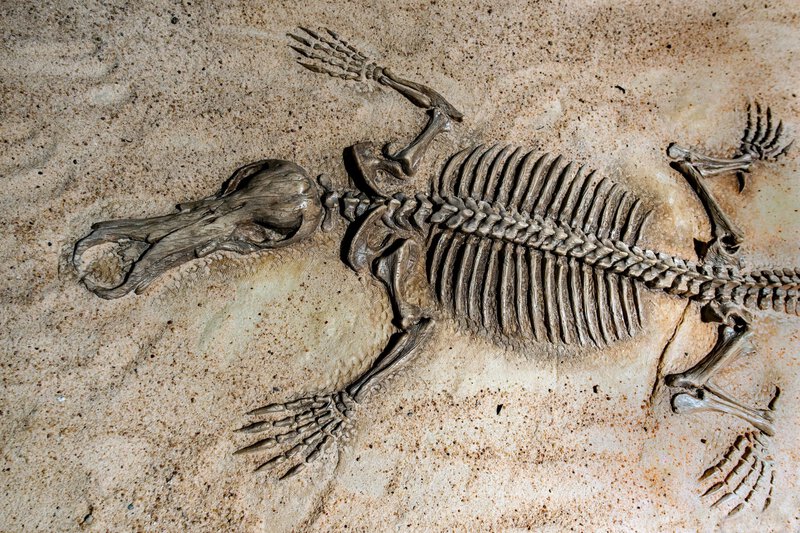
The core insight emerging from this body of research is both simple and significant: ancient ocean ecosystems were far more ecologically flexible than the competitive exclusion principle suggested in its strictest form. Apex dominance was not a winner-takes-all outcome. It was a shifting balance, negotiated over millions of years through differentiation that left room for more than one giant at a time — provided the ecosystem itself remained productive enough to support them.
This reframing also recasts megalodon’s extinction in a more instructive light. The disappearance of this predator around 3.6 million years ago was once framed as the natural endpoint of competition — something bigger, faster, or better adapted eventually dethroned it. The emerging picture is considerably more complex. Global cooling during the late Pliocene altered ocean circulation patterns and dramatically affected whale populations — the primary prey base that megalodon depended on. Isotopic studies of megalodon teeth suggest it was an obligate predator of large marine mammals, making it acutely vulnerable to any disruption in that specific prey base. Megalodon may not have lost a competition so much as lost the ecological world it was built for.
Sharks, meanwhile, survived — as they have survived every major extinction event in Earth’s history. Their resilience is not simply a matter of toughness. It reflects a combination of physiological efficiency, reproductive flexibility, and the capacity for niche diversification across thousands of species and ecological roles. That track record, read alongside the fossil evidence of ancient predator coexistence, offers a framework for understanding why some lineages endure upheaval that destroys their contemporaries.
Why Ancient Predators Still Matter
The implications of these findings reach well beyond paleontology. If ancient ocean ecosystems could sustain multiple apex predators through dynamic niche partitioning, then the ecosystems of today may be both more capable of complexity and more vulnerable to its unraveling than current models assume. Complexity, the fossil record suggests, is not a stable equilibrium — it is an active achievement, maintained by the interactions of many species across many roles.
Modern oceans are under extraordinary pressure. Climate change is warming and acidifying the water, disrupting prey populations that top predators depend on. Overfishing has removed apex predators from ecosystems at rates with no analog in the fossil record of natural extinction. The loss of a single apex predator can trigger cascading effects through entire food webs — effects that studies of ancient ocean predators help scientists anticipate and model with greater accuracy. History, in this case, is not merely academic. It is evidence written in stone, tooth, and bone, with direct relevance to decisions being made right now about the health of living oceans.
New fossil discoveries continue to emerge from seafloors, eroding cliff faces, and desert rock formations that were once ancient seabeds. Each one adds resolution to a picture that keeps growing larger and more intricate. The ocean kept its secrets for hundreds of millions of years. Every fossil pulled from the earth is a reminder that the story of life on this planet is stranger and less predictable than we imagined — and that the rules we thought were unbreakable are often just waiting for the right evidence to bend them.