
Apollo astronauts never had to worry about transferring rocket fuel in orbit. Their lunar modules launched fully loaded and flew straight to the Moon. NASA’s 2028 Artemis missions face a fundamentally different problem: one of the two commercial landers selected for crewed lunar landings has determined that a critical enabling technology cannot be made ready in time, forcing a sweeping architectural redesign that would have been unrecognizable even two years ago.
The Refueling Problem at the Heart of Artemis
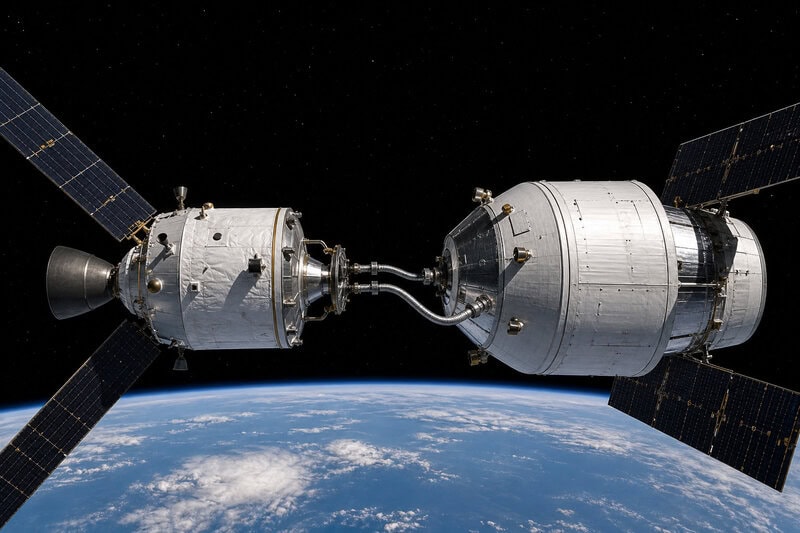
The technology in question is cryogenic propellant transfer — the process of moving ultra-cold liquid fuels such as liquid hydrogen or liquid oxygen between spacecraft while in orbit. This is not a minor engineering detail. For missions that cannot carry all their propellant from the ground in a single launch, in-space refueling is the mechanism that makes the trip to the Moon mathematically possible. As NASA confirmed in its announcement on accelerating lander development, both Blue Origin and SpaceX have revised their mission concepts for 2028 in direct response to schedule-driven pressure around this technology.
Blue Origin’s decision to defer in-space propellant transfer for its 2028 crewed lunar landing mission is the clearest signal yet of the central engineering tension shaping the Artemis program: how do you land humans on the Moon on a fixed deadline when a key enabling technology is not ready? The answer, according to NASA and its partners, is to redesign around the constraint — a pragmatic pivot that reflects the realities of developing human spaceflight hardware on a commercial timeline rather than through a decade-long government build-up.
Why 2028 Is Different From Apollo
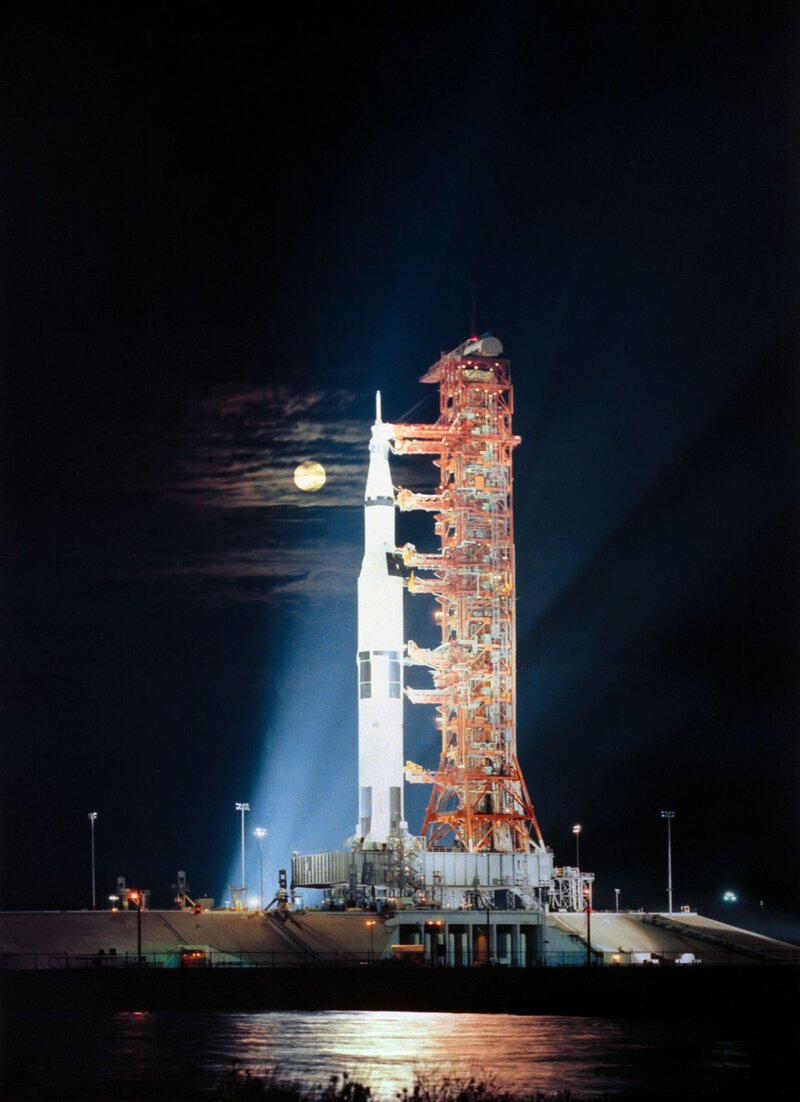
NASA is targeting a crewed lunar landing in 2028 under the Artemis program, a goal that agency officials have described as requiring deliberate adjustments to improve the probability of success within that window. NASA has said publicly that Artemis program adjustments are intended to improve the agency’s chances of achieving that landing — an institutional acknowledgment that the original plans carried more technical risk than the schedule could absorb.
The contrast with Apollo is instructive. Apollo operated under a single government chain of command with purpose-built hardware developed through a methodical, decade-long sequence: Mercury, then Gemini, then Apollo. Each phase proved specific capabilities — orbital rendezvous, spacewalks, long-duration life support — before astronauts committed to the lunar journey. The 2028 Artemis missions have no equivalent runway. Technologies that are not ready must be deferred, redesigned around, or accepted as calculated risk.
The Artemis lander effort also relies on two independent commercial contractors — Blue Origin and SpaceX — each developing their own vehicle under separate NASA task orders. That structure introduces parallel schedules, parallel technical risks, and parallel redesigns. It also means that a schedule failure at one company does not eliminate the crewed landing option entirely, which is precisely why NASA structured the program this way.
Blue Origin’s Three-Stage Solution: Engineering Around the Gap
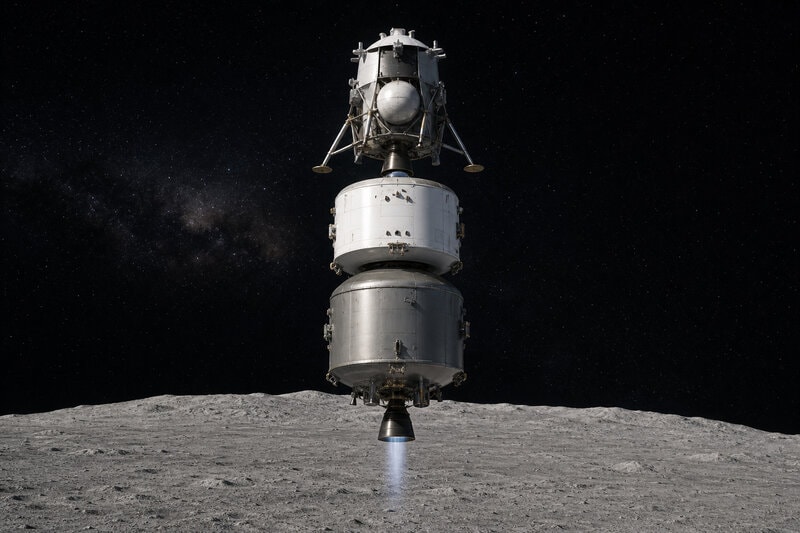
To compensate for deferring propellant transfer, Blue Origin has adopted a three-transfer-stage architecture to deliver its Blue Moon lander to the lunar surface for the 2028 mission. Rather than refueling a single vehicle in orbit, the mission will use three separate propulsion stages in sequence to accumulate the delta-v — the total velocity change needed to travel from Earth orbit to the lunar surface — that a single refueled vehicle would otherwise provide.
This approach trades architectural elegance for schedule confidence. It removes an unproven technology from the critical path while still meeting the mass and performance requirements NASA has established for a crewed landing. The tradeoff deserves to be stated plainly: more stages means more hardware, more interfaces between systems, and more potential failure points. Blue Origin has evidently calculated that those risks are better understood and more manageable within the 2028 window than cryogenic propellant transfer in microgravity would be.
Importantly, the deferred technology is not abandoned. Blue Origin’s architecture explicitly anticipates incorporating propellant transfer in later mission increments, meaning the 2028 configuration is designed as a stepping stone toward a more capable, eventually reusable lunar transportation system — not a permanent ceiling on what the vehicle can achieve.
SpaceX’s Starship HLS: A Different Philosophy, the Same Deadline
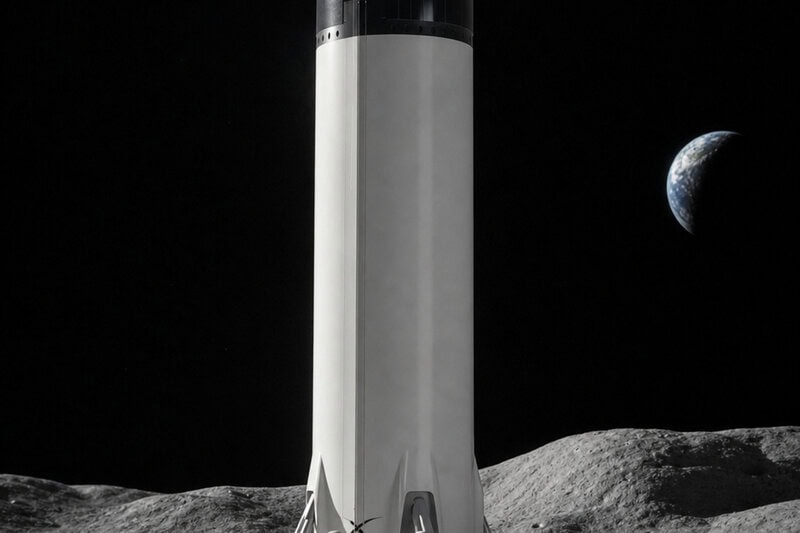
SpaceX has also revised its concept of operations for the 2028 mission, streamlining the Starship Human Landing System design in ways that represent a meaningful departure from its originally proposed architecture. Reporting on NASA, Blue Origin, and SpaceX accelerating lander development confirms that both companies have streamlined their designs in response to the shared imperative of reaching the Moon in 2028.
Starship HLS was always intended to rely on orbital propellant transfer — filling the lander’s tanks in low Earth orbit before departure for the Moon — making any simplification of that process a significant architectural decision with downstream effects across the entire mission sequence. Where Blue Origin is adding stages to sidestep a technology gap, SpaceX appears to be reducing complexity within its existing paradigm. The two approaches are philosophically distinct, reflecting each company’s different engineering culture and asset base, but they share a common driver: NASA has made clear that improving the probability of a 2028 crewed lunar landing, not preserving any particular technical approach, is the overriding program objective.
Why Cryogenic Propellant Transfer Is So Hard
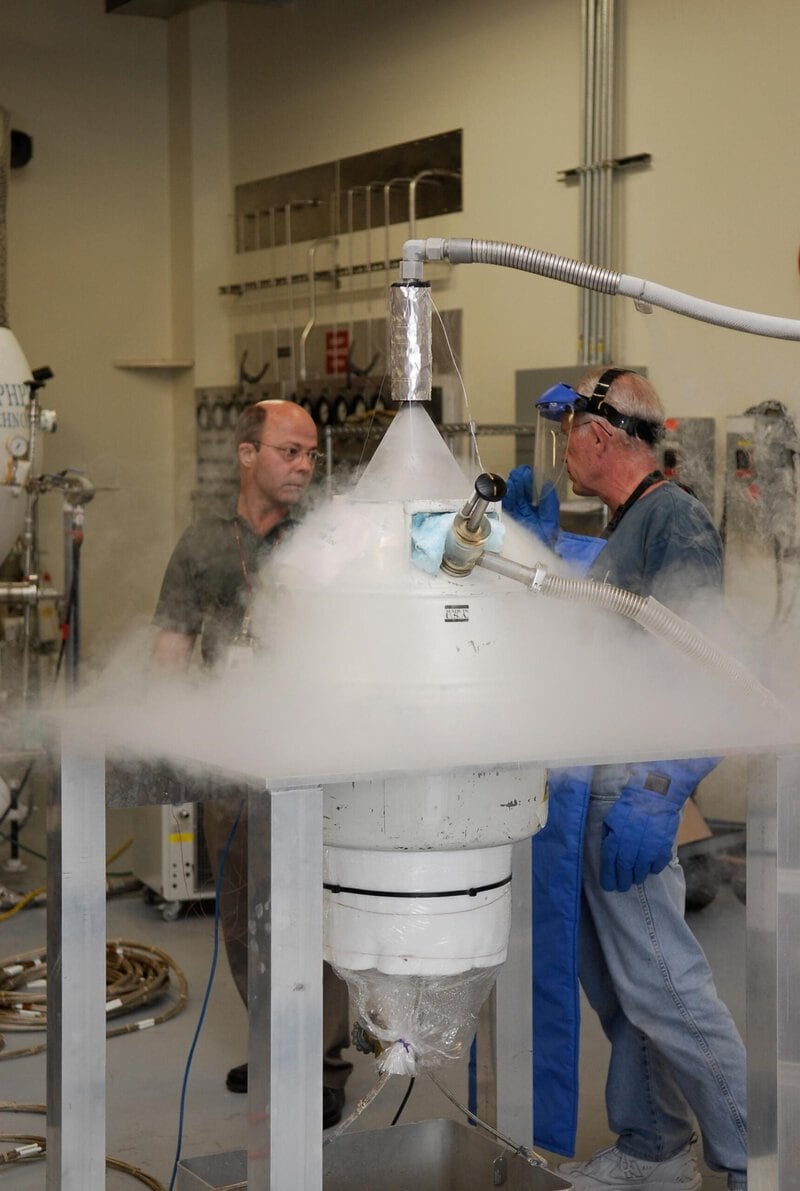
To understand why both companies are restructuring their missions around this one technology, it helps to understand what makes cryogenic propellant transfer so difficult. Cryogenic propellants — primarily liquid hydrogen, which must be kept below −253 °C, and liquid oxygen, which must stay below −183 °C — are among the most efficient rocket fuels available. They are also extraordinarily difficult to manage in space.
On Earth, gravity keeps liquid at the bottom of a tank and gas at the top, which is how fuel pumps and transfer lines know what they are moving. In microgravity, that separation disappears. Propellant forms floating blobs distributed throughout the tank, making it genuinely difficult to distinguish liquid from gas — a problem engineers call propellant management. Transferring fluid under those conditions between two spacecraft in orbit, while minimizing boiloff (the continuous evaporation of cryogenic fuel that occurs even in well-insulated tanks), is an engineering challenge that no crewed mission has ever had to solve at operational scale.
NASA has funded cryogenic fluid management research for years, and SpaceX demonstrated a small-scale propellant transfer during Starship testing, but neither effort has produced the flight-proven, human-rated system that a crewed lunar mission requires. Blue Origin’s decision to defer the technology for 2028 is not an admission of defeat — it is a textbook application of risk-informed scheduling, moving an immature capability to a later program increment rather than placing a crewed landing on its success.
NASA’s Role: Orchestrating Two Parallel Moon Missions
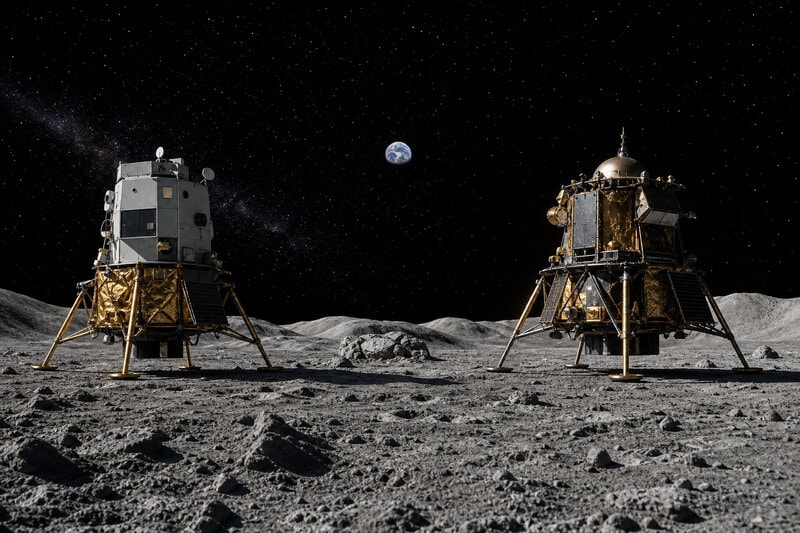
NASA’s strategy of maintaining two separate commercial lander programs simultaneously is explicitly designed to provide redundancy and competitive pressure. A technical or schedule failure at one company does not end the 2028 crewed lunar landing opportunity if the other lander remains on track. Coverage of NASA partners speeding lander development underscores that the agency is actively engaged in both programs, not watching passively as a contract administrator.
This dual-provider model is unprecedented in human spaceflight history. NASA is simultaneously funding, technically reviewing, and operationally integrating two different vehicles built by two competing companies for the same mission goal in the same year. The arrangement creates genuine scheduling complexity — covering crew assignments, Gateway space station integration, and launch vehicle coordination — that NASA’s Artemis program office must manage across contractors who are not required to share proprietary design information with each other. It is as much a project-management challenge as an engineering one.
What Success in 2028 Would Actually Prove
A successful 2028 crewed lunar landing would validate something beyond the mission itself. It would demonstrate that NASA can achieve Apollo-class objectives through fixed-price commercial contracts with private partners, rather than through the traditional cost-plus government development programs that produced the Saturn V and Space Shuttle. That proof of concept carries implications for every subsequent deep-space human exploration mission planned through the 2030s and beyond.
If both landers succeed in their streamlined 2028 configurations, NASA will have two independent, flight-proven human lunar landers — a strategic asset with no historical precedent. The decisions being made right now about which technologies to defer, which architectures to simplify, and which risks to accept in the name of schedule confidence are not merely engineering choices for a single mission. They will define the operational and economic boundaries of human activity on and around the Moon for at least the next decade, shaping what is possible long after the 2028 landing has become history.