
Roughly 3,000 feet beneath the ocean surface, in water so dark that sunlight is a distant memory, a pink-skinned shark hovers near the seafloor and detects the faint electrical field of a fish it cannot yet see — then, in less than one second, its entire jaw assembly slings forward out of its skull to close the gap. The goblin shark, Mitsukurina owstoni, possesses one of the most extreme jaw-projection mechanisms documented in any living vertebrate, and that remarkable anatomy is only the beginning of what makes this animal so scientifically arresting.
A Rare Relic of the Deep
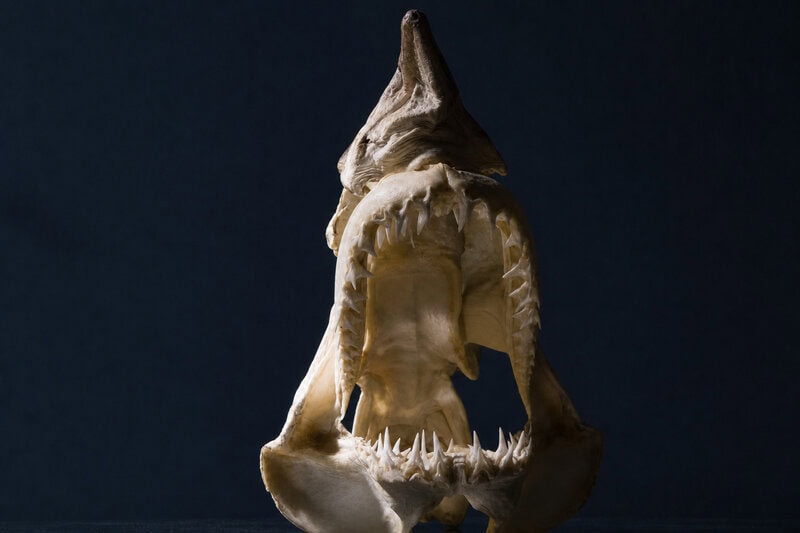
Mitsukurina owstoni was formally described to Western science in 1898 — making it one of the later large sharks to be catalogued, despite belonging to a lineage whose family, Mitsukurinidae, carries a fossil record extending back to the Cretaceous period. Adults typically reach 3 to 4 meters (roughly 10 to 13 feet) in length and present a body plan unlike anything else in the ocean: soft, flabby flesh; an unmistakable flat and elongated snout; and skin so thinly pigmented that the blood vessels beneath flush the animal a distinctive, almost fleshy pink.
That softness is not a flaw. It is a design feature shaped by millions of years of deep-sea pressure. The Smithsonian Ocean Portal notes that the goblin shark occurs near the seafloor in marine waters to depths of approximately 1,200 meters, with sightings clustering around submarine canyons and continental slopes across the Pacific, Atlantic, and Indian Oceans. Its low-density musculature reduces the energetic cost of simply remaining in the water column — a survival priority when food is scarce and the environment is unforgiving.
Scientists sometimes apply the informal label “living fossil” to the goblin shark because its body plan has remained recognizable across geological time. Evolutionary biologists working on elasmobranch evolutionary rates have been careful to note that the phrase can be misleading: the species continues to evolve, just within an environment — the deep sea — that has itself remained unusually stable. Stasis in form reflects stasis in selective pressure, not an absence of evolution.
The Slingshot Jaw: How the Strike Actually Works
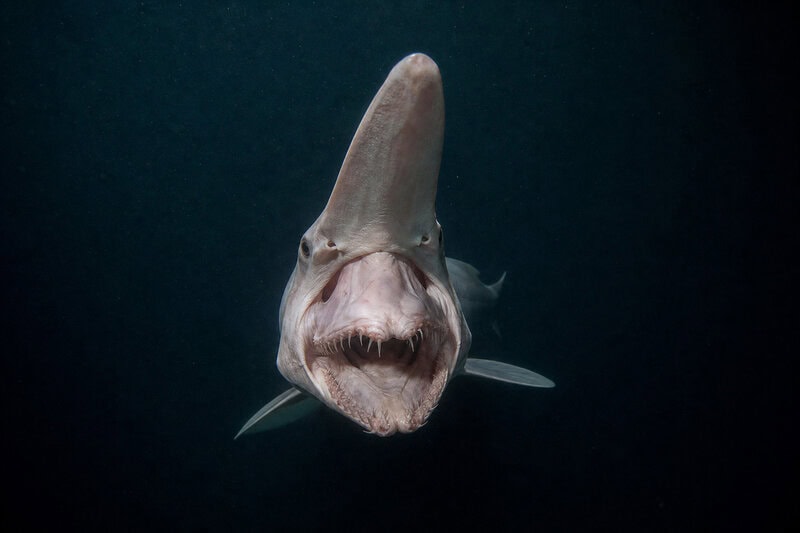
Most sharks have jaws suspended from the skull by elastic ligaments and cartilaginous struts — a system called cranial kinesis — that allows some degree of forward protrusion during a strike. The goblin shark’s version of this system is exceptionally lax, giving the jaw an unusually long travel distance when hyoid and jaw muscles fire simultaneously.
When a goblin shark strikes, it opens its mouth, rapidly expands its throat cavity to generate suction that draws prey inward, and simultaneously hurls the entire lower-and-upper jaw assembly forward. The jaw does not simply drop; it launches outward while suction does its work — a dual mechanism researchers in the peer-reviewed literature describe as “slingshot suction feeding.” High-speed footage analyzed by Kazuhiro Nakaya of Hokkaido University and colleagues, published in 2016 in the journal Scientific Reports, provided the first detailed kinematic data on this behavior in a live specimen, confirming that the strike unfolds in under one second and that the jaw can project forward by roughly 8.6 to 9.4 percent of the shark’s total body length — a proportional lunge no other known shark species matches.
It is important to be precise about what is established and what remains uncertain. The slingshot projection itself is well-documented. Whether goblin sharks routinely deploy this strike in the wild — versus relying more heavily on slow, stealthy approach — is an open question. Direct deep-sea behavioral observation of live specimens is extremely limited, and most of what science knows about goblin shark hunting behavior has been inferred from anatomy and the rare accidental footage that exists.
The Electric Snout: Sensing What Cannot Be Seen
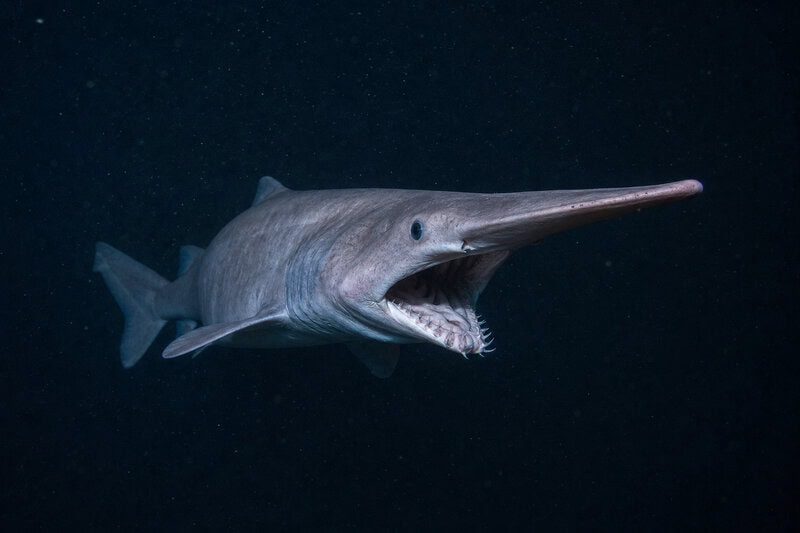
Before the goblin shark can strike, it must first locate prey in total darkness. Its long, flat, paddle-like rostrum is densely packed with ampullae of Lorenzini — gel-filled pores that detect the minute bioelectric fields all living animals generate. At 3,000 feet depth, where sunlight is effectively absent and ambient water pressure exceeds 90 atmospheres, electroreception is a far more reliable hunting sense than vision. The rostrum functions, in practical terms, as a forward-facing electromagnetic antenna.
Researchers at the Smithsonian Institution have noted that the proportionally elongated rostrum may allow goblin sharks to probe sediment and rocky outcroppings where prey — including teleost fish, squid, and crustaceans — shelter, effectively extending the shark’s sensory reach before the jaw ever needs to move. The snout is not decorative; it is the primary instrument of a predator that hunts by feel rather than sight.
A candid acknowledgment is warranted here: the precise neural processing behind goblin shark electroreception has not been studied in depth. Most inferences about how the animal uses its snout in practice are extrapolated from better-studied relatives such as the small-spotted catshark. The goblin shark’s sensory biology remains a genuine frontier of deep-sea science.
Pink Skin, Flabby Flesh, and the Physics of Deep-Sea Survival
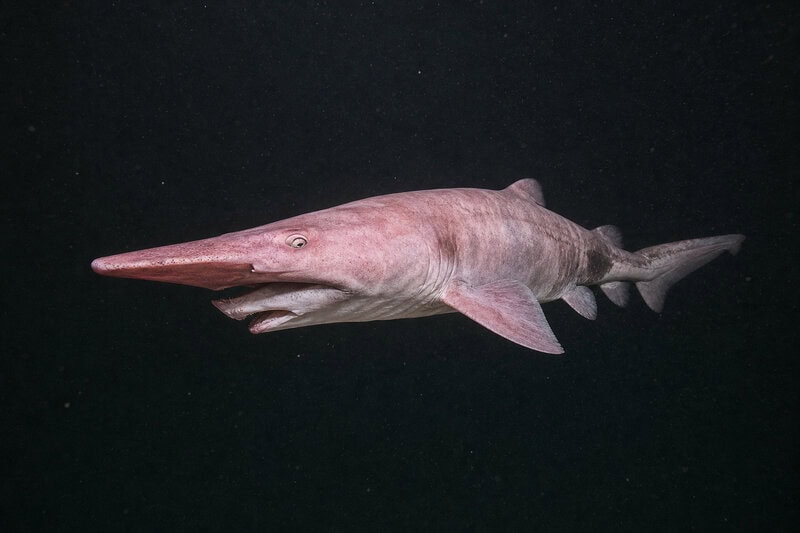
The goblin shark’s color is frequently misunderstood and deserves a precise explanation. The pink hue results from oxygenated blood in superficial capillaries showing through skin that lacks the dense pigmentation common in shallower-water species. In a habitat with no meaningful ultraviolet radiation and few visual predators, there is little evolutionary cost to thin, lightly pigmented skin — and some energetic savings in not producing melanin.
The soft, flabby body serves an equally specific function. Like many deep-sea sharks, Mitsukurina owstoni stores very low-density fatty acids in its muscle and liver tissue. This reduces overall body density and provides passive buoyancy — performing the role that the swim bladder performs in bony fish, but through tissue composition rather than a gas-filled organ. The animal can hover near the seafloor with minimal muscular effort.
The tail fin completes this energy-conservation picture. As the Australian Museum documents, the goblin shark’s tail fin lacks a lower (ventral) lobe — an asymmetrical design called heterocercal — which sacrifices sustained swimming speed in favor of a body plan suited to slow, ambush-oriented patrol. Every anatomical feature converges on the same strategy: hover efficiently, spend almost nothing on locomotion, then invest that saved energy in one fast, jaw-launching lunge when opportunity presents itself.
Why Goblin Sharks Are So Rarely Seen — and What That Costs Science
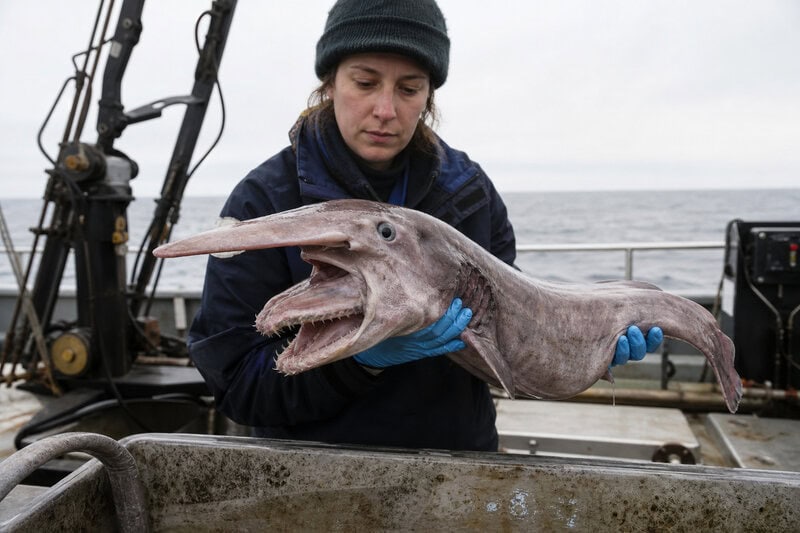
Since the goblin shark was first identified in 1898, fewer than 50 specimens have been examined by scientists, most of them accidentally caught in deep-sea fisheries nets. The U.S. Fish and Wildlife Service describes the goblin shark as one of the least-studied large sharks on Earth — a designation that carries real scientific consequences. Population size, breeding behavior, gestation period, and juvenile habitat are all essentially unknown, which makes conservation assessment genuinely difficult.
The International Union for Conservation of Nature (IUCN) currently lists the goblin shark as “Least Concern” but explicitly acknowledges data deficiency as a limiting factor in that assessment. “Least Concern” in this context does not mean the population is healthy; it means scientists lack the data to determine otherwise.
A 2007 mass bycatch event off Tokyo Bay — in which dozens of specimens were accidentally captured in deep-sea nets — provided the largest single dataset the species has ever generated and enabled the anatomical measurements researchers still cite today. The fact that a fishing accident constitutes a landmark scientific event illustrates how little deliberate study has been possible.
Advances in deep-sea autonomous underwater vehicles (AUVs) equipped with low-light cameras represent the most plausible near-term path to observing live goblin shark behavior. The goblin shark has been filmed in its native habitat on extremely rare occasions, and each such event has been treated by the research community as significant. Several marine biology laboratories have named dedicated behavioral observation as a research priority, though no long-term study of this kind has yet been published.
What the Goblin Shark Reveals About Deep-Sea Evolution
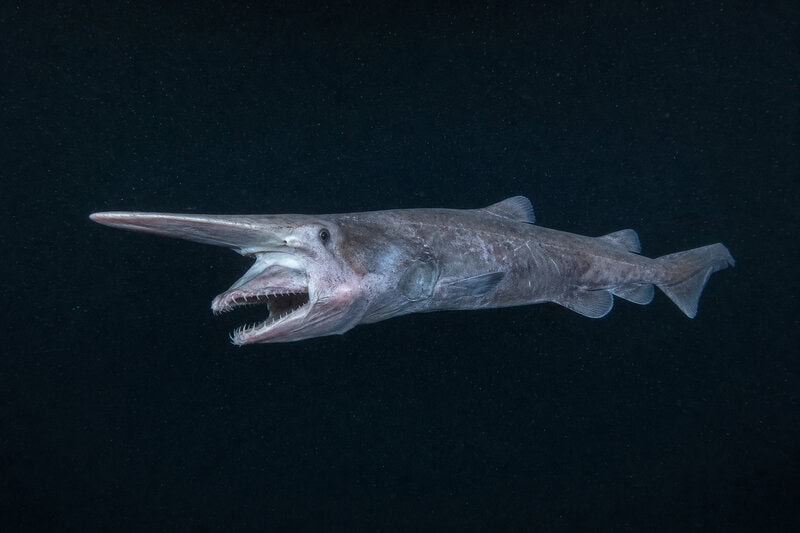
Every unusual feature of Mitsukurina owstoni — the projecting jaw, the electroreceptive snout, the buoyant fatty tissue, the asymmetric tail — is a coherent solution to the specific physical constraints of life near the deep seafloor. Taken together, these traits demonstrate a principle that runs through all of deep-sea biology: extreme environments do not produce freaks. They produce specialists whose apparent strangeness is a precise measure of how different their world is from the one humans inhabit.
The goblin shark’s anatomy has remained recognizable across geological time not because evolution stopped, but because the selective pressures of the deep ocean have remained unusually constant. Stable environment, stable form — a relationship that makes the animal invaluable to researchers studying the outer limits of vertebrate body-plan evolution. Shark researchers have characterized the goblin shark as a window into evolutionary solutions that no laboratory could design in advance.
The goblin shark is not an anomaly. It is a precise, finely tuned predator whose jaw launches out of its face because that is exactly what the deep ocean’s darkness, pressure, and scarcity of food demanded. As deep-sea exploration technology continues to improve, scientists expect that this animal — long known almost exclusively from dead or distressed specimens — will finally reveal the behavioral complexity that its extraordinary anatomy has long promised but never yet fully delivered.