
In 2020, a remotely operated vehicle descending through total darkness more than 4,000 meters below the ocean surface captured footage of a pale, gelatinous creature drifting through the abyss, gently flapping two fleshy appendages that looked, unmistakably, like ears. That animal was Grimpoteuthis — the dumbo octopus — currently recognized by scientists as the deepest-living octopus known to exist on Earth, and one of the most quietly extraordinary animals in the ocean.
A Ghost at 4,000 Meters
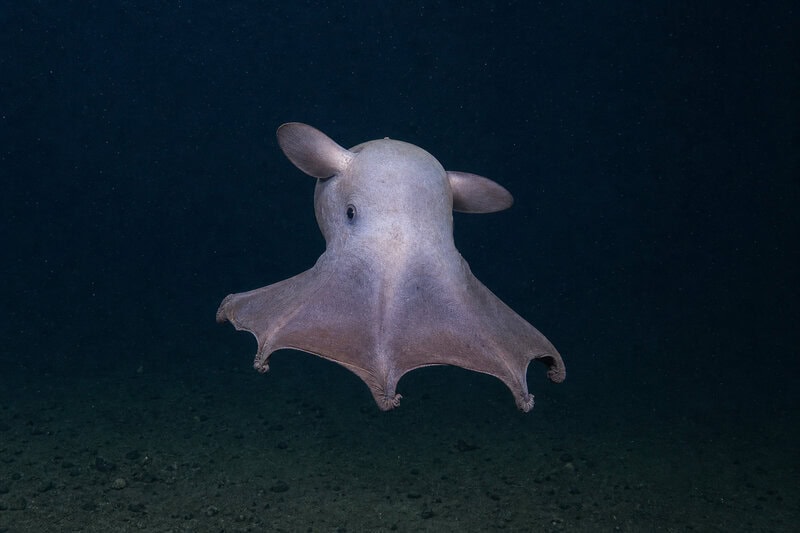
The stakes of living that deep are almost impossible to overstate. Below 4,000 meters, sunlight has been absent for so long it is meaningless as a concept. Water temperature hovers near 2-4 °C. Pressure exceeds 400 bar — roughly 400 times the pressure a human experiences standing at sea level — enough to implode unprotected equipment. Food, in any form, is vanishingly scarce. Every behavioral and anatomical feature of the dumbo octopus is, in effect, an engineering solution to an almost impossible problem. Understanding how this animal survives reframes what scientists thought was possible for soft-bodied life in the deep ocean.
What Is a Dumbo Octopus?
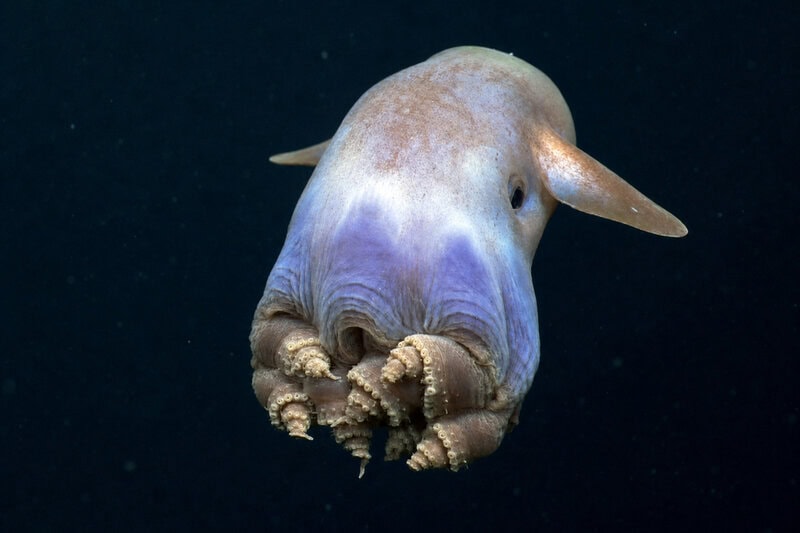
Grimpoteuthis is a genus within the order Octopoda, belonging to a subgroup known as umbrella octopuses (Cirrina), distinguished by a web of skin that stretches between their arms like an open umbrella. This trait sets them apart from the shallow-water octopuses most people picture — the reef-dwelling, ink-squirting variety that clings to rocky crevices in sunlit shallows.
The common name “dumbo octopus” refers to the pair of muscular, ear-like fins that protrude just above the animal’s eyes. The resemblance to the large-eared Disney cartoon elephant is visually arresting enough that the nickname became permanent. At least 13 species are currently assigned to the genus Grimpoteuthis according to taxonomic records maintained by the World Register of Marine Species, though deep-sea sampling gaps mean the true species count is almost certainly incomplete.
As the Natural History Museum notes, dumbo octopuses are considered elusive and rarely observed — known largely from specimens hauled up accidentally in deep trawl nets and from brief encounters captured by remotely operated vehicles. Direct, sustained observation of a living animal in its natural habitat remains an exceptional event.
Record Depths: How Far Down Do They Actually Go?
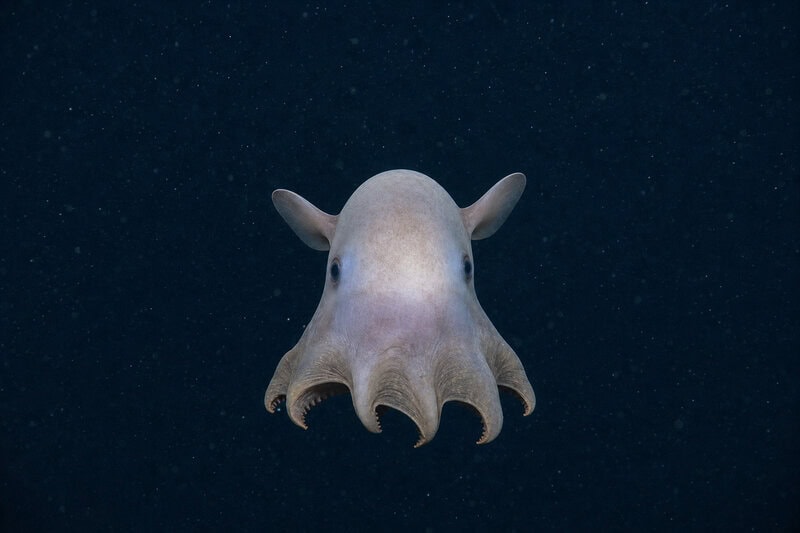
Dumbo octopuses are documented at depths of at least 4,000 meters, placing them firmly in the abyssal zone — the region of the ocean between roughly 3,000 and 6,000 meters, where conditions are among the most extreme on the planet. Some observations extend further still, into hadal depths: the deepest oceanic trenches, where the seafloor drops below 6,000 meters.
For a sense of scale, 4,000 meters is roughly equivalent to stacking four Burj Khalifas — the world’s tallest building — directly on top of one another. At that depth, a column of seawater presses down with approximately 400 bar of force. Researchers at the Monterey Bay Aquarium Research Institute (MBARI) have documented Grimpoteuthis specimens and behaviors at such depths, reinforcing the genus’s standing as the record-holder among octopuses for vertical range.
Scientists caution that the full depth range of Grimpoteuthis remains an open question. The deepest confirmed record may simply reflect the deepest point at which humans have managed to look — a meaningful distinction in a part of the ocean that remains almost entirely uncharted.
The Ear-Like Fins: More Than a Cute Feature
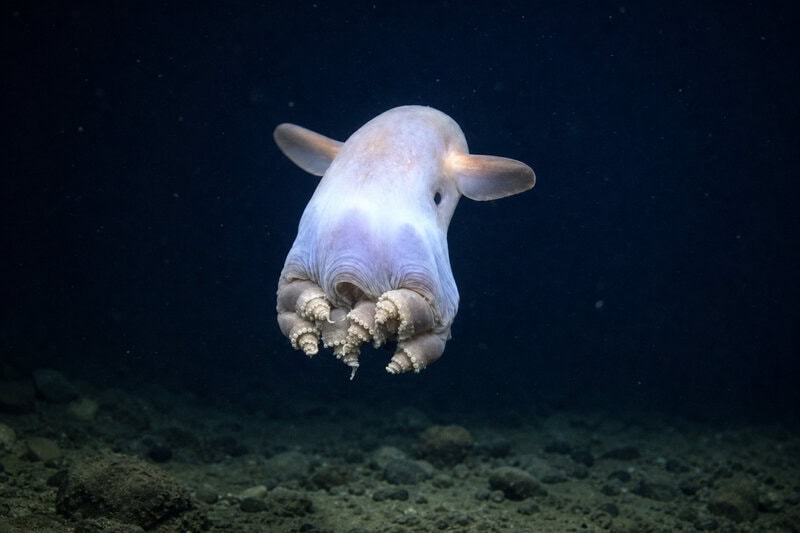
The fins that give the dumbo octopus its name are not decorative. They are the animal’s primary mode of locomotion, flapping in a coordinated rhythm to generate lift and forward thrust — a technique researchers call fin propulsion. This mechanism is metabolically cheaper than the jet propulsion used by most octopuses and squid, which works by forcibly expelling water through a muscular siphon. In an environment where caloric budgets are extremely tight, that efficiency is not a minor advantage. It may be the difference between survival and starvation.
The animal steers by adjusting the angle and timing of each fin independently, and can deploy its webbed arms as a secondary control surface, giving it fine-grained maneuverability without expensive muscular bursts. As Oceana describes, this combination of fin and arm control allows dumbo octopuses to hover, bank, and drift with a precision that belies how little energy they expend doing it.
This energy-conserving locomotion strategy mirrors convergent adaptations seen in other deep-sea animals — certain deep-water sharks, for instance, rely on low-energy gliding rather than active swimming. The pattern suggests that metabolic thrift is among the dominant selection pressures shaping life at abyssal depths, regardless of lineage.
Built for the Abyss: Anatomy Under Pressure
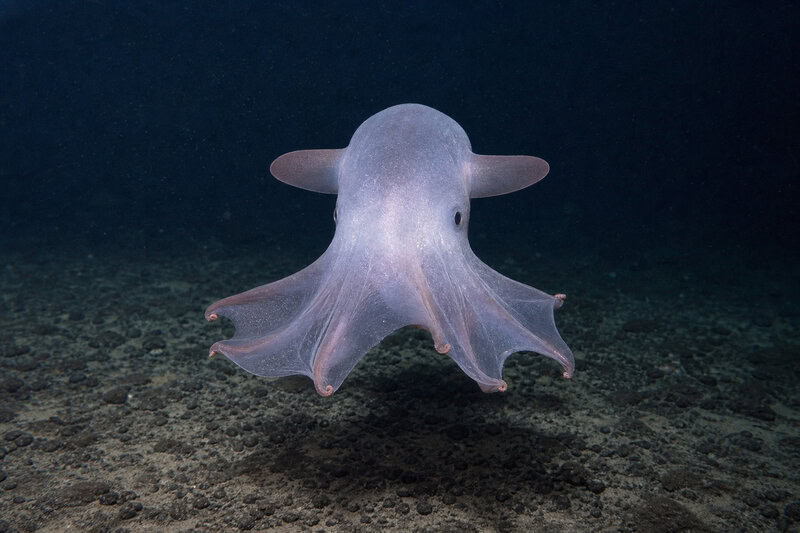
The dumbo octopus has a gelatinous, semi-translucent body — a structural choice with clear mechanical logic. A body whose density approximates that of the surrounding seawater experiences no net compressive force from the pressure above it. There is nothing rigid to crush. The softness is the adaptation.
Internally, Grimpoteuthis retains a vestigial shell reduced to a U- or V-shaped cartilaginous structure within the mantle. This remnant provides just enough internal scaffolding to anchor muscles and maintain body shape without the weight or rigidity penalty of a full shell — a compromise that works precisely because the animal never needs to resist external pressure.
The animal’s eyes are adapted to low-light conditions rather than total darkness. Deep-sea ROV footage shows pupils that respond to the artificial lights of submersibles, suggesting some capacity for vision. In its natural environment, however, the dumbo octopus likely relies more heavily on detecting bioluminescence — light produced by other organisms — and on chemoreception, the ability to detect chemical signals in the water.
Because metabolic rate decreases with depth and temperature, dumbo octopuses are believed to grow slowly and live longer than shallow-water octopus species. Precise lifespan data, however, remain sparse. Almost everything known about their physiology comes from a small number of preserved specimens and brief video encounters — a dataset that scientists consistently describe as insufficient for firm conclusions.
Diet: Opportunistic and Patient
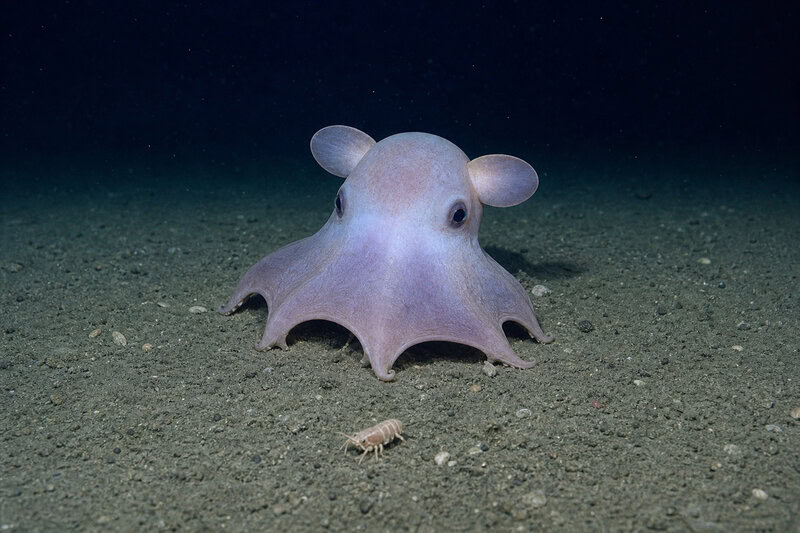
Stomach-content analyses of trawl-caught specimens indicate that dumbo octopuses are opportunistic predators. They consume small crustaceans, worms, and other invertebrates found along the seafloor or in the water column just above it — prey that is itself rare at those depths. The hunting strategy appears to be patient and deliberate rather than energetically aggressive, consistent with the animal’s broader economy of effort. Prey is typically swallowed whole rather than torn apart, which may further reduce the energy cost of feeding.
Reproduction: An Unusual Strategy
Reproduction in Grimpoteuthis is unusual among octopuses. Females appear to carry eggs at multiple stages of development simultaneously — a strategy called asynchronous brooding. Rather than coordinating a single large spawning event, females may deposit clutches incrementally, whenever a suitable hard substrate presents itself on the otherwise largely featureless abyssal seafloor. Males transfer sperm packets called spermatophores using a modified arm tip, but direct observation of mating has essentially never been recorded in the wild.
This reproductive flexibility may be an adaptation to the scarcity and unpredictability of suitable egg-laying sites at abyssal depths, where exposed rock or coral rubble is far less common than in shallower environments. It is one of several features that distinguish Grimpoteuthis from its shallow-water relatives in ways that go well beyond depth alone.
Why the Dumbo Octopus Matters Beyond Its Novelty
Grimpoteuthis represents a genuine test case for the physiological ceiling of soft-bodied animal life. If an octopus — a group not traditionally associated with extreme-depth adaptation — can sustain a complex nervous system and active behavior past 4,000 meters, it expands scientific models of where cognition and mobility are possible under pressure. The dumbo octopus demonstrates that the architectural constraints on animal life in the deep ocean are less restrictive than was once assumed.
The animal is also a potential sentinel for deep-sea ecosystem health. Because it feeds on benthic invertebrates near the seafloor, changes in its distribution or population could signal disruptions to abyssal food webs — disruptions that may be driven by deep-sea mining operations targeting seafloor mineral deposits, or by climate-driven shifts in oxygen levels at depth.
Conservation status, however, is difficult to assign with confidence. The International Union for Conservation of Nature (IUCN) lists most Grimpoteuthis species as Data Deficient — meaning not enough is known to evaluate whether they are threatened. As the Bureau of Ocean Energy Management has noted, nearly every behavioral or ecological claim about Grimpoteuthis carries the caveat that sample sizes are small. That Data Deficient classification is itself a finding: it reflects how little systematic surveying of hadal and abyssal zones has been conducted.
What Comes Next: The Science Still to Be Done
Future autonomous underwater vehicle missions — particularly those equipped with environmental DNA sampling, a technique that detects genetic material shed by organisms into surrounding water — are expected to dramatically improve population estimates and distribution maps. Better acoustic tagging methods and higher-resolution imaging systems are also expanding what ROV encounters can reveal about behavior. The Aquarium of the Pacific describes the dumbo octopus as a creature still largely defined by what remains unknown about it. The next generation of deep-ocean survey tools may finally begin to change that, turning a ghost glimpsed in passing into an animal that science can actually start to understand.
Among the strange deep-sea creatures that have emerged from the abyss into scientific attention in recent decades, few are as structurally elegant or as poorly understood as Grimpoteuthis. It has survived in one of Earth’s least hospitable environments for millions of years, without ever once seeing sunlight — and it has done so by being, in almost every measurable sense, exactly as strange as it looks.