
More than 100 million years ago, somewhere above a warm shallow sea covering what is now the Australian Outback, a pterosaur made a fatal descent toward the water — and the evidence of what happened next has survived, locked inside a single slab of Queensland rock, long enough for scientists to read it in extraordinary detail. Neutron scans of that fossil have now revealed a three-creature predation chain frozen in sequence: a flying reptile inside the stomach of a marine hunter, and bite marks on that marine hunter’s bones pointing to something far larger still.
A Meal Frozen in Stone
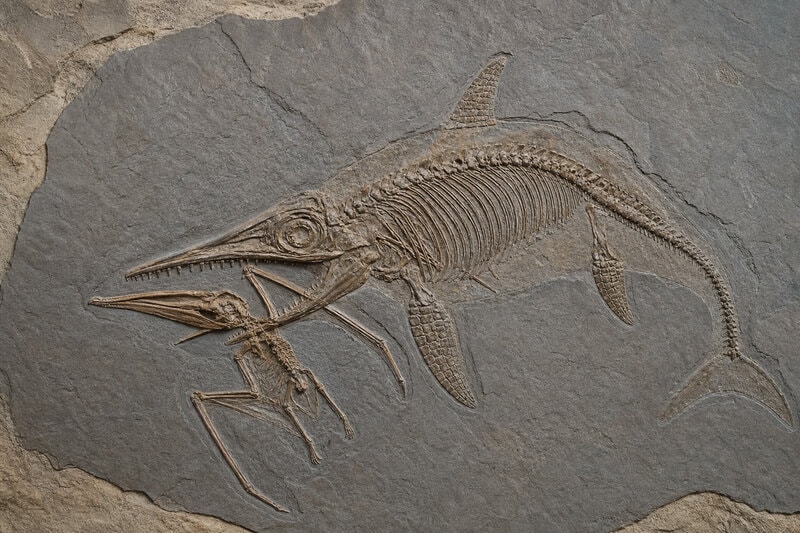
The specimen, recovered from the Australian Outback, preserves what researchers describe as world-first evidence of an ichthyosaur consuming a pterosaur — a finding that compresses a violent sequence of Cretaceous ocean events into a single, readable fossil. According to Live Science, neutron scans of the ichthyosaur’s stomach cavity revealed the remains of fish, cephalopods, and — most remarkably — a pterosaur, the first confirmed fossil record of that specific predator-prey interaction.
The ichthyosaur, however, never finished digesting its meal. Crushing bite marks etched into its exterior bones point to a Kronosaurus — a massive pliosaur among the largest marine reptiles of the Cretaceous period — as the predator that ended the ichthyosaur’s life shortly after its own opportunistic strike. The result is a three-link predation chain, pterosaur to ichthyosaur to Kronosaurus, documented simultaneously in a single specimen — a circumstance paleontologists describe as exceptional even by the already-demanding standards of fossil preservation.
Meet the Players: Ichthyosaurs, Pterosaurs, and Kronosaurus
Each of the three animals in this fossil represents a distinct ecological domain of the Cretaceous world, and understanding what they were clarifies why their intersection was both plausible and, until now, undocumented in the fossil record.
Ichthyosaurs — whose name translates roughly as “fish lizards” — were fully marine reptiles that superficially resembled modern dolphins in body shape. Despite living entirely in the sea, they were air-breathing, gave birth to live young rather than laying eggs, and functioned as apex hunters across many Mesozoic ocean ecosystems. They were fast, visually acute predators well suited to pursuing prey near the ocean surface.
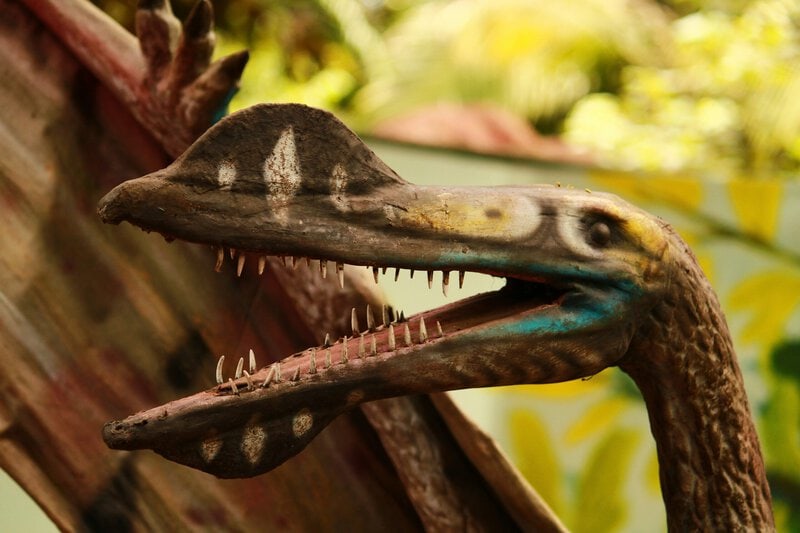
Pterosaurs were flying reptiles — not dinosaurs, a distinction paleontologists consistently emphasize — that dominated Cretaceous skies and are well documented as coastal and marine foragers. Many pterosaur species hunted fish and other marine prey at the water’s surface, which is the ecological detail that explains how one ended up within striking distance of a large marine predator operating just beneath it.
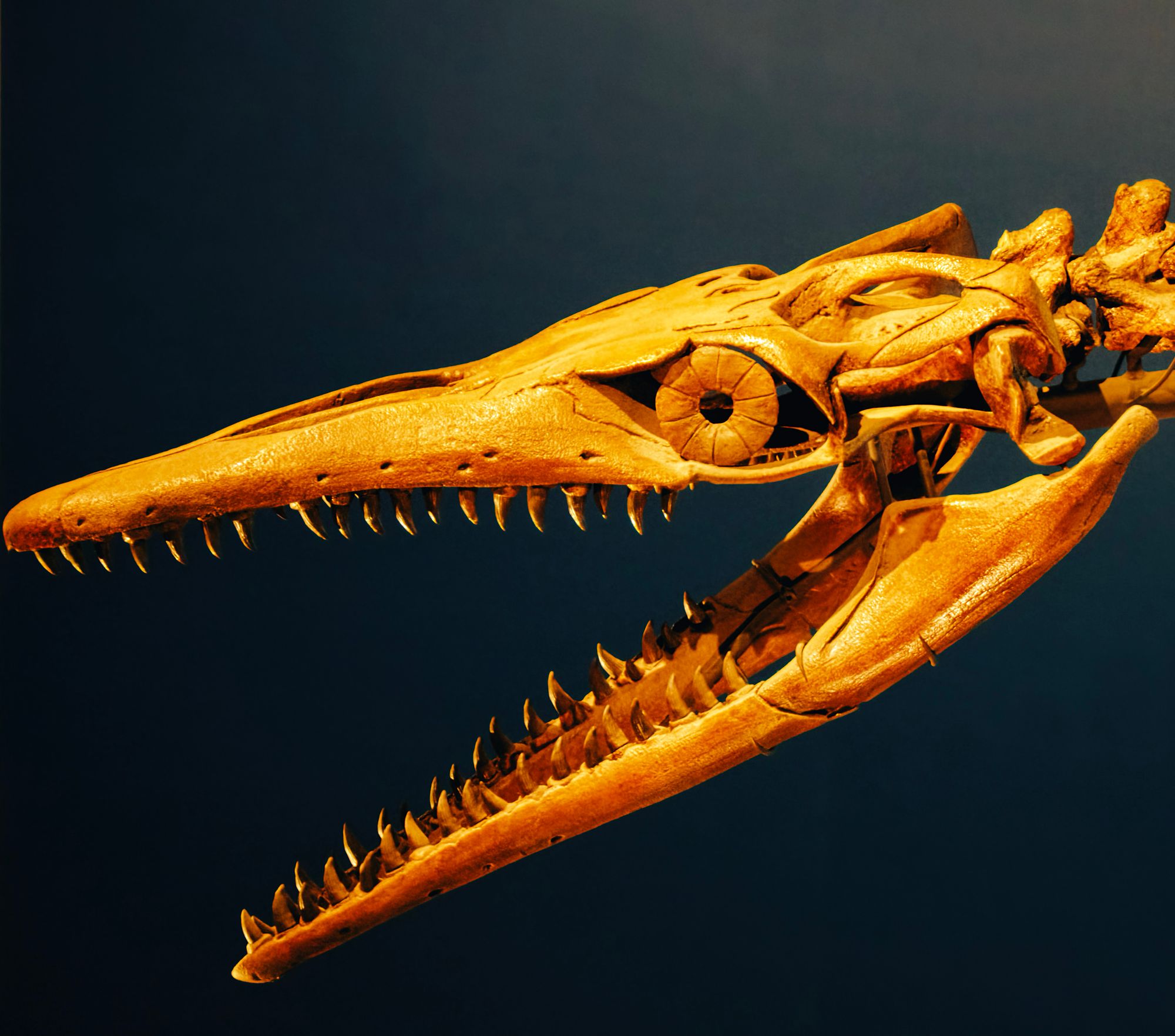
Kronosaurus was among the largest pliosaurs — a group of short-necked, large-headed marine reptiles — known from the Cretaceous period. Its skull is estimated to have reached nearly two meters in length, and its teeth were built for bone-crushing force. The geometry and spacing of the bite marks on the ichthyosaur fossil are consistent with jaw-width and tooth-size estimates derived from known Kronosaurus specimens recovered from the same region of Australia, according to Discover Magazine.
The Cretaceous period, spanning roughly 145 to 66 million years ago, saw warm, shallow seas covering much of what is now inland Australia. That environment placed aerial, surface, and deep-water predators in direct ecological proximity — the geographic and biological context that makes a three-way encounter of this kind scientifically coherent, if extraordinarily rare to capture in stone.
How Neutron Scanning Unlocked the Fossil’s Hidden Record
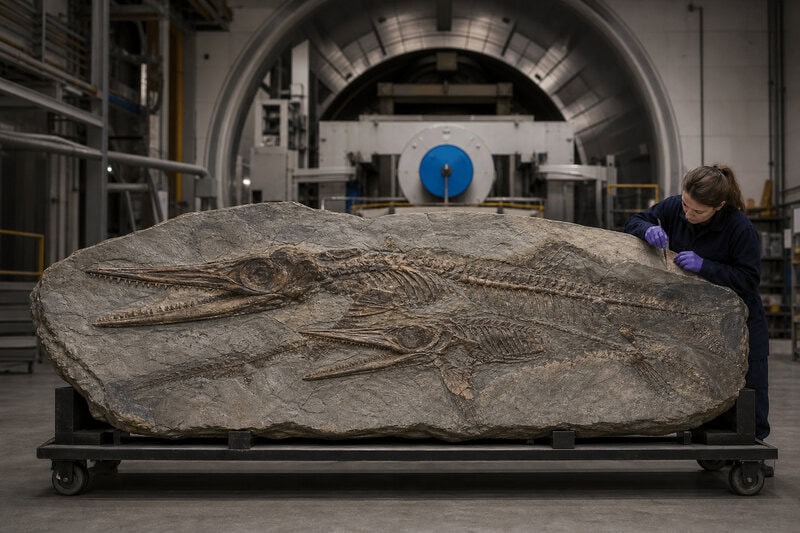
Initial visual examination of the specimen suggested a well-preserved ichthyosaur — significant in itself — but gave no clear indication of what lay inside. The breakthrough came through neutron scanning, a non-destructive imaging technique that uses beams of neutrons to penetrate dense rock and reveal subtle differences in internal density without physically disturbing the specimen.
Where conventional X-ray imaging can struggle against the mineral-dense matrix surrounding a fossil, neutron scanning distinguishes organic material from surrounding rock with considerably greater clarity. As detailed by the Times of India, those scans identified fish and cephalopod remains consistent with known ichthyosaur diets, then flagged anomalous bone structures that researchers identified as pterosaur skeletal material.
That identification — pterosaur bones within the stomach cavity — constitutes the world-first evidence of this predator-prey pairing in the fossil record. Separate analysis of bite mark geometry on the ichthyosaur’s exterior bones pointed specifically to Kronosaurus as the likely attacker, based on comparisons with known specimens. The two lines of evidence together — internal stomach contents and external attack marks — allowed researchers to reconstruct a sequence of events rather than a single frozen moment.
The role of neutron scanning in this discovery carries a broader implication for paleontology: museum collections worldwide hold specimens studied for decades using older techniques. Non-invasive imaging technologies are now capable of revealing biological data those earlier examinations could not access, effectively reopening the scientific file on fossils long considered fully understood.
Reading the Predation Chain: What the Evidence Actually Shows
The sequence paleontologists reconstruct from this specimen is inferential but well-supported by multiple independent lines of physical evidence. The ichthyosaur, researchers propose, caught and swallowed the pterosaur — most likely one that had landed on or was skimming across the water’s surface — and was then attacked by a Kronosaurus before digestion could erase the evidence of its last meal.
Preservation of stomach contents in marine reptile fossils is rare but documented in the paleontological record. For the pterosaur bones to survive inside the ichthyosaur rather than being chemically broken down, the ichthyosaur must have died and been buried in sediment with unusual speed. That rapid burial is consistent with the violent circumstances the bite marks suggest: an animal killed suddenly and sinking to the seafloor before scavengers or decomposition could disperse the remains.
Researchers are careful to frame the identity of the larger predator as a well-evidenced interpretation rather than a confirmed fact. No Kronosaurus bones were recovered at the same location. The attribution rests on the physical characteristics of the bite marks and their match to known Kronosaurus anatomy — a sound methodological basis, but one that preserves appropriate scientific uncertainty. As the Everything Dinosaur analysis notes, the specimen provides world-first documentation of all three levels of this predation interaction preserved simultaneously.
Why a Flying Reptile Ended Up in an Ocean Predator’s Stomach
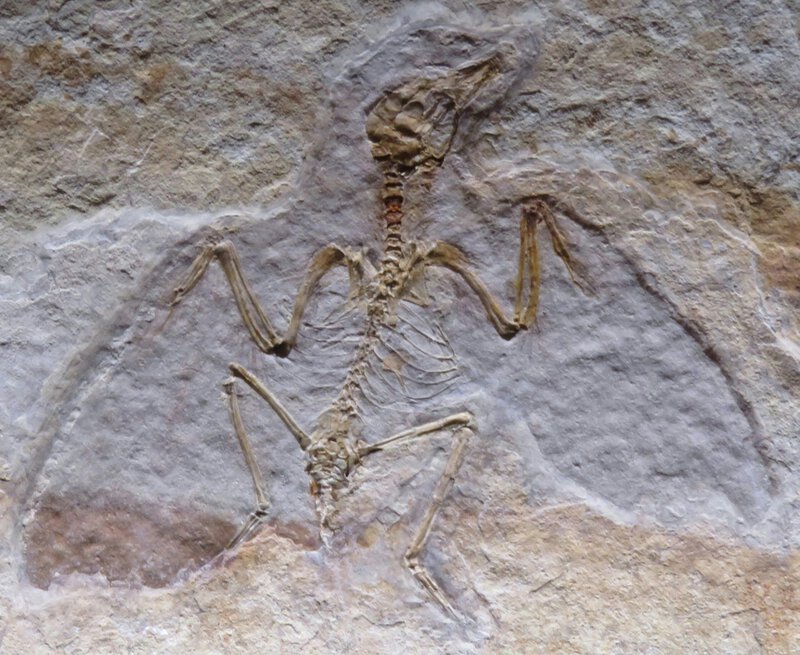
The presence of a pterosaur in an ichthyosaur’s stomach is surprising only if pterosaurs are imagined as exclusively aerial creatures. The fossil record does not support that picture. Many pterosaur species are documented as fish-eaters and coastal foragers, with skeletal anatomy adapted for plunge-diving or surface-skimming — behaviors that routinely brought them into direct contact with whatever was patrolling the water below.
A pterosaur landing on the surface, injured in a dive, or caught in adverse weather would have represented a relatively easy opportunistic target for a large, fast-moving ichthyosaur. The encounter need not have involved any unusual hunting behavior on the ichthyosaur’s part — surface prey was surface prey, regardless of whether it ordinarily lived in the air.
This discovery adds the first concrete fossil evidence to a long-standing hypothesis that pterosaurs, despite their aerial advantage, faced meaningful predation pressure from marine reptiles at the water’s surface. Prior to this specimen, that relationship was inferred from anatomy and habitat overlap. The Queensland fossil moves it from plausible inference to documented fact — a meaningful shift in the evidentiary standard the field can now apply.
Whether this type of encounter was common or exceptional in Cretaceous Australia remains genuinely unknown from a single data point. Researchers describe the fossil as a rare preserved snapshot of an interaction that likely occurred regularly but almost never survived the conditions necessary to enter the fossil record at all.
What This Fossil Changes — and What Remains Open
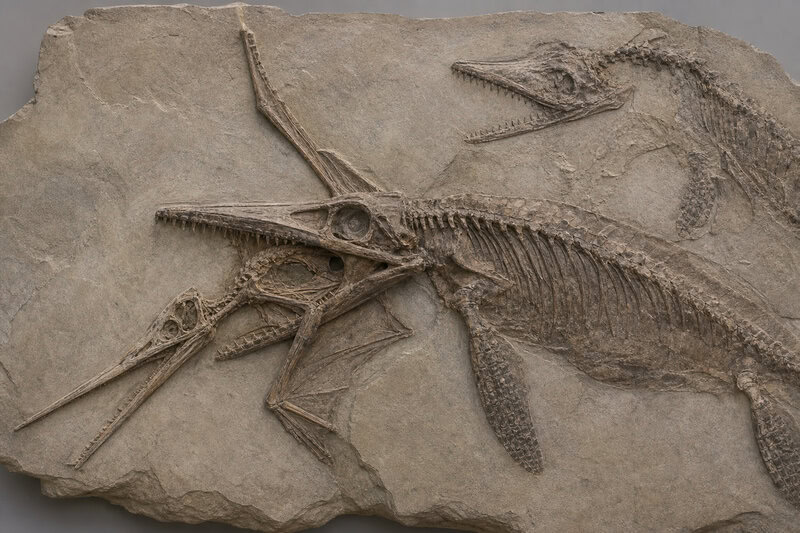
The find demonstrates that Cretaceous food webs in Australia’s ancient inland sea were more complex and vertically integrated than previously confirmed — linking the aerial, surface, and deep-water ecological layers in a single documented predation sequence. That vertical connectivity had been theorized from habitat reconstructions, but this fossil provides the first direct physical evidence of all three layers interacting.
Several important questions remain unresolved. The exact species of ichthyosaur in the specimen has not been confirmed in available reporting, and establishing its taxonomic identity could clarify whether this predatory behavior was characteristic of a particular lineage or broadly opportunistic across the group. Whether the pterosaur was actively hunted, taken as incidental surface prey, or even scavenged as an already-dead animal also remains open; stomach position and bone condition revealed by the neutron scans may offer future analytical opportunities, but have not yet settled the question.
Researchers also note that the find strengthens the scientific case for continued paleontological survey of Australia’s Outback, a region whose Cretaceous marine deposits remain comparatively underexplored relative to their demonstrated scientific yield. The inland sea that once covered this landscape has left behind a record that continues to generate discoveries capable of revising established understanding of Mesozoic ecosystems.
This fossil is ultimately a reminder of both the power and the limits of what stone can preserve. The ancient marine reptile fossil record captures violent, complex moments from more than 100 million years ago — but only rarely, and never completely. The Queensland specimen is extraordinary precisely because it preserved so much. What it leaves unanswered is a fair measure of how much the past still withholds, and why paleontologists continue to look.