
Within weeks of joining a study that paid her small cash rewards for hitting earlier bedtimes, a college sophomore who had been running on roughly five hours of sleep a night watched her exam scores climb. Her experience was not an anomaly — it was a data point in an emerging body of research suggesting that the single most overlooked academic intervention on campus may happen not in the library, but in bed.
The Sleep Crisis on Campus Is Bigger Than Most Realize
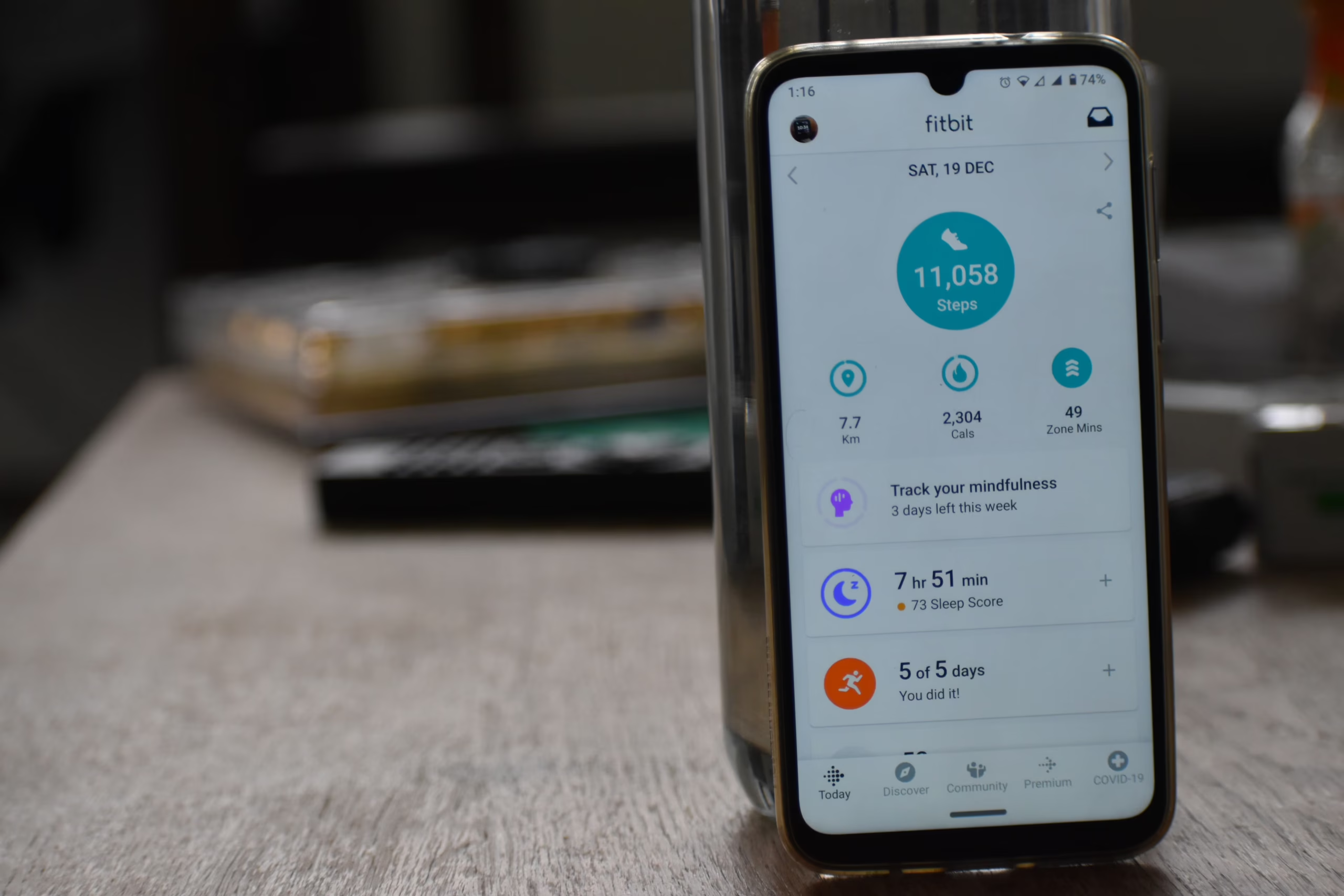
Using Fitbit sleep trackers to move beyond self-report surveys, researchers found that college students sleep an average of just 6.5 hours a night — well below the seven to nine hours the CDC recommends for adults. That gap is not merely inconvenient. Students who receive fewer than six hours of sleep experience a pronounced decline in academic performance, and the data show that negative outcomes accumulate the longer students remain below that floor.
Research increasingly shows that college students are not getting enough sleep, and that the deficit has a measurable negative impact on their grades — a pattern documented across dozens of institutions and study designs. What the early wave of observational research could not cleanly establish, however, was causation. Better quality, longer duration, and greater consistency of sleep all correlated with better grades, but correlation leaves open the possibility that high-achieving students simply have more time and discipline to sleep. To answer whether more sleep would cause improvement, researchers needed an intervention — a way to experimentally shift sleep behavior and watch what happened to academic outcomes.
What the Incentive Study Actually Did — and Found

The intervention that emerged was elegantly simple: pay students modest financial rewards for consistently going to bed earlier and extending their nightly sleep, then track compliance with wearable devices. According to a study organizer, the financial incentives successfully shifted bedtimes earlier and produced significantly longer nightly sleep, demonstrating that modest economic nudges can override the entrenched night-owl habits that campus culture tends to reinforce.
The academic results followed. Students who extended their sleep showed improved academic performance, consistent with the broader body of evidence linking sleep duration, quality, and consistency to grades. Critically, the study focused on college students without reported sleepiness or depression, which means the findings speak most directly to the general student population. Students managing diagnosed sleep conditions or mood disorders may face different barriers, and results may not generalize to those groups without further targeted research.
One particularly telling secondary finding: sleep extension significantly improved participants’ scores on the Profile of Mood States (POMS), a validated psychological instrument used to measure emotional well-being. That result points to a plausible mediating pathway — rested students may perform better academically not only because their memory consolidates more efficiently, but because they are emotionally steadier, less reactive to stress, and better able to sustain attention across a two-hour lecture or a difficult problem set. This mood dimension is frequently underemphasized in coverage of sleep and grades, and it deserves more weight.
The Neuroscience: What Sleep Actually Does to a Learning Brain

To understand why an extra hour of sleep can move the academic needle, it helps to understand what the brain is doing during that hour. Sleep is not passive rest. It is, at the neurological level, an active maintenance and consolidation process — one that no waking state can replicate.
The central mechanism is memory consolidation: during sleep, particularly during slow-wave deep sleep and REM (rapid-eye-movement) sleep, the brain replays neural activity patterns formed during waking hours, strengthening synaptic connections and converting fragile short-term memories into durable long-term storage. A student who reads a chapter on organic chemistry before bed and then sleeps a full night retains significantly more of that material than one who stays up to read a second chapter and sleeps four hours — a counterintuitive finding that sleep researchers have replicated repeatedly in laboratory settings.
Sleep also activates the glymphatic system, the brain’s dedicated waste-clearance network. During sleep, cerebrospinal fluid flushes through channels in brain tissue, removing metabolic byproducts that accumulate during waking neural activity. Sleep, in other words, is not just memory storage; it is also neural housekeeping that keeps the brain’s underlying hardware running cleanly.
REM sleep cycles are disproportionately concentrated in the final one to two hours of a full night’s sleep. Cutting sleep short — as most college students routinely do — therefore truncates the stage most critical for procedural learning, problem-solving, and creative reasoning. A student sleeping five hours is not simply getting five-ninths of the benefit of nine hours; they may be systematically eliminating the cognitively richest portion of the sleep cycle.
Why Consistency and Quality Matter as Much as Duration
Sleep duration, quality, and consistency all independently influence college students’ grades — meaning that irregular sleep schedules can undermine performance even when total hours look adequate on paper. This finding challenges the common student strategy of sleeping four hours on weekdays and catching up with ten hours on weekends.
That pattern produces what sleep researchers call social jet lag: a misalignment between the body’s circadian rhythm — its internal 24-hour clock, governed by hormonal and neurological signals — and the sleep schedule a person actually keeps. Shifting sleep timing dramatically between weekdays and weekends disrupts the consistent hormonal environment that memory consolidation and attentional control depend on, impairing academic function in ways that extra weekend hours do not fully repair.
Quality is a separate variable from duration. Fragmented sleep — even sleep that totals seven hours — suppresses slow-wave stages, reducing memory-consolidation benefit regardless of how long a student remains in bed. Alcohol, which is prevalent on many campuses, is a particularly effective suppressor of REM sleep even when consumed in moderate quantities. Screens before bed delay sleep onset by suppressing melatonin production. Noisy residence-hall environments fragment sleep architecture in ways students may not consciously notice but that wearable trackers capture clearly.
The compounding dimension of sleep loss makes the problem more serious than a single bad night suggests. Because cognitive deficits accumulate when students receive less than six hours repeatedly, a week of inadequate sleep can erode academic standing in ways that require multiple nights of recovery to reverse — and most college students never fully enter recovery mode before the next exam cycle begins.
What’s Established, What’s Emerging, and What Remains Contested
The link between chronic sleep deprivation and impaired cognitive function, mood, and academic performance is well-established across laboratory and real-world studies. This is not a fringe or preliminary finding — it reflects scientific consensus built across decades of research in both controlled sleep-lab settings and large-scale naturalistic studies using objective wearable tracking.
What is genuinely emerging — and should be treated as promising rather than proven — is the use of financial incentives as a behavioral intervention to improve student sleep. The current results are encouraging, but the field needs larger, longer-term replications across diverse student populations before incentive programs can be broadly recommended as institutional policy. One well-designed study is a strong signal, not a mandate.
What remains incompletely resolved is the precise causal pathway from sleep to grades. Memory consolidation, mood regulation, sustained attention, and reduced impulsivity likely all contribute — but their relative weights, and how they interact with individual differences in sleep need, course difficulty, and life stress, are still being disentangled. Some researchers also caution against one-size-fits-all duration targets, noting that optimal sleep varies meaningfully across individuals and that rigid prescriptions can generate their own anxieties.
Methodological transparency matters here. Studies relying on student volunteers introduce self-selection bias — participants who agree to a sleep study may already be more health-conscious than average. Short intervention windows, while logistically necessary, may not capture longer-term behavioral change or the full arc of academic impact. Real-world academic environments also introduce confounders — part-time jobs, family obligations, financial stress, course load — that controlled studies cannot fully neutralize. Acknowledging these limits is not a reason to dismiss the findings; it is a reason to replicate and extend them.
Practical Takeaways — and Why Institutions Should Pay Attention

For individual students, the most evidence-backed interventions remain unglamorous: consistent sleep and wake times every day of the week, limiting screen exposure in the hour before bed, avoiding alcohol as a sleep aid, and treating sleep as a non-negotiable academic input rather than a lifestyle luxury that yields to deadlines. Small, consistent shifts toward earlier bedtimes compound quickly — the circadian system responds to gradual change even when it resists abrupt disruption.
For universities, the incentive study raises a genuinely provocative policy question. If modest financial nudges can shift student sleep behavior enough to produce measurable grade improvements, could wellness programs, residence-hall design, or academic scheduling incorporate structured sleep support without becoming paternalistic? Later start times for morning classes, quieter residence-hall environments, and wellness stipends tied to health behaviors are all levers institutions already hold. This research gives those conversations a stronger empirical foundation — though administrators should wait for broader replication before committing to large-scale programs modeled on a single intervention study.
For researchers, the wearable-device methodology used in Fitbit-based studies offers something self-report surveys never could: scalable, objective, longitudinal sleep data collected in students’ actual environments. That methodological infrastructure opens the door to research designs that track how sleep behavior evolves across a full academic year — or a full undergraduate career — rather than a single semester window.
The synthesis that emerges from this body of work is worth stating plainly: sleep is not a lifestyle choice that competes with studying. At the neurobiological level, sleep is studying. The brain consolidates what it has learned only when given adequate, consistent, high-quality rest — and no amount of caffeine, cramming, or extra-credit effort can replicate what happens in those final, REM-rich hours of an uninterrupted night’s sleep. The incentive study did not discover that truth, but it offered something equally valuable: early evidence that colleges may be able to help students act on it.