
On February 25, 1993, NASA astronaut Barbara Morgan crouched beside a group of San Luis Obispo County students and watched as a child — not a technician, not a teacher — pressed the launch controller and sent a student-built rocket into the California sky. That single moment, engineered by small hands and young minds, illustrates something education research has spent decades confirming: the experience of doing science engages children in ways that simply hearing about it never can.
The NASA Visit: What Actually Happened in San Luis Obispo
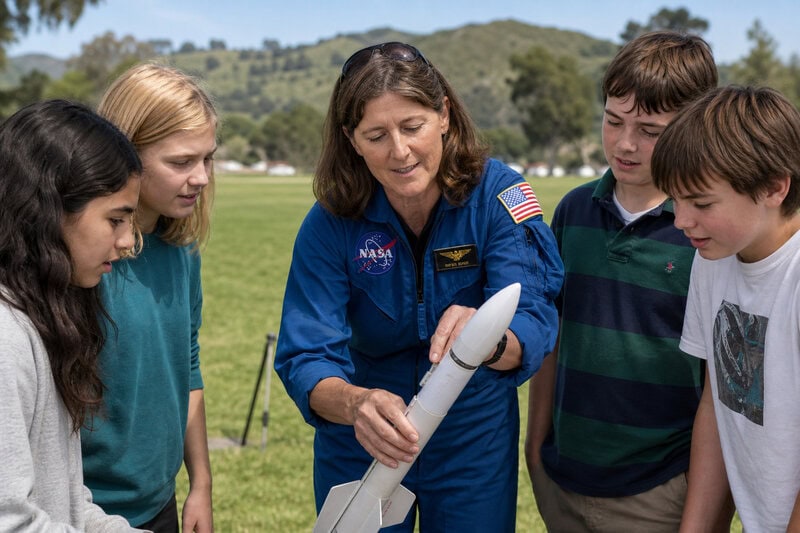
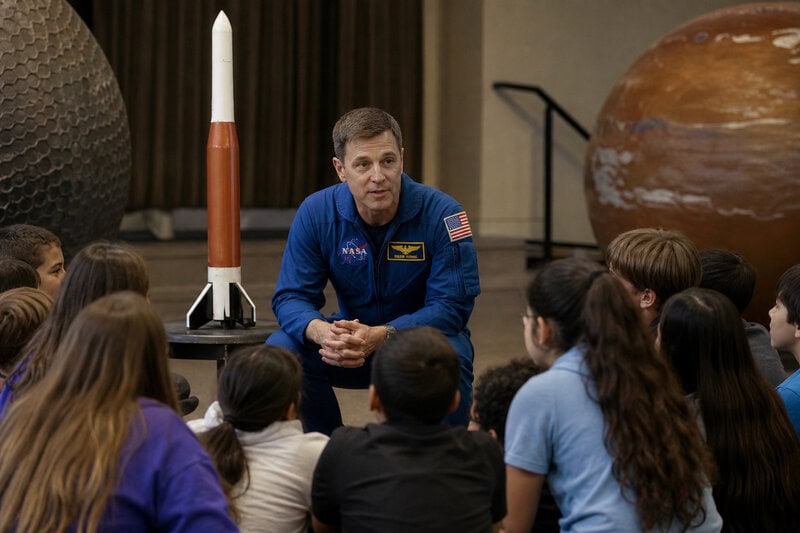
Morgan, who would later fly aboard the Space Shuttle, traveled to SLO specifically to place rocket science directly into students’ hands — guiding them through the engineering, troubleshooting, and ultimately the launch of their own rockets. She was not in San Luis Obispo County to deliver a lecture. That structural choice, participation over passive observation, was not incidental. It was the entire point.
Morgan’s visit drew from a philosophy embedded in NASA’s educator-astronaut tradition. NASA’s Office of STEM Engagement has documented this approach in its education framework materials, which consistently prioritize doing science over hearing about science — a distinction that, as the research reviewed below shows, reflects genuine cognitive differences in how children learn and retain knowledge.
What made the SLO visit emblematic was the precise nature of the children’s involvement. They were not watching a rocket launch activity unfold in front of them. They were engineering a system, identifying problems, revising solutions, and executing a launch sequence. Accounts of the visit document students grasping concepts in the field that classroom instruction had not yet made tangible. That gap — between spectator and actor — is where inspiration ends and transformation begins.
The Research Case: How Doing Wires the Brain Differently Than Watching
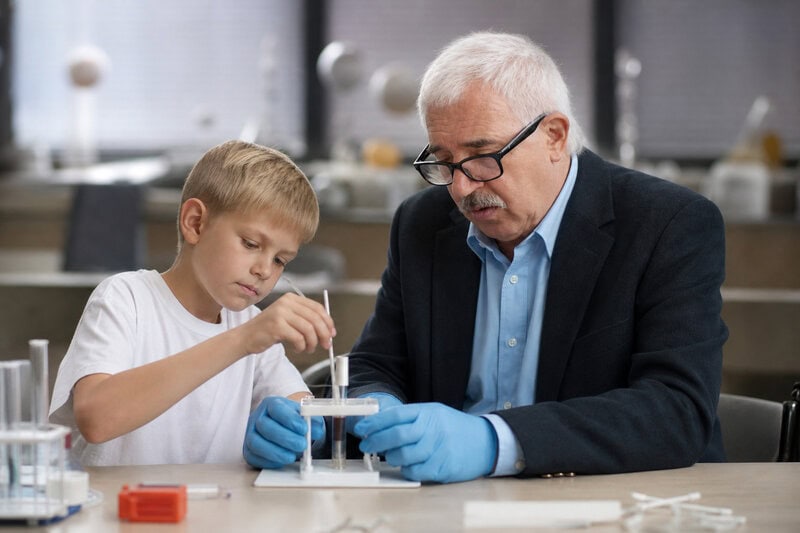
Research associated with psychologist Susan Goldin-Meadow’s work on gesture and learning has found that children who physically manipulate objects during instruction tend to retain concepts more effectively than those who only observe or listen. The underlying reason has to do with how broadly the brain is recruited during physical engagement. When a child builds and launches a rocket, multiple brain regions — including those governing motor control, sensory processing, and higher-order reasoning — activate in ways that passive listening does not produce.
A related and well-established memory phenomenon, known as the “generation effect,” helps explain why. First documented by Slamecka and Graf in 1978 and widely replicated since, the generation effect describes how information that a learner actively produces — even by physically assembling components — is encoded more durably in long-term memory than information received passively. Assembling a rocket nose cone and fin set is, in this sense, a form of generating knowledge.
An important distinction is worth making clearly here. The broad advantage of active over passive learning is well supported across decades of research and multiple age groups. The precise neural pathways responsible for long-term STEM interest formation, however, remain an active area of study. Certainty about the learning mechanism does not yet match certainty about long-term career outcomes, and readers should interpret the research accordingly.
What the evidence does support is a connection between task completion, novelty, and motivation. The successful launch of a student-built rocket produces a reward signal that becomes associated with the subject matter itself. This aligns with psychologist Mihaly Csikszentmihalyi’s research on intrinsically motivated engagement, which his work links to sustained interest in a domain. A child who experiences absorbed, self-directed engagement while working through physics and chemistry problems is more likely to associate those subjects with satisfaction rather than frustration.
Experiential Learning Theory: The Framework Behind the Activity
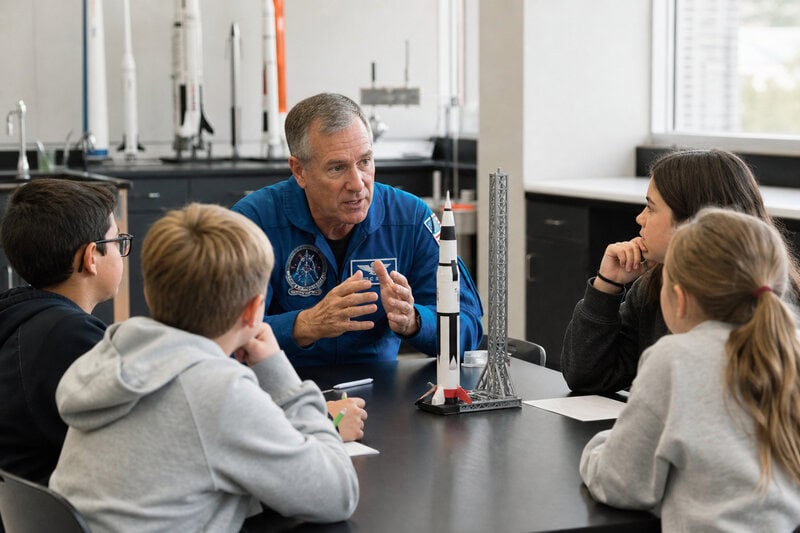
The term “experiential learning” refers to a formal pedagogical model developed by educational theorist David Kolb in 1984. Kolb’s four-stage cycle — Concrete Experience, Reflective Observation, Abstract Conceptualization, and Active Experimentation — describes how humans convert raw experience into durable knowledge. A single rocket launch activity can move a student through all four stages in under an hour, making it an unusually efficient instructional tool relative to its cost and complexity.
The evidence base for experiential and project-based approaches is substantial. A 2019 meta-analysis published in Educational Psychology Review by Hattie and Donoghue found that such approaches produced effect sizes in a range that places them among the higher-impact low-cost interventions available to schools for science achievement — though effect sizes vary by context, implementation quality, and the specific outcomes measured.
There is a nuance the research is clear about, and that NASA’s curriculum materials explicitly address: experiential learning works best when paired with structured reflection. Unguided discovery — building and launching without debriefing — shows considerably weaker outcomes than the same activity followed by facilitated analysis. NASA’s post-launch worksheets, which ask students to evaluate what worked, what failed, and why, are not supplementary paperwork. They are the stage in Kolb’s cycle where excitement converts into understanding.
Rockets are also pedagogically unusual in how many disciplines they touch simultaneously. A single launch activity integrates Newton’s three laws of motion, basic aerodynamics, the chemistry of propellant combustion, and iterative engineering design — multiple STEM domains in a single event, each made concrete by physical experience rather than abstract symbol. Few classroom activities offer that kind of interdisciplinary density in a format compelling enough to sustain a nine-year-old’s full attention.
The Astronaut Effect: Why the Messenger Matters as Much as the Method
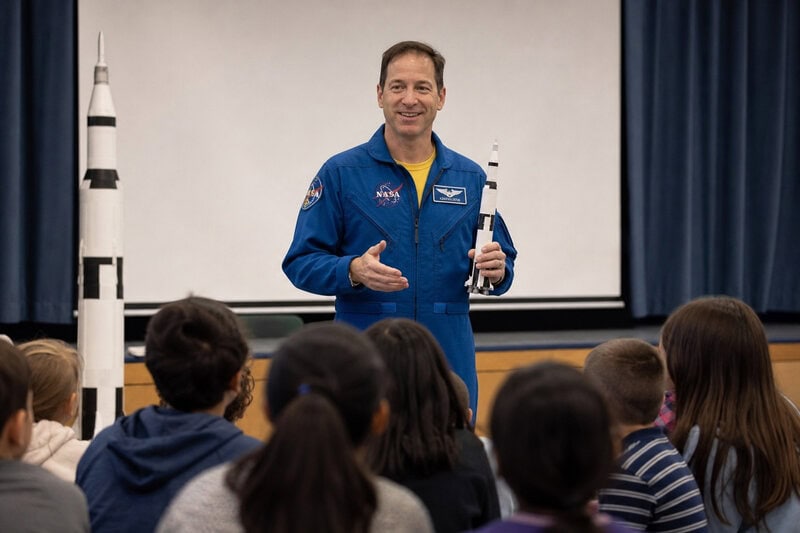
Psychologist Albert Bandura’s self-efficacy theory, developed in 1977 and extensively applied since, holds that children are most powerfully motivated by role models they perceive as relatable — someone whose success feels reachable rather than miraculous. Astronauts occupy an unusual position in this regard. Their achievements are exceptional almost by definition, which risks making them aspirationally remote. NASA has historically addressed this by having astronauts emphasize their ordinary school experiences, their early failures, and their gradual development — not innate genius that set them apart from peers.
Barbara Morgan’s dual identity as both a classroom teacher and a space-mission crew member made her a strategically significant messenger. She embodied, without requiring explanation, the argument that teaching and science are not separate worlds — that someone who spent years in an elementary school classroom could also conduct experiments in orbit. NSF survey data have documented a persistent perception among students that STEM careers require a type of exceptional ability incompatible with ordinary academic experience. Morgan’s biography, made visible by her presence in a San Luis Obispo schoolyard, argued against that perception more efficiently than any curriculum unit could.
Quantitative evidence on astronaut outreach specifically is limited but suggestive. A 2020 survey by the Aerospace Industries Association found that students who received in-person STEM presentations from aerospace professionals were more likely to express interest in STEM careers one year later, compared to control groups — though the authors explicitly noted self-selection bias as a significant limitation. Students who attend such events may already be more inclined toward STEM, making causal interpretation uncertain. The finding is worth noting, not overstating.
The message that curiosity — not innate talent — is the primary prerequisite for a STEM path lands differently when delivered by someone standing beside a launchpad than when encountered in a textbook, because the experiential format is itself evidence: the child is already doing what scientists do.
How to Inspire Kids in STEM: What Schools and Parents Can Replicate
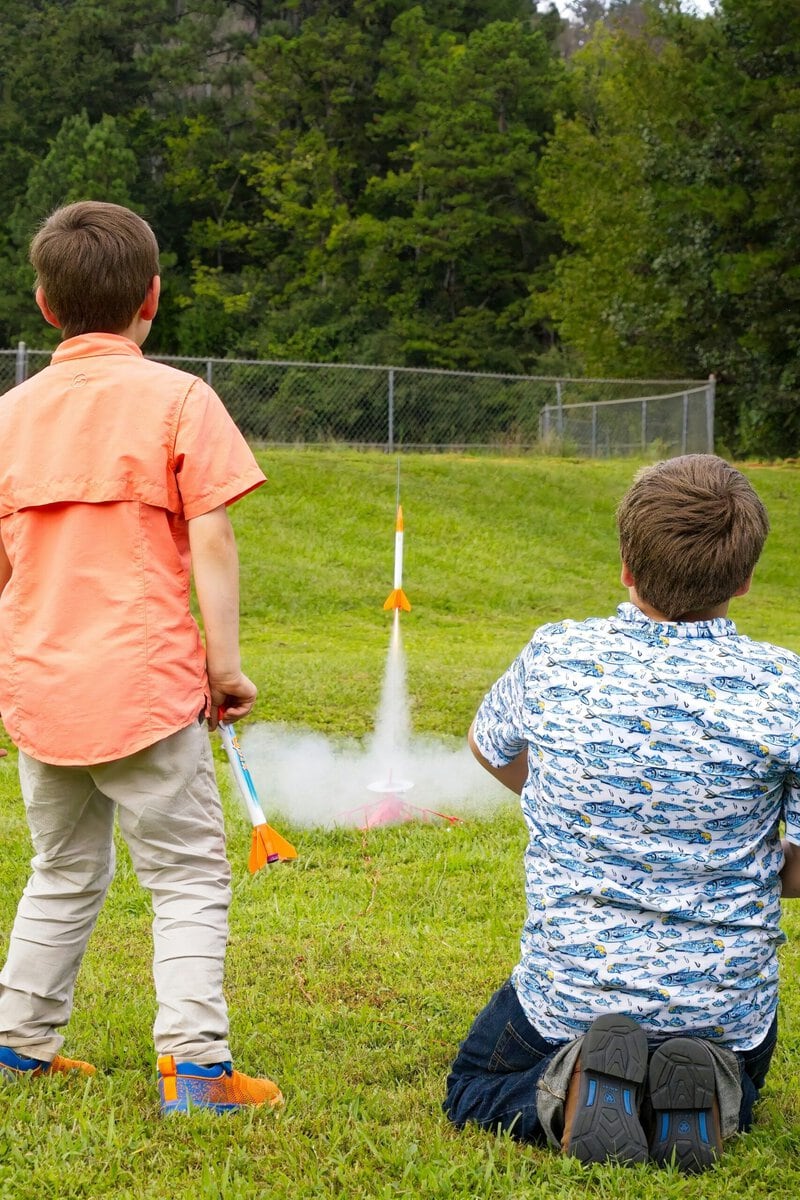
The research reviewed here supports a clear, if carefully bounded, conclusion: low-cost, hands-on science activities are reliably effective at building STEM interest in children. They are not guaranteed career pipelines, and a single afternoon does not determine a child’s future. But the evidence positions such activities as meaningful on-ramps to scientific identity — and that identity shift, not the volume of information transferred, is what appears to produce long-term engagement.
Accessible resources exist to support replication at scale. NASA’s free “Rockets Educator Guide,” available through nasa.gov, provides step-by-step rocket launch activity instructions for elementary through high school levels, built on the same experiential learning framework that informed Morgan’s 1993 SLO visit. The materials include post-launch reflection components that the evidence identifies as essential, not optional.
For parents and educators attempting to replicate the approach informally, the structural ingredient most frequently omitted is that structured reflection. Asking children “What surprised you? What would you change, and why? What does that tell you about how the system works?” is the step that converts excitement into durable conceptual understanding. Without it, the experience remains vivid but shallowly encoded. With it, a backyard bottle-rocket launch becomes a genuinely instructive science activity.
A realistic framing matters here. A single rocket launch will not determine whether a child becomes an engineer. But education research suggests it can lower the psychological distance between a child and the self-perception of “someone who does science” — and that shift in identity is where lasting STEM engagement tends to originate.
Why Hands-On Outreach Is an Infrastructure Problem, Not Just a Nice-to-Have
The stakes extend well beyond any individual visit. The U.S. Bureau of Labor Statistics has projected that STEM occupations will grow substantially faster than most other fields in the coming decade, meaning that how educators ignite early interest in science and engineering carries genuine consequences for workforce development and innovation capacity. The National Science Board’s 2022 Science and Engineering Indicators report found persistent gaps in STEM exposure correlated with income, geography, and school-resource levels — making visits like Morgan’s to San Luis Obispo County something closer to equity interventions than supplemental enrichment.
That framing comes with an honest limitation. Education researchers, including Jonathan Osborne of Stanford’s Graduate School of Education, have critiqued one-off outreach models precisely because a single afternoon of rocket launches cannot substitute for sustained, high-quality science instruction delivered by well-supported teachers over years. The visit is a catalyst, not a curriculum. Treating it as sufficient, rather than as a complement to robust classroom instruction, misreads what the evidence actually supports.
What the evidence does support — without overreaching into advocacy — is that funding for experiential learning infrastructure, including laboratory equipment, project-based curricula, and structured outreach programs, is at least as important as funding for information delivery. Textbooks convey facts. Launchpads, used well, help children begin to see themselves as people who make things happen in science.
Barbara Morgan’s 1993 visit to San Luis Obispo County was a single day, organized around a principle that subsequent decades of research have continued to support: children learn science most deeply when they are trusted to do it. The child who pressed that launch controller experienced, in the seconds before ignition, something no lecture could have provided — the physical sensation of being the person responsible for making a scientific event occur. That sensation, it turns out, is not incidental to STEM education. According to the best available evidence, it may be precisely the point.