
Fine-grained silicate dust ejected by the Chicxulub asteroid impact may have blotted out the sun for up to a year — long enough to collapse the photosynthesis-dependent food chains that three-quarters of all living species on Earth relied upon. New research suggests that the real killing blow delivered 66 million years ago wasn’t the fireball, the shockwave, or even the sulfur-laced aerosols that followed; it was the slow-settling curtain of pulverized rock that lingered in the atmosphere long after everything else had cleared. The finding reorders scientific understanding of which atmospheric agent was most responsible for one of the most consequential mass extinctions in the history of life on this planet.
What We Already Knew: The Chicxulub Impact and the K-Pg Extinction
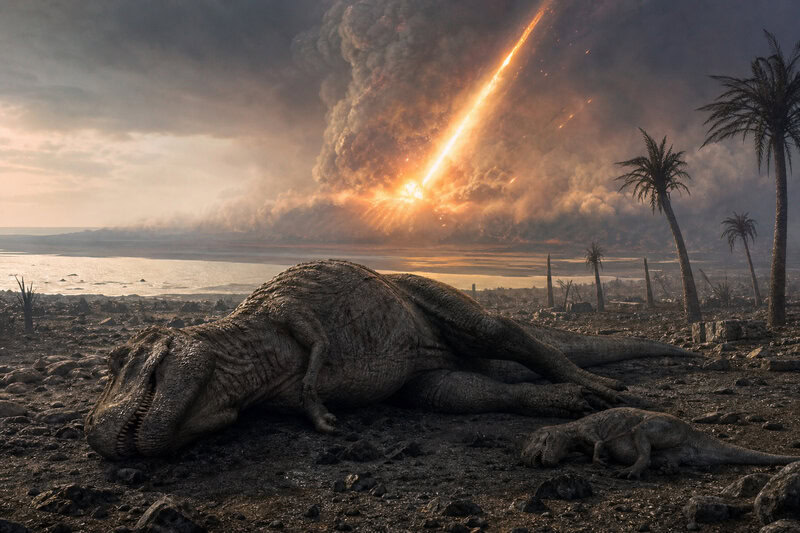
The Cretaceous-Paleogene (K-Pg) extinction event, which occurred approximately 66 million years ago, eliminated roughly 75 percent of all species on Earth, including all non-avian dinosaurs. The overwhelming scientific consensus identifies the Chicxulub impact — named for the crater it gouged near present-day Mexico’s Yucatán Peninsula — as the primary cause of this catastrophe. The asteroid, estimated to have been several miles wide, released energy orders of magnitude beyond any human-made weapon and triggered a cascade of environmental disasters that persisted for years.
The established “impact winter” theory holds that the collision injected enormous quantities of dust, soot from continent-spanning wildfires, and sulfur aerosols into the upper atmosphere. Together, these contaminants dramatically reduced the amount of sunlight reaching Earth’s surface, triggering sharp temperature drops and shutting down photosynthesis — the biological process that underpins virtually every food web on the planet. According to research compiled by the Lunar and Planetary Institute, the global effects of the impact were swift, severe, and mutually reinforcing.
What scientists have continued to debate is precisely which atmospheric contaminant deserves the most blame for the prolonged darkness and cooling. Sulfur aerosols dissipate on a timescale of months to a few years. Soot from wildfires, while highly effective at absorbing sunlight, is subject to relatively rapid atmospheric washout. Fine mineral dust — specifically silicate dust, the most physically abundant material ejected by the impact — had not been rigorously modeled as a standalone extinction driver until now. That gap is exactly what the new study addresses.
The New Finding: Silicate Dust as the Primary Extinction Engine
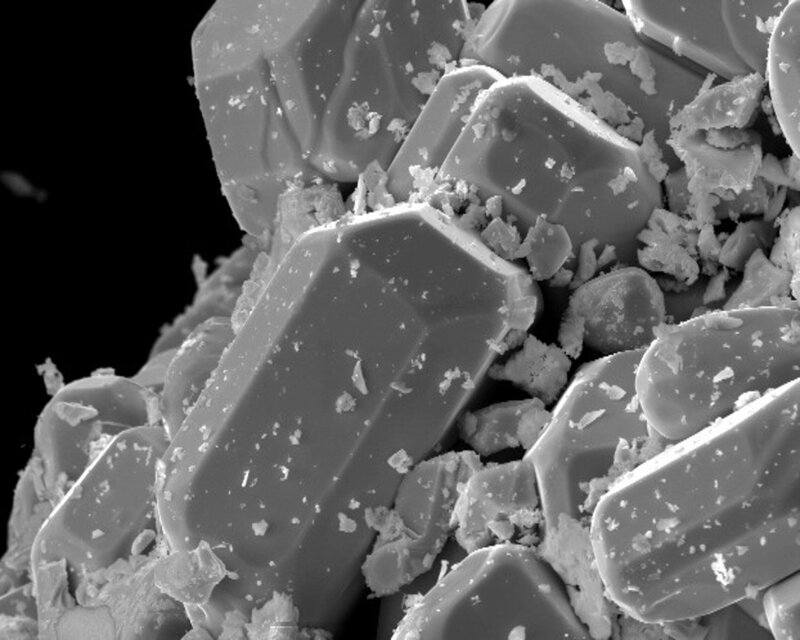
Silicate dust refers to microscopic particles of rock — primarily compounds of silicon and oxygen — that were pulverized and blasted into the upper atmosphere when the asteroid vaporized and shattered the carbonate and crystalline target rock of the Yucatán. These particles are extraordinarily fine: small enough to remain suspended in the stratosphere far longer than coarser debris, which falls out of the atmosphere within days or weeks under the pull of gravity.
According to reporting by Archaeology Magazine on the new study, silicate dust from the Chicxulub impact was so abundant and so fine that it could have remained suspended in the atmosphere for up to a year, blocking sufficient sunlight to halt photosynthesis on a global scale. The authors identify silicate dust — not soot, not sulfur aerosols, and not volcanic gases — as the single most impactful agent in the post-impact extinction cascade. That is a meaningful revision of the conventional picture, which has long treated dust as one contributor among several roughly equal ones.
The mechanism becomes clear once the particle physics are understood. Ultra-fine silicate particles have an extremely low settling velocity — they drift downward at a glacial pace relative to heavier counterparts. This means their light-blocking effect persisted long after wildfires burned out and sulfur compounds rained out of the sky. The sun, for the creatures that survived the initial catastrophe, was effectively gone for the better part of a year.
The study also finds that airborne silicate dust didn’t only block sunlight in the aftermath — it played an active role in worsening conditions during the impact’s immediate phase. As detailed in Purdue University’s newsroom coverage of the research, the dust cloud helped trap and intensify the thermal radiation produced by the impact itself, contributing to the charbroiling of surface environments in the hours and days that followed the strike. Silicate dust, in other words, made the fires worse before it made the darkness worse — a dual role that previous models had not fully captured.
How the Dust Made Everything Worse: Fire, Cold, and Cascade Collapse

The sequence of destruction unfolded in distinct but overlapping phases. During the impact’s immediate aftermath, silicate dust trapped thermal radiation near the surface, amplifying the intense heat that ignited wildfires across vast swaths of the planet. Then, as dust, soot, and aerosols fully saturated the atmosphere, the dynamic reversed: surface temperatures dropped sharply below pre-impact baselines, plunging the planet into a prolonged period of cold, darkness, and biological paralysis that scientists call an impact winter.
The ecological cascade that followed was predictable in its logic if staggering in its scale. Without adequate sunlight, photosynthesis failed across terrestrial and marine ecosystems alike. Without plant life, the herbivores that depended on it starved. Without herbivores, large predators — including the apex carnivorous dinosaurs — had no prey base to sustain them. The food web didn’t so much collapse as dissolve from the bottom up, and the animals least equipped to endure deprivation died first and in the greatest numbers.
Large-bodied, high-metabolism animals like non-avian dinosaurs were particularly vulnerable. They required enormous caloric inputs to survive, and those inputs simply ceased to exist. Smaller animals — the ancestors of modern birds and mammals among them — fared better. They could burrow, enter torpor-like states, and subsist on seeds, insects, and detritus that persisted even when living plant material was gone. The year-long dust-induced darkness functioned as a ruthless filter: it selected for small body size, metabolic flexibility, and low energy requirements, and it killed nearly everything else.
Marine ecosystems suffered along parallel lines. Phytoplankton — the photosynthetic foundation of ocean food webs — collapsed under the light-blocking dust cloud, starving the zooplankton, fish, and marine reptiles that depended on them. The extinctions were not confined to land, and the dust cloud’s global reach meant no ocean basin was spared.
Ruling Out the Volcano Theory — and Why the Debate Matters
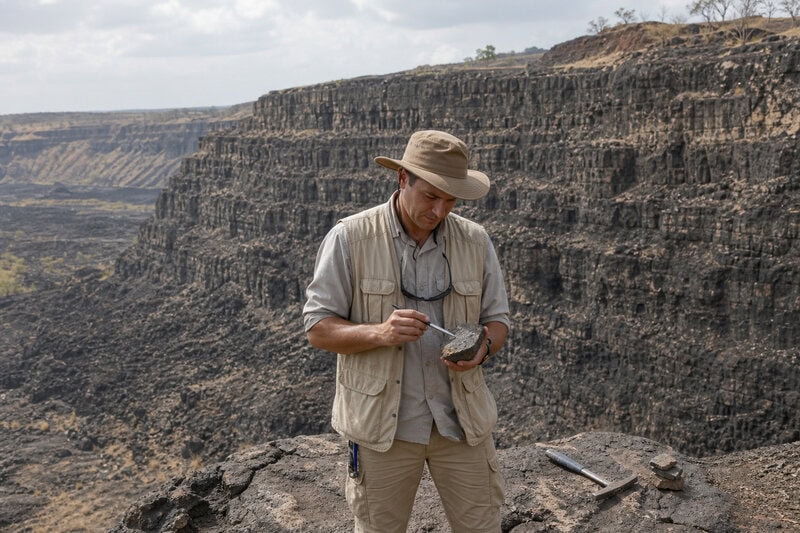
Any serious accounting of the K-Pg extinction must grapple with the Deccan Traps — a massive volcanic province in present-day India that was actively erupting around 66 million years ago and releasing substantial quantities of carbon dioxide, sulfur dioxide, and other gases into the atmosphere. Some researchers have argued that this volcanism contributed significantly to the extinction event, and a smaller number have proposed it as the primary driver, with the Chicxulub impact playing a secondary role.
The authors of the new study take a clear position: their findings effectively rule out volcanic activity as the primary extinction trigger. The silicate dust model, they argue, accounts for the scale, speed, and global reach of the extinction event without requiring volcanism to carry significant explanatory weight. This is not a claim that the Deccan Traps had zero effect on Cretaceous ecosystems — volcanic gases almost certainly contributed to environmental stress — but rather that the dust loading from Chicxulub was so overwhelming that it renders a volcanic primary cause unnecessary and, by the study’s modeling, inconsistent with what the geological record shows.
Settling this debate carries consequences well beyond paleontology. How scientists model the relative contributions of dust, soot, and volcanic gases to the K-Pg extinction directly informs how they construct models of planetary catastrophes more broadly. It shapes the interpretation of the fossil record, guides the search for extinction signatures in other geological periods, and has direct relevance to contemporary discussions about nuclear winter scenarios and the long-term consequences of future large asteroid strikes.
How Scientists Reconstructed a 66-Million-Year-Old Dust Cloud
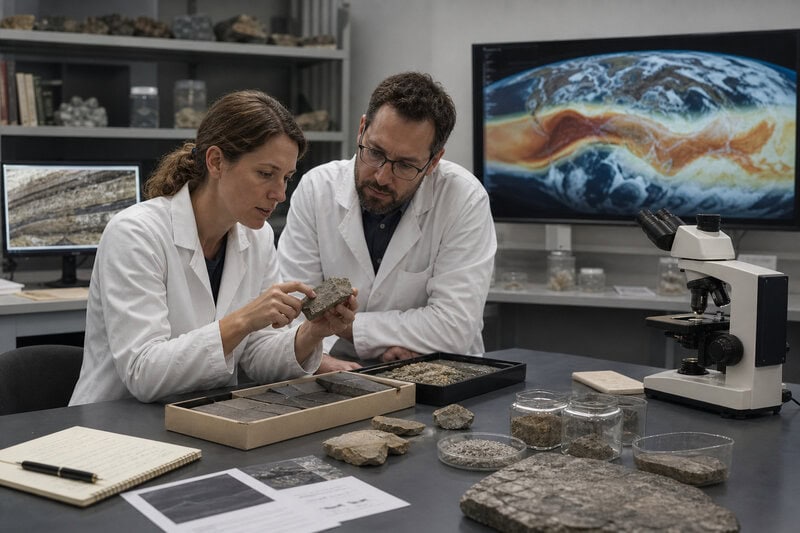
Reconstructing atmospheric conditions from 66 million years ago is not a matter of direct observation — it requires the careful integration of physical evidence with computational modeling. Researchers combined climate and atmospheric models with analysis of the geological record preserved in K-Pg boundary sediments found at sites around the world. These sediments contain a thin, globally distributed layer rich in iridium — an element rare in Earth’s crust but common in asteroids — along with silicate spherules and fine mineral particles that provide a chemical and physical fingerprint of the original impact ejecta.
By analyzing the particle size distribution and optical properties of silicate dust — specifically, how effectively particles of a given size scatter and absorb incoming solar radiation — the research team modeled the dust cloud’s behavior in the upper atmosphere independently of soot and sulfur contributions. This isolation of silicate dust as a distinct variable is what makes the study’s approach distinctive and scientifically significant. Previous models had typically treated the post-impact aerosol mixture as a combined forcing, making it difficult to assign relative responsibility to individual components.
As Ars Technica’s coverage of the study explains, the dual role of the dust — first as a heat trap, then as a sunlight blocker — represents a more complete and more troubling picture of what the immediate post-impact environment would have looked like for any creature unlucky enough to have survived the initial strike.
What remains uncertain is the precise duration and density of the dust cloud. Climate models carry inherent assumptions about atmospheric circulation, particle chemistry, and ocean-atmosphere feedbacks, and those assumptions can shift results meaningfully. The authors acknowledge that their conclusions will need validation through additional geochemical analysis of sediment cores from the Chicxulub crater itself and from K-Pg boundary sites worldwide, as well as through independent climate simulations conducted by other research groups. Science advances through replication and challenge, and this study is best understood as a significant step forward rather than a final answer.
What This Means Now: Lessons for Planetary Science and Asteroid Defense

The practical relevance of understanding Chicxulub’s dust dynamics extends well beyond reconstructing a prehistoric catastrophe. Scientists who model the consequences of hypothetical future asteroid impacts — and those who study nuclear winter scenarios, which share important atmospheric physics with impact winters — rely on accurate parameterizations of how fine particles behave in the stratosphere. If silicate dust is confirmed as the dominant extinction driver at the K-Pg boundary, it refines those parameterizations in ways that matter for real-world risk assessment.
For planetary defense planning, the implication is sobering: the most dangerous legacy of a large impact may not be the immediate thermal pulse or the blast wave, but the slow, patient darkness that follows. An impactor capable of lofting sufficient fine silicate material into the stratosphere could trigger a photosynthesis shutdown lasting long enough to unravel global food webs, even if its direct destructive radius were geographically limited. That realization shifts where risk modelers should focus attention — and underscores why characterizing an impactor’s composition and target rock, not just its size, matters for consequence assessment.
The study is also a reminder that mass extinctions rarely have a single cause that operates in isolation. The Chicxulub impact set off a sequence of interacting catastrophes — thermal radiation, wildfires, acid rain from sulfur aerosols, and finally the sustained cold and dark of an impact winter dominated, the new research argues, by silicate dust. Understanding which element of that sequence did the most damage is not an academic quibble; it is the kind of mechanistic knowledge that informs everything from planetary defense modeling to our understanding of how life recovers after global-scale catastrophe.
Sixty-six million years after the Chicxulub asteroid struck, science is still piecing together the precise sequence of events that ended the age of dinosaurs. Fine rock dust, it now appears, may have been the slow-acting agent that sealed their fate — patient, pervasive, and ultimately more lethal than the fire that preceded it.