
Approximately 167 million years ago, a small reptile moved through a world still dominated by early dinosaurs — and a fossil of that creature, named Breugnathair elgolensis, is now pushing the known origin of the snake body plan deeper into the Jurassic Period than many researchers had previously accepted. That single specimen, combined with a cluster of other rare ancient snake fossils emerging from Brazil and beyond, is reshaping one of paleontology’s most persistent debates: not just when snakes lost their legs, but why.
A 167-Million-Year-Old Window Into Snake Origins
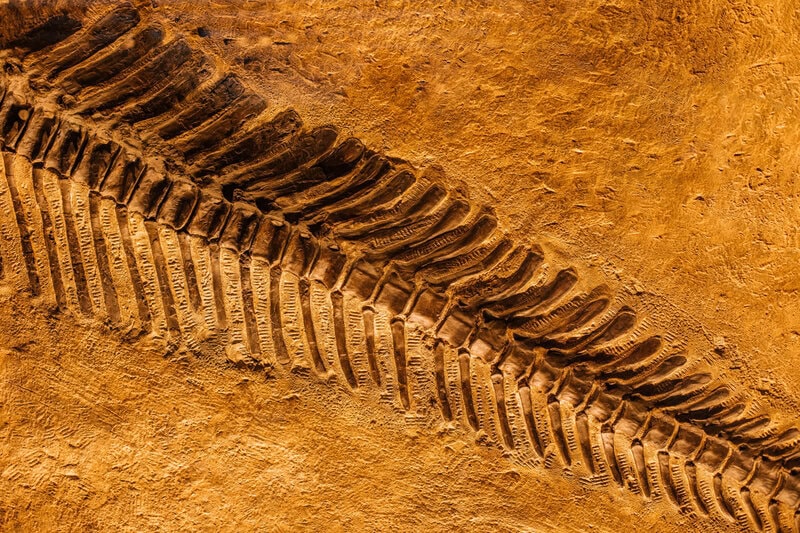
For decades, the early chapters of snake evolution have been frustratingly incomplete. Snake skeletons consist of hundreds of small, loosely connected bones that scatter rapidly after death, meaning the fossil record for early snakes is thin almost by definition. Against that backdrop, the discovery of Breugnathair elgolensis, dated to approximately 167 million years ago, represents an unusually clear window into the period when the snake lineage began diverging from its lizard ancestors.
At the other end of this emerging timeline sits Tametara mirim, described by researchers as one of the best-preserved early snake fossils on record. Dating to roughly 75 to 85 million years ago during the Cretaceous Period — when non-avian dinosaurs still walked the Earth — Tametara mirim offers a later snapshot of a lineage already well along its evolutionary path toward the limbless form we recognize today. Taken together, these specimens and others allow scientists to trace a rough but illuminating arc of snake evolution spanning more than 90 million years.
The core tension driving all of this research is deceptively simple: scientists broadly agree that snakes evolved from limbed lizard ancestors, but they remain divided on what ecological pressure made a long, legless body advantageous in the first place. Was it life underground, hunting in water, or something else entirely? A newly described dinosaur-era fossil from Brazil is now adding fresh anatomical evidence to that argument — and the interpretation it suggests may surprise those who assumed the question was close to settled.
Why Ancient Snake Fossils Are So Rare
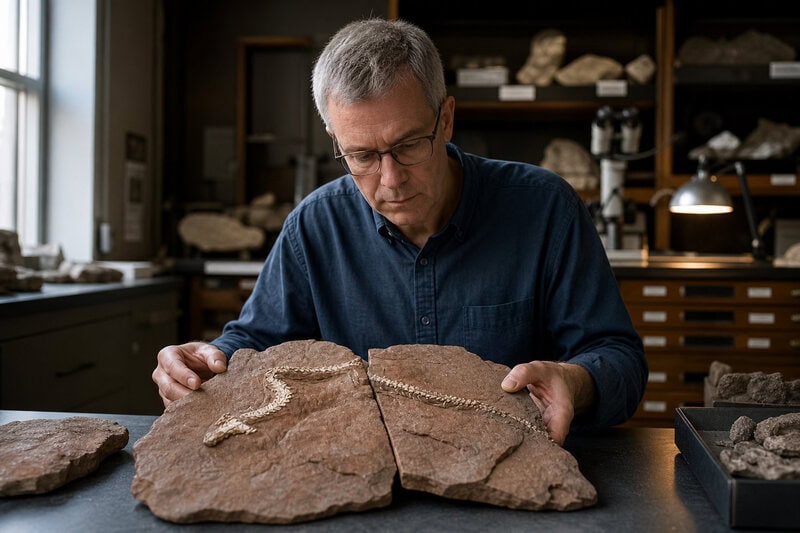
To appreciate why each new find carries such weight, it helps to understand the preservation problem. Snakes belong to the squamates — the broader reptile group that includes all lizards and snakes — and determining when the snake lineage branched from its lizard relatives is a foundational question in vertebrate paleontology. The difficulty is structural: a single snake can carry more than 300 individual vertebrae, plus dozens of small rib and skull bones, none of which are locked together by rigid joints the way a mammal’s skeleton is. After death, those elements scatter, are carried off by scavengers, or dissolve in sediment. A reasonably complete ancient snake fossil is, as a result, a genuinely rare geological event.
This scarcity is precisely what makes specimens like Tametara mirim and Breugnathair elgolensis disproportionately valuable. Each well-preserved find does not merely add a single data point — it adds a hard constraint, narrowing the range of evolutionary scenarios that can plausibly explain the snake body plan. When such fossils surface, the paleontology community pays close attention.
How Snakes Lost Their Legs: A Gradual Disappearing Act
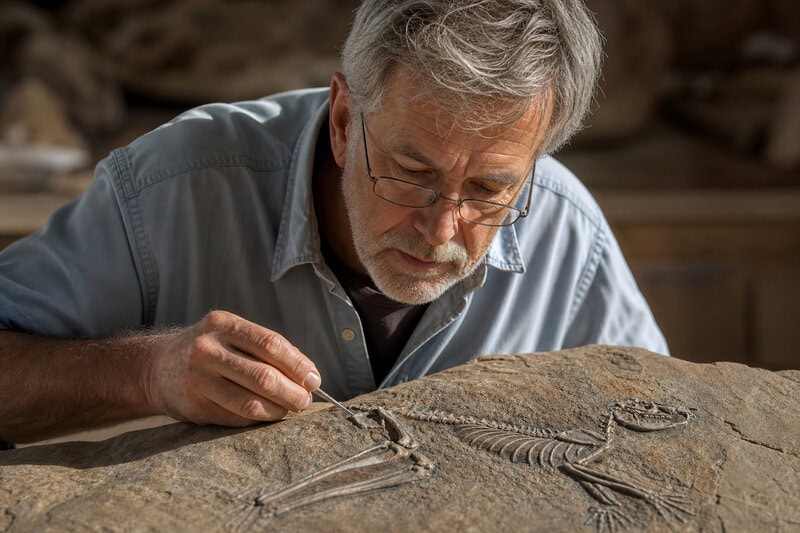
One of the most striking pieces of evidence in this corner of the fossil record is Najash rionegrina, a snake that lived during the dinosaur era and still possessed functional hind legs. Najash rionegrina demonstrates clearly that snakes did not shed their limbs in a single dramatic evolutionary moment, but rather through a prolonged, incremental process playing out across millions of years. Its body looked strikingly unlike any snake alive today — longer-limbed, differently proportioned — and yet it was unmistakably part of the snake lineage.
Evolutionary biologists describe this process as vestigialization: structures that no longer confer a meaningful survival advantage shrink across successive generations, because individuals with reduced or absent limbs can move more efficiently through confined spaces and devote less biological energy to building costly appendages. Over enough generations, limbs that were once essential become vestigial — present but functionally marginal — and eventually disappear from the lineage entirely.
It is broadly accepted among vertebrate paleontologists that leg loss in snakes was gradual rather than sudden. What remains genuinely contested is the primary selective pressure that made limblessness advantageous in the first place. Fossils like Najash rionegrina do not capture a single transformative moment; they offer snapshots of an animal caught mid-process, with rear limbs already reduced but still present. That anatomical ambiguity is precisely what keeps the origin debate alive.
The Burrowing Hypothesis: What the Brazilian Fossil Argues
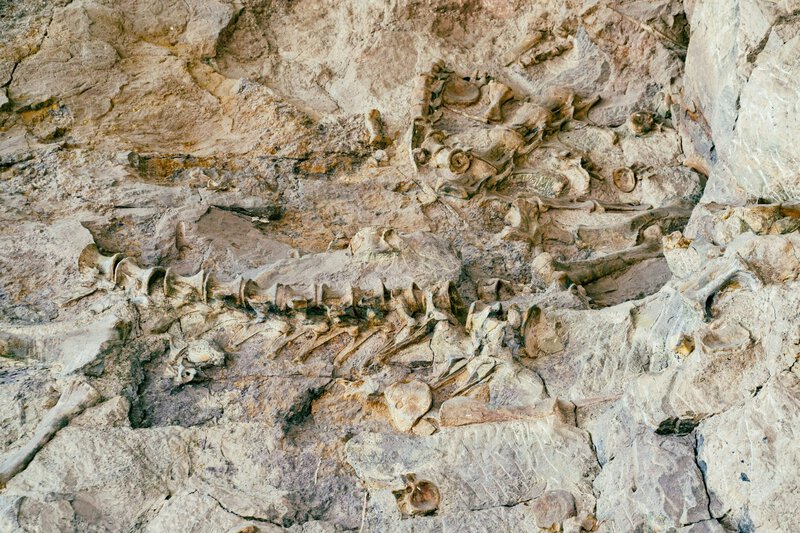
The newly described Brazilian specimen enters this debate with a specific anatomical argument. Analysis of the fossil’s morphology suggests that early snakes likely adapted for burrowing — a lifestyle that would reward precisely the kind of long, slender, limbless body plan that defines modern snakes. Underground navigation through tight tunnels places a premium on compactness, flexibility, and the absence of protruding limbs that would create drag or become lodged in confined spaces.
The skeletal features paleontologists associate with fossorial, or burrowing, behavior include a robust and compact skull built to push through soil, reduced eye socket size consistent with diminished reliance on vision in dark environments, and reinforced vertebrae capable of withstanding the mechanical stresses of tunneling. Where such traits cluster together in a single specimen, researchers interpret them as evidence of an underground lifestyle.
If the Brazilian specimen’s burrowing interpretation holds up to further peer scrutiny, it would lend meaningful support to the fossorial origin hypothesis over competing theories. Researchers are careful to note, however, that a single specimen rarely settles long-running debates of this kind. The burrowing interpretation should be understood as a well-supported hypothesis rather than a confirmed conclusion, and the broader question of snake origins remains an active area of research within both paleontology and herpetology.
Reading the Snake Evolution Timeline Across 90 Million Years
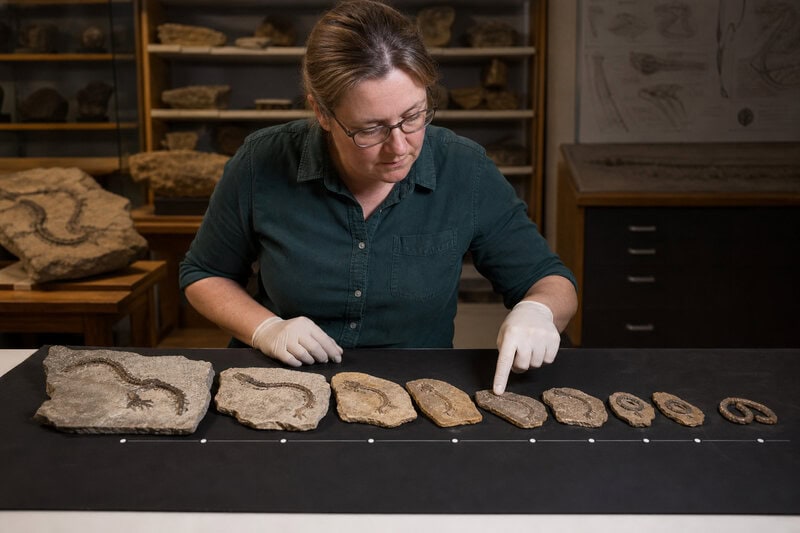
Mapping these specimens chronologically produces a rough but genuinely informative picture of snake evolution. Breugnathair elgolensis, at approximately 167 million years old, anchors the earliest end of the current fossil window and provides critical evidence about how snakes first diverged from lizard ancestors during the Jurassic Period. Najash rionegrina and the new Brazilian specimen occupy the mid-Cretaceous, capturing snakes at a transitional stage — limbless or nearly so, but still anatomically distinct from their modern descendants. Tametara mirim, at roughly 75 to 85 million years ago, represents a later, more derived stage in which the snake body plan was already well established.
Comparing specimens across this range reveals a directional trend: skull specialization increases, vertebral elongation becomes more pronounced, and limb structures reduce progressively. That trajectory is consistent with snakes adapting over millions of years to a particular ecological niche — though the precise nature of that niche is still being debated. Even with these finds, the fossil record for early snake evolution contains significant gaps, and paleontologists acknowledge that the specimens currently known almost certainly do not capture the full diversity of snake lineages that existed during the Mesozoic Era.
Genetic studies of living snakes and lizards have independently estimated divergence times that broadly align with the fossil record, though the precise date of the snake-lizard split remains a point of ongoing refinement. Molecular clock researchers and paleontologists are working from converging lines of evidence — bones and genes — but have not yet reached full agreement on the details.
Why This Debate Has Lasted So Long
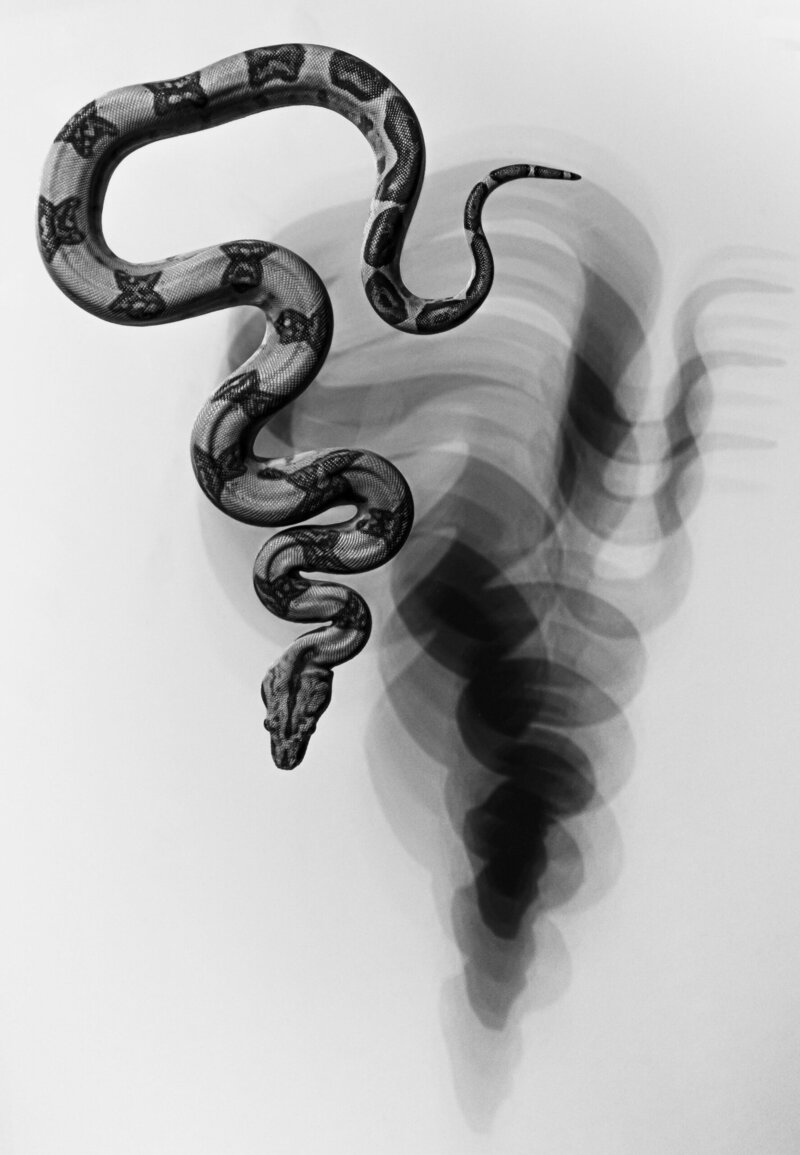
Three competing hypotheses have dominated the snake-origins debate for decades, and each has survived because each is supported by a distinct subset of fossil and anatomical evidence.
- The fossorial hypothesis holds that snakes evolved their body plan underground, where limblessness aids movement through burrows. It draws support from fossils with compact skulls and reduced eye sockets, including the newly described Brazilian specimen.
- The marine hypothesis points to early snake fossils recovered from marine sediments, arguing that limblessness first evolved as an adaptation for aquatic hunting, where streamlining matters and limbs create drag.
- The surface-hunter model, a more recent proposal, argues that snakes evolved on open ground rather than underground or underwater, with limb reduction driven by predatory mechanics rather than burrowing or swimming.
No single specimen found to date definitively excludes any of these models, which is precisely why a rare Brazilian fossil is described as shedding new light on an enduring controversy in evolutionary thought rather than resolving it. Paleontologists broadly agree that the strongest test of these competing models would come from better-preserved specimens from the Jurassic and Early Cretaceous — the critical window between Breugnathair elgolensis and the later snakes already known. That gap in the fossil record remains the field’s most pressing unsolved problem.
As of the most recent published studies, no scientific consensus has been reached on which single ecological pressure drove snake limblessness. Any single-cause explanation, including the burrowing hypothesis, should be treated as a leading interpretation rather than settled fact.
What These Fossils Mean Beyond Paleontology
The snake case is one of the clearest natural examples of what evolutionary biologists call convergent body-plan evolution — where distinct lineages independently arrive at similar body forms under similar ecological pressures. Legless lizards, for instance, evolved limblessness independently of snakes. Understanding the drivers of limb reduction in snakes helps researchers model how and why such dramatic body-plan changes occur across vertebrates more broadly, with implications for evolutionary developmental biology well beyond reptiles.
There is also a biomedical dimension worth noting. Research into the genetic regulatory switches that accompanied limb reduction in snakes has identified DNA sequences — sometimes called enhancer elements — that are also present in mammals, including humans. Studies published in peer-reviewed developmental biology journals have linked these sequences to limb development pathways, with potential relevance to understanding certain congenital conditions. The evolutionary history preserved in ancient snake fossils is not, in other words, entirely separate from questions about human biology.
With active fieldwork ongoing in Brazil, North Africa, and Central Asia — regions that preserve Cretaceous and Jurassic sediments in abundance — paleontologists expect the coming decade to yield specimens that could meaningfully constrain, or perhaps finally narrow, the debate over how and why snakes became the legless animals they are today. Each rare fossil that emerges from the rock does not just tell the story of one ancient creature. It reduces the space of possible answers to one of biology’s most enduring questions.