
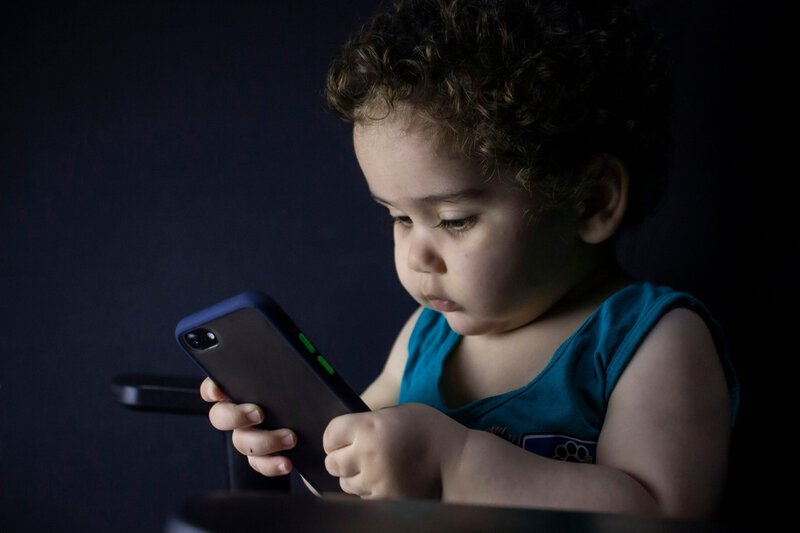
In the middle of a game of building blocks, a parent glances down at their phone — just three seconds, barely a blink. Repeated hundreds of times across the early years of a child’s life, that fractional diversion accumulates into something researchers are beginning to measure with uncomfortable precision: a gradual erosion of the attentional signal children depend on to learn how to read faces, manage emotions, and trust that the people who love them will actually show up.
What the Research Actually Shows

A study of 600 U.S. teenagers aged 12 to 17 found that children consistently reported feeling marginalized and neglected when a parent’s attention drifted to a device — not during work calls or emergencies, but during time nominally set aside for them. The word marginalized is deliberate and precise: it does not describe a dramatic rupture but a chronic, low-grade signal that the child’s presence was not quite enough to command full attention. Bloomberg’s reporting on the study noted that teens were remarkably articulate about the dynamic — a finding that suggests the effect does not soften as children develop greater cognitive sophistication. It may simply become more consciously painful.
Separate research has found that more frequent parental smartphone use is associated with more frequent episodes of anger and sadness in children, suggesting the device functions as an emotional wedge rather than a neutral distraction. A 2023 study conducted in China added another dimension: parental phone attachment made children measurably more prone to developing their own problematic screen use — a transmission effect operating through both behavioral modeling and reduced face-to-face emotional guidance. The peer-reviewed findings, published through the National Institutes of Health’s PubMed Central, point toward two parallel pathways: children learn that heavy phone use is normative by watching their parents, and they receive less of the attentive interaction that would otherwise buffer them against seeking stimulation elsewhere.
What the science can and cannot yet claim deserves explicit care. Correlational study designs dominate this literature, and researchers are actively working to disentangle whether distressed or overstretched family environments independently drive both parental phone overuse and child emotional difficulties — or whether phone use is itself the primary driver. Causality has not been cleanly established in either direction. What the evidence does consistently show, across multiple populations and methodologies, is a reliable association between parental smartphone distraction and measurable child emotional consequences. That association is strong enough to take seriously without overstating it.
The Neuroscience of the Interrupted Gaze

To understand why phone distraction may matter so much in the early years, it helps to understand what developmental neuroscientists call serve-and-return interaction. When an infant babbles, points at something across the room, or mirrors an expression on a caregiver’s face and the caregiver responds in kind, the back-and-forth exchange physically reinforces neural pathways involved in social cognition and emotional regulation. Researchers at institutions including Harvard University’s Center on the Developing Child have described this process as analogous to laying fiber-optic cable for emotional intelligence: the wiring is built through repetition, and the quality of the signal matters at every stage.
Related experimental work has produced what researchers call the still-face effect — a paradigm in which a caregiver who has been warmly engaged suddenly goes expressionless and unresponsive. Even brief exposures to that withdrawal cause measurable infant distress and spikes in cortisol, the body’s primary stress hormone. Researchers have argued that a parent absorbed in a smartphone produces a functionally similar signal: the face is present but the contingent responsiveness — the back-and-forth that tells the child I see you, I am here — has gone quiet.
The prefrontal cortex, the brain region governing impulse control, emotional regulation, and social judgment, develops primarily in response to co-regulated social interaction during early childhood. This means the quality of face-to-face attention a child receives in the first years of life is not incidental background noise — it is formative input. The Guardian’s coverage of recent research highlighted how parental attachment to phone screens is associated with anxiety and emotional dysregulation in children, framing the issue in terms that align with this broader neurodevelopmental picture.
A significant scientific boundary must be acknowledged here: direct neuroimaging studies specifically linking parental phone use to altered brain development in children remain limited in number and scope. Most mechanistic claims in this area rest on reasonable extrapolation from the larger attachment and serve-and-return literature rather than from studies designed to isolate smartphone behavior as the variable of interest. More targeted longitudinal research is needed before strong causal claims can responsibly be made, and that distinction matters when translating findings into policy or parenting guidance.
How Children Interpret the Snub

Children — particularly younger ones who do not yet have the cognitive tools to attribute a parent’s distraction to external demands — tend to default to a self-referential explanation when a caregiver’s eyes drop to a screen: I am less interesting than that object. This is not melodrama. It is developmentally appropriate reasoning from limited information. A toddler has no framework for understanding push notifications or work deadlines. What they have is a highly calibrated system for reading whether an attachment figure is truly available, and that system is acutely sensitive to precisely the kind of partial, divided attention a phone produces.
Developmental psychologists use the term internal working model to describe the mental template children construct — largely before they can articulate it — of how reliably other people will show up for them. A single phone glance during play is trivial and easily recovered from. A consistent pattern of such glances across thousands of interactions in the early years begins to write entries into that template: attention is conditional, presence is partial, bids for connection may or may not be answered. The accumulated ledger, researchers argue, shapes how a child approaches relationships long after any individual moment is forgotten.
The 600-teen study is notable partly because it demonstrates that adolescents, who do possess the cognitive sophistication to understand why a parent checks a phone, still report feeling the sting. Comprehending the cause does not appear to neutralize the emotional signal. The Straits Times’ reporting on the study captured the core finding precisely: phone distraction during family time, rather than work time, was the consistent driver of children’s sense of being sidelined — a distinction the teens themselves drew clearly.
The Addiction-Transmission Loop

The 2023 Chinese study introduced a concept that has since gained traction in the research literature: the idea of a self-reinforcing cycle in which parental emotional unavailability, mediated by phone use, elevates a child’s risk of developing their own screen dependency, which in turn further reduces the face-to-face interaction that might help repair the developmental deficit. Each turn of the cycle compounds the gap rather than closing it.
Researchers studying this phenomenon have adopted the term technoference — defined as technology interference in face-to-face relationships — to describe how devices insert themselves into family interactions even when no one consciously intends them to. The reflexive reach for a phone during a quiet moment, a lull in conversation, or the pause while a child is absorbed in a toy is not a deliberate choice to disengage; it is an automatized behavior. That is precisely what makes it difficult to interrupt and what makes its cumulative effect easy to underestimate: each individual instance feels inconsequential precisely because it is.
Researchers are also careful to flag important cultural and socioeconomic nuance. The Chinese study and the U.S. teen survey represent specific populations with specific relationships to technology, family structure, and economic stress. Economic pressure independently influences parenting behavior in ways that can resemble phone-driven distraction but have entirely different roots and may require entirely different responses. Discussion of the research in technology media has raised similar cautions about overgeneralizing findings across populations with different structural circumstances. Drawing uniform conclusions across all family contexts would outrun the evidence the studies actually support.
What Protective Factors Look Like

The research does not call for eliminating smartphones from family life. The documented harms are associated with unmanaged, reflexive phone use during child-directed time — not with device ownership or moderate use during adult-facing activities. The distinction matters, because the practical implication is one of intentionality rather than abstinence.
Attachment science offers a particularly clarifying insight here: it is not the absence of attentional ruptures that most predicts secure attachment outcomes in children — ruptures are inevitable in any real family — but the consistency of repair. A parent who glances at a phone and then returns full, engaged attention, re-entering the child’s world with warmth, is doing something developmentally meaningful. The return matters as much as the lapse. The research suggests that helping parents notice and repair attentional gaps may be as valuable as asking them to prevent every one — a more realistic goal and arguably a more instructive one.
Some researchers are beginning to examine whether structured family media agreements, device-free zones during meals and play, and parental mindfulness training produce measurable improvements in child emotional outcomes. This intervention literature is early-stage and should be treated as promising rather than proven. What the broader attachment science does support clearly is this: a caregiver who is present and genuinely responsive even for shorter, undivided periods may provide stronger developmental scaffolding than one who is physically present but repeatedly and unpredictably divided in attention. Duration matters less than quality of availability.
What We Know and What We Still Need to Learn
The established column of this science is reasonably solid. Parental responsiveness is foundational to child development — that is among the most replicated findings in developmental psychology. Smartphone use demonstrably interrupts responsiveness in real time. Children across multiple studies, cultures, and age groups report and display emotional consequences ranging from felt neglect and increased anger and sadness to elevated risk of developing their own screen dependency.
The contested column is equally important to hold in view. Direct neurobiological evidence linking parental phone use to lasting structural changes in child brain development is not yet definitive. Most studies remain correlational. Effect sizes vary meaningfully by child age, temperament, and the broader family environment. The researchers who work most closely in this area are generally careful to frame their findings as establishing risk associations rather than deterministic outcomes — a precision that tends to get stripped away in popular coverage of the topic.
The most significant gap in the literature is the shortage of longitudinal studies: research that follows children from infancy through adolescence while systematically measuring parental phone behavior and tracking neurological and emotional development in parallel. Such studies are expensive, methodologically demanding, and slow to yield results. They are also, most researchers in this area agree, urgently needed before the field can move responsibly from association to causal inference — and before interventions can be designed with real confidence rather than reasonable intuition.
Until that evidence matures, the practical summary is both simpler and more durable than any single study: the evidence is not yet complete, but it is consistent enough that treating a child’s bid for eye contact as something worth setting the phone down for is, at minimum, a low-risk and high-reward decision — one that costs little and may matter more than any of us can yet fully measure.