
At 9:21 a.m. on July 22, 1962, an Atlas-Agena B rocket carrying Mariner 1 lifted off from Cape Canaveral with America’s first interplanetary mission aboard — and exactly 293 seconds later, a range safety officer pressed the destruct button, sending $18 million worth of spacecraft tumbling as burning debris into the Atlantic Ocean. The cause was a single horizontal line left off one letter during transcription of the guidance code: an omission so small it would be invisible in ordinary handwriting, and so consequential that it erased the United States’ first attempted flyby of Venus.
What Mariner 1 Was Built to Do
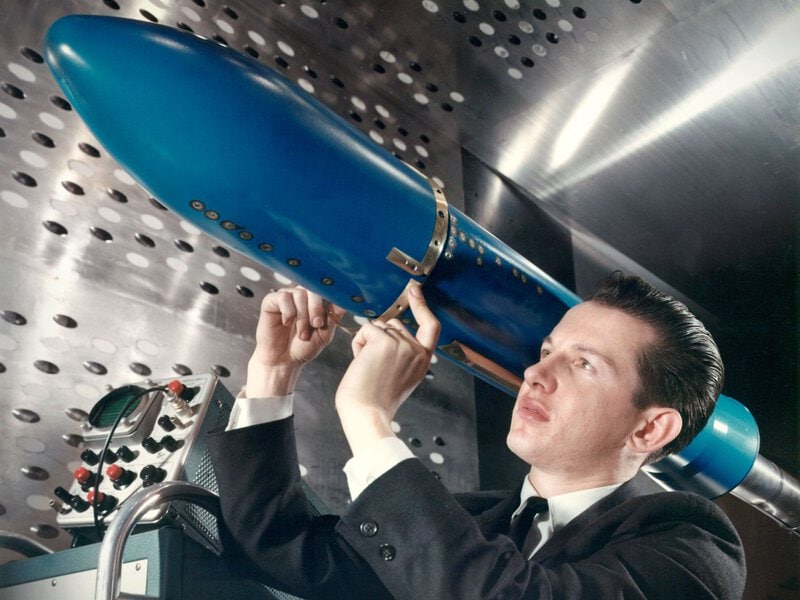
Mariner 1 was NASA’s first interplanetary spacecraft, designed to fly within roughly 30,000 kilometers of Venus and return the first close-range scientific measurements of another planet’s atmosphere and surface temperature. The mission carried real geopolitical weight: the Soviet Venera 1 had already failed en route to Venus in 1961, and a successful Mariner flyby would have represented a significant victory in the Space Race at a moment when every milestone counted.
The guidance architecture divided responsibility between onboard hardware and a ground-based computer at Cape Canaveral. The two systems exchanged continuous corrective signals throughout the early phase of flight, which meant that the accuracy of the ground-side equations was not a background concern — it was a direct steering input. Any error in those equations would propagate, in real time, into the vehicle’s flight path. The Atlas-Agena B airframe added further constraint: it was a repurposed military missile with guidance hardware only partially adapted for deep-space navigation, leaving limited tolerance for any mismatch between specification and implementation.
The Overbar: One Symbol, One Job
In the guidance equations governing Mariner 1’s trajectory, an overbar — a horizontal line drawn above a variable, standard notation in applied mathematics — indicated that the value in question should be smoothed using an average of recent radar readings rather than taken as a raw, instantaneous data point. That distinction was not a minor technical preference. It was structurally essential to how the steering algorithm was supposed to function.
Raw radar velocity data from a rocket in flight is inherently noisy. Sensors register momentary fluctuations that do not correspond to actual changes in the vehicle’s trajectory. Feeding unsmoothed numbers directly into a steering algorithm causes the system to treat measurement noise as genuine flight deviation and issue corrections accordingly — corrections that are themselves erroneous, which generate further erroneous corrections, compounding progressively. The overbar’s smoothing function existed specifically to break that feedback loop before it could form.
When a NASA engineer transcribed the guidance equations from their handwritten specification into the code that would fly the mission, the overbar above one variable was omitted. Without it, the guidance computer received raw, unaveraged radar data and interpreted normal sensor noise as legitimate trajectory error. It began commanding steering corrections almost immediately after liftoff. The Atlas-Agena B responded by executing a series of increasingly erratic maneuvers, swinging toward a path over inhabited North Atlantic shipping lanes — a trajectory that range safety rules of the period could not permit.
Why the “Missing Hyphen” Story Gets It Wrong
Arthur C. Clarke memorably described the disaster as the result of “the most expensive hyphen in history,” a phrase so compact and vivid that it became the canonical shorthand for the Mariner 1 failure and has circulated in popular accounts of costly software bugs for more than six decades. It is also, by the best available technical analysis, inaccurate in its specifics — and the inaccuracy is not trivial.
A hyphen is a punctuation mark used to join words or compound terms in prose. An overbar is a mathematical operator with a precise computational meaning: it specifies how a value is calculated, transforming an instantaneous reading into a smoothed average. Calling the missing symbol a hyphen reduces a functional specification failure — the absence of a transformation instruction — to a typographical mishap. The guidance system did not fail because of a formatting mistake. It failed because a specific averaging operation was absent from the algorithm responsible for steering the vehicle.
NASA’s own post-failure documentation and subsequent analysis by aerospace engineers identify the missing symbol as an overbar in the guidance specification. Technical examination of the transcription error’s context makes clear that the “missing hyphen” framing, however culturally durable, obscures the actual mechanism of failure. Clarke’s quip performed a genuine service by communicating to a non-technical audience that software errors carry physical consequences at the scale of rocket programs. But the real story is about the gap between a mathematical specification and its software implementation — a gap of one small mark that the transcription process failed to close.
The persistence of the simplified version is itself worth noting. As popular retellings of the Mariner 1 error illustrate across decades, a memorable simplification tends to displace technical precision in the public record and can hold that position for generations. The “hyphen” framing is now so embedded that correcting it requires more effort than the original error did to cause.
Four Minutes and Fifty-Three Seconds
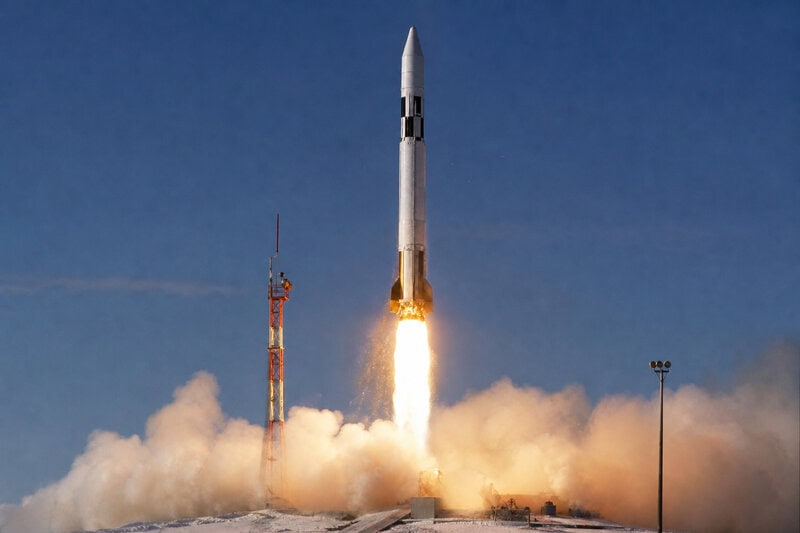
In the seconds immediately following liftoff, Mariner 1’s guidance computer began receiving unsmoothed radar velocity data and responding to normal measurement noise as though it represented genuine trajectory deviation. The Atlas-Agena B executed a sequence of increasingly severe steering corrections. Its heading moved toward a path that range safety controllers could not allow over populated ocean areas under the safety protocols of the time.
At T+293 seconds — four minutes and fifty-three seconds after liftoff — the range safety officer transmitted the destruct command. The vehicle’s onboard explosive charges fired. Mariner 1 ceased to exist as a functioning spacecraft, and burning debris fell into the Atlantic. No personnel were injured. But America’s first Venus mission was gone, and the next viable launch window to Venus would not open for another 19 months.
The financial toll was approximately $18 million in 1962 dollars — a figure that exceeds $180 million in current terms. The scientific cost was the delay of the first direct measurements of another planet’s environment by nearly two years. Both figures trace back to one missing line above a single letter in a handwritten equation.
A Specific Class of Engineering Failure
The Mariner 1 disaster belongs to a well-documented category of engineering failure: not a flaw in physical design, not a misunderstanding of the relevant physics, but a breakdown in the translation layer between a correct mathematical specification and its software implementation. In 1962, no systematic independent verification process existed to catch that kind of mismatch before launch. An engineer wrote the equation correctly; another transcribed it with one symbol missing; no automated or procedural check intercepted the discrepancy before the rocket left the pad.
This failure mode would recur. The European Space Agency’s Ariane 5 explosion in 1996 destroyed a rocket and its payload because software reused from Ariane 4 encountered a flight condition it had not been designed to handle — a specification mismatch between two programs. NASA’s Mars Climate Orbiter was lost in 1999 because one software module produced force values in pound-force seconds while another expected newton-seconds — a unit conversion error that survived every pre-launch review. In all three cases, the underlying physics were understood correctly by the engineers involved. The failure occurred in the handoff between specification and implementation, between what was intended and what was actually encoded.
Modern aerospace guidance software is subject to independent verification and validation processes — commonly abbreviated IV&V — specifically designed to catch specification-implementation mismatches before they reach a vehicle. Formal verification techniques, in which software behavior is mathematically proven against a specification rather than only tested empirically, and model-based code generation, in which executable code is automatically produced from a verified model rather than manually transcribed, both address the structural vulnerability that the Mariner 1 overbar error made visible. Neither approach existed in systematic form in 1962. Their development, in part, traces a direct line back to the lessons of failures like this one.
What the Mission Ultimately Accomplished

Mariner 2, launched 36 days after the destruction of Mariner 1 on August 27, 1962, carried essentially the same scientific payload and succeeded. It flew within approximately 34,833 kilometers of Venus on December 14, 1962, becoming the first spacecraft in history to complete a successful planetary flyby. It returned the first direct measurements of another planet’s environment, confirming that Venus has a slow retrograde rotation, extremely high surface temperatures, and an atmosphere dominated by carbon dioxide — data that rewrote what planetary scientists thought they understood about Earth’s nearest neighbor.
The science that Mariner 1 was built to gather was ultimately gathered, one launch window later, by its twin. That outcome is worth holding alongside the disaster: the error did not permanently foreclose the mission’s scientific goals. It delayed them at enormous cost and demonstrated, in terms no one in aerospace could ignore, what the gap between a specification and its implementation could produce when left unguarded.
The Mariner 1 overbar error also accelerated NASA’s investment in rigorous software documentation, requirements traceability, and testing discipline — a culture of procedural precision that would later underpin the Apollo program’s ability to operate reliably at the edge of what was technically possible.
One Line. 293 Seconds. $18 Million.
Sixty-three years after an Atlas-Agena B disintegrated over the Atlantic, the Mariner 1 failure remains the clearest available demonstration that mathematical notation is not decorative. Every symbol in a guidance equation encodes a specific instruction. The overbar above one variable was the difference between a smoothed signal and a noise-driven feedback loop — between a spacecraft on course for Venus and burning debris falling into the sea.
Clarke’s “most expensive hyphen in history” is a better story than the truth. The truth is more instructive: a small mark with an irreplaceable function was left off during transcription, no process existed to catch it, and 293 seconds later a range safety officer had no choice but to press a button. The lesson is not about carelessness. It is about the load-bearing nature of every symbol in a specification, and the cost of assuming that translation from notation to code is a routine step that takes care of itself.
It does not. Mariner 1 is the proof.