
On June 22, 2026, NASA’s PACE satellite captured something extraordinary: the Black Sea glowing a vivid, almost surreal turquoise — a transformation so striking it was visible from hundreds of miles above Earth’s surface and documented in detail by NASA Earth Observatory. The cause was not pollution, a trick of light, or a one-time anomaly, but one of nature’s most spectacular recurring biological events, driven by an organism smaller than the width of a human hair.
A Sea That Changes Color from Space
Every spring and summer, the Black Sea undergoes a dramatic visual transformation. Its surface shifts from a deep grey-blue to brilliant swirls of pale blue and milky turquoise — color patterns so large and geometrically complex that they can be tracked in real time from orbit. The June 22, 2026, PACE satellite image represents one of the most detailed records of this phenomenon to date, confirming what scientists have observed across multiple years: the Black Sea’s annual color shift is a measurable, recurring, and scientifically significant event.
Understanding what causes it — and why researchers around the world watch it so closely — requires looking at one of the ocean’s most ancient and consequential life forms.
The Living Paint: What Coccolithophores Are and Why They Matter
The turquoise color is produced by a massive bloom of coccolithophores (pronounced kok-oh-LITH-oh-forz) — single-celled marine algae that are a type of phytoplankton, meaning microscopic, plant-like organisms that drift near the ocean surface, photosynthesize sunlight, and form the base of the marine food web. What makes coccolithophores visually distinctive is their armor: each cell surrounds itself with tiny white plates made of calcium carbonate, called coccoliths. These plates scatter sunlight in all directions, turning the water milky and bright.
Each individual coccolithophore is invisible to the naked eye. But when billions upon billions of them congregate in warm, sunlit surface waters, their collective reflectivity becomes powerful enough to register on satellite sensors hundreds of miles above Earth. According to NASA Earth Observatory, phytoplankton blooms — including coccolithophore events — added a milky blue hue to the Black Sea and nearby waterways throughout spring and summer 2026, confirming the biological origin of the color change rather than any chemical or optical cause.
Coccolithophores are among the most ecologically important organisms on Earth. They photosynthesize carbon dioxide, produce oxygen, and when they die, their calcium carbonate shells sink toward the seafloor, carrying carbon with them in a process that connects ocean biology to the planet’s long-term carbon cycle. The chalk cliffs of Dover, England, are composed largely of ancient coccoliths — a tangible reminder of how long these organisms have shaped Earth’s chemistry.
How NASA’s PACE Satellite Sees the Bloom

NASA’s PACE (Plankton, Aerosol, Cloud, ocean Ecosystem) satellite, launched in February 2024, represents a meaningful advance in ocean monitoring. Unlike earlier satellites that observe the ocean in a handful of broad color bands, PACE carries a hyperspectral ocean color instrument that analyzes how the ocean absorbs and reflects light across hundreds of individual wavelengths. This capability allows scientists not just to detect that a bloom is occurring, but to identify which organisms are driving it — distinguishing coccolithophores from other phytoplankton types based on their unique optical signatures.
NASA describes this as a significant step forward for ocean biology monitoring: earlier satellites could confirm a bloom’s presence and approximate extent; PACE can help characterize its biological composition from space. The June 22, 2026, Black Sea image stands as one of the most detailed records of a coccolithophore bloom yet produced from orbit, providing a level of scientific information that was not available to researchers even a decade ago.
NASA Earth Observatory’s documentation of the turquoise phenomenon across multiple years has been instrumental in establishing that this is not an isolated event. The annual Black Sea bloom is now a confirmed, trackable feature of the region’s seasonal ecology, with satellite records allowing researchers to monitor its timing, geographic extent, and intensity year over year.
The Annual Cycle: Why the Black Sea Blooms Every Spring and Summer
The Black Sea’s recurring turquoise transformation is driven by a reliable convergence of physical conditions. Each winter, cooling surface waters mix with deeper, nutrient-rich layers, replenishing the upper ocean with phosphorus, nitrogen, and other compounds that phytoplankton require to grow. As spring arrives, increasing sunlight warms the surface, forming a stable, well-lit upper layer — and the stage is set for a bloom.
Coccolithophores are particularly well-suited to exploit this seasonal window. They thrive in conditions where nutrients are available but not overabundant, and where the water column is stable enough to keep them near the sunlit surface. The Black Sea’s semi-enclosed geography — it connects to the Mediterranean only through the narrow Bosphorus Strait — means its waters stratify predictably each year, creating a recurring ecological niche that coccolithophores have evolved to fill.
As spring progresses into summer, warming accelerates this stratification, and coccolithophores proliferate rapidly before faster-growing phytoplankton species can outcompete them. The result is a bloom that appears on a broadly predictable schedule but varies in its exact timing, peak intensity, and spatial extent depending on wind patterns, river runoff volumes, and sea surface temperature anomalies in a given year. These year-to-year variations are precisely what researchers hope long-term satellite records from PACE will help them understand — particularly as climate change begins to alter the seasonal patterns that drive the cycle.
What the Colors Actually Tell Scientists
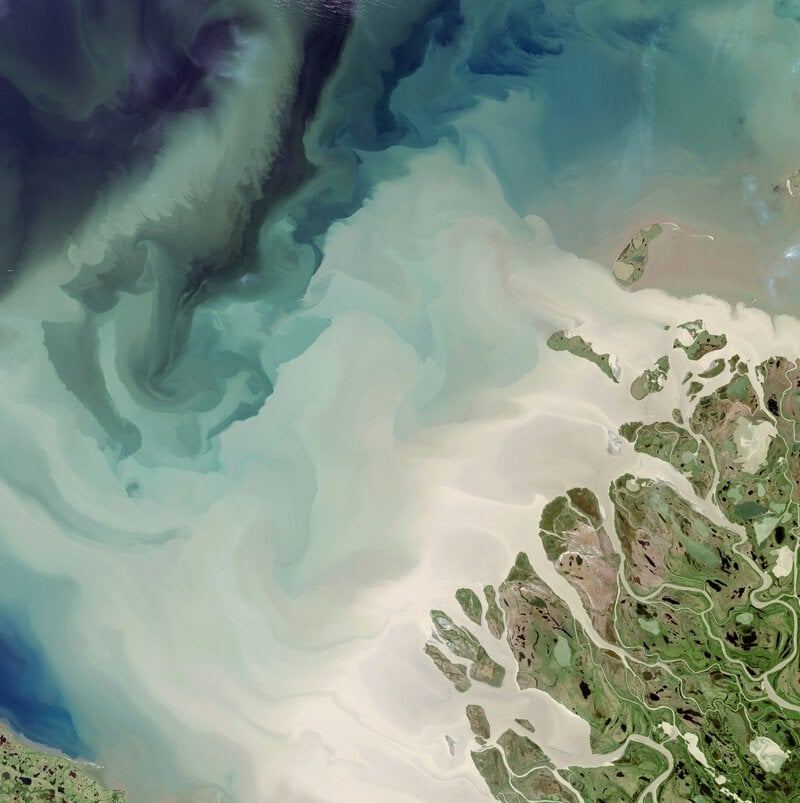
The visual drama of the Black Sea’s color shift carries measurable scientific information well beyond its aesthetic impact. The transition from deep grey-blue to bright turquoise functions as a direct proxy for bloom density: the more coccolithophores present, the greater the concentration of light-scattering coccoliths in the water, and the brighter and more opaque the turquoise color appears in satellite imagery.
The swirling patterns of pale blue and milky turquoise that spread across the Black Sea’s surface during peak bloom also serve as natural tracers of ocean dynamics. Because phytoplankton drift with the water, their spatial distribution reveals the shapes of ocean currents, eddies, and upwelling zones that would otherwise be invisible. Scientists can read the bloom’s swirls as a map of the sea’s circulation, identifying features that influence heat distribution, nutrient transport, and biological productivity across the entire basin.
Beyond physical oceanography, the bloom data feeds directly into carbon cycle research. Coccolithophores are unusual among phytoplankton in that they produce both organic carbon through photosynthesis and inorganic calcium carbonate in their shells — two forms of carbon with different fates and different effects on atmospheric carbon dioxide levels. A large Black Sea bloom therefore represents a measurable flux of carbon between the ocean and atmosphere. It is worth noting, however, that the net climate effect of coccolithophore blooms — whether they represent a net carbon sink or source when both photosynthesis and calcification are fully accounted for — remains an active and unresolved area of scientific research.
Ecological Significance: A Bloom That Feeds and Signals
The annual coccolithophore bloom is not merely a visual spectacle: it represents a pulse of primary production that energizes the Black Sea’s food web. The phytoplankton are consumed by zooplankton, which in turn support fish larvae, juvenile fish, and ultimately the adult fish populations that sustain commercial fisheries across the region. The coastal communities of Turkey, Romania, Bulgaria, Ukraine, and Georgia all depend, directly or indirectly, on the ecological productivity that blooms like this one help sustain.
Yet the Black Sea is also one of the world’s most ecologically stressed enclosed seas. Decades of nutrient pollution from agricultural runoff, the introduction of invasive species such as the comb jellyfish Mnemiopsis leidyi in the 1980s, and sustained fishing pressure have substantially altered its ecosystem from its pre-industrial state. The bloom now occurs in a sea that has changed considerably, and researchers have noted that shifts in bloom timing, intensity, or species composition could serve as early indicators of broader ecosystem stress.
Separating the influence of climate change from that of local stressors requires careful, multi-year datasets — precisely the kind that NASA’s PACE satellite is now positioned to provide. The visual record captured from space is therefore simultaneously a sign of ecological vitality and a long-term monitoring data point for one of the planet’s most pressured marine environments.
Why This Matters Beyond the Black Sea
Coccolithophore blooms are not unique to the Black Sea. They occur across the global ocean — in the North Atlantic, the Bering Sea, the Arabian Sea, and elsewhere — making the Black Sea a well-studied natural laboratory for understanding how these organisms respond to environmental change. Its semi-enclosed geography, strong seasonal cycle, and proximity to multiple research institutions make it an ideal site for validating satellite observations against direct in-water measurements.
The data flowing from NASA’s PACE satellite, combined with NASA Earth Observatory’s ongoing documentation of events like the 2026 Black Sea bloom, are helping scientists build global baseline records against which future change can be measured. As ocean temperatures rise and nutrient dynamics shift under climate change, the trajectory of coccolithophore blooms — whether they will intensify, diminish, or shift toward higher latitudes — carries implications that extend well beyond any single sea. These organisms influence the reflectivity of the ocean surface, the efficiency of the biological carbon pump, and the structure of marine food webs on a planetary scale.
For now, the Black Sea’s annual turquoise transformation stands as one of the most vivid demonstrations that Earth’s oceans are alive, dynamic, and legible — a living system whose condition can be read, at least in part, simply by observing its color from space.